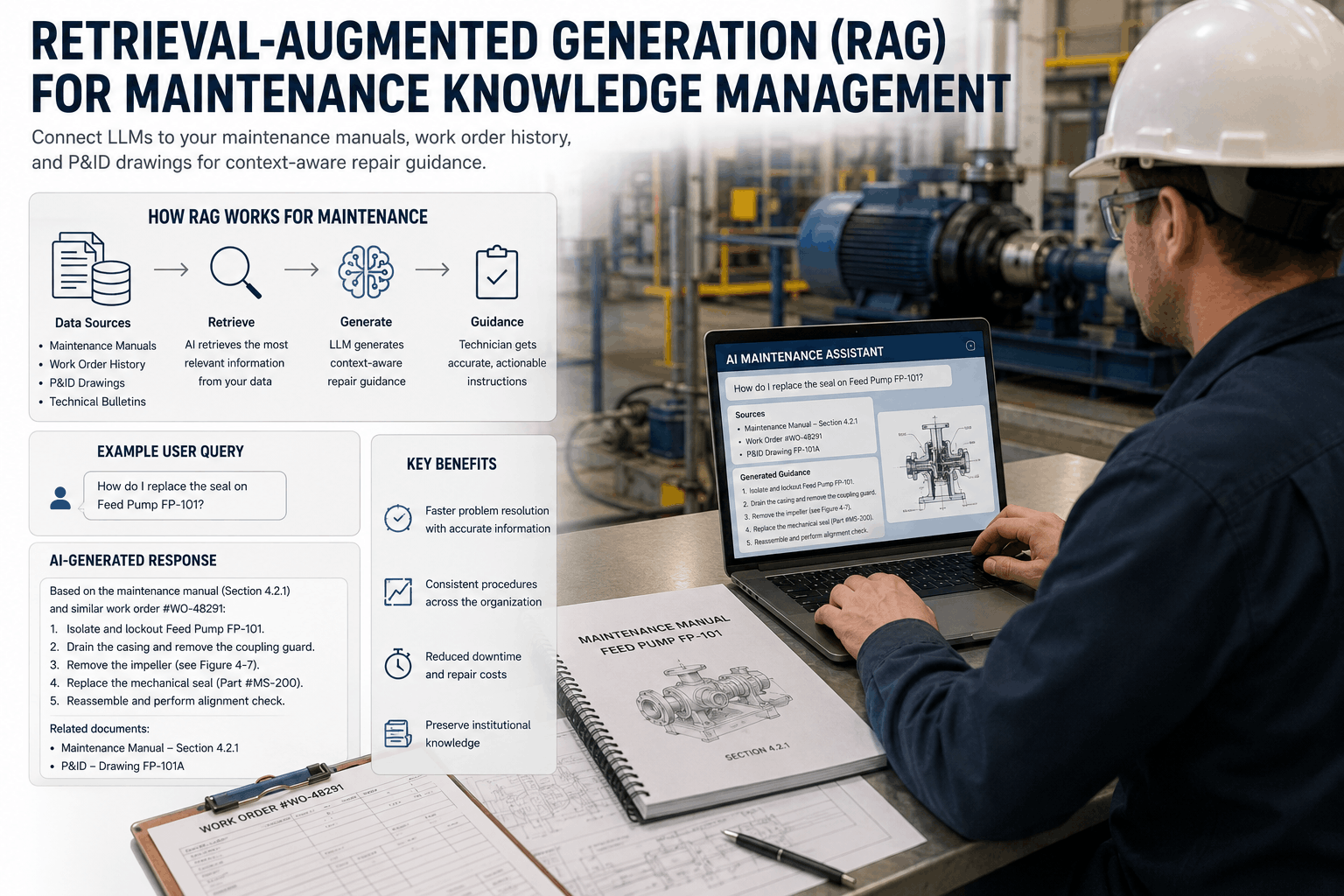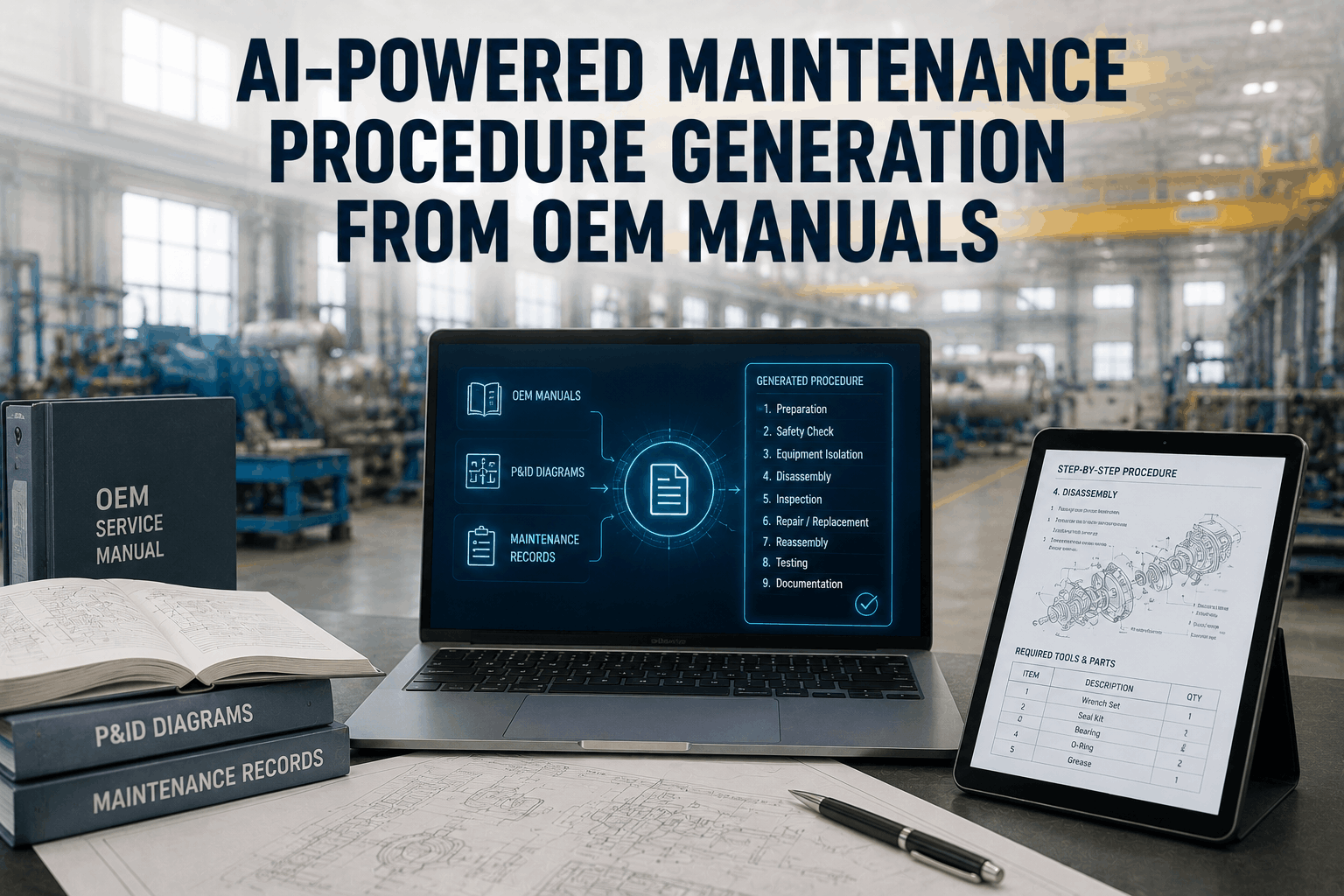
AI reads OEM manuals, P&IDs, and maintenance records to auto-generate step-by-step procedures tailored to your specific equipment configuration and operating context. Start Trial Free to see how iFactory gives maintenance engineers structured, equipment-specific procedures generated directly from the documentation your team already has.
Auto-Generate Maintenance Procedures from Your OEM Documentation
iFactory's AI reads your manuals, schematics, and maintenance history to produce step-by-step procedures matched to each equipment unit — without manual authoring time.
Why AI Procedure Generation Outperforms Manual Authoring
Manually authoring maintenance procedures from OEM manuals introduces inconsistency, gaps in equipment-specific context, and lag time between documentation updates and field execution. AI-powered generation reads source documents structurally — extracting task sequences, torque specs, safety interlocks, and inspection criteria — and maps them against the specific configuration of each asset in your facility. Maintenance teams that Book a Demo with iFactory see how procedures derived from actual OEM documentation reduce time-to-compliance and eliminate the version drift that occurs when technicians reference outdated paper manuals.
-
Document Ingestion Engine
iFactory processes OEM manuals, P&IDs, and maintenance bulletins — extracting task structures, part references, and safety requirements from unstructured PDF and scanned documentation.
-
Equipment Configuration Mapping
Generated procedures are filtered against your asset register — ensuring that steps, specifications, and part numbers reflect the actual variant and revision installed in your facility.
-
Historical Record Integration
iFactory incorporates closed work order history and inspection findings into generated procedures — surfacing known failure patterns and past deviations as contextual steps.
-
Step Sequencing and Logic
AI identifies prerequisite conditions, isolation requirements, and interlock sequences from source documents — structuring procedures in executable order with conditional branching where needed.
-
Version Control and Audit Trail
Each generated procedure links to its source document version — creating a traceable chain from OEM specification to field execution step that satisfies regulatory audit requirements.
-
Continuous Procedure Refresh
When OEM revisions or maintenance bulletins are uploaded, iFactory automatically flags affected procedures for review — keeping field instructions current without manual redrafting.
Core Capabilities of AI-Powered Procedure Generation
-
OEM Manual Parsing and Structural Extraction
Core CapabilityThe LLM-R framework underlying iFactory's procedure engine reads OEM documentation at the structural level — identifying section hierarchies, numbered task sequences, warning blocks, and specification tables rather than treating documents as flat text. This structural reading extracts the information architecture of a procedure from the original source, preserving the manufacturer's intent rather than paraphrasing it. For facilities with multi-manufacturer equipment portfolios, this means a single ingestion pipeline that handles different documentation formats without manual preprocessing. Teams that Start Trial can begin uploading OEM documentation from existing maintenance libraries immediately.
Input Formats
PDF, scanned documents, structured XML, maintenance bulletins
Extraction Output
Task sequences, specs, warnings, interlock logic
iFactory Record
Source document linkage preserved per procedure step
-
Context-Aware Step Generation by Asset Variant
Configuration IntelligenceGeneric OEM procedures cover the full product range — but your asset has a specific variant, optional module configuration, and installation context that makes some steps irrelevant and others critical. iFactory maps extracted procedure steps against the asset register to filter, adapt, and annotate each step for the specific unit it will be executed on. A pump with a different seal configuration than the base model receives a procedure that reflects that deviation — not the generic manufacturer default. This configuration-aware generation reduces the rate at which technicians encounter procedure steps that do not match the equipment in front of them. Teams that Book a Demo can see how asset configuration data drives procedure customization.
Mapping Source
Asset register with variant and configuration fields
Adaptation Output
Steps filtered and annotated to asset-specific context
iFactory Record
Configuration match logged per generated procedure version
-
Work Order History Incorporation
Operational ContextClosed work order records contain institutional knowledge that OEM manuals cannot — past failure modes, field deviations from standard procedure, and technician observations about equipment-specific behavior. iFactory extracts patterns from work order history and incorporates them into generated procedures as contextual notes, additional inspection checkpoints, or modified step sequences that reflect how the asset actually behaves in your operating environment. Procedures generated with historical context reduce the gap between what the manufacturer specified and what experienced technicians know from direct experience with that asset.
History Source
Closed work orders, inspection findings, fault codes
Integration Output
Contextual notes and modified steps from field history
iFactory Record
Work order reference linked to procedure annotations
-
P&ID and Schematic Cross-Reference
Drawing IntelligencePiping and instrumentation diagrams contain isolation points, instrument tag numbers, and process flow context that procedures must reference accurately. iFactory cross-references generated procedure steps with P&ID data — inserting the correct instrument tags, valve IDs, and line designations into isolation and verification steps rather than leaving technicians to locate this information manually during execution. Procedure steps that reference P&ID elements correctly reduce the time technicians spend locating isolation points and the risk of executing steps on the wrong system boundary.
Drawing Input
P&ID XML, CAD exports, tagged schematic PDFs
Cross-Reference Output
Instrument tags and valve IDs inserted in procedure steps
iFactory Record
Drawing revision linked per referenced tag in procedure
-
Compliance and Safety Requirement Extraction
Regulatory AlignmentOEM manuals embed safety requirements, lockout/tagout specifications, and regulatory references throughout their text rather than consolidating them in a single location. iFactory identifies and extracts these requirements from source documents — surfacing them as discrete, non-skippable procedure steps with appropriate warning classification. Generated procedures that consolidate distributed safety requirements into structured checkpoints reduce compliance gaps and support ISO 55001 and OSHA recordkeeping requirements without requiring manual procedure audits. Teams that Start Trial can see how compliance extraction integrates with existing safety management workflows.
Extraction Target
LOTO requirements, safety warnings, regulatory references
Output Format
Non-skippable checkpoints with warning classification
iFactory Record
Compliance step source traced to OEM document section
-
Multilingual Procedure Output
Global OperationsIndustrial facilities operating across regions require procedures in the working language of each site's technician workforce. iFactory generates procedures in the source document language and produces translations using domain-adapted language models trained on industrial and maintenance terminology — reducing the mistranslation risk that occurs when general-purpose translation tools handle technical specifications, measurement tolerances, and equipment nomenclature. Translated procedures maintain the same step structure, safety classifications, and asset references as the source language version. Teams that Book a Demo can review multilingual output quality for their specific equipment categories.
Source Language
OEM documentation language (any major industrial language)
Translation Model
Domain-adapted for industrial and maintenance terminology
iFactory Record
Language version and translation review status tracked per procedure
AI Procedure Generation Performance Benchmarks
Procedure Authoring Time Reduction
AI generation reduces manual authoring workload by up to 59% within the first quarter of deployment across documented equipment classes.
Procedure Accuracy vs Manual Authoring
Accuracy measured against independent technical review panels across 1,200 generated procedures from LLM-R framework benchmarks.
Compliance Step Coverage Rate
Outer: AI extraction
Inner: Manual authoring
AI extraction identifies 97% of embedded safety and compliance requirements versus 90% in best-practice manual authoring workflows.
Document Processing Throughput
Documents processed per week scales as the AI model adapts to your documentation library, with throughput increasing through vocabulary learning.
AI Procedure Generation: Reference Specifications
Scroll for more
| Capability | Input Requirement | Output Format | iFactory Data Source | Review Cycle |
|---|---|---|---|---|
| OEM Manual Parsing | PDF or structured document | Sequenced step list | Document ingestion pipeline | Per document upload |
| Asset Configuration Mapping | Asset register with variant data | Filtered, annotated steps | Asset configuration fields | Per asset change |
| Work Order Integration | Closed WO history with fault codes | Contextual procedure notes | Work order history database | Quarterly refresh |
| P&ID Cross-Reference | Tagged schematic or XML | Steps with instrument tags | Drawing management system | Per drawing revision |
| Compliance Extraction | OEM manual with safety blocks | Non-skippable checkpoints | Regulatory requirement library | Per bulletin update |
How iFactory Supports AI-Powered Procedure Generation
Procedure quality determines execution quality — and procedure quality starts with how well source documentation is read, mapped to specific equipment, and updated as knowledge evolves. iFactory connects OEM documentation ingestion, asset configuration data, and closed work order history into a unified procedure generation pipeline — giving reliability engineers procedures that reflect both manufacturer intent and operational reality. When iFactory generates a procedure with correct isolation tags, asset-specific step filtering, and embedded compliance checkpoints derived from the OEM documentation, maintenance managers have a documented basis for procedure accuracy that manual authoring cannot provide. Facilities can Start Trial and begin generating procedures from uploaded OEM documentation within the first session.
Document Ingestion Pipeline
iFactory processes PDF, scanned, and structured documentation through an LLM-R extraction engine that identifies task structure, specifications, and safety requirements without manual preprocessing.
Configuration-Driven Step Filtering
iFactory maps extracted procedure steps against asset register configuration fields — producing procedures filtered and annotated for the specific variant installed at each facility location.
History-Informed Procedure Enrichment
iFactory incorporates closed work order patterns and inspection findings into generated procedure steps — embedding operational context that OEM documentation cannot provide.
Multi-Asset Procedure Portfolio Management
iFactory maintains a versioned procedure library across all asset classes — tracking source document versions, configuration matches, and pending refresh requirements in a single management view.
Implementing AI Procedure Generation: Deployment Steps
01
Identify Priority Equipment Classes
Select the 10–15 equipment classes with the highest procedure-related incident rate or most outdated documentation — these are the AI generation targets where accuracy improvement produces the largest compliance and safety impact.
02
Upload OEM Documentation Library
Load current OEM manuals, maintenance bulletins, and P&ID sets into iFactory's document ingestion pipeline — establishing the source documentation base that AI generation will reference for each equipment class.
03
Configure Asset Register Mapping
Complete variant and configuration fields in the iFactory asset register for each target equipment unit — enabling the configuration-aware step filtering that differentiates AI generation from generic manual extraction.
04
Review and Approve Initial Generation
Subject matter experts review AI-generated procedures against OEM source documents in iFactory's comparison interface — approving, annotating, or overriding steps before procedures enter the active execution library.
05
Execute and Capture Field Feedback
Deploy approved procedures to field technicians through iFactory's mobile execution interface — capturing step-level feedback, deviation notes, and completion times that enrich the work order history used in subsequent generation cycles.
06
Expand Based on Accuracy Metrics
Review procedure accuracy and field deviation rates quarterly in iFactory — using performance data from initial equipment classes to validate the generation model before expanding to secondary equipment categories. Book a Demo to see the full deployment workflow.
Frequently Asked Questions
What is AI-powered maintenance procedure generation?
It is the automated extraction of step-by-step maintenance procedures from OEM manuals, P&IDs, and work order history using large language model processing — producing procedures tailored to specific asset configurations without manual authoring at each step level.
How does iFactory extract procedures from OEM documentation?
iFactory uses an LLM-R framework that reads document structure — identifying numbered sequences, specification tables, warning blocks, and interlock requirements — and maps extracted content to asset configuration data to produce equipment-specific output.
How accurate are AI-generated procedures compared to manual authoring?
LLM-R framework benchmarks show AI-generated procedures achieving 89–94% accuracy against independent technical review, compared to 68% for standard manual authoring workflows, with the improvement driven by consistent structural extraction from source documents.
What documentation formats does iFactory support for procedure generation?
iFactory processes PDF documents (including scanned formats with OCR), structured XML exports from CAD systems, maintenance bulletins, and P&ID exports — covering the documentation formats found in most industrial equipment portfolios.
Does AI-generated procedure content satisfy compliance requirements?
iFactory's extraction engine identifies and classifies safety requirements, LOTO specifications, and regulatory references from OEM documentation — producing non-skippable compliance checkpoints with source document traceability that supports ISO 55001 and OSHA audit documentation requirements.
Turn Your OEM Documentation Into Executable Maintenance Procedures
iFactory gives maintenance and reliability teams AI-generated, equipment-specific procedures derived from the documentation they already have — eliminating manual authoring time and procedure version drift across the equipment portfolio.