Airport Wastewater, Drainage, and De-Icing Fluid Management
By Grace on May 29, 2026
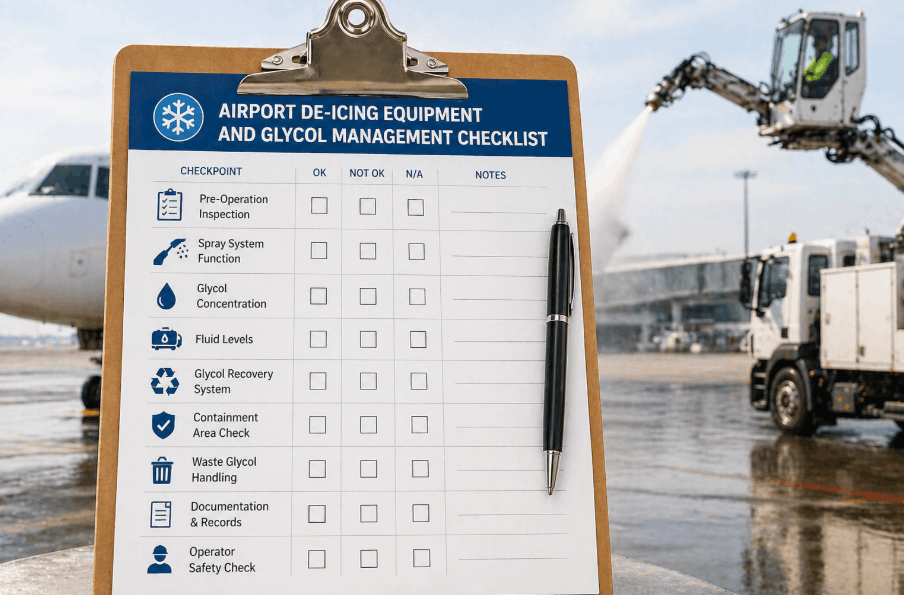
Every winter operation at a commercial airport produces a compliance obligation that does not disappear when the ice does. Spent aircraft de-icing fluid — primarily propylene glycol — drains across aprons, taxiways, and deicing pads into stormwater systems that feed local waterways. The EPA Airport Deicing Effluent Guidelines require collecting a minimum of 60% of all aircraft deicing fluid at qualifying airports. NPDES stormwater permits demand continuous monitoring with monthly and quarterly discharge reports. And glycol-laden runoff discharged without adequate treatment can trigger municipal wastewater surcharges exceeding $2.8 million annually at hub airports. This is not a seasonal problem — it is a year-round documentation and system management challenge. Compliance tracking makes the difference between an audit-ready operation and a six-figure enforcement action.
Minimum ADF collection rate required by EPA for qualifying airports
$2.8M
Annual wastewater surcharges at hub airports without glycol recovery
97%
Minimum COD effluent removal rate required for direct waterway discharge
3
Simultaneous regulatory frameworks triggered by a single drainage failure
The Triple Compliance Challenge Winter Operations Create
Airport environmental compliance is not a single permit — it is a layered structure of federal, state, and municipal obligations that interact with each operationally. Missing one creates exposure across the others. Understanding how they connect is the prerequisite to managing them systematically.
Framework 01
EPA Airport Deicing Effluent Guidelines
Applies to primary commercial airports with 10,000+ annual departures in cold climate zones. Mandates minimum aircraft deicing fluid collection rates (60% for new airports), documentation of every deicing event, and annual reporting of collection system performance. Non-compliance triggers enforcement under the Clean Water Act.
Key Obligation
Document every ADF deicing event with fluid type, volume, collection rate, and disposal pathway
Framework 02
NPDES Stormwater Permit
Requires monthly and quarterly Discharge Monitoring Reports comparing stormwater runoff quality against effluent limitation concentrations, plus annual reports summarizing monitoring results and treatment program improvements. Monitoring stations must be maintained and sample events logged continuously — not reconstructed before submission deadlines.
Key Obligation
Continuous monitoring records with monthly DMRs and quarterly submission to state permitting authority
Framework 03
Municipal Discharge and Surcharge Rules
Glycol-contaminated wastewater discharged to municipal treatment systems without adequate pre-treatment generates surcharges based on chemical oxygen demand (COD) load. At hub airports processing high deicing volumes, this surcharge exposure reaches millions annually — and is entirely avoidable with documented glycol recovery and pre-treatment compliance.
Key Obligation
Pre-treatment documentation per discharge event to avoid COD-based municipal surcharge assessments
The Three Systems That Must Work Together
Airport environmental management is not one program — it is three interconnected infrastructure systems, each with its own maintenance schedule, inspection protocol, and compliance documentation chain. A failure in any one creates downstream exposure in the others.
System 01 — De-Icing Fluid Collection
Aircraft and Pavement De-Icing Recovery Infrastructure
Dedicated deicing pads with drainage capture glycol-laden runoff from aircraft treatment. Collection infrastructure includes catch basins, underground pipe networks, detention storage, and glycol recovery vehicles (GRVs) — vacuum trucks that gather stormwater contaminated with spent ADF. Advanced recovery systems achieve glycol purity levels above 99%, enabling resale or reblending that can reduce de-icing operational costs by up to 50%. Each collection event requires documentation of fluid type (propylene glycol for aircraft vs potassium acetate for pavement), volume collected, collection rate against the regulatory minimum, and disposal or recovery pathway.
What Compliance Tracking Must Document
Deicing event log — aircraft tail, fluid type, volume applied, date and time, weather conditions
Collection system performance — volume recovered vs volume applied, running collection rate vs 60% minimum
GRV deployment and maintenance records — cycle counts, vacuum integrity, scheduled PM compliance
Recovery facility throughput — glycol concentration at intake, treatment output, disposal or resale documentation
Pavement deicer records — separate documentation for runway/taxiway treatments from aircraft fluid, per EPA requirement
System 02 — Stormwater Drainage Network
Conveyance, Treatment, and Discharge Infrastructure
Airport stormwater systems collect and route runoff from all impervious surfaces — aprons, taxiways, runways, terminals, and access roads. FAA criteria require zero ponding within Runway Safety Areas, making drainage maintenance a safety obligation as well as an environmental one. Standing water also attracts wildlife, creating bird strike risk. The conveyance network — catch basins, underground pipes, detention ponds, and treatment systems — requires scheduled inspection, sediment removal, and outlet clearing. Industrial wastewater streams (contaminated with glycol, fuel, or deicing chemicals) must be kept separate from general stormwater drainage, each routed to its appropriate treatment pathway.
What Compliance Tracking Must Document
Catch basin and inlet inspection log — frequency per zone, sediment level, condition findings, corrective action taken
Industrial vs stormwater separation verification — inspection records confirming routing integrity after maintenance events
Detention pond condition — standing water status, outlet function, wildlife attraction assessment per FAA drainage standards
Monthly DMR preparation data — continuous monitoring records formatted for NPDES quarterly submission
System 03 — Wastewater Treatment and Discharge
Pre-Treatment, Biological Processing, and Effluent Control
Airports that directly discharge treated wastewater to waterways are subject to Best Available Technology (BAT) standards requiring a minimum 97% chemical oxygen demand (COD) removal rate. Airports routing to municipal treatment systems must pre-treat to avoid surcharge assessments based on COD load. Advanced biological treatment — including anaerobic digestion and post-lagoon rock media beds (SAGR) — handles glycol breakdown even at low temperatures where bacteria reproduction slows. Treatment system performance must be continuously documented against permit limits, with any exceedance reported to the permitting authority within the required notification window.
What Compliance Tracking Must Document
Influent and effluent quality logs — COD concentration at intake and discharge, calculated removal rate against 97% BAT minimum
Treatment system maintenance — biological media condition, aeration system performance, temperature monitoring records
Exceedance notifications — automatic flagging when effluent quality crosses permit thresholds, with required notification timeline tracking
Municipal discharge documentation — pre-treatment records per discharge event supporting surcharge challenge or avoidance
The Compliance Gap: Where Manual Documentation Fails
Most airports manage these three systems with a combination of paper logbooks, spreadsheets, and inspection forms that are completed manually and filed separately. The problem is not the people — it is the structure. When a monitoring report is due, documentation needs to be compiled from three systems, cross-referenced against permit limits, and formatted for submission. When an inspection is missed during a weather event, the gap is not immediately visible. When a COD exceedance occurs, the notification clock starts — but only if someone is watching the data.
Compliance Risk Matrix: Manual vs Tracked Management
Compliance Event
Manual Documentation Risk
With Compliance Tracking
ADF Collection Rate Falls Below 60%
Discovered at year-end annual report — EPA enforcement already triggered
Running collection rate tracked per event; alert issued when trending below minimum
NPDES Monthly DMR Deadline
Data scattered across inspection logs and lab reports; compiled under deadline pressure with gaps
DMR pre-populated from continuous monitoring records; reviewed and submitted, not assembled
COD Exceedance in Effluent
Identified during lab review days after event; notification deadline potentially already passed
iFactory's compliance tracking platform turns continuous inspection and monitoring data into audit-ready documentation — automatically. See how it works for your airport's environmental systems.
Glycol Recovery: The Compliance Obligation That Pays for Itself
Glycol recovery is the rare compliance investment that generates a measurable financial return on top of its regulatory value. Advanced recovery systems can achieve glycol purity above 99% — meeting ASTM standards for recovered glycol that can be sold to recyclers or reblended for future deicing operations. At airports where de-icing operational costs run into millions annually, a well-documented recovery program reduces both the cost of new fluid purchases and the municipal surcharge exposure from unrecovered glycol discharge.
Without Documented Recovery
Glycol enters stormwater system and is routed to municipal treatment — COD surcharge assessed on full load
Collection rate falls below EPA 60% minimum — enforcement exposure under Clean Water Act
Spent glycol disposed as waste at cost — no revenue recovery from resale or reblending
No documentation available to challenge surcharge assessments or demonstrate compliance effort
With Tracked Recovery Program
Recovery rate continuously tracked against 60% minimum — shortfall flagged before it becomes a violation
Recovered glycol at 99%+ purity resold or reblended — de-icing operational costs reduced by up to 50%
Pre-treatment documentation supports surcharge challenge — avoidable surcharges not paid by default
Full event-level audit trail available on demand — EPA annual report is compiled, not reconstructed
"
The surcharge conversation changed completely once we had event-level pre-treatment documentation. Before the tracking system, we were paying every assessment because we had nothing to dispute it with. After the first full winter season with documented COD records per discharge event, we challenged three assessments and recovered more than the entire annual cost of the compliance program. The documentation was always the product — we just had no way to produce it until the system generated it automatically.
— Environmental Compliance Manager, North American Hub Airport — 11 Years Airport Operations
Frequently Asked Questions
The EPA Effluent Limitation Guidelines for airport deicing apply to primary commercial airports — generally those with 10,000 or more annual passenger departures located in cold climate zones where aircraft and pavement deicing operations are conducted. New source performance standards apply to new airports in those categories. The specific collection rate requirement (60% minimum for aircraft deicing fluid) and the applicable best available technology standards depend on the airport's size, discharge pathway, and the volume of deicing fluid used annually. NPDES permit requirements flow from these federal guidelines and are administered by EPA or state agencies with delegated authority. Book a Demo to see how iFactory maps these requirements to your specific permit structure.
iFactory's platform accepts data from existing sensor networks, lab management systems, and SCADA inputs via API or scheduled data export. The compliance layer sits on top of your existing monitoring infrastructure — it does not replace sensor hardware or lab processes, it adds the documentation, scheduling, alert, and reporting layer that converts raw readings into permit-ready records. For airports starting from paper-based systems, the platform also supports structured manual entry with photo verification, GPS tagging, and timestamping that creates legally defensible inspection records from day one. Talk to an Expert to begin your compliance program configuration.
iFactory's compliance tracking module is built to pre-populate Discharge Monitoring Report fields from continuous monitoring records — so the monthly and quarterly DMR preparation process becomes a review and submission task rather than a data assembly task. The platform maps monitoring station readings, lab results, and flow measurements against the specific effluent limits in your NPDES permit, flags any results approaching or exceeding limits, and generates the formatted report structure ready for submission. The compliance team reviews, approves, and files — not spends a week locating records. Book a Demo to see the DMR generation workflow for your permit format.
Yes. EPA guidelines require separate documentation for aircraft deicing fluid (propylene glycol) and airfield pavement deicers (potassium acetate, sodium acetate, sodium formate), as they create different contamination profiles and are subject to different monitoring and collection requirements. iFactory's event logging structure captures fluid type, application area (runway, taxiway, apron, gate), volume, and collection pathway per event — maintaining the separate documentation chains required for full regulatory compliance without duplicating the data entry effort. Each event record is timestamped, geotagged, and linked to the relevant permit reference for immediate audit retrieval.
Conclusion
Airport wastewater, drainage, and de-icing fluid management is a compliance program that runs twelve months a year and produces enforcement exposure every time a record is missing. The EPA collection rate minimum, NPDES continuous monitoring requirements, and municipal surcharge documentation obligations are not seasonal — they are permanent features of operating a primary commercial airport in a cold climate zone. The difference between an airport that manages this well and one that does not is not the quality of its environmental systems. It is the quality of its documentation.
iFactory's compliance tracking platform closes the documentation gap — turning inspection schedules, monitoring data, glycol collection records, and treatment system logs into a continuous, audit-ready compliance record that is current every day, not just the week before a regulator visits. Book a Demo to see how the platform maps to your airport's specific permit structure, or Talk to an Expert to begin your compliance program configuration today.
Your next NPDES report is being assembled right now — manually, from scattered records, under deadline pressure. There is a better way.
iFactory turns airport environmental monitoring into continuous compliance — wastewater tracking, drainage inspections, glycol collection records, and DMR preparation in one audit-ready platform. Sign up or book a demo to see it for your operation.