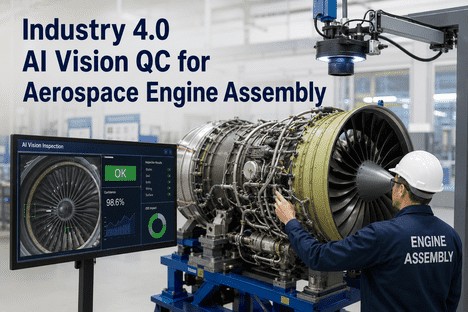
A turbine blade crack that a human inspector rates as "within limits" during a borescope inspection may be growing in a direction and at a rate that violates limits by the next scheduled check interval. The inspector makes that call under time pressure, with degraded image quality, after examining dozens of blades in sequence. Deep learning doesn't fatigue, doesn't vary with experience, and doesn't make the same classification twice for the same pixel pattern. In 2026, the state of the art in deep learning for turbine blade damage detection has moved well past proof-of-concept: YOLOv8-based architectures are achieving 93–94% precision on real borescope datasets, enhanced Mask R-CNN frameworks are simultaneously classifying damage type, localising the affected zone, and segmenting the damage area in a single forward pass, and thermal imaging combined with convolutional networks is detecting fatigue damage patterns that are invisible to optical inspection. This article reviews where the technology stands, what each architecture is best suited for, and how iFactory's Engine Component AI Analytics platform integrates these capabilities into operational MRO workflows. Book a Demo to see blade damage detection in action on real engine inspection imagery.
93.8%
precision achieved by YOLOv8 on aero-engine turbine blade defect detection datasets in 2025 deployment studies
3-in-1
Mask R-CNN frameworks now classify, localise, and segment turbine blade damage in a single model pass — replacing three separate inspection steps
35,000+
commercial aircraft in the global fleet requiring regular borescope turbine inspection — the volume that makes AI analysis operationally essential
6 types
of damage reliably detected by current AI systems: erosion, thermal fatigue cracks, coating degradation, FOD, corrosion pitting, and tip curl
Why Manual Borescope Inspection Has a Structural Accuracy Problem
Traditional borescope inspection places a human technician at the end of a flexible probe working through tight engine ports under time pressure, evaluating blade surfaces in real time from degraded imagery. The problems this creates are not individual failures — they are structural features of the process that no amount of training fully resolves.
Fatigue and Sequence Effects
An inspector examining the 40th blade in a session applies different cognitive resources than they did to the 4th. Fatigue-driven miss rates have been documented in aviation NDT research — and borescope inspection of a turbine stage involves far more than 40 images per session.
Experience-Dependent Classification
Classifying the same crack as "within limits" or "requires action" depends on the inspector's experience with that specific damage morphology, engine type, and operator limits document. Inter-inspector agreement rates on borderline cases in borescope data are consistently below 80% — which means more than one in five borderline decisions produces a different outcome depending on who holds the probe.
No Trend Intelligence
A human inspector evaluates the current image. They do not simultaneously compare it to the same blade's image from 6 inspection cycles ago, calculate the crack growth rate, and project when the crack will exit limits. Deep learning models, connected to a structured inspection database, do all three automatically on every image processed.
The Damage Types Deep Learning Is Trained to Detect
Each turbine blade damage mode has a distinct visual and thermal signature, and each requires a different detection strategy. Current state-of-the-art models handle all six primary damage categories in a unified architecture — with separate classification heads trained on each defect type to preserve the distinct feature patterns that distinguish erosion from cracking from coating failure.
The Architecture Landscape: Which Deep Learning Approach for Which Task
The deep learning literature on turbine blade damage detection has converged on three primary architectural approaches, each with distinct strengths and appropriate deployment contexts. Understanding the trade-offs determines which architecture — or combination — is correct for a given operational inspection programme.
Thermal Imaging + Deep Learning: Seeing What Optical Inspection Cannot
Optical borescope inspection detects surface features — cracks visible on the blade surface, erosion at the leading edge, coating discolouration. What it cannot detect is subsurface fatigue damage, disbonding beneath the TBC layer, and the temperature distribution anomalies that indicate internal cooling channel blockage or degraded wall thickness. Infrared thermography combined with deep learning addresses this gap.
Active Thermography for TBC Assessment
Active thermography uses controlled thermal excitation — flash lamp, induction, or ultrasonic — to create a transient thermal response in the blade surface. Areas with disbonding, delamination, or subsurface porosity respond differently from intact material, producing thermal anomaly patterns in the cooling curve that deep learning models classify with high accuracy. CNN-based analysis of active thermography sequences achieves disbond detection sensitivity comparable to fluorescent penetrant inspection for TBC evaluation on ex-service blades.
Passive Thermography Under Fatigue Loading
Published research demonstrates that U-Net-based models applied to passive thermography sequences — capturing blade surface temperature during cyclic loading — achieve fatigue damage segmentation accuracy comparable to human observation with fewer training images than equivalent optical inspection models. The key advantage is that passive thermography detects heat-generating crack growth before the crack is visible on the surface. This provides a detection lead time that optical inspection cannot match for fatigue-critical blade sections.
The Data Problem: Why Small Defect Datasets Require Specific Solutions
The primary barrier to deploying deep learning for turbine blade inspection is not architectural — it is data. Engine blade defect datasets are small by deep learning standards because defects are rare (by design), documentation has historically been inconsistent, and operator data sharing is constrained by competitive and regulatory concerns. The 2025–2026 literature has produced several solutions specifically addressing this constraint.
Solution 01
Transfer Learning from General Vision Models
Pre-training on large general image datasets (ImageNet, COCO) before fine-tuning on blade defect imagery dramatically reduces the quantity of domain-specific labelled data required. Models initialised with general visual features require as few as 20 labelled crack images to produce usable detection performance — with accuracy improving significantly as domain data accumulates.
Solution 02
Synthetic Data Generation with GANs
Generative Adversarial Networks trained on real defect imagery produce photorealistic synthetic examples of crack, erosion, delamination, and FOD damage that are physically plausible and annotated by construction. GAN-augmented training datasets have been shown to improve detection performance significantly for rare defect types where real examples number in the dozens rather than thousands.
Solution 03
Few-Shot and Multi-Modal Learning
Few-shot learning approaches — including visual-language multi-modal models that leverage natural language descriptions of defect types alongside image data — are achieving competitive performance on aero-engine blade defect detection with very limited labelled examples. CLIP-guided segmentation models in particular show strong results on rare defect classes where traditional supervised approaches fail due to insufficient positive examples.
iFactory Engine Component AI Analytics
Connect Deep Learning Damage Detection Directly to Your MRO Workflow.
iFactory integrates AI-based borescope image analysis into a complete engine component tracking system — every inspection image linked to engine serial number, every defect finding triggering a prioritised work order, every trend tracked across inspection intervals. No separate software. No manual data entry. No missed findings.
Pilot in 30 days. Full integration in one quarter.
From Detection to Decision: How iFactory Closes the Inspection Loop
A deep learning model that detects a crack and produces a confidence score has solved half the problem. The other half is connecting that finding to the operator's limits document, the engine's maintenance history, the component's remaining life, and the work order system that will action the result. iFactory's Engine Component AI Analytics platform is built to close the entire loop.
Frequently Asked Questions
On clear-cut cases — large FOD, obvious leading edge erosion — experienced inspectors and well-trained AI models perform comparably. The performance difference is most significant on three dimensions. First, borderline cases: AI applies the same decision boundary consistently across every image, where human inter-inspector agreement on borderline borescope findings is documented below 80%. Second, small defects: CNNs trained on high-resolution imagery detect pitting and micro-cracks that visual inspection routinely misses under operational conditions. Third, trend analysis: AI automatically tracks defect growth across inspection intervals and flags acceleration trends, which human inspection does not do systematically without a structured database and dedicated analysis step. The current consensus in the MRO literature is that AI performs as a consistent second opinion that catches what fatigued or less experienced inspectors miss — not as a replacement for inspector judgment on complex findings.
The minimum useful resolution for crack detection on aero-engine turbine blades is approximately 1080p for borescope imagery, with 4K capture significantly improving model performance on fine surface features including micro-cracks and early-stage pitting. Image quality factors that most affect model performance are lighting uniformity (specular reflections on blade surfaces cause false positives in poorly calibrated models), motion blur (a particular problem with flexible borescopes in narrow passages), and jpeg compression artefacts (which interact badly with edge-detection-based crack features). iFactory's image processing pipeline includes automated quality assessment at capture — flagging images below acceptable quality thresholds before they enter the detection model, prompting recapture rather than producing unreliable outputs from degraded input imagery.
Aviation airworthiness documentation requires that every inspection finding be traceable: who inspected it, when, under what procedure, with what result, and what action was taken. iFactory's platform generates inspection records that meet this standard automatically for every AI-analysed image: the finding record includes the image file, the AI model version used, the confidence score, the defect classification, the measured dimensions, the limits comparison outcome, and the technician's acceptance of the AI finding. Where a technician overrides an AI finding — accepting a flagged defect or rejecting a finding they assess as false — the override is recorded with the technician's identity and reason. This audit trail satisfies EASA Part-145 documentation requirements and is structured for FAA Part 145 compliance equivalency. The complete inspection package per engine is exportable in formats compatible with standard MRO documentation workflows.
Direct detection of internal cooling channel blockage from optical borescope imagery is not possible — the borescope cannot image the interior of cooling channels. However, iFactory's thermal imaging integration does provide indirect detection capability: blocked cooling channels produce characteristic surface temperature anomaly patterns under thermographic analysis because the blade surface above the blockage runs hotter than the surrounding material. U-Net-based analysis of thermal sequences identifies these temperature distribution anomalies with sensitivity that exceeds what operators can detect from standard thermal imaging review. For direct internal inspection, emerging miniaturised robotic endoscope systems — some capable of navigating cooling hole entry points — are expected to provide direct internal imagery suitable for AI analysis by 2027. iFactory's architecture is designed to accommodate these new data sources as they become operationally available without requiring workflow redesign.
iFactory's Engine Component AI Analytics uses a transfer learning foundation that allows new engine type deployment without a full custom training programme. The base model, pre-trained on a broad corpus of aero-engine blade imagery spanning multiple engine families, provides strong general damage detection capability from day one of deployment on a new engine type. As the operator accumulates inspection data on the new engine type — typically reaching meaningful volume within 6–18 months depending on fleet size and inspection interval — the model's fine-tuned layer is updated with domain-specific data, progressively improving accuracy for the specific defect morphologies and surface characteristics of that engine family. Performance benchmarking reports, comparing AI-flagged findings against inspector verdicts on the same images, are generated at each update cycle so the operator has a quantified view of model accuracy at all times.
iFactory Engine Component AI Analytics
The Crack Your Inspector Rated Within Limits May Not Be. AI Tracks the Trend Across Every Inspection Interval.
iFactory's Engine Component AI Analytics platform integrates deep learning damage detection, thermal imaging analysis, and limits comparison into a unified inspection workflow — giving MRO teams the detection capability and documentation trail to make every borescope visit count. Trusted by aviation maintenance operators across the UK, EU, Middle East, and Asia-Pacific.
Pilot in 30 days. Full integration in one quarter.