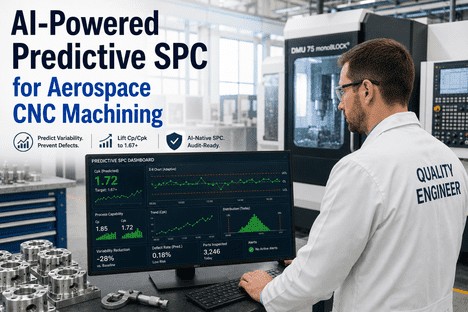
Most aerospace CNC cells post an OEE number at the end of each shift. The number lands somewhere between 55% and 72%. The supervisor records it, the production manager reviews it, and nothing changes — because OEE as a lagging metric tells you what already happened, not what is about to go wrong. The real problem is not the score. It is that by the time the score reflects a capability problem, the process has already produced out-of-spec parts. Predictive OEE changes the supervisor's role from scorekeeper to early-warning analyst — using ML-driven SPC and adaptive control limits to surface Cp/Cpk degradation before the first defect escapes the cell.
Predictive OEE · Adaptive SPC · Cp/Cpk Monitoring · AS9100 Traceability
Your OEE Score Doesn't Predict the Next Escape. Predictive OEE Does.
iFactory gives aerospace CNC supervisors a live Cp/Cpk dashboard with ML-driven SPC, adaptive UCL/LCL limits, and tool-life quality correlation — so process capability degradation is caught and corrected before it produces a nonconforming part or an NCR.
Key Stats Strip
1.67+
Target Cpk for flight-critical aerospace features — the threshold that separates a capable process from one that will eventually escape tolerance
55–72%
Typical OEE range for aerospace CNC machining cells running without predictive quality feedback — with significant recoverable losses hiding below the surface
40%
Reduction in predictive maintenance costs achieved when AI-driven process monitoring replaces calendar-based tool change and machine servicing schedules
80%
Reduction in defect recurrence when AI-detected Cp/Cpk drift findings are linked directly to CNC parameter corrections at the cell level
Why OEE Alone Is Not Enough in Aerospace CNC Machining
OEE is a useful production summary. It measures availability, performance, and quality loss across the shift. But its quality component is binary: a part is either conforming or rejected. It does not tell the supervisor that the last 30 parts before that rejection were already drifting toward the specification boundary — and that the rejection was predictable 20 parts earlier had anyone been watching the Cpk trend in real time.
In aerospace CNC machining, process capability is the quality metric that actually matters. A process with Cpk of 1.67 on a flight-critical diameter has six sigma headroom between the process mean and the nearest specification limit. A process with Cpk of 1.10 is legal — but it is one tool-wear cycle or one fixture drift event away from producing nonconforming parts. Predictive OEE incorporates live Cp/Cpk data into the equipment effectiveness calculation, so the supervisor sees not just what happened last shift, but where the process is heading this one.
Visual: OEE vs Predictive OEE comparison
Traditional OEE vs Predictive OEE — What Each Model Actually Shows the Supervisor
Reports shift-end quality loss — after out-of-spec parts have already been produced and may have moved downstream
Static SPC control limits set at process qualification — outdated when tool wear or material lots change
Tool changes on fixed intervals — too early on stable tools, too late on tools accelerating through wear
Quality score reflects scrap and rework already incurred, not capability risk still building in the process
Supervisor responds to escapes and NCRs — no mechanism to intervene before the first defect
Live Cpk trend per feature — supervisor sees capability degrading in real time, not after the escape
Adaptive UCL/LCL limits recalculate against rolling process data — always current, always relevant to the actual production state
Tool change point driven by observed quality data — extend life where Cpk is strong, intervene early where wear is accelerating
OEE quality component reflects predicted quality risk — not just historical reject rate, but forward-looking capability headroom
Supervisor acts on Cpk drift alerts 15–25 parts before the tolerance breach — preventing the defect, not documenting it
Process Capability as the Core OEE Quality Metric
Cp measures the potential of a process — how well the natural process spread fits within the specification window, assuming perfect centering. Cpk measures actual performance — the same ratio, but penalised for any offset between the process mean and the specification centre. For aerospace CNC machining, the minimum acceptable threshold is Cpk ≥ 1.33. Flight-critical features demand Cpk ≥ 1.67. World-class operations target Cpk ≥ 2.0 on key characteristics.
The problem is not calculating Cpk — any quality engineer can do that from a batch of CMM data. The problem is that in a production cell running 24 hours across three shifts, Cpk changes continuously as tools wear, fixtures drift, and thermal conditions vary. A Cpk of 1.72 at first-off can degrade to 1.18 by part 60 of a tool run without triggering a single machine alarm. The batch CMM picks it up after the run. Predictive OEE picks it up at part 38, when there is still time to intervene.
Visual: Cpk Degradation Timeline
Cpk Degradation Across a Typical Tool Run — Where Predictive OEE Fires the Alert
Parts 1–20: Cpk 1.85+
Parts 21–40: Cpk 1.55–1.72
Parts 41–55: Cpk 1.20–1.40
Parts 56–65: Cpk <1.10
New Tool — Optimal
Process centred, full specification headroom. Cpk exceeds 1.67 threshold. No action required. OEE quality component at maximum.
Mid-Life — Monitor
Cpk trending down — still above 1.33 minimum. Predictive OEE registers amber status. Supervisor monitors trend.
Alert Zone — Act Now
Predictive OEE fires alert here — 15 to 20 parts before tolerance breach. Supervisor schedules tool change before first escape.
Escape Zone — Too Late
Traditional OEE detects this at batch CMM. Parts already in circulation. NCR investigation begins from zero traceability.
How Adaptive UCL/LCL Limits Keep SPC Honest Across Every Shift
Standard SPC control limits are calculated from a process capability study conducted at a fixed point in time — often at product qualification, months or years before the current run. Those limits reflect the process as it was, not as it is. When a new material lot arrives, when a fixture is replaced, or when ambient temperature shifts on the night shift, the real process distribution changes. Static limits become either too wide to catch real drift or too narrow to ignore, generating alert fatigue that trains operators to dismiss every warning.
Adaptive UCL/LCL limits recalculate continuously against the rolling data window — typically the last 20 to 50 parts from the live production run. The algorithm separates common-cause variation, which should move the limits, from assignable-cause events, which should trigger an alert. Every limit adjustment is timestamped and logged with the data window and statistical basis that drove the recalculation. The result is a control chart that is always calibrated to current process behaviour — tighter when the process is stable, appropriately wider when genuine variation increases, and always honest about the difference between noise and signal.
Adaptive SPC Table
Production Event
Static SPC Outcome
Adaptive UCL/LCL Outcome
New tool insert fitted
Limits unchanged — miss the tighter capability window a fresh insert provides; early wear drift invisible
Limits tighten to match new-tool capability baseline; wear drift is visible from part 1 of the new interval
Material lot change
New lot variation fires false alarms on old limits; operators learn to ignore alerts across that operation
Limits adjust to new lot's baseline variation; real drift still detected, false alarm rate falls below 5%
Night shift temperature shift
Thermal expansion changes diameter reading — looks like drift on static limits, flagged as assignable cause when it is common cause
Algorithm recognises shift as common cause, adjusts baseline; genuine dimensional drift still fires alert correctly
AS9100 audit review
Static limit rationale requires re-justification when process conditions have changed since the capability study
Every limit change is logged with timestamp and data rationale — limits are always current and auditable on demand
CTA Band
Live Cpk Dashboard · Adaptive Control Limits · Tool-Life Quality Correlation
A Cpk of 1.10 Looks Fine on Paper. It Looks Like an NCR at the Customer. See the Difference on Your Cell.
iFactory's predictive OEE platform shows supervisors exactly where process capability is degrading — by cell, by feature, by shift — with adaptive SPC alerts that fire before the first escape, not after it.
The Supervisor's Predictive OEE Playbook: Four Actions That Lift Cp/Cpk to 1.67+
Improving process capability is not a one-off engineering project. It is a shift-by-shift management practice driven by the right data at the right time. The following four actions represent the core of what predictive OEE enables a supervisor to do that traditional OEE monitoring does not.
Replace Fixed Tool Change Intervals with Quality-Data-Driven Intervention Points
Fixed tool change intervals are a compromise — set conservatively to avoid escapes, but almost always too early on stable tools and sometimes too late on tools wearing faster than expected. When predictive OEE tracks the Cpk trend against tool life counter in real time, the supervisor sees the actual quality degradation curve for each cutting tool on each operation. The tool change point becomes the part number at which the Cpk amber threshold is reached — not part 50 by default, but part 38 on this spindle this week, or part 63 on the cell that is running particularly stable. The result is longer useful tool life on stable operations and earlier intervention on operations where wear is accelerating — with every decision traceable back to the quality data that drove it.
Use Cpk Shift-to-Shift Comparison to Identify Machine Condition Drift Before It Produces Scrap
A machine that achieves Cpk 1.72 on day shift and Cpk 1.31 on night shift is telling the supervisor something specific: the process is not stable across conditions. The usual causes are thermal expansion affecting bore diameters as the spindle heats up, coolant temperature variation between shifts, or operator setup differences that produce different fixture seating. Predictive OEE surfaces this shift-to-shift Cpk variance automatically — not in a monthly quality review, but on the dashboard the morning after the night shift. The supervisor can investigate the cause and resolve it before the gap widens and the night shift falls below the 1.33 minimum. Without Cpk tracking per shift, this pattern remains invisible until a batch CMM reveals it, at which point a full investigation and likely rework are inevitable.
Connect Cpk Alerts to the CNC Parameter Log to Find Root Cause Without a Full Investigation
When predictive OEE fires a Cpk alert, the investigation question is always the same: what changed? In a traditional quality system, answering that question requires pulling shift logs, interviewing operators, reviewing CNC programme versions, and reconstructing the parameter history manually — a process that takes hours and often produces inconclusive findings. When the Cpk alert is automatically linked to the machine's parameter log at the time of the degradation event, the answer is immediate: spindle speed dropped by 4% at part 34, cutting feed increased at part 28, or the coolant pressure sensor reading changed at the shift changeover. Root cause narrows from a full investigation to a focused parameter comparison, and corrective action can be authorised within minutes rather than days.
Build the AS9100 Traceability Record From Cpk Data — Not From End-of-Batch Manual Entry
AS9100 Rev D Clause 8.5.2 requires that in-process verification records link each part to the process conditions and equipment state at the time of manufacture. In most aerospace CNC operations, this obligation is met through manual inspection entries, batch CMM reports, and shift log summaries that are assembled after production and attached to the part traveller. Predictive OEE generates this traceability record automatically — part serial number, Cpk value at time of machining, adaptive SPC status, machine identifier, programme version, cutting tool lot, and material billet — without operator data entry. For an NCR investigation or an AS9100 audit, the complete process capability history for any part in any run is retrievable in seconds, not reconstructed over days from scattered paper records.
What Predictive OEE Looks Like on the Supervisor Dashboard
The supervisor dashboard is built around one question: what needs attention right now, and why? Every panel is designed to surface the highest-priority action, not the highest volume of data.
Live Floor View
Cpk Status by Cell — Green, Amber, Red Across All Machines Simultaneously
Every CNC cell running predictive OEE displays a live capability status. Green means Cpk is above the amber threshold on all monitored features. Amber means at least one feature's Cpk trend is heading toward the minimum threshold — supervisor monitors and checks the trend data. Red means a feature has breached the minimum Cpk threshold or an adaptive control limit has been exceeded — supervisor responds immediately, inspects the cell, and authorises a hold or parameter correction. The alert reaches the supervisor's mobile device at the same moment the dashboard updates. There is no lag between detection and notification.
Action: One screen, all cells. Priority is clear without any manual check of individual machine logs.
Tool Life Intelligence
Quality-Correlated Tool Life — Where on the Run the Capability Starts to Slip
Each cutting tool is tracked against the quality trend of the features it generates. The dashboard shows the Cpk curve across the tool's life — the characteristic degradation slope that tells the supervisor not just that the tool is wearing, but exactly where in the tool life cycle the quality risk begins to accumulate. For each operation, the predicted quality-safe intervention point is calculated from the observed degradation rate, not from a fixed count assumption. Supervisors plan tool changes around data, not convention — extending life where the quality trend allows and acting earlier where wear is non-linear.
Action: Schedule the next tool change at the data-predicted point — neither early nor late.
Capability Pareto
Cpk Rankings by Feature and Machine — Where the Systemic Capability Gap Lives
The Pareto view ranks features and machines by Cpk, lowest first. This view reveals which operations are chronically at the lower end of acceptable capability — the features that are always amber, always requiring supervisor attention, always on the edge of generating an escape. These are not random incidents; they are systemic capability gaps that need an engineering response, not a shift-by-shift intervention. The supervisor can escalate the Pareto findings directly to the process engineer with the supporting Cpk trend data, converting isolated reactive firefighting into structured capability improvement prioritised by actual risk.
Action: Escalate the bottom 20% of Cpk rankings to engineering as structured improvement inputs, not NCR triggers.
Shift Handover Record
Automated Shift Summary — Cpk History, Alerts Fired, and Actions Taken, Per Part Serial Number
At shift end, predictive OEE generates a complete shift quality summary: total parts produced, Cpk value per feature at shift end, alerts fired and supervisor disposition for each, tool changes completed and predicted change points for the next shift, and any adaptive limit adjustments with rationale. This summary is the shift handover record — the incoming supervisor knows exactly what the process state is, which features are trending amber, and which tool change interventions are due within the next 20 parts. There is no verbal handover interpretation required, no data hunting through machine logs, and no quality information lost between shifts.
Action: Incoming supervisor reviews shift summary in under 3 minutes — full process capability picture from part one.
Testimonial
"
Before predictive OEE, our supervisors were managing quality by exception — investigating after the escape, not preventing it. The Cpk dashboard changed the conversation on the floor entirely. Instead of asking what went wrong, supervisors are now asking which cell is amber and what the tool life is at. We moved two chronic low-Cpk operations from 1.21 to 1.68 within a quarter. The engineering team had the data to act on. Before, they just had NCRs.
— Quality Manager, Tier 1 Aerospace Machining — Engine Component and Structural Assembly Programme
Predictive OEE and the AS9100 Audit: What the Records Show
AS9100 Rev D Clause 8.5.1 requires documented evidence of in-process verification. Clause 8.5.2 requires traceability linking each part to the equipment, materials, and process conditions used in its manufacture. Clause 9.1.1 requires monitoring and measurement of process performance. Traditional compliance with these clauses involves manual inspection entries, batch CMM reports, and quality planning documents that are accurate at the time of creation but quickly become disconnected from the actual production state.
Predictive OEE satisfies all three clauses through automated records generated continuously during production. Every part receives a Cpk snapshot at the time of machining, linked to the adaptive SPC status, the machine identifier, the programme version, and the cutting tool lot. Adaptive limit adjustment events are logged with timestamps and statistical rationale. Alert events are logged with the supervisor action taken. The result is an audit package that does not need to be assembled before the audit — it already exists, in full, for every part on every run.
Compliance quick reference
AS9100 Clause 8.5.1
In-Process Verification
Per-part Cpk snapshot at time of machining constitutes documented in-process verification of critical feature compliance — without manual inspection entry or batch-end CMM requirement for covered features.
AS9100 Clause 8.5.2
Traceability
Part record links serial number to machine ID, programme version, tool lot, material billet, and operator ID at time of machining — the complete traceability chain for any NCR containment or customer escape investigation.
AS9100 Clause 9.1.1
Process Performance Monitoring
Continuous Cpk monitoring with timestamped adaptive limit history demonstrates sustained process performance monitoring — satisfying the clause's requirement for evidence that monitoring is ongoing, not periodic.
Conclusion
A traditional OEE number summarises the shift after it ends. Predictive OEE guides the supervisor through the shift as it unfolds — surfacing capability degradation in real time, correlating it with tool life and machine parameters, and firing alerts when there is still time to prevent the first defect rather than document the one that escaped. For aerospace CNC machining supervisors managing flight-critical features with tolerances at ±0.01 mm or tighter, this is not a marginal improvement. It is a fundamental change in the quality model: from reactive NCR response to proactive Cp/Cpk management at the cell level.
The four actions that lift Cpk to 1.67 and above — quality-driven tool change, shift-to-shift capability comparison, parameter-linked root cause, and automated AS9100 traceability — are all made possible by the same underlying data infrastructure: live Cpk per feature, adaptive UCL/LCL limits calibrated to current process behaviour, and an automated part record that links every inspection result to the production context that generated it. iFactory's predictive OEE platform provides all of this, configured for your specific cell, your key characteristics, and your AS9100 quality plan.
For supervisors who are ready to manage quality forward rather than backwards, the shift starts with seeing what the process is doing right now — not what it did last shift. Book a Demo to see predictive OEE operating on an aerospace CNC use case matched to your production profile, or talk to an expert about configuring live Cpk monitoring and adaptive SPC for your specific cells and key characteristics.
Frequently Asked Questions
Final CTA
Your Process Capability Is Either Rising or Falling Right Now. Predictive OEE Shows Which.
iFactory's predictive OEE platform gives aerospace CNC supervisors live Cpk monitoring, adaptive UCL/LCL alerts, tool-life quality correlation, and AS9100 traceability records — generated automatically on every part your cells produce, every shift.