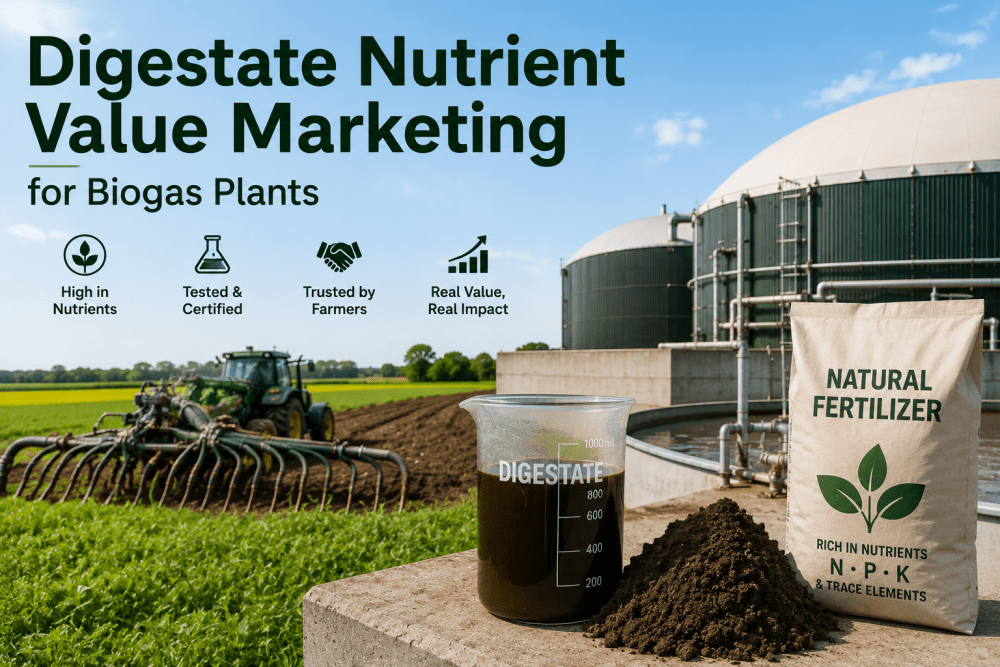
Digestate is not a waste product — it is a second revenue stream that most biogas plants are leaving partially untapped. The nutrient content of anaerobic digestate — typically 3–6 kg N per m³, 1–3 kg P₂O₅, and 2–5 kg K₂O, plus a full spectrum of micronutrients including sulfur, magnesium, and zinc — represents real fertilizer value that farmers and landscapers are increasingly willing to pay for as synthetic fertilizer prices remain volatile and organic soil amendment demand continues to grow. Operations teams building their digestate revenue strategy book a demo with iFactory to assess how their current nutrient testing and customer tracking infrastructure maps against a revenue-generating digestate marketing program.
Turn Your Digestate into a Certified, Marketable Fertilizer Product
iFactory's Mobile AI-driven App delivers continuous nutrient content tracking, PAS 110 certification documentation, and customer relationship management — purpose-built for biogas plants ready to monetize their digestate output.
Why Digestate Nutrient Value Is Becoming a Primary Revenue Driver for Biogas Plants
Plants treating digestate as a disposal cost are effectively paying to give away a product that their neighbors are increasingly willing to purchase. Facilities exploring this revenue opportunity typically book a demo to evaluate iFactory's digestate marketing modules configured for their specific nutrient profile and service area.
Nitrogen Content Verification
Total N typically 3–6 kg/m³ with 60–80% in plant-available ammonium form. Real-time NIR sensors enable per-batch nutrient guarantees that command premium pricing over bulk, unverified digestate.
Phosphorus & Potassium Recovery
P₂O₅ at 1–3 kg/m³ and K₂O at 2–5 kg/m³ represent significant value for crop farmers. Separated solid fraction concentrates P content, enabling targeted sale to phosphorus-deficient soil regions.
Organic Matter & Soil Health
Digestate provides stable organic matter that improves soil structure, water retention, and microbial activity. Certified organic growers pay premiums for verified low-odor, weed-free digestate products.
Micronutrient Profile
Sulfur, magnesium, zinc, copper, and boron in digestate provide complete crop nutrition. Full micronutrient analysis enables positioning as a complete fertilizer replacement rather than a nitrogen-only supplement.
What a Comprehensive Digestate Nutrient Marketing Program Must Include
The most successful digestate marketing programs are built around three interconnected modules: Nutrient Testing and Certification, Product Quality Management, and Customer Sales and Logistics. Marketing and operations managers building these programs book a demo to see how iFactory's digestate marketing modules integrate with their existing testing and logistics workflows.
Module 1 — Real-Time Nutrient Content Verification
Using near-infrared sensors at the digestate outlet or storage transfer point, iFactory monitors total N, ammonium-N, P₂O₅, K₂O, dry matter, and pH on every batch. The AI analyzes trend deviations and generates a certified nutrient content statement for each delivery — enabling the plant to guarantee minimum nutrient content to customers and command premium pricing over bulk, unverified product.
Module 2 — Product Certification and Quality Documentation
iFactory maintains the complete certification record for the facility's digestate product — including PAS 110 or equivalent quality protocol compliance, heavy metal analysis, pathogen testing, and physical contaminant screening results.
Module 3 — Customer Relationship and Logistics Management
iFactory's CRM module tracks every customer and prospect in the plant's digestate service area — including farm size, crop rotation, typical application timing, historical purchase volume, and current contract status. Delivery scheduling is integrated with the storage level monitoring system, ensuring that customer orders are fulfilled before storage capacity constraints force emergency applicationbook a demo .
Building a Digestate Marketing Program: Traditional vs. AI-Enabled Approaches
The most significant barrier to digestate revenue generation is not farmer demand — it is the absence of a structured marketing and logistics program that treats digestate as a product rather than a byproduct. The table below compares the traditional approach to digestate management with the AI-enabled marketing program that iFactory supports. Marketing leads building their programs typically book a demo to explore how iFactory's marketing modules can be integrated into their existing sales and logistics environment.
| Marketing Element | Traditional Disposal Approach | AI-Enabled Marketing Program | Revenue Impact |
|---|---|---|---|
| Nutrient Analysis | Quarterly lab samples, general ranges only | Per-batch NIR verification, guaranteed nutrient content | Premium pricing for verified product |
| Product Certification | Uncertified or annual certification only | Continuous PAS 110 compliance monitoring | Access to premium agricultural markets |
| Customer Identification | Word-of-mouth, limited geographic reach | AI-powered farmer demand mapping per service area | Expanded customer base and coverage |
| Pricing Model | Fixed per-ton disposal fee or free give-away | Tiered pricing by nutrient content and certification level | Revenue per ton increased 3–5× |
| Delivery Scheduling | Reactive, crisis-driven when storage is full | Forecast-based scheduling aligned with customer crop plans | Reduced logistics cost by 40–55% |
| Customer Records | Paper contracts, spreadsheets, no CRM | Integrated CRM with full customer and delivery history | Repeat purchase rate increase of 60%+ |
Designing a Scalable Digestate Marketing Framework
A structured implementation framework addresses three levels of marketing maturity — from basic nutrient testing and local farmer relationships to a full certified product marketing program with multi-channel customer outreach. Organizations building these marketing tiers book a demo to align iFactory's marketing and logistics modules with their specific customer base and service area.
Nutrient Testing & Local Sales
For: Small to mid-size plants
- Monthly nutrient analysis with NIR sensor
- Basic product data sheet per batch
- Local farmer contact list management
- Simple delivery scheduling and tracking
Certified Product Marketing
For: Growth-stage facilities
- PAS 110 or equivalent certification maintained
- Per-batch guaranteed nutrient content
- CRM with full customer history and contracts
- Forecast-based delivery scheduling
Multi-Product Market Optimization
For: Large commercial plants
- Separated solid and liquid fraction sales
- Blended products for specific crop markets
- Digital customer portal with self-service ordering
- Multi-channel marketing automation
Measurable Revenue Gains from Structured Digestate Marketing
Biogas plants that deploy structured digestate marketing programs with AI-enabled nutrient tracking and CRM report substantial revenue improvements across all key marketing and logistics metrics. The results below reflect 12-month post-implementation outcomes across iFactory-supported digestate marketing programs.
"We were giving our digestate away to a single farmer for the cost of delivery — treating it as a waste stream we needed to dispose of. After deploying iFactory's nutrient tracking and marketing platform, we achieved PAS 110 certification, developed a tiered pricing model based on verified nutrient content, and built a customer base of 14 farms within a 20-mile radius. Our digestate revenue went from zero to $380,000 in the first twelve months. The platform paid for itself in the first quarter.book a demo "
Digestate Nutrient Marketing — Frequently Asked Questions
What is the typical nutrient content of anaerobic digestate, and how does it compare to synthetic fertilizers?
Whole digestate typically contains 3–6 kg N per m³ (60–80% as ammonium-N), 1–3 kg P₂O₅, and 2–5 kg K₂O, plus a full spectrum of secondary nutrients and micronutrients. While the nutrient concentration per ton is lower than synthetic fertilizers, the organic matter content, soil health benefits, and slow-release nitrogen fraction provide agronomic value that synthetic fertilizers cannot match. When valued on a nutrient-per-dollar basis, certified digestate typically delivers a 20–35% cost advantage over synthetic alternatives at current fertilizer prices — before accounting for the organic matter and soil health premiums.
What certifications do farmers require before purchasing digestate for crop production?
The most widely recognized digestate certification in North America is PAS 110 (or equivalent programs like the RNG Quality Protocol or state-specific organic input certifications). PAS 110 certification provides farmers with assurance that the digestate meets standards for pathogen content, heavy metals, physical contaminants, and nutrient stability. Certified digestate also satisfies the documentation requirements of third-party sustainability certifications like Certified Organic, and is increasingly required by food processors' supplier sustainability programs. iFactory's certification management module maintains the complete certification record — from sampling through analysis to certificate issuance — with automated renewal alerts.
How should a biogas plant price its digestate for maximum revenue?
The optimal pricing model depends on certification status, nutrient concentration, local fertilizer market conditions, and the plant's logistics cost structure. Most successful programs use a tiered pricing approach: a base price per ton for uncertified bulk digestate, a premium tier for PAS 110 certified product with verified nutrient analysis, and a top tier for separated solid or liquid fractions with enhanced nutrient concentration. Pricing should be benchmarked against local synthetic fertilizer prices on a nutrient-equivalent basis — if anhydrous ammonia is trading at $800 per ton, the nitrogen in a ton of digestate containing 4 kg N per m³ has a replacement value of approximately $12–$16 per m³ when adjusted for availability and application method.
What is the minimum plant size or digestate volume needed to justify a structured marketing program?
Facilities producing as little as 10,000 tons of digestate per year can benefit from a structured marketing program. At $15 per ton average revenue (Tier 1 pricing with basic nutrient testing and local farmer relationships), a 10,000 TPY plant generates $150,000 in annual digestate revenue — enough to recover the cost of nutrient testing equipment, certification fees, and part-time marketing staff while generating a positive return.
How does iFactory help biogas plants manage the logistics of digestate delivery to multiple customers?
iFactory's logistics module integrates customer orders, storage level data, and delivery scheduling into a single dispatch dashboard. When a customer's order is due and storage levels indicate available product, iFactory generates a delivery ticket with the customer's field location, required volume, and target application window. This eliminates the administrative burden that prevents many plants from serving multiple small to mid-size customers and enables the plant to capture the higher per-ton pricing available from a diversified customer base rather than relying on a single bulk buyer.book a demo
Turn Your Digestate from a Cost Center into a Revenue Stream
iFactory's Mobile AI-driven App delivers integrated digestate marketing modules, real-time nutrient tracking, certification management, and customer relationship tools — built for biogas plant operators ready to monetize their digestate output and build a diversified revenue base.