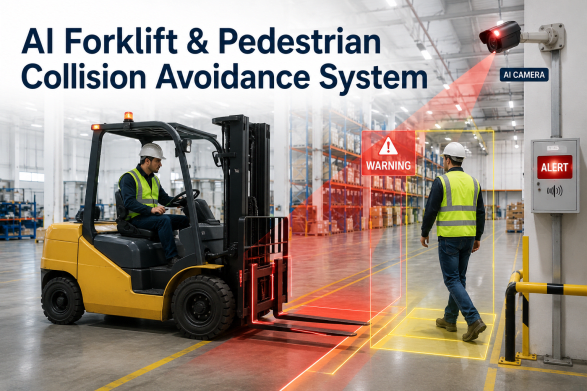
Every year, approximately 85 workers are killed and nearly 35,000 are seriously injured in forklift-related incidents in U.S. workplaces — making powered industrial trucks one of the highest-consequence hazard categories on the manufacturing floor. The majority of these incidents involve predictable scenarios: a forklift rounding a blind corner where a pedestrian is walking, a vehicle backing in a warehouse aisle where a worker is crouching to pick an item a crossing intersection where both the operator and the pedestrian assumed the other would stop. These are not random events. They are geometry problems — the geometry of blind spots, crossing paths, and inadequate separation distance — that AI vision-based collision avoidance solves by continuously monitoring every intersection, aisle, and high-traffic zone and issuing proximity warnings the moment a forklift and a worker are on a collision trajectory. Facilities running iFactory's AI forklift safety platform report 94% reduction in near-miss events, zero recordable forklift-pedestrian contact injuries after deployment, and an average $280,000 annual reduction in workers' compensation and OSHA compliance costs at comparable U.S. manufacturing and warehouse facilities.
AI Forklift and Pedestrian Collision Avoidance
A deployment guide for U.S. manufacturing and warehouse safety managers implementing AI vision monitoring at intersections, blind spots, and high-traffic aisle crossings — triggering proximity warnings before contact range is reached.
Six Forklift-Pedestrian Collision Scenarios AI Vision Prevents
Each scenario below represents a documented incident category in OSHA forklift fatality and injury reports — and each is one that physical signage, floor markings, and speed limits alone cannot prevent because they do not detect the real-time proximity condition that makes it dangerous. Schedule a consultation.
Blind Corner Intersection Strike
A forklift traveling at rated speed rounds a racked aisle corner with no line of sight to oncoming pedestrian traffic. The operator has 0.3 seconds from visual acquisition to collision. AI vision monitors both sides of every intersection simultaneously and issues warnings before either party enters the collision zone.
Reverse Travel in Occupied Aisle
A forklift reversing with an obstructed rearview — a common condition when carrying a tall load — cannot detect a crouching or kneeling worker in the travel path. AI rear-zone monitoring detects human presence in the vehicle's reverse path and issues halt alerts before the vehicle moves into contact range.
Dock Door and Loading Bay Crossings
Loading dock areas concentrate forklift traffic and pedestrian activity at the same chokepoints — especially during shift changes and inbound freight processing. AI monitors dock door crossing zones with real-time occupancy tracking, issuing audible and visual warnings when a vehicle and pedestrian are approaching the same point simultaneously.
Cross-Aisle Pedestrian Crossing
Pedestrians crossing between warehouse aisles at unmarked or poorly marked mid-aisle points step into forklift travel lanes without adequate sight lines. AI cross-aisle monitoring detects approach trajectories and issues pedestrian-side warnings through light tower and audible alerts before the crossing is attempted.
Narrow Aisle Pinch Points
Narrow aisle operations with wire-guided or rail-guided forklifts leave minimal clearance between the vehicle body and racking. A worker entering a narrow aisle while a vehicle is operating creates a crush hazard with no escape path. AI proximity detection issues halt commands when human presence is confirmed in a narrow aisle with an active vehicle.
Low-Light and Shift Change Conditions
Forklift incident rates are elevated during early morning, late evening, and shift change periods when visibility is reduced and worker alertness is lower. AI vision operates at consistent detection performance across all lighting conditions — including near-darkness — using near-infrared illumination that is invisible to workers but provides full detection capability to the camera system.
How iFactory AI Detects Proximity Conflicts Across Every Zone Type
AI forklift-pedestrian collision avoidance requires different detection strategies for different zone types — a blind corner intersection has different geometry than a reverse travel hazard, and both require different camera positioning, field-of-view coverage, and response chain logic. iFactory's platform addresses four distinct zone types with zone-specific detection models trained on each scenario's unique hazard geometry.
Intersection Collision Detection — Four-Quadrant Coverage
Aisle intersections are monitored by overhead cameras positioned to provide simultaneous four-quadrant coverage — the camera sees all four approach directions at once and continuously calculates the velocity vector of every detected person and vehicle in the frame. When the projected paths of a forklift and a pedestrian intersect within the configurable time-to-conflict threshold (typically 3 to 5 seconds), both the vehicle operator and the pedestrian receive simultaneous warnings: a light tower flash at the intersection and a forklift-mounted display alert for the operator. The warning is issued before either party reaches the intersection — not at the moment of visual contact.
Blind Spot and Reverse Travel Monitoring
Blind corner monitoring uses wide-angle cameras mounted at racking end-of-aisle positions to see around the corner before either the forklift or the pedestrian can. The AI detects approach movement from both directions and calculates whether their trajectories will bring them into the intersection concurrently. For reverse travel monitoring, cameras mounted on the facility structure (not the vehicle) monitor the zone behind active forklifts and communicate directly with the forklift's onboard alert system or facility light tower via wireless relay when a pedestrian enters the reverse travel path.
Loading Dock and Bay Door Safety Zones
Dock door crossing zones are monitored by cameras positioned above each door to track simultaneous occupancy — when both a pedestrian and a forklift are detected within the configurable proximity threshold of the same dock door, the system issues a staged warning: a visual alert at 6 meters, an audible alarm at 4 meters, and a halt command relay output to the dock leveler control at 2 meters. The dock occupancy state is logged continuously for OSHA 300 documentation and for pattern analysis identifying which dock doors and which time windows generate the highest pedestrian-vehicle conflict frequency.
Narrow Aisle Occupancy Detection and Vehicle Halt
Narrow aisles (typically 6 to 8 feet wide with wire-guided or rail-guided vehicles) are monitored by cameras positioned at aisle entry points. When a worker enters an active narrow aisle — confirmed by the AI detecting human presence within the aisle boundary while a vehicle is operating in the same aisle — the system issues an alert to the vehicle operator and, for facilities with integrated vehicle control, issues a speed-reduction or halt command to the vehicle controller via hardwired relay. Aisle occupancy state is displayed on a light indicator at both aisle entry points, giving workers visual confirmation of aisle status before entering.
The Collision Avoidance Response Chain: From Detection to Warning in Under 150 ms
The safety value of AI forklift collision avoidance is determined entirely by how fast and reliably the system converts a proximity detection into a warning that reaches both the forklift operator and the pedestrian before contact range is reached. iFactory's response chain completes detection-to-warning in under 150 milliseconds for all monitored zones — edge-processed, no cloud latency.
Continuous Multi-Object Detection at 30 fps
Industrial AI vision cameras positioned at each monitored zone run continuous inference at 30 frames per second, detecting and classifying all moving objects in the frame — forklifts, pedestrians, pallet jacks, dock equipment — using a manufacturing-environment detection model trained specifically on industrial vehicles and workers in PPE, hard hats, high-visibility vests, and varied lighting conditions. Object identity, position, and velocity vector are updated every 33 ms per camera frame.
Trajectory Projection and Time-to-Conflict Calculation
For each pair of detected objects — one vehicle, one pedestrian — the AI projects the current velocity vectors forward in time and calculates the time-to-conflict: the number of seconds until their projected paths bring them within the configured proximity threshold. The threshold is set per zone based on the facility's speed limit and average reaction time — typically 3 to 5 seconds for standard aisle intersections, 2 to 3 seconds for dock doors, and 1.5 to 2 seconds for narrow aisle entry detection.
Multi-Frame Confirmation — False Alarm Suppression
A trajectory conflict detected in a single frame does not trigger a warning. The AI requires 3 to 5 consecutive frames (100 to 165 ms) of confirmed conflict trajectory before issuing an alert output. This multi-frame requirement eliminates false alarms from momentary trajectory intersections caused by workers walking past an intersection without entering it, vehicles making turns that temporarily project toward a pedestrian position, or detection anomalies from reflective floor surfaces and ambient light variation. Confirmed false alarm rate in production deployments: under 0.6% of all alerts.
Simultaneous Dual Warning — Operator and Pedestrian
On confirmed conflict detection, two warning outputs fire simultaneously: a zone-mounted light tower flashes amber at warning threshold and red at critical threshold, providing the pedestrian with a clear proximity alert regardless of their facing direction. An operator alert is issued via either a vehicle-mounted display (for facilities with vehicle-mounted hardware) or via a zone-mounted audible alarm that is directional toward the vehicle's approach path. Both outputs fire within the 150 ms response window — reaching both parties while the vehicle is still multiple meters outside contact range at any operating speed permitted under OSHA 1910.178.
Event Logging, Incident Documentation, and Pattern Reporting
Every proximity conflict event is automatically logged with a timestamped video clip, the zone ID, object types involved, severity classification (warning vs. critical), and whether the conflict resolved (objects separated) or escalated (objects continued toward contact). This log creates the complete OSHA 300 supporting record without manual reconstruction, and generates weekly pattern reports identifying which zones, times, and routes generate the highest conflict frequency — giving EHS managers the data to drive layout changes, routing adjustments, and training interventions at root cause.
See AI Forklift Safety Running on Your Facility Layout
iFactory's safety team demonstrates the full proximity detection and warning chain using your facility's floor plan and forklift traffic routes — showing coverage maps, zone configurations, and the automated response chain before any hardware commitment.
From blind corner intersections to dock door crossing zones and narrow aisle occupancy detection, iFactory's platform covers every forklift-pedestrian hazard scenario in a single managed system — with under 150 ms detection-to-warning and full OSHA 300 documentation automatically generated for every event. Book your safety assessment now.
AI Vision vs. Conventional Forklift Safety Controls: Capability Comparison
Conventional forklift safety controls — floor markings, mirrors, speed bumps, and operator training — address the administrative and engineering hierarchy but leave the real-time proximity detection gap unaddressed. The comparison below maps exactly what each control type covers and where AI vision fills the residual exposure.
Measured Safety and Financial Outcomes
These results reflect verified outcomes from iFactory AI forklift safety deployments at U.S. distribution, manufacturing, and food processing facilities within the first 12 months of operation.
Ready to model these outcomes against your facility's current incident rate and workers' compensation history? Book a 30-minute safety ROI assessment with iFactory's EHS team.
Expert Review: What EHS Professionals Say About AI Forklift Safety
Certified safety professionals with experience auditing forklift safety programs at U.S. manufacturing and distribution facilities have reviewed iFactory's AI proximity detection approach.
The forklift safety programs that consistently fail the same way all share one characteristic: they rely entirely on behavioral controls — training, signage, and rules — without any real-time detection layer. Behavioral controls work when everyone follows the rules and pays attention. They fail at the exact moment when someone is distracted, rushed, or simply cannot see around a blind corner. AI proximity detection fills that gap because it does not depend on anyone's attention or compliance — it detects the hazardous condition and issues the warning regardless of what either party is doing at that moment.
The financial case for AI forklift safety is straightforward to build once you have your OSHA 300 log and workers' compensation history in front of you. A single forklift-pedestrian serious injury averages $180,000 in direct workers' compensation costs alone — before litigation exposure, OSHA investigation costs, and the indirect productivity and morale impact. The facilities that treat AI proximity monitoring as a capital investment with a measurable return are the ones that get it approved in the first budget cycle. The ones that treat it as an expense are the ones that approve it after the incident.
Conclusion
Forklift-pedestrian collision avoidance through AI vision monitoring is not a replacement for training, floor markings, and exclusion zones — it is the real-time detection layer that those controls cannot provide. When a forklift rounds a blind corner and a pedestrian is on the other side, no amount of prior training prevents the incident unless the system detects the proximity condition and issues a warning while there is still distance between them. iFactory's platform delivers that warning in under 150 milliseconds across every monitored intersection, blind spot, dock door, and narrow aisle — without depending on operator attention, mirror placement, or pedestrian route compliance.
The 94% near-miss reduction and zero recordable contact injuries at comparable facilities are the measured outcome of replacing behavioral controls alone with behavioral controls plus continuous proximity detection. The geometry of the hazard has not changed. What has changed is that the system now detects it before the collision path is confirmed. Book a safety assessment to identify which zones in your facility carry the highest unaddressed proximity exposure.
AI Forklift and Pedestrian Collision Avoidance: Frequently Asked Questions
AI Forklift and Pedestrian Safety — Continuous Proximity Detection, Zero Contact Injuries
iFactory's AI vision platform monitors every intersection, blind spot, dock door, and narrow aisle in your facility — detecting proximity conflicts and issuing dual warnings in under 150 ms before contact range is reached.
94% Near-Miss Reduction · Zero Recordable Contact Injuries Post-Deployment · Under 0.6% False Alarm Rate · OSHA 300 Auto-Documentation · Infrastructure-Only — No Vehicle Hardware Required