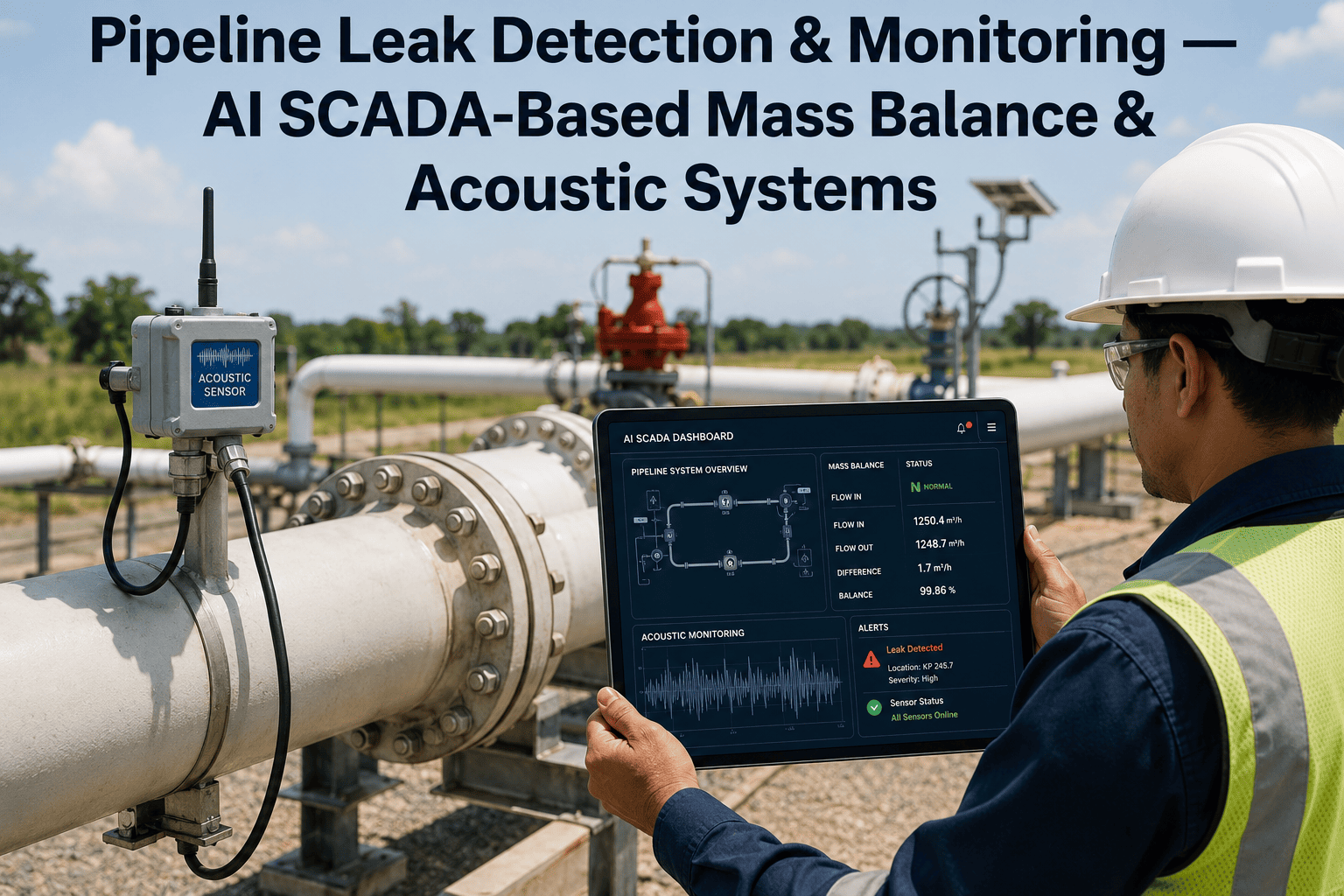
Most pipeline leaks are not found on a control room screen — they are found later, by a landowner who smells product in a ditch or a drone flyover that spots a sheen weeks after the release began. Conventional mass balance systems only flag a leak once it reaches roughly one to two percent of flow rate, which on a large-diameter transmission line can mean thousands of barrels lost before an alarm ever fires. Acoustic sensors, pressure transient analysis, and fiber optic sensing can each catch what mass balance misses on its own, but only when the signals are correlated together instead of watched as separate screens by separate people. EHS managers working under API 1130 and the PHMSA Valve and Rupture Rule are now expected to prove a leak detection program actually performs, not just that it exists in a binder. Many operators start by choosing to book a demo to see how their own SCADA history would score against a combined AI model.
Catch a Sub-1% Leak Before It Becomes a 10,000-Barrel Release
iFactory fuses SCADA mass balance, acoustic leak signatures, and pressure transient analysis into a single AI model that flags real leaks within minutes and clears out the false alarms that make dispatchers stop trusting the system.
Why Mass Balance Alone Leaves an EHS Manager Exposed
A computational pipeline monitoring system built on mass balance compares what enters a line against what leaves it, correcting for line pack, temperature, and compressibility along the way. It is the backbone of most CPM programs, and it is also the method with the least sensitivity of the group, typically catching leaks only once they reach one to two percent of flow rate. On a high-throughput crude or NGL line, that threshold can hide a meaningful loss for hours or days, particularly during the transient states — pump starts, batch changes, slack line conditions — where mass balance is most prone to both missed leaks and false alarms.
Under 49 CFR 195.452, operators must document a means to detect leaks that has actually been evaluated against the risk to high-consequence areas, not simply installed and left running. When an incident review shows a leak sat below the mass balance threshold for days before discovery, the gap between what was documented and what the system could actually see becomes the finding an inspector writes up.
Four Detection Layers, Correlated Into One Signal
No single method covers every leak size, location, and flow condition on its own, which is why API 1130 encourages operators to combine complementary techniques rather than lean on one. iFactory runs these four layers continuously and cross-checks them against each other before anything reaches a dispatcher.
Sensitivity and Response Time by Detection Method
Each method trades off sensitivity, cost, and false-alarm risk differently, which is why the right combination depends on line diameter, right-of-way access, and the consequence area the segment runs through.
| Method | Typical Sensitivity | Detection Time | Key Limitation |
|---|---|---|---|
| Mass balance / CPM | 1–2% of flow rate | Minutes to hours | Prone to false alarms during transients |
| Acoustic emission | Down to <1% of flow | Seconds to minutes | Sensitive to ambient noise without correlation |
| Pressure point analysis | Best on ruptures & large leaks | Near-instant on ruptures | Weaker on small, slow seeps |
| Distributed fiber (DAS/DTS) | High on instrumented sections | Seconds to minutes | Coverage limited to fiber route |
Run Your Last 12 Months of SCADA History Through the Same Model
Most operators already have the flow, pressure, and temperature data needed to answer one question: would iFactory have caught your last reportable incident earlier than it was actually caught?
Built Around API 1130 and the PHMSA Valve & Rupture Rule
API 1130 is incorporated by reference into 49 CFR 195.134 and 195.444, and it shapes how a CPM system must be designed, evaluated, operated, and tested. The 2022 Valve and Rupture Rule layered on additional obligations around rupture-mitigation valve spacing, pressure monitoring at those valves, and immediate 911 notification once a rupture is suspected. iFactory is built to generate the evidence an EHS manager needs against both.
Before this, our mass balance system threw a false alarm almost every time we started a pump, so dispatchers had started treating every alert the same way — worth a glance, not a shutdown. Once acoustic and pressure data were correlated with the mass balance number instead of standing alone, the alarm volume dropped and the ones that came through actually meant something. That is the difference between a system that exists on paper and one people trust enough to act on.
What Changes After Correlated Detection Goes Live
The shift most EHS teams describe is not one dramatic catch — it is a steady drop in wasted attention on false alarms alongside a real increase in confidence that a genuine small leak will not sit unnoticed for days.
Pipeline Leak Detection — Frequently Asked Questions
Stop Finding Out About a Leak From a Landowner Instead of a Sensor
iFactory correlates the flow, pressure, and acoustic data your pipeline already produces into one AI-driven leak detection signal — built to catch small leaks early and to hold up under an API 1130 or PHMSA review.