In cement manufacturing, a single PPE compliance failure can escalate from a OSHA citation to a fatality within seconds. Rotating kiln drives, airborne silica dust, molten clinker splash zones, and overhead crane paths create a hazard density that no human safety supervisor can monitor continuously across every square foot of a 500-acre plant. In 2026, AI vision systems that detect missing hard hats, safety vests, goggles, and gloves in real time are no longer a "smart factory" experiment — they are the operational baseline for plants that want to maintain their OSHA 300 log, protect their insurance premiums, and keep their workforce on the floor. This guide delivers a technical framework for deploying real-time PPE compliance AI across your cement plant's highest-risk zones, from the kiln platform to the bagging hall. Book a free demo to see how iFactory's AI vision platform closes your safety compliance gap today.
Why Cement Plants Are the Highest-Risk Environment for PPE Non-Compliance
Cement production combines more simultaneous hazard categories than almost any other heavy industry. Workers operate within range of extreme heat from kiln shells reaching 300°C on the surface, fugitive silica dust that causes irreversible pulmonary disease with cumulative exposure, falling objects from overhead conveyors and bucket elevators, and high-voltage electrical systems running motor drives up to 6.6kV. The Bureau of Labor Statistics consistently ranks cement and concrete manufacturing among the highest injury-rate industries in U.S. heavy manufacturing, with struck-by and caught-in incidents accounting for a disproportionate share of fatalities.
The enforcement problem is not a shortage of safety rules — it is the physical impossibility of monitoring compliance at scale. A 5,000 tpd integrated cement plant may have 300–500 workers distributed across a site where direct line-of-sight supervision covers less than 15% of active work areas at any given moment. Traditional safety walks and manual audits create a compliance "snapshot" that is outdated within minutes of the safety officer moving to the next zone. AI vision changes this entirely by making every camera a continuous compliance monitor. Book a demo to see live PPE detection across cement plant zones.
The Six PPE Categories AI Vision Monitors Continuously in Cement Plants
Not all PPE carries equal risk weight in cement operations. A missing hard hat in a low-traffic corridor carries different consequence severity than an exposed face in the kiln platform's falling-object exclusion zone. iFactory's detection model is configured to weight alerts by zone-specific hazard severity, ensuring that the highest-consequence violations trigger the fastest escalation response.
Mandatory in all areas with overhead object hazards. AI detects presence, color-coding compliance (visitor vs. zone-assigned workers), and correct fit positioning. Accounts for 38% of struck-by fatalities in cement plants.
Class 2 and Class 3 high-visibility vests are ANSI/ISEA 107 requirements in all vehicle interaction zones. AI detects retroreflective strip presence and ANSI class-appropriate coverage area by zone assignment.
Silica dust, clinker splash, and chemical contact create persistent eye hazard. AI distinguishes between safety glasses (ANSI Z87.1) and full chemical splash goggles by zone-specific hazard requirement assignment.
Respirable crystalline silica (RCS) triggers OSHA's Silica Rule (29 CFR 1926.1153) at action levels as low as 25 μg/m³. AI detects N95, half-face, and full-face respirator presence in designated dust exposure zones.
Cut-resistant and chemical-resistant gloves are mandatory for maintenance and chemical dosing tasks. AI detects glove presence and color-coded glove type against zone-specific chemical or cut-hazard requirements.
Steel-toed footwear is ASTM F2413 mandatory in crushing, clinker transport, and heavy equipment zones. AI detects non-compliant footwear (sneakers, open-toe) by comparison against approved footwear profile libraries.
How iFactory AI Vision Works: The PPE Detection Pipeline
Deploying AI PPE detection in a cement plant is not as simple as pointing a camera at a doorway. The system must handle cement dust haze, backlighting from kiln flame, thermal distortion near hot surfaces, and workers partially obscured by equipment. iFactory's detection pipeline is engineered for the specific visual conditions of cement manufacturing environments.
Camera Network and Zone Mapping
High-resolution IP cameras (minimum 4MP) are deployed at zone entry/exit points, chokepoints, and continuous monitoring positions within high-hazard areas. Each camera is assigned a zone profile specifying which PPE items are mandatory — so the same worker walking from the kiln platform to the control room triggers different compliance checks at each zone boundary.
Edge AI Processing and Person Detection
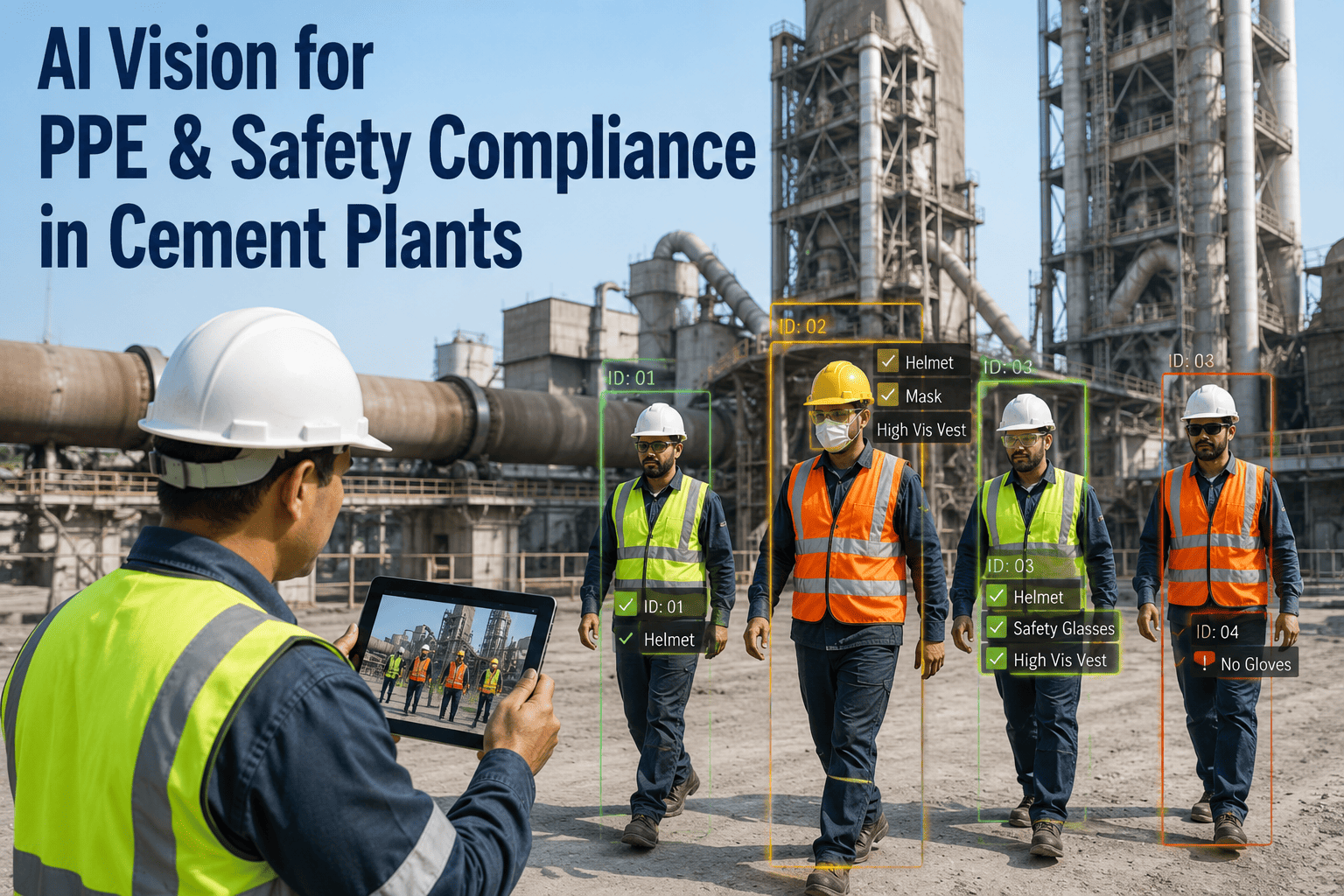
Video frames are processed at the edge — on an NVIDIA Jetson or equivalent compute module installed at the camera cluster — reducing bandwidth requirements and eliminating cloud-dependent latency. The person detection model locates each worker in the frame and constructs a bounding box for each individual, regardless of occlusion by equipment or other personnel.
PPE Classification Against Zone Requirements
Within each person bounding box, a secondary classification model identifies the presence or absence of each required PPE item — hard hat, vest, goggles, respirator, gloves, footwear. The model is trained on a dataset including workers in cement dust haze, partial occlusion, and high-contrast kiln-light environments. Detection confidence thresholds are configurable per PPE category.
Violation Escalation and Alert Routing
A confirmed violation (sustained for a configurable 3–5 second window to eliminate false positives from transient occlusions) triggers a multi-channel alert: SMS to the zone supervisor, push notification to the safety manager's dashboard, and an optional audible annunciator in the zone. The alert includes a timestamped image frame of the violation event for accountability documentation.
OSHA Compliance Log Generation
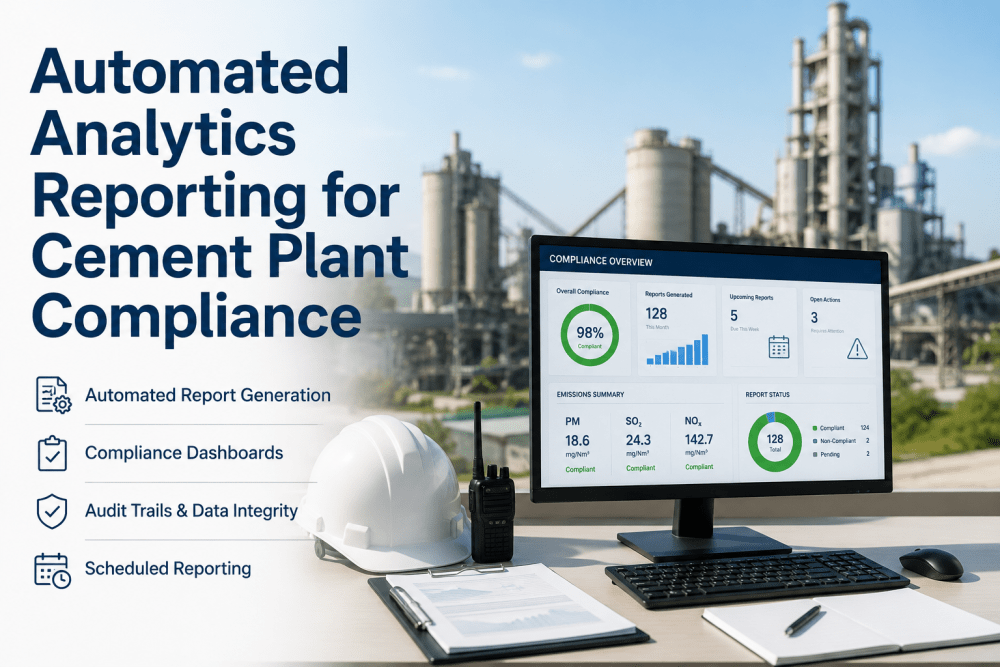
Every violation event is logged with timestamp, zone, PPE category, image evidence, and resolution status (supervisor acknowledged, worker corrected). These logs are automatically compiled into OSHA 300-ready compliance reports, exportable monthly or on-demand for regulatory inspections, insurance audits, or incident investigations.
Zone-Based Compliance Matrix: Matching Detection to Hazard Severity
Effective PPE AI is not a one-size-fits-all system. Each production zone in a cement plant carries a distinct hazard profile. The compliance matrix below maps the six primary cement plant zones against their mandatory PPE requirements and the AI detection priority level iFactory assigns to each combination. Book a demo to see how we configure zone-specific detection for your plant layout.
| Plant Zone | Hard Hat | Hi-Vis Vest | Goggles | Respirator | Gloves | Alert Priority |
|---|---|---|---|---|---|---|
| Kiln Platform | Mandatory | Mandatory | Mandatory | Zone-Specific | Task-Based | P1 — Immediate |
| Raw Mill / Grinding | Mandatory | Zone-Specific | Mandatory | Mandatory | Task-Based | P1 — Immediate |
| Clinker Cooler Area | Mandatory | Mandatory | Mandatory | Zone-Specific | Mandatory | P1 — Immediate |
| Vehicle / Dispatch Zone | Mandatory | Mandatory | Task-Based | Not Required | Not Required | P2 — 60 Seconds |
| Packing & Bagging Hall | Mandatory | Mandatory | Mandatory | Zone-Specific | Task-Based | P2 — 60 Seconds |
| Electrical / Control Rooms | Task-Based | Not Required | Task-Based | Not Required | Task-Based | P3 — End of Shift |
AI Vision vs. Traditional Safety Audits: A Structural Comparison
Understanding exactly where manual safety programs fail — and what AI vision replaces, augments, or complements — is essential for building the business case for deployment. The following comparison maps the performance of both approaches across the dimensions that matter most to a Safety Director presenting to a plant operations board.
Quantifying the Safety ROI: Cost of Non-Compliance vs. Cost of AI Deployment
The financial case for AI PPE monitoring in cement plants extends well beyond avoiding OSHA fines. Direct and indirect costs of a single recordable safety incident — medical treatment, workers' compensation, lost production, OSHA investigation, legal defense, and insurance premium adjustment — routinely exceed $150,000 per event for heavy industrial operations. For fatalities, total liability exposure including litigation regularly reaches $2M–$8M. Against these numbers, the deployment cost of an AI vision system becomes a straightforward actuarial calculation.
Implementation Roadmap: Deploying PPE AI Across a Cement Plant
A phased deployment approach minimizes operational disruption while achieving rapid coverage of the highest-consequence zones first. Most cement plants achieve full-site coverage within 90 days of initial camera installation.
Zone Hazard Assessment and Camera Position Planning
iFactory's safety engineers conduct a site walkthrough to map each production zone's PPE requirements against OSHA 29 CFR 1910 Subpart I and plant-specific SOPs. Camera positions are selected to maximize worker coverage while complying with privacy and labor agreement requirements. Output: a zone-PPE matrix and camera placement plan.
Camera Infrastructure and Edge Compute Installation
High-resolution IP cameras are installed at priority zones — kiln platform, raw mill, clinker cooler, and vehicle traffic areas in Phase 1. NVIDIA Jetson edge compute modules are installed at camera cluster points, eliminating cloud dependency and achieving sub-1.2-second alert latency. Cameras are certified to IP66 or higher for cement dust environments.
Model Training and Site-Specific Calibration
The base PPE detection model is fine-tuned on images captured from your specific plant environment — your PPE color schemes, lighting conditions, and worker population. This site-specific training phase typically takes 10–14 days and raises detection accuracy from a generic 78% to a plant-specific 92%+ across all PPE categories.
Alert Routing Configuration and Supervisor Training
Alert escalation workflows are configured by zone, PPE category, and shift schedule. Zone supervisors are trained on the mobile alert interface, acknowledgment protocols, and escalation procedures for unresolved violations. The safety manager's dashboard is integrated with the plant's existing EHS management system for unified incident tracking.
Go-Live, OSHA Reporting Activation, and Continuous Improvement
System goes live with a 30-day parallel period during which AI detections are cross-validated against manual audits. OSHA compliance report generation is activated, with monthly reports scheduled automatically for the Safety Director and Plant Manager. Model performance is reviewed quarterly and updated as PPE specifications or plant layout changes occur.
Expert Review: What Safety Directors Say About AI PPE Monitoring
The hardest part of safety management in a cement plant is not writing the rules — it is enforcing them at 2 AM on a Saturday in the raw mill with three people on shift. AI vision solved that problem for us completely. Within six months of deployment, our TRIR dropped from 2.4 to 0.9. The OSHA documentation alone saved us $60,000 in legal preparation time when we had an inspection last year. The system paid for itself before the first annual renewal.
What most people underestimate is the behavioral effect. Once workers know that PPE compliance is monitored continuously and violations are documented with their image, the culture shifts. We saw a 40% reduction in voluntary non-compliance within the first 60 days — not because of disciplinary action, but because the social contract changed. When everyone knows the system sees everything, the peer pressure dynamic inverts entirely in favor of compliance.
Conclusion: From Safety Audits to Safety Intelligence
PPE compliance monitoring in cement plants has historically been a sampling problem — safety teams could observe a fraction of workers, in a fraction of zones, for a fraction of operational hours. Every unobserved interval was an unmanaged risk interval. AI vision eliminates the sampling problem entirely by converting every camera into a continuous compliance monitor that never fatigues, never misses a shift, and never fails to document what it sees.
For U.S. cement producers managing OSHA exposure, workers' compensation premiums, and the human cost of preventable incidents, the decision calculus is straightforward. A single prevented recordable incident typically exceeds the annual operating cost of a full-plant AI vision deployment. A single prevented fatality exceeds the total 10-year cost of the system. The plants that achieve best-in-class TRIR scores in 2026 are not doing so with better safety rules — they are doing so with better data about whether those rules are being followed, on every shift, in every zone, without exception.
Frequently Asked Questions: PPE AI Vision for Cement Plants
After site-specific model training — which takes 10–14 days using images captured from your actual plant environment — iFactory's detection model achieves 92%+ accuracy across all six PPE categories in cement dust haze, high-contrast kiln-light conditions, and partial occlusion scenarios. The base model accuracy of 78% in generic environments rises significantly because the model learns your plant's specific PPE colors, lighting patterns, and worker density. False positive rates are controlled by requiring a sustained 3–5 second detection window before triggering an alert.
iFactory's PPE detection operates entirely on edge compute hardware installed on-site — NVIDIA Jetson or equivalent modules at each camera cluster. No internet connectivity is required for real-time detection, alerting, or local logging. Cloud connectivity, when available, is used for model updates, remote dashboard access, and report synchronization. This edge-first architecture ensures that PPE monitoring continues uninterrupted during network outages and eliminates the latency of cloud-dependent processing systems.
The AI detection model checks for the presence of each required PPE item regardless of the worker's affiliation — all persons in a zone are subject to the same zone-specific PPE requirements. For visitor hard hat color-coding compliance (where many plants assign different colors to visitors for identification), iFactory can be configured to detect and flag color-code violations in addition to PPE presence. Contractor workers are handled identically to plant employees, ensuring that third-party workers do not represent a compliance blind spot during turnarounds or maintenance periods.
Yes. iFactory's compliance logs include timestamped violation events with image evidence, zone identification, PPE category, supervisor acknowledgment records, and corrective action status. These logs are formatted to support OSHA 300 Log recordkeeping requirements and can demonstrate to an OSHA inspector that violations were identified and corrected in real time — which is a significant factor in negotiating citation severity and penalty reduction. Many plants have used iFactory documentation to successfully contest willful violation classifications by demonstrating systematic, continuous enforcement of PPE requirements.
A full-coverage deployment for a 5,000 tpd integrated cement plant typically requires 40–80 cameras depending on site layout, zone count, and existing camera infrastructure. Many plants already have partial camera networks that can be integrated directly, reducing new hardware requirements by 30–50%. Total capital investment including cameras, edge compute, installation, and initial model training ranges from $85,000–$220,000. Annual software licensing and model maintenance costs range from $18,000–$40,000. Most deployments achieve full payback within 18–24 months based solely on OSHA penalty avoidance and workers' compensation reduction — before factoring in insurance premium improvements.