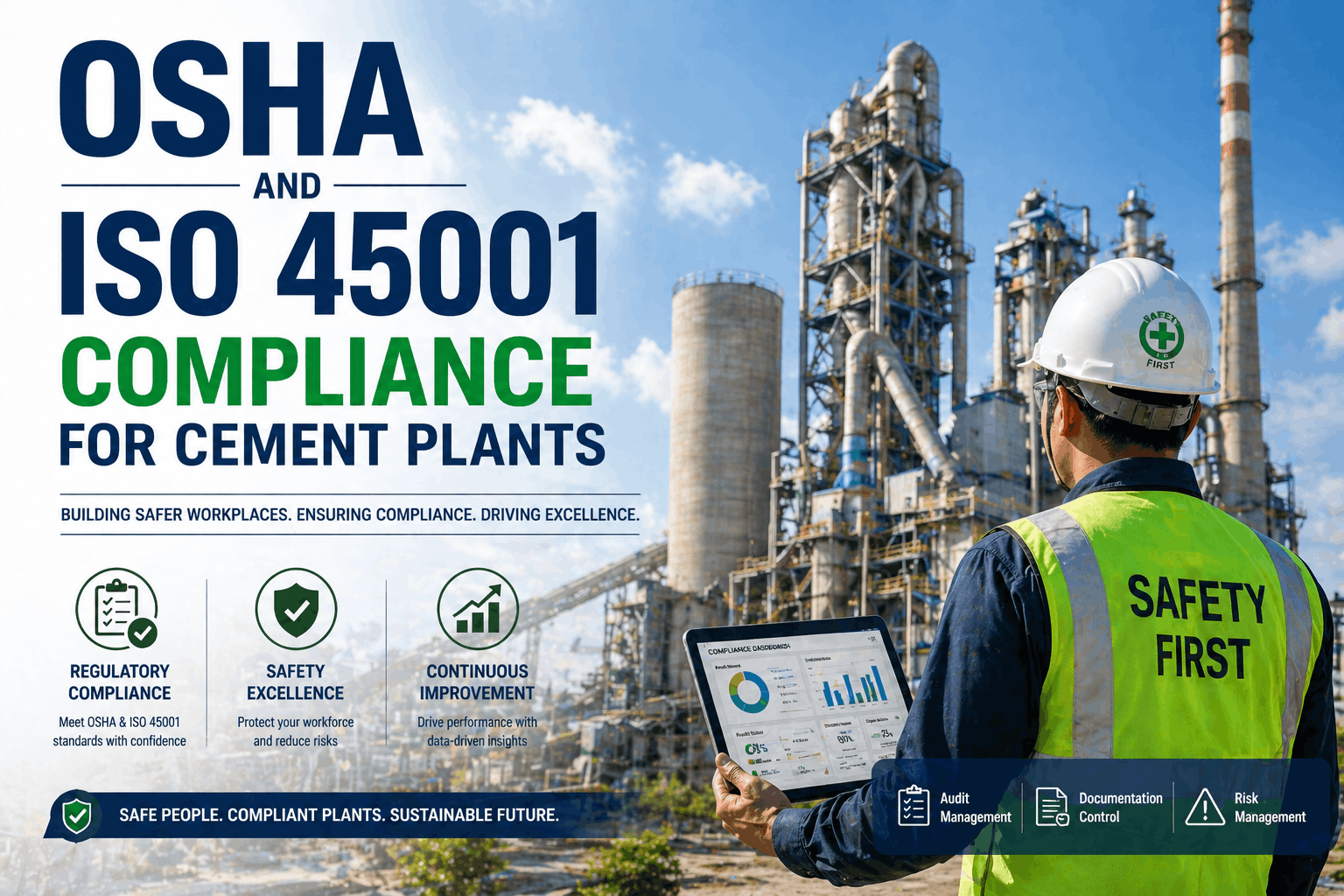
For cement producers, navigating the dual requirements of OSHA mandatory standards and ISO 45001 voluntary management systems is a significant operational burden. Between the strict enforcement of respirable crystalline silica (RCS) limits and the systemic demands of occupational health and safety (OHS) governance, the risk of non-compliance has never been more costly. In 2026, leading cement plants are moving beyond reactive audit preparation toward Autonomous Compliance Governance. By digitizing the legal register and automating corrective action tracking, these facilities are transforming compliance from a periodic hurdle into a continuous, data-driven competitive advantage. Book a demo to see how iFactory's compliance platform ensures 100% audit readiness.
Is Your Compliance Program Truly Audit-Ready?
Unify your regulatory legal register, internal audits, and corrective action plans into one intelligent compliance platform built for the cement industry.
The Synergy of OSHA & ISO 45001: Building a Resilient Safety Culture
While OSHA defines the "minimum" legal requirements for safety in the United States, ISO 45001 provides the "how-to" for building a sustainable management system. In a cement plant, this synergy is critical for managing high-risk areas like quarry faces, high-voltage grinders, and preheater towers. Modern compliance platforms bridge the gap between these frameworks by providing a central "Digital Evidence Locker." When HSE directors schedule a compliance audit, they move from "Hunting for Files" to "Presenting Data," reducing audit duration by up to 50%.
Digital Legal Register
Centralize all applicable OSHA/MSHA standards and ISO clauses. Receive automated alerts when regulations change, ensuring your internal SOPs are always up-to-date with current laws.
Automated Audit Scheduling
Replace manual spreadsheets with an automated audit calendar. Systematically track internal inspections across multiple sites to ensure 100% coverage of ISO performance requirements.
Non-Conformance Tracking (NC)
Instantly log audit findings and link them to automated corrective action plans. Monitor the closure rate of non-conformances in real-time to prevent "Audit-Day Panic."
Always-Audit-Ready Dashboards
Present real-time compliance KPIs to external auditors and corporate leadership. Demonstrate proactive safety governance through data visualization and immutable digital logs.
Mapping Standards to Cement Plant Digital Solutions
iFactory's compliance platform is pre-configured with the specific regulatory requirements of the cement industry. From the Silica Rule to Machinery Guarding, the system enforces the correct documentation and inspection frequency for every high-risk area. Compliance leads who book a demo consistently report that our "Regulatory Mapping" feature is the key to passing multi-day certification audits.
| Standard / Regulation | Core Requirement | Cement Plant Application | Digital Solution | Priority Level |
|---|---|---|---|---|
| OSHA 1910.1053 | Silica Exposure Control | Grinding & Packing areas | Real-time Dust/IAQ Monitoring | Critical |
| ISO 45001 Cl. 8.1.3 | Management of Change (MoC) | Equipment upgrades/retrofits | Automated MoC Workflows | Critical |
| OSHA 1910.212 | Machinery Guarding | Conveyors & Drive belts | Mobile Visual Guard Audits | High |
| ISO 45001 Cl. 9.2 | Internal Audit Program | Site-wide Safety Reviews | Mobile Inspection App & RCA | High |
| OSHA 1910.1200 | Hazard Communication | Chemical/Raw Mat handling | Digital SDS Management | Standard |
— Corporate HSE Manager, Multi-Regional Cement Portfolio
5 Phases to Digitizing Your Regulatory Compliance Framework
Gap Analysis & Legal Registry Setup
Audit your current compliance posture against OSHA and ISO requirements. Map every site-specific regulation to a digital "Legal Registry."
Standardized Audit Digitization
Migrate paper audit checklists into the mobile platform. Establish standard "Passing" criteria to ensure objective safety scoring across all departments.
Non-Conformance & CAPA Automation
Activate automated Corrective and Preventive Action (CAPA) workflows. Ensure every audit finding instantly triggers a trackable task for the area lead.
Continuous Performance Evaluation
Leverage dashboards to monitor compliance health. Use AI to identify "Recurring Findings" that indicate systemic gaps in your safety management system.
Autonomous Recertification Governance
Enable a self-sustaining compliance culture. Automate reporting for regulatory bodies and maintain a perpetual, audit-ready digital evidence locker.
Critical Gaps in Legacy Compliance Management
When incident reports, audit logs, and training records sit in separate systems, HSE teams cannot build a unified view of regulatory risk.
Paper-based findings often sit in an inbox for weeks, leaving hazardous non-conformances open and exposing the plant to OSHA penalties.
During an audit, the inability to instantly prove a worker was trained for a specific task is a primary cause of major ISO/OSHA findings.
Manually compiling monthly compliance reports is prone to error, often resulting in inaccurate data being presented to corporate or regulatory bodies.
Without an automated legal register, plants often fail to adapt to new rules (like the updated Silica PEL), leading to unexpected non-compliance.
Relying on "gut feel" for audits across different sites leads to inconsistent data and an inability to benchmark safety performance objectively.
Eliminating these gaps requires more than a spreadsheet — it requires a compliance platform designed for the complexity of the cement industry. Compliance leads regularly book a demo to benchmark their program against digital-first standards.
OSHA & ISO 45001 Compliance — Frequently Asked Questions
How does the platform handle the Respirable Crystalline Silica (RCS) rule?
iFactory integrates with real-time dust sensors to monitor silica levels against OSHA's PEL (Permissible Exposure Limit). If levels exceed the limit, the system pings area leads and documents the event in your compliance log.
Can this system manage both OSHA and MSHA requirements?
Yes. The platform's flexible legal register allows you to track OSHA 1910 standards for the plant and MSHA Part 46/48 requirements for quarry operations in a single dashboard.
Does the platform automate the creation of the ISO 45001 Audit Report?
Absolutely. Once an internal audit is completed on the mobile app, the system instantly generates a formatted report including findings, photo evidence, and assigned corrective actions for your management review.
How do we track "Management of Change" (MoC) for compliance?
The system includes a dedicated MoC module. Before any equipment or process is modified, the system requires a digital sign-off from HSE leads to ensure the change maintains regulatory integrity.
What is the "Digital Evidence Locker"?
It is a secure, centralized repository for all compliance-related documents: training certificates, equipment certifications, audit reports, and corrective action histories, organized by ISO clause.
Can external auditors be given access to the system?
Yes. You can create a "Read-Only" auditor profile that gives them access to specific compliance folders and dashboards, allowing them to conduct remote or hybrid audits efficiently.
Does it support OSHA 300 log generation?
Yes. The incident management module automatically feeds data into your OSHA 300, 300A, and 301 logs, ensuring 100% accurate and timely submission to regulatory bodies.
How long does it take to implement a full ISO 45001 digital system?
Most plants can migrate their existing paper-based system to the iFactory digital platform and be "Audit-Live" within 8-12 weeks.
Modernize Your Cement Plant Compliance Program Today
Deploy a unified compliance platform that integrates OSHA standards, ISO 45001 management, and real-time audit automation — built for industrial leaders.