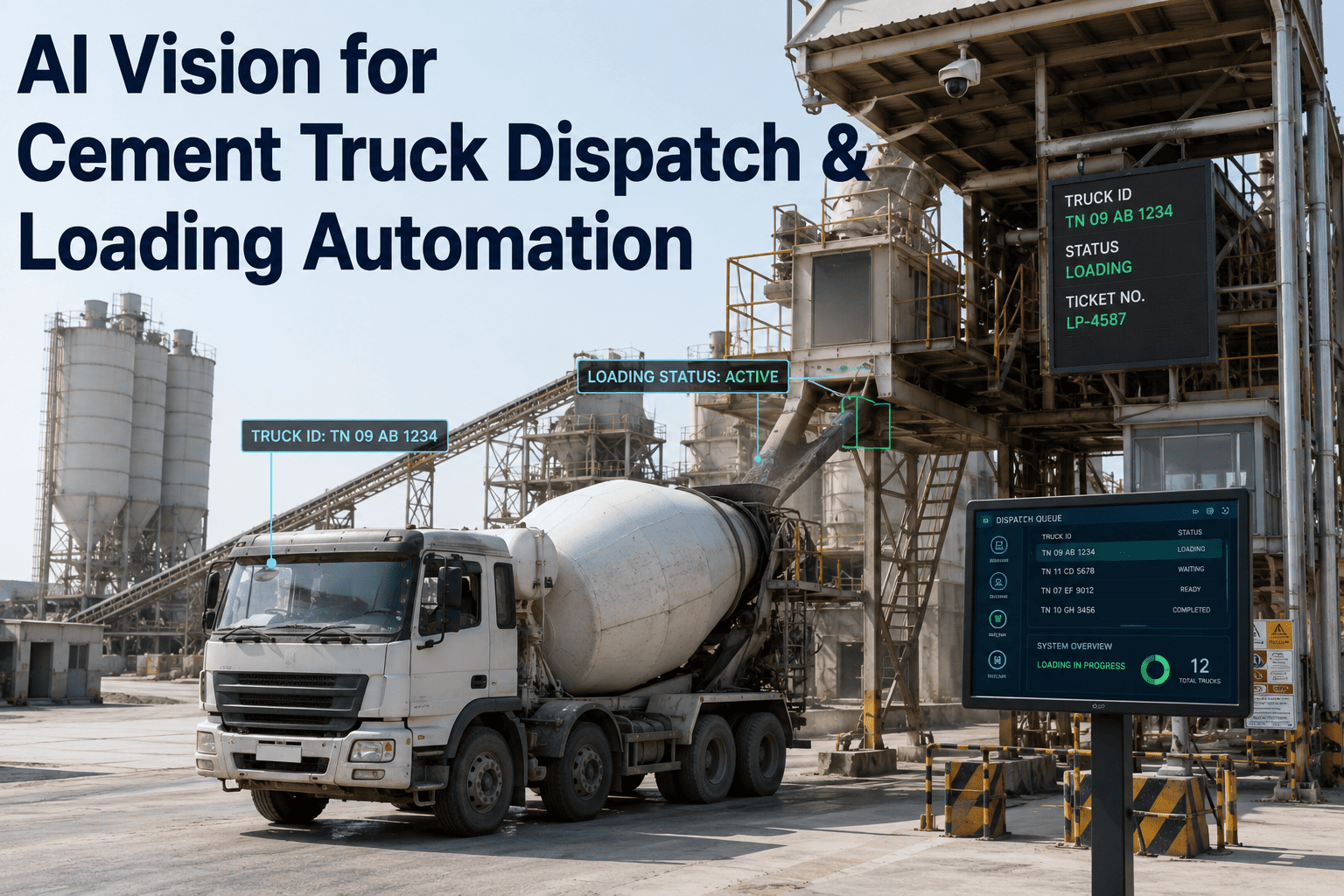
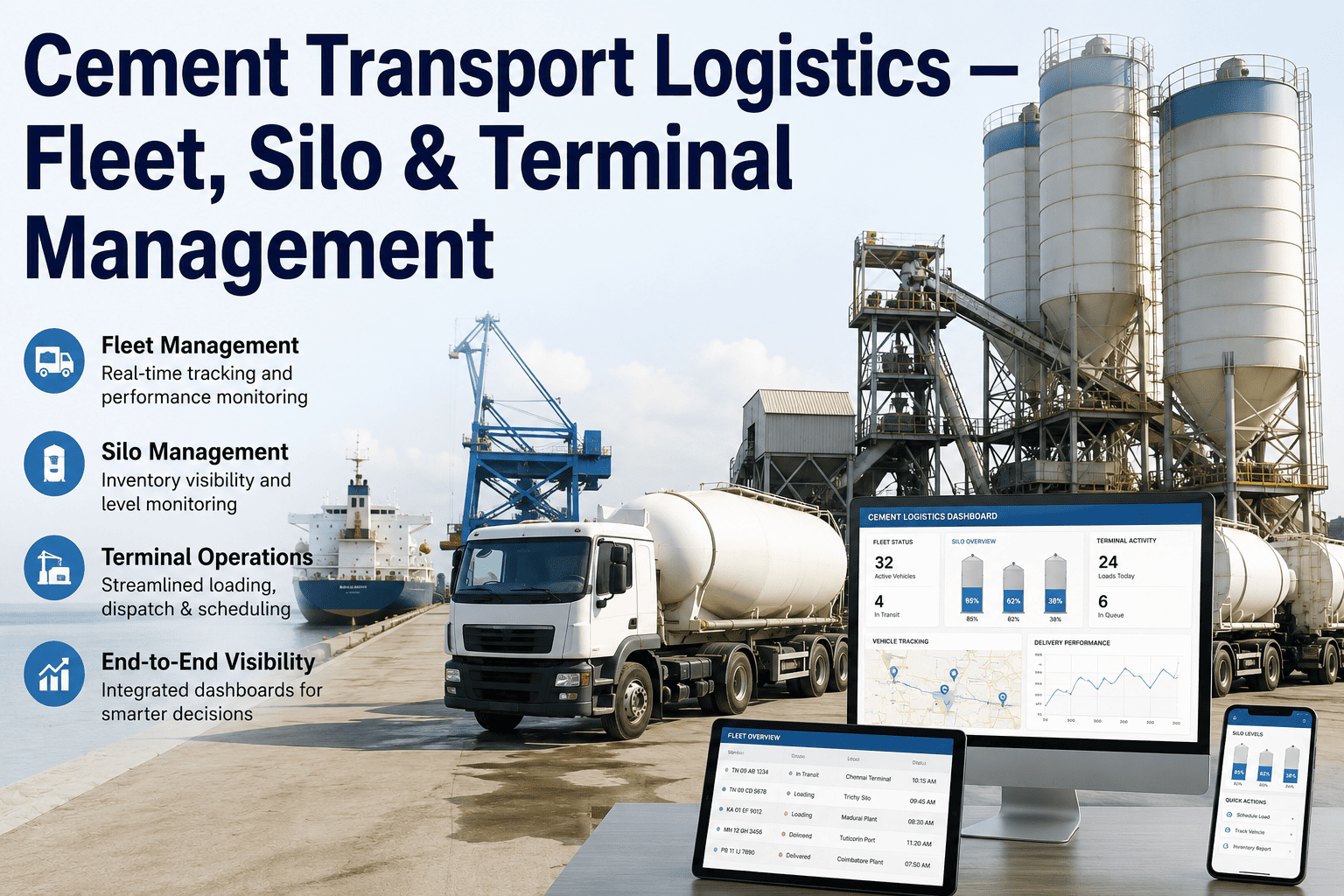
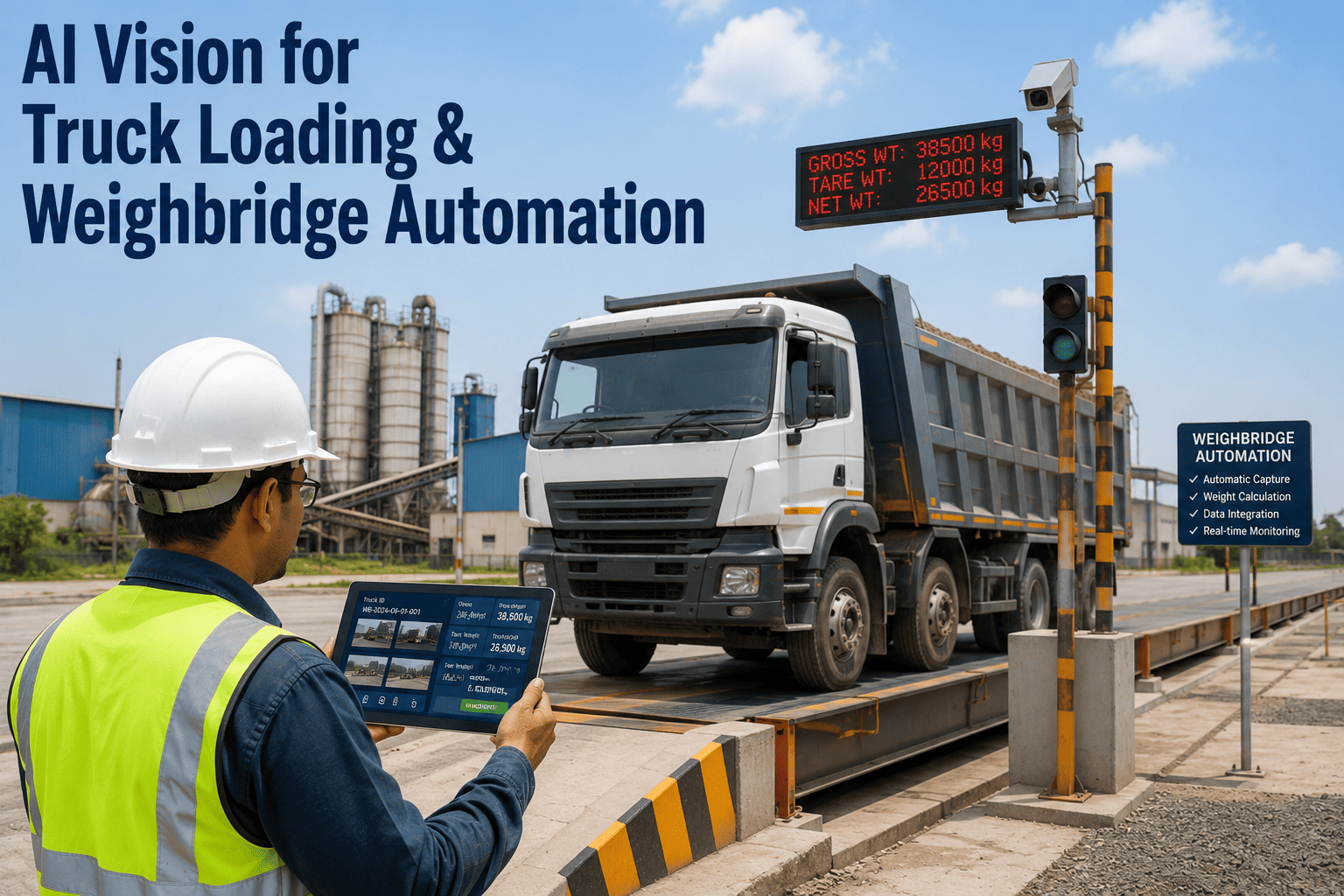
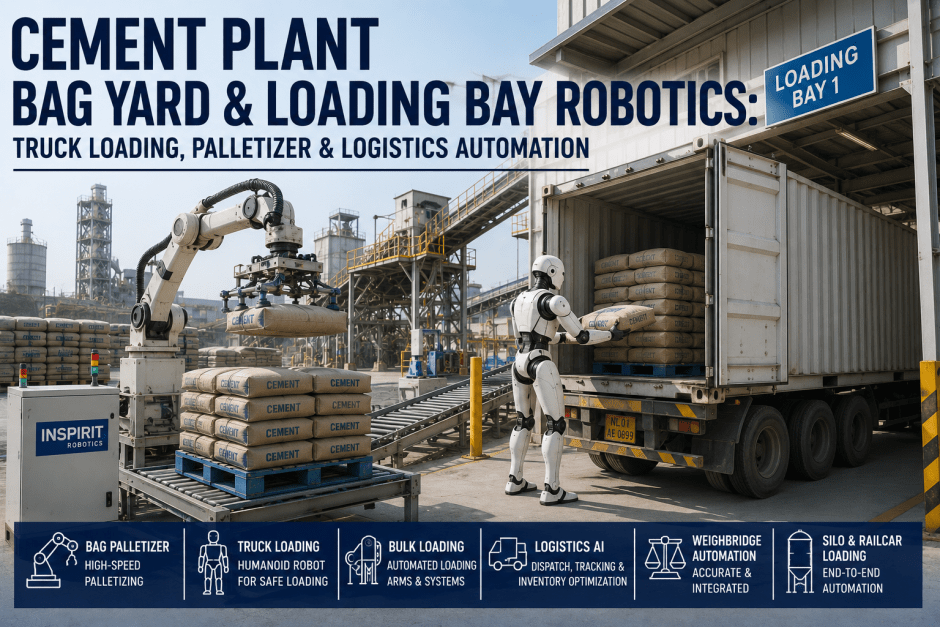
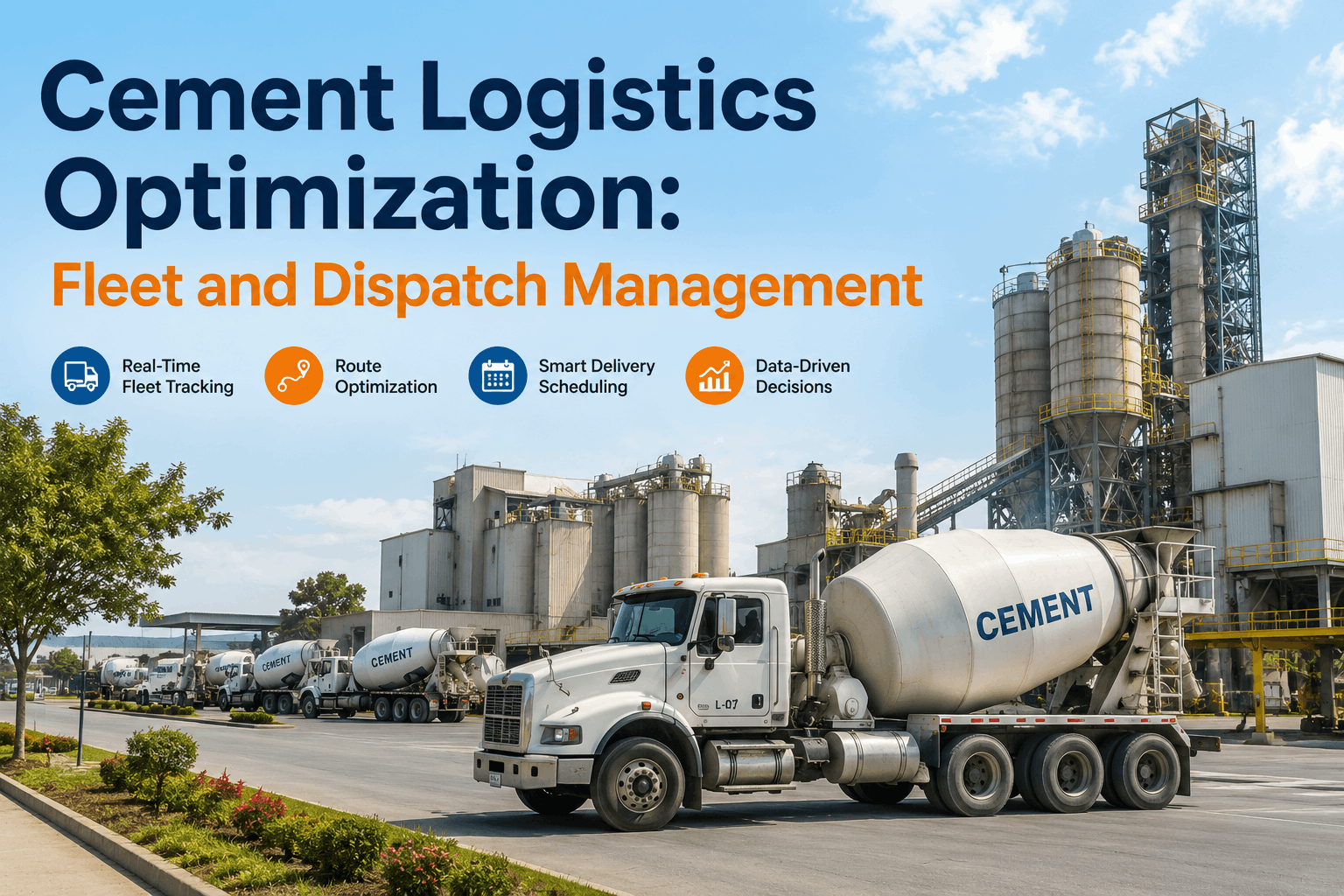
A cement truck idling outside your gate for forty extra minutes looks like a driver's problem until the detention invoice lands on your desk. A weighbridge running half a percent hot looks harmless until it quietly gives away thousands of tons of product a year at full production cost. Dispatch is the last four to six hours of a production cycle that took three or four days to complete, and most plants still run it on paper tickets, verbal bay assignments, and a security guard squinting at a number plate. Camera-based AI vision changes that by watching the truck from gate entry to gate exit and catching the errors paper never could, and you can see exactly how when you book a walkthrough of your own dispatch yard.
VISION AI · CEMENT DISPATCH & LOADING
Every truck, every silo, every ton — verified by camera before the gate ever opens.
From number plate recognition at the gate to tarpaulin checks at exit, AI vision turns dispatch from a paper log into a verified, auditable process — without adding a single person to the yard.
GATE ENTRY
→
SILO SELECT
→
LOADING
→
WEIGHBRIDGE
→
GATE EXIT
$180K–$420K
Typical annual loss at a 2,000 TPD plant from detention charges, giveaway, and rehandling combined.
Under 8 min
Achievable average dwell time per truck with camera-verified queue and bay assignment.
0.15%
Achievable giveaway rate with vision-verified, continuously calibrated weighbridge checks.
Gate to gate
Every truck tracked by number plate from entry through loading to final exit.
Where dispatch quietly bleeds margin
None of these losses show up as a single alarming number. They hide inside dispatch records as normal variation until someone reconciles weighbridge data against invoiced tonnage at the transaction level — and by then the money is already gone.
Detention Charges
Individual truck loading time can run well above the mechanical minimum at plants without digital queue and bay scheduling, and that extra time accumulates directly into driver detention invoices.
Product Giveaway
A weighbridge running even slightly above target weight on a high-volume plant gives away real product at full production cost with zero revenue — invisible until reconciled against invoiced tonnage.
Rehandling Labor
Loading errors caught only after the truck reaches the weighbridge or the customer site mean re-routing product, re-loading trucks, and paying labor twice for work that should have been right the first time.
Capped Throughput
Queue congestion at the gate and weighbridge caps effective dispatch capacity below what the plant's production rate could actually support, leaving finished product waiting behind a bottleneck that has nothing to do with the kiln.
The truck's journey through camera-verified dispatch
Every truck passes through the same six checkpoints, and a camera watches each one. No checkpoint depends on a person remembering to check it — the vision system either confirms the condition or holds the gate.
01
Gate Entry & Number Plate Recognition
A camera reads the number plate on approach and matches it against the day's booked order, confirming the right truck arrived for the right load before it enters the yard at all.
02
Silo and Bay Selection
The system checks live silo inventory and assigns the truck to the bay holding the correct product grade, then displays the assignment on a yard signal so the driver never guesses which bay to approach.
03
Loading Verification
A camera at the loading bay confirms the chute is correctly positioned over the hatch, watches for spillage or overfill, and verifies loading actually started and completed within the expected time window.
04
Weighbridge Compliance
Vision confirms the truck is correctly and fully positioned on the weighbridge platform before weight capture, preventing the partial-position readings that are one of the most common sources of inaccurate tickets.
05
Tarpaulin and Cover Check
Before gate exit, a camera confirms the tarpaulin or cover is properly fitted over bulk material, reducing road spillage and keeping the load compliant with transport regulations before it ever leaves the property.
06
Gate Exit and Digital Record
The full journey — entry time, bay assignment, loading duration, verified weight, and cover check — is written to a single digital record before the barrier lifts, ready for audit or dispute resolution.
See the six-checkpoint flow running against your own yard layout
We'll map gate entry, silo selection, loading, weighbridge, and exit checks against your current cameras and yard flow.
What the camera catches at each checkpoint
Each checkpoint has its own failure mode, and each one has historically depended on a person noticing it in real time. The table below maps the vision check to the specific risk it removes.
| Checkpoint | Vision AI check | Risk if missed |
| Gate entry |
Number plate matched to booked order |
Wrong truck loaded, order mix-ups, gate fraud |
| Silo/bay selection |
Live inventory matched to correct product grade |
Wrong grade loaded, customer complaints, rehandling |
| Loading bay |
Chute position, spillage, and duration verified |
Spillage cleanup cost, overfill, extended dwell time |
| Weighbridge |
Full and correct platform position confirmed |
Inaccurate weight tickets, product giveaway |
| Exit gate |
Tarpaulin/cover presence confirmed |
Road spillage, transport compliance violations |
Manual dispatch versus camera-verified dispatch
The difference is not just speed — it is the shift from trusting a person to remember every check, to trusting a system that cannot forget one.
Manual Dispatch
Paper tickets and verbal bay assignments with no real-time queue visibility
Weighbridge accuracy depends on correct manual positioning every single time
Tarpaulin and cover checks depend on a guard remembering to look
Dispute resolution relies on memory and incomplete paper logs
Camera-Verified Dispatch
Real-time queue position and automated bay assignment displayed to every driver
Vision-confirmed platform position before every weight capture
Every truck checked for cover compliance before the barrier lifts
Full digital record per truck, ready for audit in seconds
Frequently asked questions
Does this replace our existing weighbridge hardware?
No. Vision AI works alongside your existing weighbridge and load cells rather than replacing them, adding a camera-based position check that confirms the truck is fully and correctly placed before the weight reading is accepted. This protects the accuracy of a reading your legal metrology certification already depends on, without touching the certified equipment itself.
Book a demo to see how it integrates with a weighbridge like yours.
How does silo selection actually work with AI vision involved?
The dispatch system checks live silo inventory levels and production status, then assigns each incoming truck to the bay holding the correct product grade for its order. Vision cameras at the bay confirm the correct chute is engaged and loading proceeds against the right silo, catching the mix-ups that happen when a driver is directed verbally and simply goes to the wrong bay. The result is a loading queue that reflects what is actually available rather than what dispatch assumes is available.
Contact our support team to see how silo data feeds into the dispatch queue.
What actually causes product giveaway, and how does vision reduce it?
Giveaway most often comes from weighbridges that are technically functioning but reading slightly high due to positioning drift or minor calibration slip that goes unnoticed for months. Vision AI confirms full and correct truck positioning before every weight capture, removing one of the most common sources of positional error, and continuous monitoring flags calibration drift before it accumulates into meaningful lost tonnage. On a high-volume plant this difference adds up to real recovered margin over a year.
Book a demo to see a giveaway reconciliation example.
Can this integrate with our existing ERP and dispatch software?
Yes, camera-based dispatch verification is designed to sit alongside your existing ERP and dispatch software as a verification layer rather than a replacement system. Truck identification, loading confirmation, weight data, and gate exit records feed into your existing systems so dispatch, accounting, and logistics all see the same verified data instead of reconciling separate paper and digital records after the fact.
Contact our support team for an integration map specific to your ERP.
How long does it take to deploy across a full dispatch yard?
A typical single-yard deployment covering gate entry, silo/bay assignment, loading verification, weighbridge, and exit checks runs six to ten weeks depending on the number of cameras and gates involved and how much integration the existing ERP requires. Early weeks cover camera installation and calibration against real truck traffic, followed by a shadow-mode period where the system verifies without holding the gate, before moving to full live enforcement.
Book a demo to scope a deployment timeline for your yard.
Turn your dispatch yard into a verified, auditable process
iFactory watches every truck from gate entry to gate exit — number plate, silo, loading, weighbridge, and cover check — in one connected system.