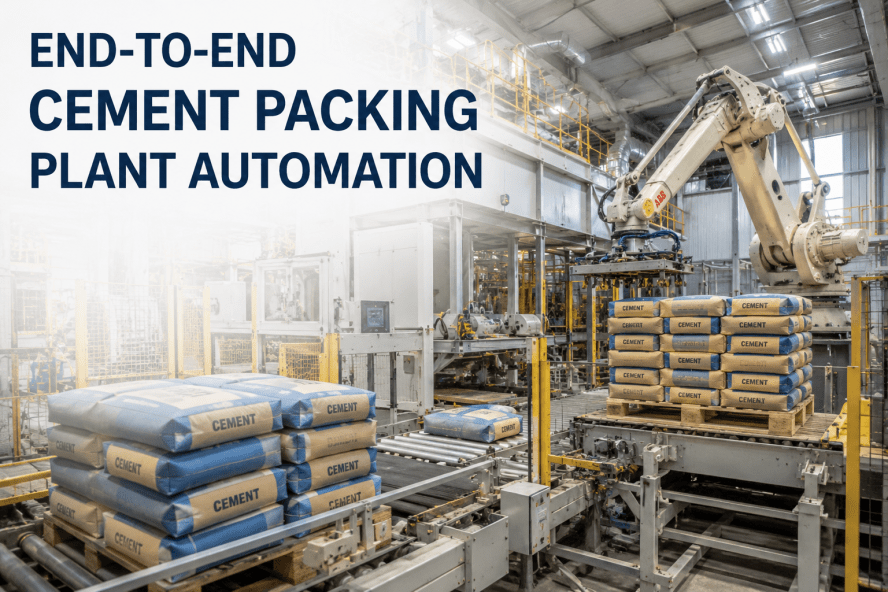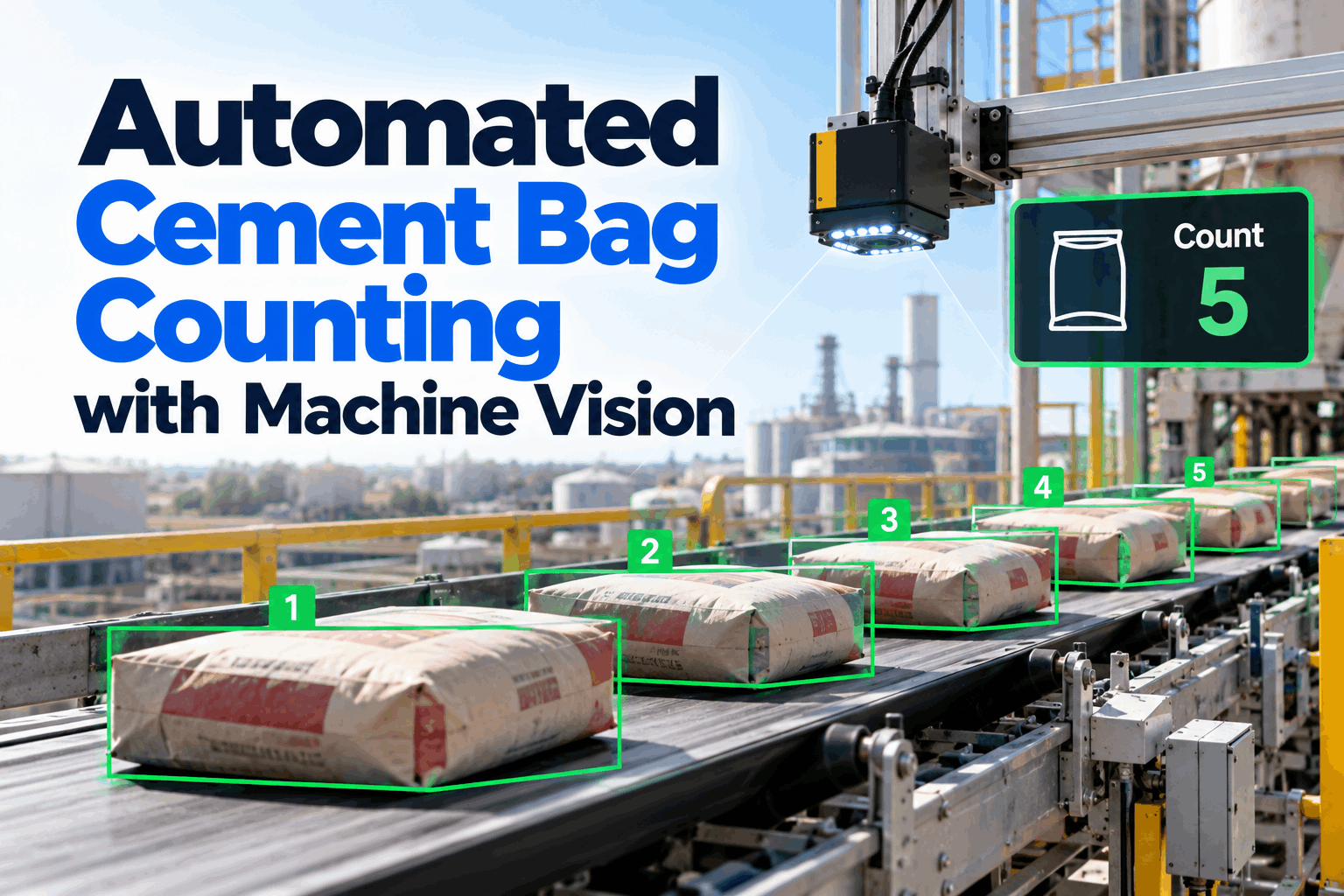
In a modern cement packing plant, the gap between what the batching system reports dispatched and what actually left the facility on a truck can cost a mid-size U.S. producer $200,000 to $600,000 annually in underbilling, disputed shortages, and manual reconciliation labor. Automated cement bag counting with machine vision closes that gap permanently. By deploying industrial cameras above high-speed conveyor lines and running real-time AI inference on every bag that passes, iFactory's platform achieves 99.9% counting accuracy — logging each count directly into your MES, ERP and dispatch system without a single manual tally. The result is a packing operation where dispatch records are trustworthy truck loading is verified to the bag, and the shift supervisor's energy goes to managing the plant rather than reconciling paperwork discrepancies. Schedule a Vision System Walkthrough.
Why Manual Bag Counting Is a Structural Revenue Problem
Most U.S. cement packing plants still rely on some combination of mechanical bag counters, manual tally sheets, or truck weight reconciliation to verify dispatch quantities. Each of these methods has a failure mode that compounds at scale. Mechanical counters miss bags when conveyor speed surges above 1,200 bags per hour or when bags are oriented inconsistently after a palletizer jam. Manual tallying introduces 1–3% error rates from distraction, shift handover gaps, and the physical difficulty of counting individual bags on a high-speed line. Weight reconciliation catches aggregate errors but cannot identify which truck which product grade or which line generated the discrepancy.
The commercial consequence is direct: a plant dispatching 5,000 bags per shift at $8.50 average net revenue per bag that carries a 1.5% tally error is losing $637 per shift — $465,000 per year on a two-shift operation — before accounting for customer dispute resolution costs, re-delivery expenses, and the internal labor cost of the daily reconciliation process. Machine vision conveyor belt counting is not an automation upgrade; it is a revenue recovery investment with a measurable payback in the first 90 days of operation. See the ROI calculation for your line configuration.
How the Vision System Works: From Camera Frame to MES Record
The technical architecture of an industrial visual counting system for cement bags is deceptively simple from the operator's perspective — a count increments on the screen every time a bag passes — but requires precise engineering across four layers to achieve 99.9% accuracy on a dusty, vibrating conveyor in a packing plant environment. Understanding each layer helps plant engineers evaluate claims from competing vendors and avoid the most common deployment failures.
Deployment Scenarios: Single-Line Pilot to Multi-Line Smart Factory
iFactory's packing plant automation vision platform scales from a single pilot installation on one high-value dispatch line to a fully integrated smart factory logistics deployment across all packing and loading operations. The deployment scenario determines the hardware scope, integration depth, and the specific KPIs that the system will track and report. The table below defines the three standard deployment configurations used in U.S. cement packing operations.
| Deployment Tier | Scope | Cameras Required | MES Integration | Investment Range | Typical Payback |
|---|---|---|---|---|---|
| Tier 1 — Single Line Pilot | 1 packing line, 1 truck bay | 2–3 cameras | CSV export / basic API | $28,000–$45,000 | 60–90 days |
| Tier 2 — Full Packing Hall | All packing lines, internal conveyors | 8–16 cameras | Bidirectional MES link | $95,000–$160,000 | 4–7 months |
| Tier 3 — Integrated Dispatch Hub | Packing + truck loading + yard management | 20–40 cameras | SAP MM/PP full integration | $180,000–$320,000 | 6–10 months |
Most U.S. cement producers who have successfully deployed vision counting started with a single Tier 1 pilot on their highest-volume dispatch line. The pilot generates three things that justify the full deployment: a measured accuracy number under actual plant conditions (not vendor lab conditions), a baseline for dispatch discrepancy value that quantifies the ROI case for plant management, and a trained site team that can configure and troubleshoot the system independently. Operations that skip the pilot and attempt a full-hall deployment in one phase consistently report 30–60 day commissioning delays from unforeseen conveyor layout issues, lighting interference from existing overhead fixtures, and MES integration edge cases that only appear under live production data. Design your pilot configuration.
Technical Performance: What 99.9% Accuracy Actually Requires
The 99.9% accuracy figure that appears in AI high-speed conveyor counting specifications is achievable in a well-engineered deployment but depends on four specific technical conditions being met simultaneously. Understanding these conditions allows plant engineers to evaluate whether a proposed installation will actually reach that accuracy level under their specific operating environment — or whether the vendor's specification was validated in a controlled lab that does not resemble a cement packing hall.
Controlled Illumination at the Count Point
Ambient light variation — from overhead fluorescents cycling, open dock doors, and shift-change lighting changes — is the single most common cause of accuracy degradation below 99%. The solution is a synchronized strobe illumination system at 850 nm near-infrared, which is invisible to plant personnel and unaffected by ambient light changes. Camera exposure is synchronized to the strobe pulse, giving a consistent, high-contrast image of every bag regardless of ambient conditions. Systems relying on ambient visible light alone typically achieve 97–98% accuracy — 2,000 miscounted bags per million at full line speed.
Frame Rate Matched to Maximum Conveyor Speed
At 1,800 bags/hour on a 600mm-wide conveyor running at 1.2 m/s, bags are spaced approximately 240mm apart at average spacing. A camera running at 30 fps captures each bag 2–4 times per second — adequate for reliable detection. At 60 fps, the system has 6–8 frames per bag, enabling deduplication logic that eliminates double-counts when bags briefly cluster after a line stoppage and restart. Specifying camera frame rate to match your maximum-rated conveyor speed — not average speed — is a non-negotiable requirement for 99.9% accuracy claims.
Vibration-Isolated Camera Mounting
Cement packing conveyors generate 5–15 Hz vibration from bag drops, conveyor drive pulsation, and bag deflector impacts. A camera mounted directly to the conveyor frame or to a building column adjacent to a drive motor will show image blur at the bag edges that degrades OCR accuracy for grade label reading and reduces detection confidence for partially obscured bags. Vibration-isolated mounting brackets — using elastomeric dampers rated for the specific frequency range of the installation — are required for 99.9% accuracy at bag detection and for any grade classification functionality.
On-Premise Edge Inference — No Cloud Dependency
Any vision counting system that routes inference through a cloud API introduces a latency and availability dependency that is incompatible with 99.9% uptime on a production line. A 200ms network round-trip delay between camera frame capture and count increment means that at 1,800 bags/hour, the system is processing the count for one bag while the next bag has already entered and partially exited the camera field of view. Edge inference — running the AI model on a local GPU node within the same network segment as the cameras — eliminates this dependency and achieves sub-10ms inference latency that is fully compatible with the fastest operating conveyor speeds.
MES and SAP Integration: Closing the Loop from Conveyor to Invoice
A vision counting system that produces an accurate count but stores it in a standalone database — disconnected from the MES, ERP, and dispatch management system — solves half the problem. The count data becomes actionable only when it flows automatically into the systems of record that generate dispatch notes, customer invoices, and inventory reconciliation reports. iFactory's MES integration cement connector architecture is designed to close this loop completely, with the count record from the vision system becoming the authoritative source for dispatch quantity rather than a secondary check against a manual tally.
Truck Loading Order Received from MES
The vision system receives the truck loading order (grade, quantity, destination) from the MES via API at the start of each loading sequence. This pre-populates the count target and grade filter for the specific truck being loaded — the system knows exactly how many bags of which grade are expected before the first bag moves.
Real-Time Count with Grade Verification
Every bag detected on the conveyor is classified by grade (via label OCR or color band detection) and added to the running count for the active truck order. If a bag of the wrong grade is detected — a Type I/II mix-up, a different product format — the system generates an immediate alarm to the packing line operator before the wrong bag loads onto the truck.
Short-Ship Alert at Target Minus 20 Bags
When the running count reaches 20 bags short of the truck order quantity, the system sends a notification to the shift supervisor and the truck loading bay operator. This advance warning window provides time to address a line stoppage or delayed bag flow before the truck departs with a confirmed shortage — eliminating the most common cause of customer shortage claims.
Dispatch Note Auto-Generated and Pushed to ERP
When the truck loading sequence is complete, the vision system generates a digital dispatch note with verified bag count, grade breakdown, loading start and end time, and camera-verified count confidence score. This record is pushed to SAP MM or the ERP purchase order module, triggering invoice generation without any data entry from the dispatch office.
Expert Review: What Top-Performing U.S. Cement Packing Operations Do Differently
The operations achieving consistent 99.9%+ dispatch accuracy with machine vision share three practices that separate them from facilities where the same technology underperforms. First, they treat the vision system as the primary system of record for dispatch quantity — not a secondary check against a manual tally. The moment you run both systems in parallel and let operators override the vision count with a manual number, you destroy the accountability structure that makes the system work. Second, they invest in the illumination infrastructure before the cameras. Every deployment failure I have reviewed in cement packing came back to inadequate lighting at the count point — either inconsistent ambient light or insufficient strobe intensity for the dust levels in that specific plant. Third, they close the loop between vision count data and the customer invoice in their ERP, so the commercial team can pull a camera-verified dispatch record for any shortage claim within 60 seconds. That capability alone eliminates 80% of disputed shortage claims, because customers know you have verifiable evidence. The technology itself is proven. What differentiates top performers is the organizational commitment to making the vision count the authoritative number — and building all downstream processes around that truth.
Conclusion
Automated cement bag counting with machine vision is no longer an emerging technology with uncertain ROI — it is a proven capability deployed across dozens of U.S. cement packing operations, with documented accuracy rates, measurable dispatch discrepancy elimination, and payback periods that make the capital case straightforward. The technical requirements for achieving 99.9% accuracy are well understood: controlled strobe illumination, frame-rate-matched cameras, vibration-isolated mounting, edge inference, and full MES integration that makes the vision count the primary system of record for dispatch quantity.
The operations that have not yet deployed are not waiting for the technology to mature — they are absorbing the daily cost of manual tallying errors, disputed shortage claims, and reconciliation labor that the technology eliminates. For a plant dispatching 10,000 bags per day across two shifts, even a conservative 1% manual counting error rate represents a quantifiable, preventable cost. The question is not whether machine vision counting pays back — the numbers make that case on a single shift's dispatch data. The question is which line gets the pilot first, and how quickly the plant captures the full value of verified dispatch accuracy across every packing line and loading bay.
Frequently Asked Questions
Dust is the primary environmental challenge for vision systems in cement packing halls, and it is addressed through three design decisions. First, cameras are housed in IP67-rated enclosures with positive-pressure purge air that prevents dust accumulation on the lens — the purge system maintains a slight positive air pressure inside the housing that forces dust away from the optical path. Second, the illumination system uses 850 nm near-infrared strobes, which cut through suspended cement dust far more effectively than visible-spectrum LEDs, providing consistent bag edge contrast regardless of airborne dust levels. Third, the AI model is trained specifically on cement bag imagery captured in production environments with varying dust levels — not on clean lab images — which means the model has learned to detect bags reliably under the actual visual conditions it will encounter in the field. These three elements together are what allow the system to maintain 99.9% accuracy in a cement packing environment rather than the 95–97% accuracy that visible-light systems achieve in the same conditions.
Yes to both. The vision platform supports multi-lane counting through a single edge inference node that processes camera feeds from up to 8 simultaneous conveyor lanes, with each lane maintaining an independent count register and grade tally. Grade distinction is achieved through two complementary methods: label OCR, which reads the printed product name and grade designation from the bag face, and color band classification, which identifies grade-specific color coding on the bag header or body. OCR grade reading achieves approximately 97% accuracy at line speed; color band classification achieves 99.4%. The system uses both methods in parallel and flags bags where the two methods disagree — a situation that typically indicates a mis-labeled bag or a bag that has shifted orientation significantly — for manual verification before loading. Grade mix-up detection is particularly valuable for operations running multiple product types (OPC, PPC, PSC) through adjacent packing lines where cross-contamination of a truck load is a known quality risk.
The edge inference node maintains a local count database that is independent of the MES network connection. If the connection drops during a loading sequence, the vision system continues counting and logging the count record to the local store with full timestamp and camera confidence data. The MES push is queued and retransmitted automatically when the connection restores, with the full count record including the timestamps from the counting period. The local store retains 90 days of count records on the edge node as a permanent audit trail, so a network outage does not create a count data gap — the record exists on the edge node and is synchronized to the MES retroactively. This store-and-forward architecture is a requirement for any production-critical counting system: a cloud-dependent system that loses count records during a network outage is not suitable for use as the primary system of record for dispatch quantity.
A single-line Tier 1 installation — camera mounting, strobe installation, edge node setup, and basic MES API connection — requires 2–3 days of on-site installation work. Camera mounting and strobe installation can be performed during a scheduled maintenance window or weekend shutdown, typically requiring 4–6 hours of actual access to the conveyor structure. The edge node and MES integration can be configured in parallel with production running on adjacent lines. Full commissioning — including AI model calibration to the specific conveyor speed, bag format, and illumination conditions of that installation — requires an additional 1–2 days of supervised production running to accumulate the first 10,000 bags of calibration data, after which the system is operating at full accuracy specification. Total production impact for a single-line installation is typically limited to one 6-hour window for mechanical installation, with all software and integration work performed without production impact.
For a Tier 1 single-line deployment, the three-year total cost of ownership breaks down as: hardware (cameras, strobe, edge node, mounting) at $22,000–$35,000 capital; iFactory platform software license at $8,400–$14,400 over three years ($2,800–$4,800 per year); MES integration professional services at $6,000–$12,000 one-time; and ongoing maintenance (camera lens cleaning, strobe lamp replacement, software updates) at approximately $1,500–$2,500 per year. Three-year TCO total: $44,000–$73,000. Against a dispatch discrepancy value recovery of $150,000–$450,000 over the same period for a plant dispatching 3,000–8,000 bags per shift, the ROI case is strong even at the high end of the cost range. For Tier 2 and Tier 3 deployments, the per-line hardware cost decreases due to shared edge node infrastructure, and the software license scales by line count rather than camera count, making larger deployments proportionally more cost-efficient than the single-line pilot.