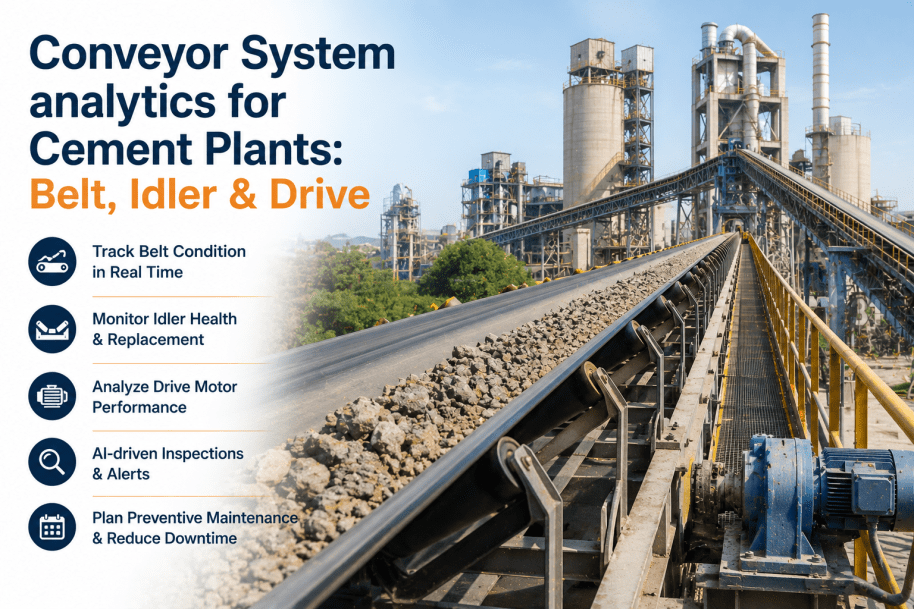
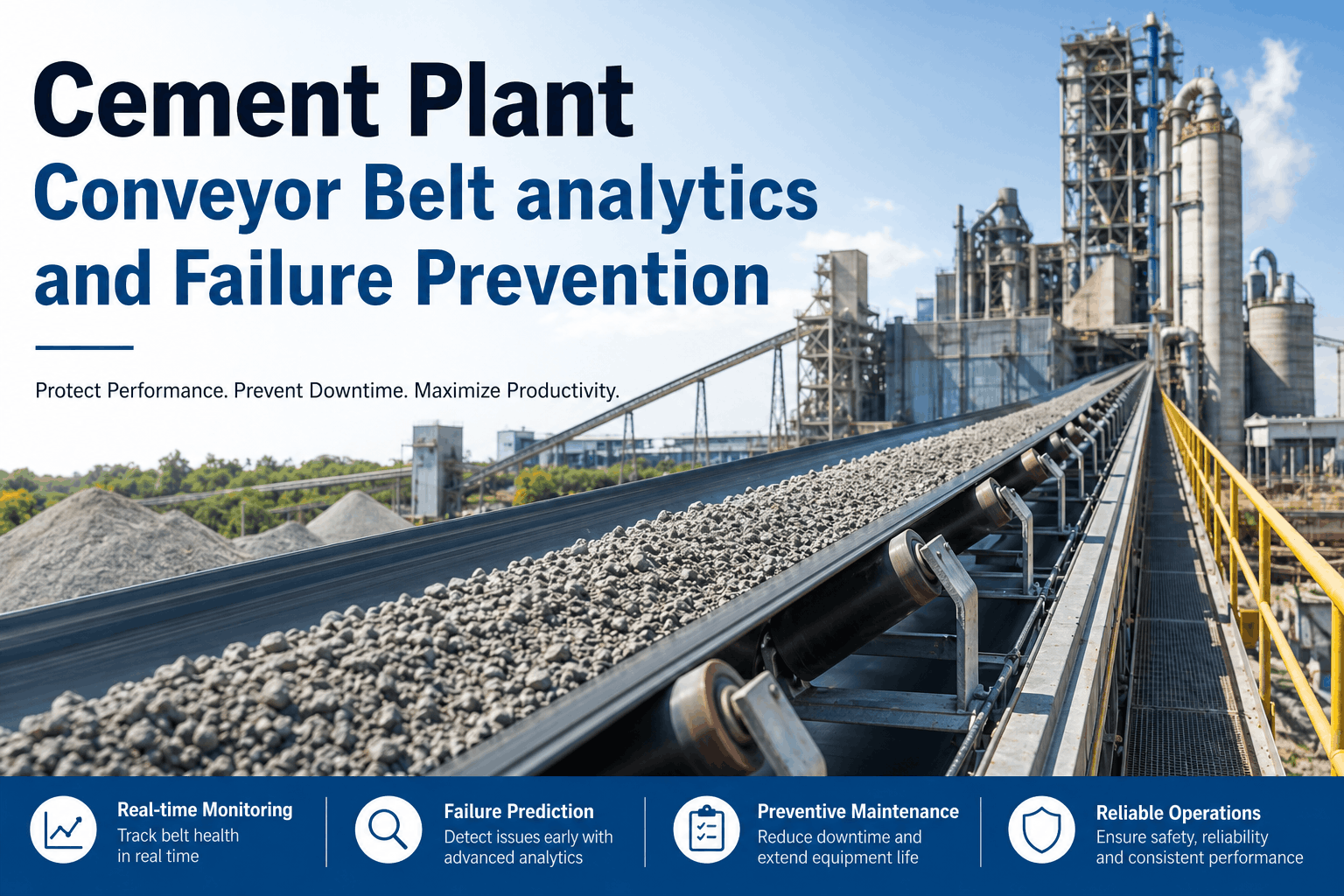
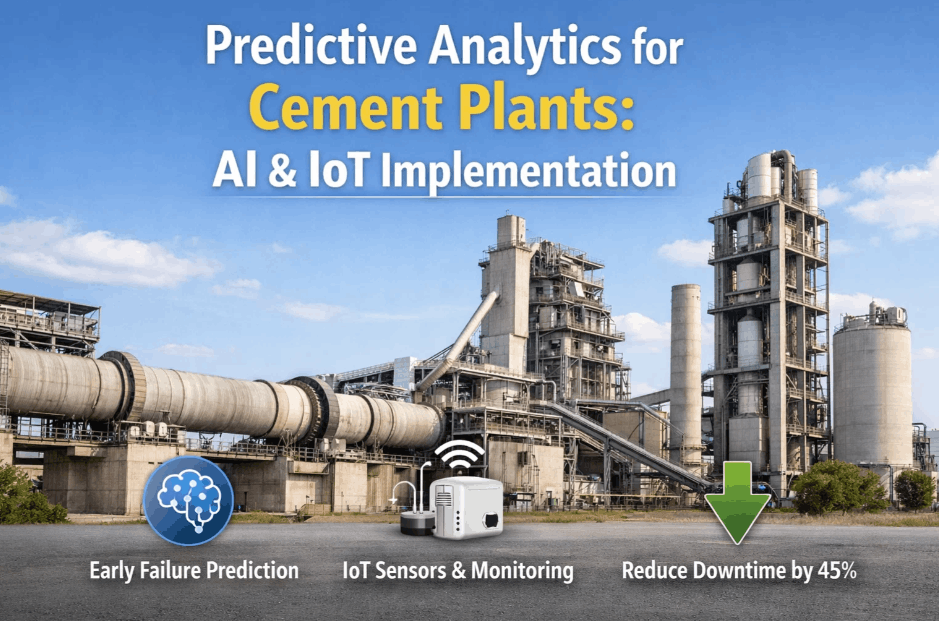
A cement plant's conveyor network is its circulatory system. Limestone from the quarry, raw meal to the preheater, clinker from the cooler, finished cement to the silo — every ton passes through conveyors multiple times before it leaves the plant. A typical cement facility runs 5 to 15 kilometers of conveyor belt across dozens of systems, all operating 24/7 through conditions that destroy equipment: abrasive clinker dust that infiltrates everything, ambient temperatures exceeding 200°C near the kiln, and loads that never stop. Yet most plants still manage this critical infrastructure with scheduled walkarounds and reactive repairs. Your maintenance team walks the belt line for 20 minutes and catches what's visible. An AI camera monitors that same conveyor 86,400 seconds per day and catches what the human eye cannot.
Cement Plant Conveyor Intelligence
Your Cement Plant Runs on Conveyors. Do You Actually Know Their Health Right Now?
AI vision and predictive analytics that monitor every belt, roller, and motor in your cement plant — detecting wear, misalignment, and failure patterns weeks before breakdowns stop production
45-55%
Reduction in unplanned stops within first year
95%+
Accuracy in anomaly detection with AI vision
4-8 wks
Early warning before conveyor failure occurs
The Cement Conveyor Problem Nobody Talks About
Every cement plant knows their kiln is the most expensive asset. So that's where monitoring investment goes. But kilns don't run without conveyors feeding them. And when the conveyor network fails, the kiln sits idle at a cost of $50,000 to $200,000 per unplanned stop. The reality is that conveyor failures cascade faster and more unpredictably than kiln issues — and they get a fraction of the monitoring attention.
Where Conveyors Sit in Your Cement Process — And What Happens When Each One Fails
Quarry to Crusher
Limestone, clay, shale
Impact damage from oversized rocks, extreme abrasion from raw stone. Failure starves the entire plant of raw material.
Full plant stoppage
Raw Material to Raw Mill
Crushed limestone, additives
Material buildup and carryback from sticky blends. Mistracking from uneven loading patterns creates edge wear and spillage.
Raw mill feed disruption
Raw Meal to Preheater
Fine raw meal powder
Dust accumulation on rollers and idlers causes seizure. Belt tension anomalies from fine powder buildup on return side.
Kiln feed interrupted
Clinker Cooler to Silo
Hot clinker, 100-200°C
Extreme thermal stress on belt material. Heat-resistant belts degrade faster. Thermal deformation of idler bearings accelerates wear.
Clinker storage bottleneck
Gypsum & Additive Feed
Gypsum, slag, fly ash
Corrosive and abrasive additives accelerate surface degradation. Moisture-related belt slip in outdoor sections.
Cement mill ratio disrupted
Finished Cement to Packing
Fine cement powder
Cement dust infiltrates every bearing and roller. Packing line stops if feed conveyor fails — dispatch and revenue halt immediately.
Dispatch stops, revenue lost
Every one of these conveyor zones has different failure patterns. AI monitors each one differently. See how it works for your layout.
How AI Vision Works on Cement Plant Conveyors
Your plant already has cameras. Dozens of them — mounted on walls, pointed at conveyors. But those cameras are just recording. Nobody watches 90% of that footage until after something breaks. AI vision turns existing cameras into intelligent monitoring systems that detect problems at the pixel level, 24 hours a day.
What AI Vision Detects
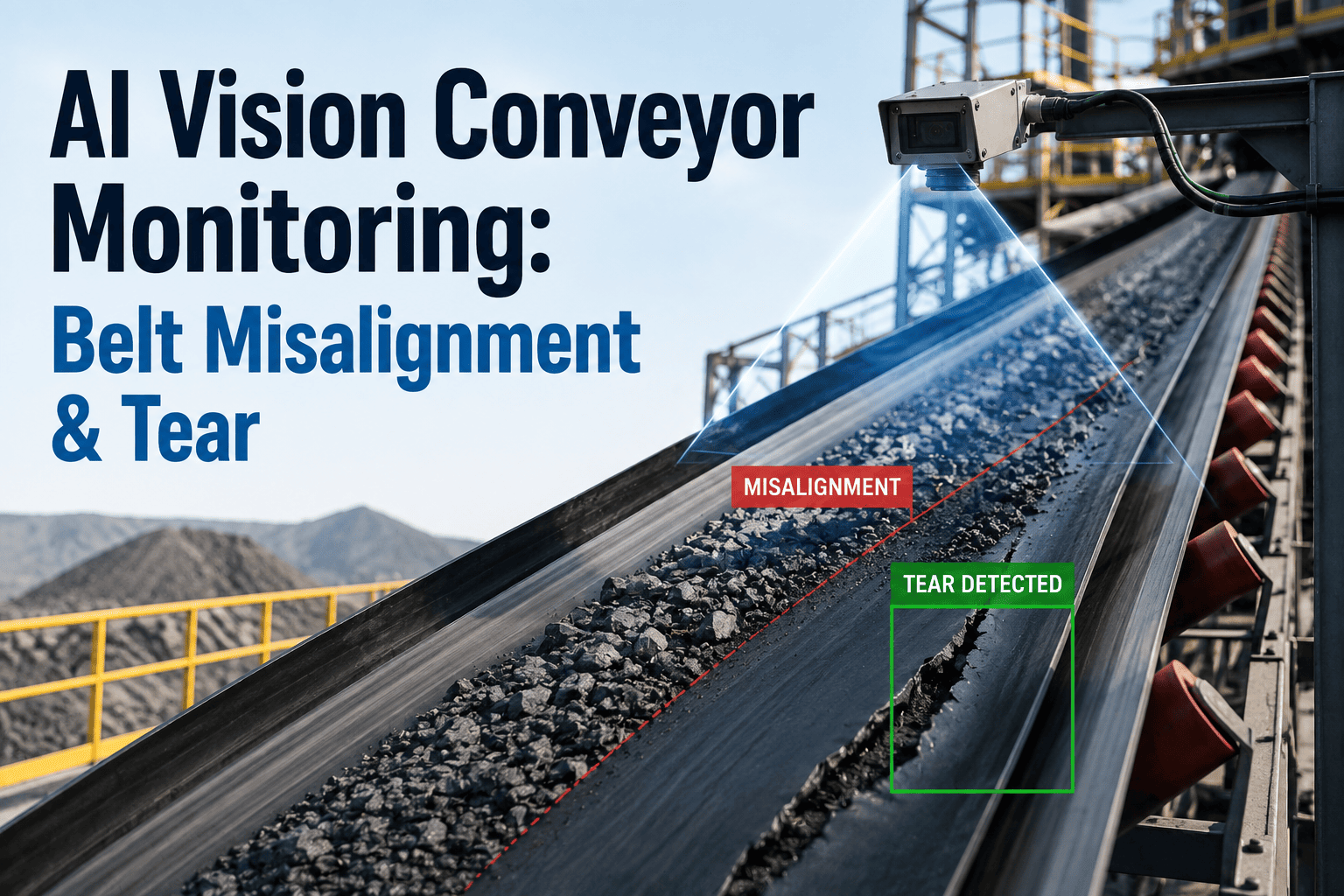
Surface Cracks & Tears
Hairline cracks invisible to walkaround inspections are detected from belt surface analysis at full speed. AI tracks crack growth rate to predict when intervention is needed.
Belt Misalignment & Drift
Visual analysis of belt tracking in real time detects lateral drift before edge damage occurs. Pattern recognition identifies whether the cause is idler misalignment, load imbalance, or belt stretch.
Material Buildup & Carryback
Detects material accumulation on return-side belts, chutes, and rollers that causes drag, accelerates wear, and leads to belt damage if not cleaned.
Foreign Object Detection
Identifies oversized rocks, tramp metal, and debris on the belt surface before they reach transfer points and cause damage to chutes, screens, or downstream equipment.
Splice Condition Monitoring
Tracks the condition of splice joints — the number one failure point during production — detecting lift, separation, and edge peeling before catastrophic failure.
How It Works in Cement Dust
The number one concern plant engineers raise about AI cameras is dust. Cement plants generate massive particulate matter that can obscure lenses within hours. This problem has been solved.
Positive-Pressure Housings
Filtered air creates a constant barrier across the lens, preventing dust from settling even in the dustiest zones.
Automated Lens Cleaning
Scheduled wiper or air-blast cleaning cycles maintain optical clarity without manual intervention.
Thermal + Visible Dual Cameras
Thermal imaging penetrates dust clouds that obstruct visible-light cameras, maintaining monitoring even in heavy particulate conditions.
AI Dust Compensation
Deep learning models trained specifically on cement plant conditions — dust, heat shimmer, vibration — maintain 95%+ detection accuracy.
Real-Time Health Scoring: From Red/Yellow/Green to Predictive Intelligence
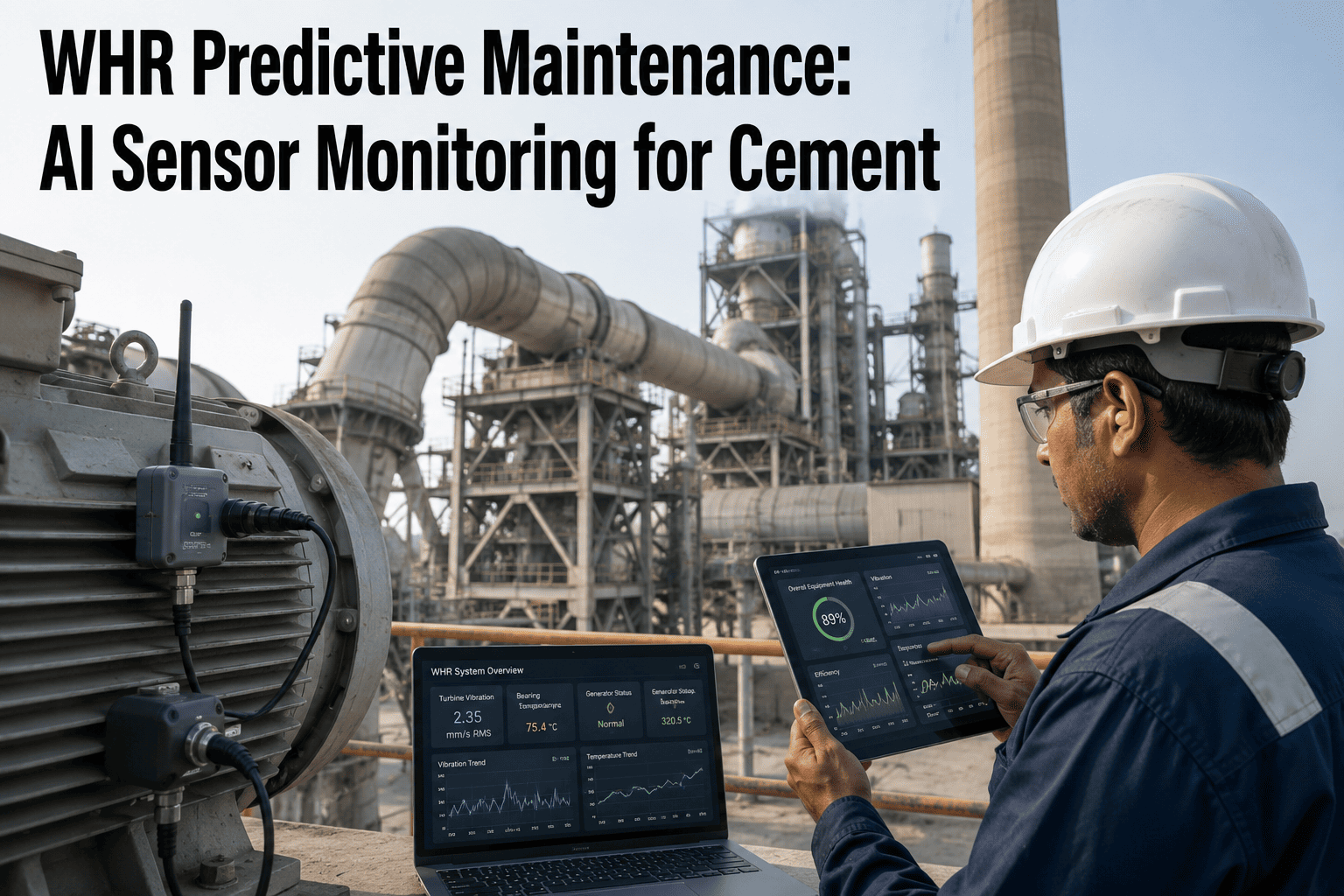
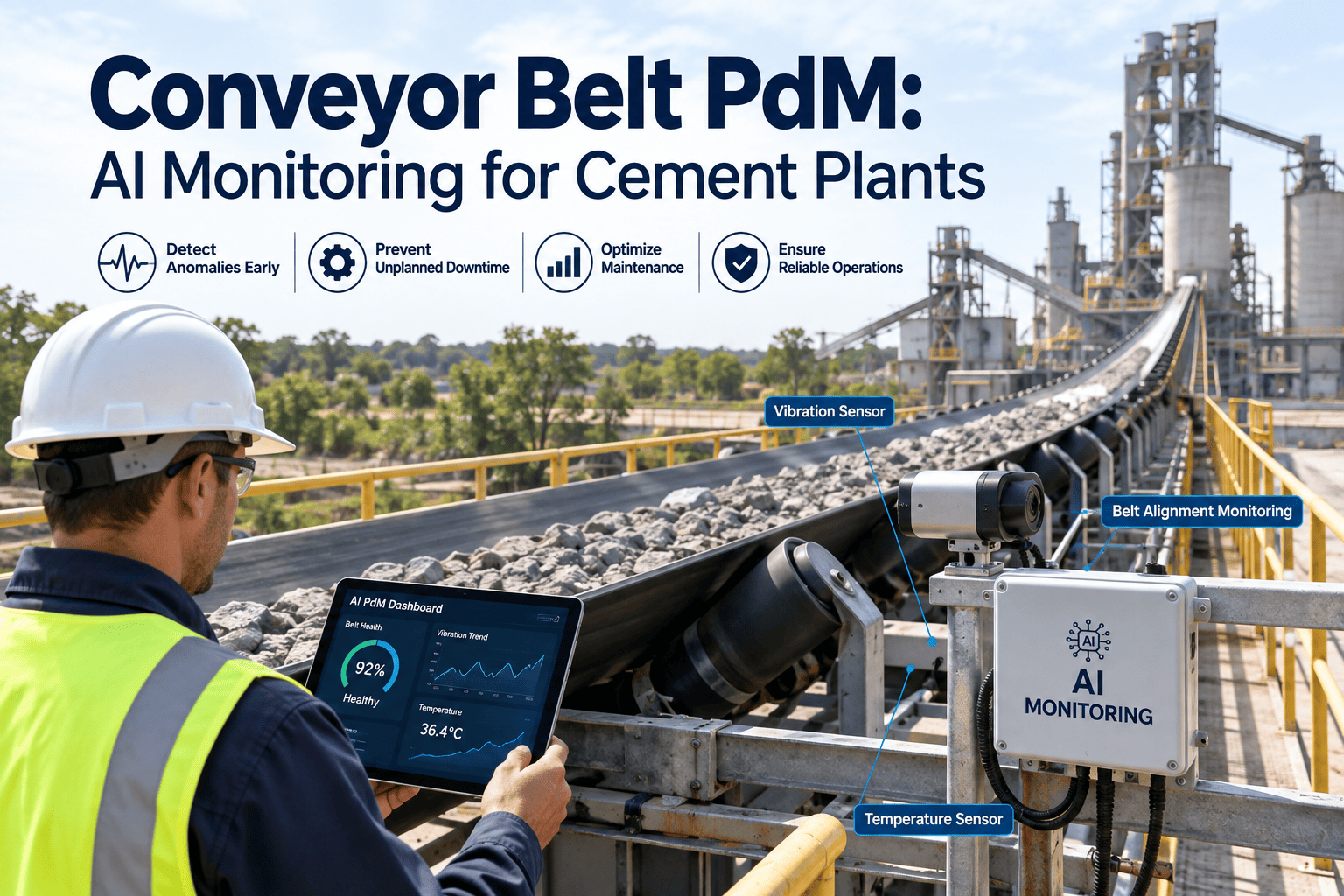
Every conveyor in your plant gets a live health score that combines data from vibration sensors, thermal monitoring, motor current analysis, and AI vision into a single number that tells you exactly where to focus attention and how much time you have before action is needed.
iFactory — Conveyor Health Monitor
Live
CV-101 Quarry Feed
94
Healthy
All parameters normal. Next scheduled maintenance: 18 days.
CV-205 Raw Mill Feed
88
Healthy
Minor carryback buildup detected. Cleaning recommended within 5 days.
CV-312 Clinker Transport
67
Attention
Bearing vibration trending up on idler set 14-18. Predicted failure: 3-4 weeks. WO #3841 auto-created.
CV-408 Cement to Silo
91
Healthy
Belt wear within spec. Splice joint integrity: strong.
CV-506 Packing Line
42
Critical
Drive motor current anomaly detected. Winding degradation confirmed. Schedule replacement before next shift change.
See Every Conveyor's Health Score — Live, On One Screen
iFactory combines AI vision, vibration analysis, thermal monitoring, and motor diagnostics into a single health score per conveyor. Red means act now. Yellow means plan. Green means verified healthy — not just "no one has checked."
The Cement-Specific Challenges That Generic Monitoring Misses
Cement plants are not factories. They are outdoor, multi-kilometer, high-temperature processing chains that operate through dust, weather, and thermal extremes that destroy standard monitoring equipment. Here is what makes cement conveyor monitoring fundamentally different from other industries.
Clinker is one of the most abrasive materials any conveyor handles. Belt wear rates are 3-5x higher than in general manufacturing. Continuous thickness monitoring isn't optional in cement — it's mandatory for preventing mid-production belt failures that halt the kiln.
Cement dust infiltrates every bearing, roller, and motor winding in the plant. Standard IP65 sensors fail within months. Monitoring equipment needs IP68+ ratings, positive-pressure housings, and AI models specifically trained to compensate for dust-obscured visual data.
Clinker exits the cooler at 100-200°C. Conveyors near the kiln zone operate in ambient temperatures that accelerate every degradation mode — belt material fatigue, bearing grease breakdown, and idler thermal deformation happen dramatically faster than in cooler environments.
Multi-Kilometer Networks
High
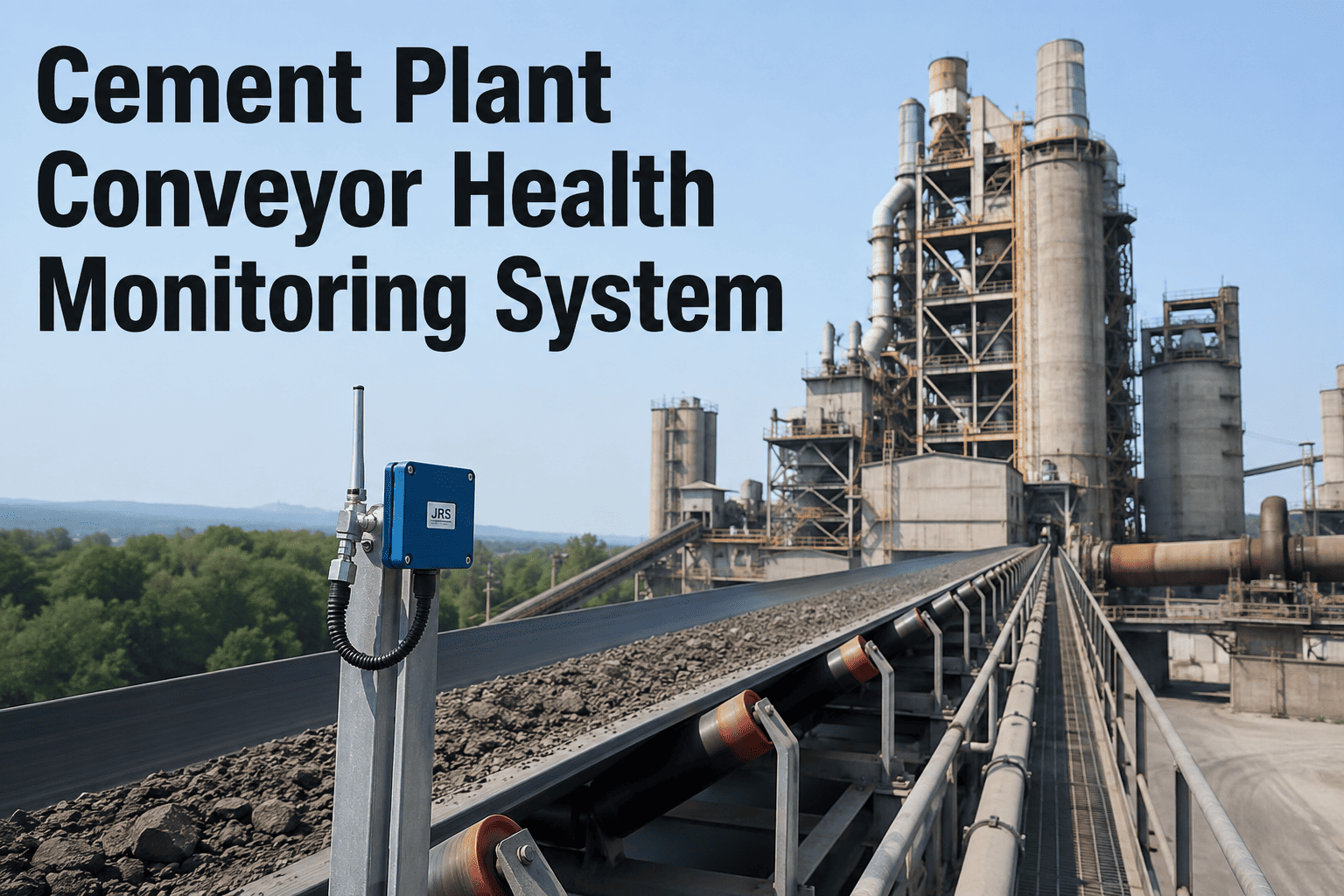
A single cement plant may have 5-15 km of conveyor belt across outdoor and indoor sections. Manual walkarounds can't cover this network with the frequency needed. Wireless sensor mesh networks with battery life exceeding 5 years solve the coverage problem without cable infrastructure.
Implementation: Your Existing Cameras and Sensors Are the Starting Point
You don't need to rip out your current infrastructure. Most cement plants already have 70-80% of the hardware needed for AI conveyor monitoring. Here's how deployment works.
Week 1
Audit & Connect
Existing cameras, PLCs, SCADA, and sensors are assessed and connected. AI processing deploys via edge compute units on-site. Most plants go live in a single production shift for initial monitoring.
Week 2-3
Baseline & Gap Fill
AI establishes health baselines for each conveyor. Wireless sensors fill any gaps — vibration on critical bearings, thermal on clinker-zone belts, tension on long-haul sections. Installation takes hours per conveyor, no shutdowns.
Month 2
Predictive Alerts Active
AI models trained on your plant's data begin generating predictive alerts with failure mode, severity, time-to-failure estimate, and recommended action. Work orders auto-generate in your CMMS. First prevented failures typically occur within 60 days.
Month 4-6
Full Optimization
Health scores across all conveyors visible on a single dashboard. Historical trending enables belt lifecycle optimization — replacing belts at the right time, not too early (wasting money) or too late (risking failure). ROI typically achieved within 8-14 months.
Frequently Asked Questions
How does AI vision work in cement plant dust conditions?
Industrial AI cameras for cement plants use positive-pressure housings that blow filtered air across the lens, preventing dust settlement. Dual-mode thermal and visible cameras maintain monitoring even in heavy dust. AI models are trained specifically on cement plant visual conditions — dust, heat shimmer, vibration — and achieve 95%+ detection accuracy even in the harshest zones. Automated cleaning cycles keep optics clear without manual intervention.
Can we use our existing cameras for AI monitoring?
Yes. Most deployments leverage existing camera infrastructure where possible. AI processing happens at the edge via an on-site compute unit, analyzing feeds from cameras you already have installed. Where additional coverage is needed — thermal monitoring near the kiln zone, for example — new industrial-grade cameras are added at specific high-value points.
What ROI can a cement plant expect from conveyor monitoring?
Cement plants implementing AI conveyor monitoring typically see a 45-55% reduction in unplanned conveyor stops within the first year. A single prevented failure on a kiln-feed conveyor — avoiding $50,000-$200,000 in lost production — can cover the entire monitoring investment. Plants report 25-40% lower conveyor maintenance costs and full payback within 8-14 months.
How does this integrate with our existing maintenance system?
iFactory connects directly to existing DCS, SCADA, and CMMS platforms through standard APIs and OPC-UA. When AI detects a conveyor anomaly, it auto-generates a work order in your maintenance system with full context — equipment ID, failure mode, severity, predicted time to failure, recommended action, and supporting sensor data. No manual data entry, no communication gaps.
How much conveyor belt does the system actually monitor?
The system monitors every meter of belt, every roller, every motor, and every splice point across your entire conveyor network. Sensor-based diagnostics have been proven across facilities monitoring over 100 km of belt, extending service life for the majority of belts while identifying the small percentage that need early replacement. The AI doesn't sample — it monitors continuously, 86,400 seconds per day.
Your Conveyors Run Your Cement Plant. It's Time They Got the Monitoring They Deserve.
Every unmonitored conveyor is a production stoppage waiting to happen. iFactory puts AI eyes on every belt, every roller, every motor — turning silent degradation into planned maintenance and turning unplanned stops into a thing of the past.