A quality lab is only as good as the sample that reaches it. A grab sample taken by hand once a shift — from whatever part of the material stream happens to be convenient at that moment — tells you what that one scoop looked like, not what the batch actually was. Cement chemistry varies continuously as raw meal blends shift, kiln conditions fluctuate, and grinding circuits respond to feed changes, which means a non-representative sample doesn't just introduce noise into your quality data; it can hide a real deviation entirely. iFactory's automated sampling integration connects cross-belt and screw samplers directly into a continuous quality data pipeline, so every sample reflects the material as it actually flows.
Manual Grab Sampling Was Never Designed to Catch What Modern Cement QC Needs to See
Cross-belt and screw samplers extract representative increments automatically, at consistent intervals, from the material actually moving through your process — turning sampling from a once-a-shift snapshot into a continuous, defensible quality record.
Why "Representative" Is the Word That Matters Most in Sampling
Every principle of good sampling practice — whether drawn from ASTM D75, ISO 3082, or a plant's own internal quality procedure — comes back to a single requirement: every particle in the material stream must have an equal chance of ending up in the sample. A hand-scooped grab sample almost never meets that bar. It captures whatever is on top of the pile or at the surface of the belt at the moment someone happens to walk by with a sample bag, which systematically misses segregation effects — coarser particles that settle to the bottom of a stream, finer material that migrates to the edges of a belt — that are often exactly the variation a quality program is trying to detect in the first place.
Cross-Belt vs. Screw Samplers: How Each One Actually Works
The two automated sampling technologies used most widely across cement production each solve the representative-sampling problem differently, and the right choice depends on where in the process the sampling point sits and what form the material takes at that point.
Cross-Belt Sampler
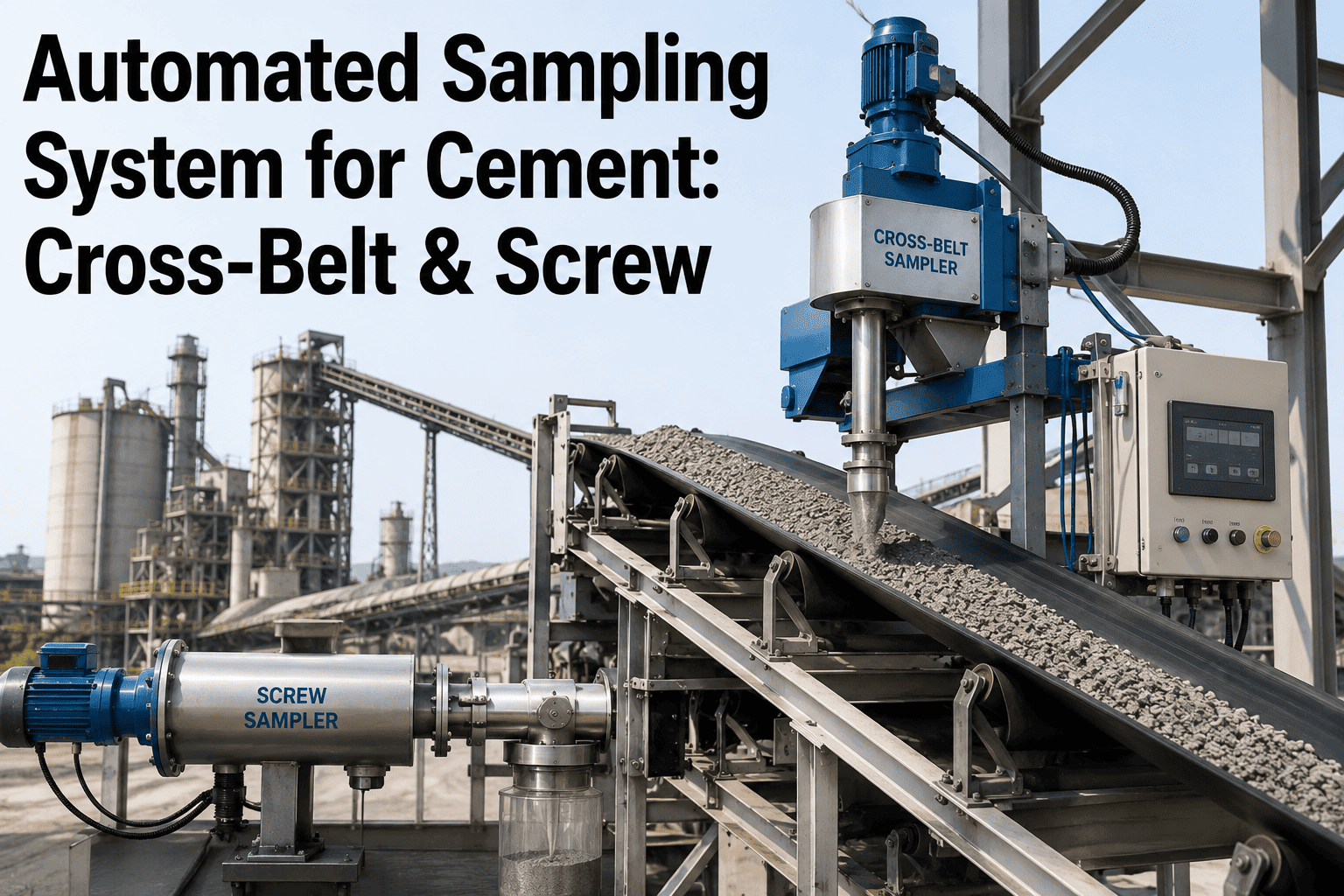
A cutter arm sweeps across the full width of the belt at set intervals, capturing a complete cross-section of material — top to bottom, edge to edge — in a single pass. Best suited to sampling directly off a conveyor carrying bulk material such as raw meal, clinker, or finished cement.
Screw (Auger) Sampler
A rotating auger extracts a metered increment directly from a flowing material stream inside a chute or pipe, drawing material across the full cross-section as it turns. Well suited to enclosed transfer points and finer, free-flowing material like powdered cement or raw meal in a pneumatic or gravity line.
Where Sampling Points Belong Across the Cement Process
Automated sampling delivers the most value when it's placed at the process points where a quality deviation would otherwise go undetected the longest, or where the cost of an undetected deviation is highest.
Raw Meal Feed
Sampling ahead of the kiln catches chemistry drift in the raw mix before it affects clinker quality, giving the earliest possible warning in the production sequence.
Kiln Feed
A sampling point immediately before the kiln confirms the blended, homogenized material actually reaching the burning zone matches the target chemistry.
Clinker Discharge
Sampling clinker as it leaves the cooler validates burning zone performance and free lime content, both critical indicators of clinker quality.
Finished Cement
Sampling at the cement mill discharge or before load-out is the final checkpoint confirming the shipped product meets specification before it leaves the plant.
A Grab Sample Tells You About a Scoop. An Automated Sample Tells You About the Batch.
iFactory connects cross-belt and screw sampler data directly into your quality system, turning representative sampling into a continuous, traceable record instead of a periodic manual task.
From Primary Increment to Lab Sample: The Preparation Chain
Taking a representative primary sample off the belt or out of the stream is only the first step. The sample has to be reduced from a bulk primary increment down to a small, homogeneous lab sample without introducing bias along the way — a chain that automated sample preparation handles far more consistently than manual splitting.
Primary increment collection
The cross-belt or screw sampler extracts a full-cross-section increment from the process stream at a fixed time or mass interval, accumulating a composite primary sample over the sampling period.
Crushing and size reduction
Coarser material such as clinker is crushed to a consistent particle size before splitting, since particle size variation is itself a major source of sampling bias if left uncontrolled.
Riffling or rotary splitting
The primary sample is divided down through a riffle splitter or rotary divider, a mechanical process designed to preserve representativeness at each reduction stage rather than introducing new bias.
Final lab sample delivery
A small, homogeneous final sample — sized appropriately for the lab's analytical instruments — is delivered automatically, labeled and time-stamped, ready for testing without manual handling in between.
Manual vs. Automated Sampling: What Actually Changes
| Factor | Manual Grab Sampling | Automated Cross-Belt / Screw Sampling |
|---|---|---|
| Sampling frequency | Typically once per shift, dependent on operator availability | Continuous increments at consistent time or mass-proportional intervals |
| Representativeness | Susceptible to segregation bias — surface or top-of-pile material only | Full cross-section cut of the material stream, by design |
| Operator exposure | Requires physical access to a moving belt or open stream | Enclosed, automated extraction with minimal operator exposure |
| Traceability | Dependent on manual logging of time and location | Automatically time-stamped and linked to process conditions at collection |
| Consistency across shifts | Varies with operator technique and diligence | Identical mechanical procedure regardless of shift or operator |
A Composite Scenario: The Deviation a Grab Sample Missed
Consider a mid-size cement plant relying on a once-per-shift manual grab sample from the finished cement conveyor to confirm fineness and chemistry before load-out. A grinding circuit adjustment made mid-shift shifted product fineness outside specification for roughly ninety minutes before operators corrected it — a window that fell entirely between two scheduled grab samples. The deviation was never caught at the point of production; it surfaced only later, in a customer complaint about a shipped batch that tested outside spec, well after the affected product had already left the plant.
With a cross-belt sampler collecting continuous increments over the same shift, the fineness deviation would have shown up in the composite sample covering that time window, flagged before the affected material reached load-out. The cost difference between catching a ninety-minute quality deviation on the production floor and discovering it after a customer complaint — in rework, in shipped product recall risk, in the relationship cost of a customer-reported quality issue — is the exact gap automated sampling exists to close.
Getting Started: What to Assess Before Specifying a Sampler
None of this requires replacing your existing lab or testing procedures — the change automated sampling introduces happens upstream of the lab, in how the sample itself is collected and prepared, so the analytical methods your quality team already trusts stay exactly the same while the sample feeding them becomes more representative and far more frequent.
Frequently Asked Questions
How do we decide between a cross-belt sampler and a screw sampler for a given point?
The choice mostly comes down to how the material is moving at that point in the process. An open conveyor carrying bulk material like clinker or raw meal is typically better suited to a cross-belt sampler, while an enclosed chute, pipe, or pneumatic line handling finer material is usually a better fit for a screw sampler. Visit support for guidance specific to your process layout.
Does automated sampling replace our lab testing equipment?
No — automated sampling addresses how the sample is collected and prepared, not how it's analyzed. Your existing lab instruments and testing methods continue to be used on the final sample; what changes is that the sample arriving at the lab is more representative, more frequent, and consistently traceable back to its collection time and process conditions.
How does automated sampling data connect to our quality management system?
Sample collection events, timestamps, and associated process conditions are captured automatically and can be fed directly into existing quality and production systems, so sample results are traceable back to exactly when and where they were taken rather than relying on manual logbook entries. Book a demo to see how the data integration is typically configured.
What sampling standards does automated equipment need to comply with?
Automated sampler design and sampling frequency are typically specified to meet recognized standards such as ASTM D75 for aggregates and bulk materials sampling, alongside applicable ISO sampling standards and any internal quality procedures your plant already follows. Confirming which standard governs each sampling point is a useful early step in specifying the right equipment.
Is retrofitting an automated sampler onto an existing conveyor or chute disruptive to production?
Installation is generally scoped to fit within a planned maintenance window rather than requiring an extended shutdown, since sampler units are designed to mount onto existing conveyor or chute infrastructure without a major structural rebuild. Scope and duration still depend on the specific installation point, so an early site assessment helps set realistic expectations.
Stop Making Quality Decisions on a Once-a-Shift Snapshot
iFactory helps cement plants connect automated cross-belt and screw sampling into a continuous, traceable quality data pipeline. See what representative sampling looks like at your process points.