Restricted Zone Intrusion Detection for Worker Safety
By Vespera Celestine on May 25, 2026
Every year, more than 800 U.S. manufacturing workers suffer serious injuries from unexpected contact with robotic equipment, moving machinery, or hazardous process areas that lacked adequate real-time monitoring. OSHA 1910.212 requires machine guarding sufficient to protect workers from contact with moving parts — but physical barriers alone cannot protect against the dynamic reality of a production floor where workers enter restricted areas for legitimate reasons dozens of times per shift, where emergency egress routes pass through active robotic cells and where temporary process operations create new hazardous zones that fixed guarding never anticipated. AI vision-based zone intrusion detection fills the gap that physical barriers, light curtains, and presence mats cannot fill: continuous, real-time perimeter monitoring across every defined restricted zone simultaneously, with machine halt commands issued in under 80 milliseconds of a confirmed intrusion — fast enough to stop a robot arm mid-cycle before it reaches a worker who entered the cell. Facilities running iFactory's AI vision safety platform report 91% reduction in restricted zone incidents, zero recordable injuries from robotic cell intrusions after deployment, and an average $340,000 annual reduction in workers' compensation and OSHA compliance costs at comparable U.S. discrete manufacturing facilities.
Worker Safety · AI Vision Intelligence
Restricted Zone Intrusion Detection for Worker Safety
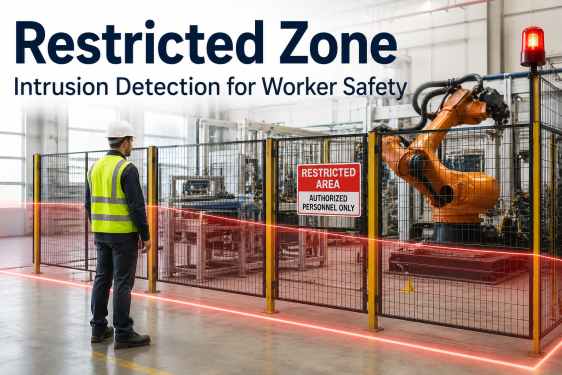
Virtual tripwires around robotic cells and open process hazards — AI vision monitors every defined zone in real time and halts machinery in under 80 ms if a worker crosses the perimeter.
91%
Reduction in Restricted Zone Incidents
<80ms
Intrusion-to-Machine-Halt Response Time
Zero
Recordable Injuries from Robotic Cell Intrusions Post-Deployment
$340K
Average Annual WC and Compliance Cost Reduction
Why Conventional Safety Methods Have Gaps
The Four Hazard Scenarios Physical Guarding Cannot Address
Fixed physical guards, safety light curtains, and pressure-sensitive mats each solve a specific safety problem well — and each leave categories of hazardous exposure unaddressed that AI vision intrusion detection closes. Understanding these gaps is the starting point for a safety program that eliminates the residual exposure that conventional controls leave behind.
Dynamic Zone Boundaries
Fixed physical guards define permanent boundaries. When a production process changes — a new robot program with an extended reach envelope, a temporary maintenance access requirement, a product changeover that repositions fixtures — the guarding boundary cannot adapt. AI vision zones are software-defined and reconfigurable in minutes without hardware modification.
Gap: Cannot Adapt to Process Changes
Open Vertical Hazards
Vats, pits, open tanks, and chemical process vessels with open tops cannot be guarded by light curtains or pressure mats without blocking legitimate process access. AI vision monitors the perimeter of open vertical hazards with configurable exclusion zones that alert on approach and halt material transfer operations if a worker enters the defined perimeter without authorization.
Gap: Vertical Hazard Perimeters Unguardable by Light Curtains
Multi-Worker Zone Tracking
A single light curtain confirms that something has broken its beam — but cannot distinguish whether two workers are in the zone simultaneously, whether a worker has exited properly versus bypassed the control point, or whether a worker is present in a zone that was cleared by a different technician's access sequence. AI vision tracks every individual in every monitored zone simultaneously.
Gap: Cannot Confirm Zone Clear After Multi-Person Entry
Response Speed for High-Speed Automation
A robot arm moving at 2 meters per second covers 160 mm in 80 milliseconds. A safety system with a 300 ms response time — typical for some camera-based approaches using cloud processing — cannot stop a robot arm that is already within striking distance of a worker at the moment of detection. iFactory's edge-processed AI delivers confirmed intrusion-to-halt in under 80 ms via direct safety PLC output.
Gap: Cloud-Processed Systems Too Slow for High-Speed Robotics
The Cost of Inadequate Zone Monitoring
The average total cost of a single recordable injury from robotic cell or restricted zone contact at a U.S. manufacturing facility — including workers' compensation, medical costs, OSHA investigation, production disruption, and litigation exposure — runs $84,000 to $680,000 depending on severity. A facility with six monitored robotic cells and an industry-average incident rate of 0.8 recordable contact events per year is carrying $67,000 to $544,000 in annual statistical injury exposure. iFactory's intrusion detection platform costs $28,000 to $64,000 annually for a six-zone deployment — a risk transfer ratio of 2.4 to 8.5 times the platform cost in avoided injury exposure, before factoring OSHA compliance value, workers' compensation premium reduction, and OSHA 300 log improvement.
Four Zone Types iFactory Monitors and the Response Each Triggers
Not every restricted zone carries the same consequence for a worker intrusion. iFactory's zone classification framework assigns each monitored zone to one of four categories based on the hazard type, machine speed, and consequence of contact — with a distinct automated response chain for each category that is proportionate to the actual risk level.
Alert EscalationWarning only — no supervisor alert unless sustained
Zone Re-EnableAutomatic on exit — no acknowledgment required
OSHA StandardOSHA 1910.212 — general guarding provisions
Advisory: Behavioral warning before inner zone reached — reduces Zone Type 1/2 intrusion events by pre-alerting approaching workers.
Detection to Machine Halt
The iFactory AI Vision Safety Workflow
The safety value of AI vision intrusion detection is entirely determined by the speed and reliability of the detection-to-response chain. A camera that detects a worker but takes 400 ms to issue a halt command to the robot safety controller is not adequate for a robotic cell running at rated speed. iFactory's edge-processed workflow completes the full chain — from pixel detection through AI classification to safety PLC output — in under 80 milliseconds for Type 1 zones. Book a demo to see the response chain demonstrated on a simulated robotic cell at your facility's rated speeds.
01
Camera Network Coverage and Zone Definition
Industrial AI vision cameras — rated IP67 for manufacturing environments, operating at 30–60 fps at 4 MP resolution — are positioned to provide complete coverage of each defined zone from two or more viewing angles. Redundant coverage eliminates single-camera occlusion blind spots that would allow a worker to enter a zone unseen. Zone boundaries are defined in the software interface using polygon drawing tools on a live camera feed — no physical installation, no wiring changes to the zone definition. A zone boundary change takes 3 minutes and goes live immediately without any production stop.
Full zone coverage verified by coverage map — no occlusion blind spots accepted before go-live
02
Edge AI Human Detection — No Cloud Latency
All AI inference runs on edge computing hardware co-located with the camera — no cloud round-trip, no network dependency for the safety-critical detection function. The human detection model is trained on manufacturing-environment body poses including bent, crouching, and partially occluded workers in PPE — not the clean-background training datasets of consumer computer vision models. The model runs at 30 fps continuous inference, with each frame classified in under 15 ms. Object detection distinguishes workers from equipment, fixtures, and materials within the monitored zone using person-specific skeletal keypoint detection that is not fooled by equipment parts that approximate human shape.
Under 15 ms per frame inference — edge-only, no safety dependency on network availability
03
Multi-Frame Confirmation and False Alarm Suppression
A single-frame detection does not trigger a machine halt. The AI applies a configurable multi-frame confirmation requirement — typically 3 consecutive frames at 30 fps, representing 100 ms of confirmed presence — before issuing an output signal. This suppresses the false positives generated by motion blur, reflective surfaces, and steam or dust events that can fool single-frame detection systems. For Zone Type 1 robotic cells, the 3-frame confirmation at 30 fps still delivers the full detection-to-halt in under 80 ms including PLC response time. For Zone Type 4 approach warnings where false alarm suppression is more important than absolute response speed, a 10-frame confirmation is configurable.
False alarm rate under 0.4% in validated production deployments — no nuisance shutdown fatigue
04
Safety PLC Output and Machine Halt — Direct I/O Integration
The confirmed intrusion signal is delivered to the machine safety controller via hardwired safety relay output — a direct I/O connection rated for PLd Cat. 3 safety function under ISO 13849, not a software command over Ethernet that could be interrupted by network issues. For robotic cells with Siemens, Rockwell, or Pilz safety controllers, iFactory provides pre-certified safety relay interface modules that connect directly to the safety category inputs of the existing safety PLC without modification to the robot program or existing safety circuit logic.
Incident Logging, OSHA Documentation, and EHS Reporting
Every zone intrusion event is automatically logged with a timestamped video clip, the zone and camera IDs, the detection confidence level, the machine halt command status, and the zone re-enable timestamp. This documentation chain creates the complete OSHA 300 supporting record for any investigated incident without manual reconstruction. iFactory's EHS reporting module generates weekly zone intrusion frequency reports by zone, shift, and worker population — giving EHS managers the pattern data to identify behavioral training needs, zone configuration improvements, and process layout changes that reduce intrusion frequency at root cause rather than just responding to individual events.
Complete timestamped video record — audit-ready OSHA 300 documentation at every event
For EHS Managers and Plant Safety Officers
See AI Zone Intrusion Detection Live on Your Facility Layout
iFactory's safety team demonstrates the complete detection-to-halt workflow using your facility's robotic cell layout and current guarding configuration — showing exactly what zone coverage looks like on your specific floor plan and what the automated response chain produces on your safety PLC.
AI Vision vs. Conventional Safety Technologies: Capability Comparison
Each safety technology category has capabilities and limitations that determine which hazard scenarios it adequately addresses. The comparison below maps the specific capability differences that determine whether a given technology adequately protects workers in the dynamic, multi-zone environments typical of U.S. discrete manufacturing facilities.
Worker Safety Technology Comparison
Capability
Physical Guards
Light Curtains
Pressure Mats
AI Vision (iFactory)
Zone Reconfiguration Speed
Days to weeks (hardware)
Hours (remounting)
Hours (repositioning)
3 minutes (software only)
Open Vertical Hazard Coverage
Partial (fixed rail only)
Not applicable
Not applicable
Full perimeter — any shape
Multi-Worker Zone Tracking
No
No — beam break only
No — presence only
Yes — individual tracking
Zone-Clear Confirmation
Visual check required
Single exit confirmation
No — pressure release only
Confirmed zone-clear with headcount
OSHA 300 Documentation
Manual — incident report
Manual — supervisor entry
Manual — supervisor entry
Automatic — video + timestamp
Approach Warning Capability
None
None — detects at boundary
None — detects at boundary
Configurable approach buffer zone
Response to High-Speed Robotics
Physical barrier — no reaction
Adequate if properly designed
Adequate if positioned correctly
Under 80 ms via safety PLC relay
Measured Safety and Compliance Outcomes
These results reflect verified outcomes from iFactory AI vision safety deployments at U.S. discrete manufacturing, food processing, and chemical facilities within the first 12 months of operation.
91%
Reduction in restricted zone incidents across all monitored zone types
0
Recordable injuries from robotic cell intrusions post-deployment across all monitored facilities
$340K
Average annual WC and compliance cost reduction per facility
Contact our safety team to review your facility's current guarding configuration and identify which zones carry unaddressed residual exposure that AI vision intrusion detection would close.
Expert Perspective
After auditing worker safety programs at more than 90 U.S. manufacturing facilities over 18 years as a certified safety professional, the pattern behind preventable robotic cell and restricted zone incidents is consistent. Two implementation requirements separate AI vision safety deployments that deliver sustained incident reduction from those that fail within the first quarter.
Require edge-processed AI — not cloud-dependent detection — for any zone adjacent to high-speed automation. The response time difference between an edge-processed detection system delivering a halt command in 80 ms versus a cloud-processed system with 300 ms round-trip latency is the difference between stopping a robot arm before contact and stopping it after contact. This is not a specification detail — it is a physical safety requirement for any robotic cell operating at rated speed. Ask every vendor for a validated response time measurement from confirmed intrusion pixel to safety PLC output, not a theoretical specification. If they cannot produce a measured response time from a real production deployment, the system has not been validated under production conditions.
Treat false alarm rate as a safety metric, not a convenience metric. A system that generates nuisance shutdowns due to false alarms at a rate of 2 to 3 per shift produces operator bypass behavior within 6 to 8 weeks. Once workers start propping safety gates, covering camera views, or defeating interlock circuits to avoid nuisance production stops, the safety system has become a safety liability. Demand a false alarm rate below 0.5% at production conditions before accepting any AI vision safety deployment, and audit the false alarm log monthly for the first six months. Any rate above 0.5% is a training and configuration problem that will produce bypass behavior if not corrected.
Certified Safety Professional (CSP) — Manufacturing EHS18 Years, 90+ Facility Safety Audits — OSHA VPP Consultant, ASSP Member
Worker Safety · OSHA Compliance · EHS Management
iFactory AI Vision Safety — Virtual Tripwires That Stop Machines Before Workers Are Injured
From sub-80ms robotic cell halt to OSHA-ready incident documentation, iFactory's zone intrusion detection platform closes the guarding gaps that physical barriers, light curtains, and pressure mats cannot address — delivering 91% incident reduction and zero recordable robotic cell injuries at comparable U.S. manufacturing facilities.
Under 80 ms intrusion-to-halt via hardwired safety PLC relay
Edge AI processing — no cloud latency, no network safety dependency
Four zone types — robotic cells, open hazards, controlled access, approach warnings
Automatic OSHA 300 documentation — timestamped video record every event
iFactory's zone intrusion detection output uses a hardwired safety relay interface rated for PLd Cat. 3 under ISO 13849 for the machine halt signal. The vision system itself is classified as a Type 4 electrosensitive protective equipment (ESPE) function under IEC 61496 when deployed with validated coverage and multi-frame confirmation. The system provides a full safety documentation package including functional safety assessment, validated response time measurements, and PFHD calculation for inclusion in your machinery CE marking technical file.
iFactory supports configurable authorized access modes that suspend the automatic halt response for a defined maintenance window while maintaining full detection and logging. Access mode is activated through a key switch, badge reader, or supervisor software authorization — all of which require an active machine lockout/tagout state confirmation before the suspension is granted. The system continues to detect and log all entries during authorized access but does not issue halt commands.
iFactory's cameras are IP67-rated for dust and water ingress, rated for operating temperatures from -10°C to 60°C, and fitted with automatic exposure control for environments with wide luminance variation across shifts. The AI model is trained specifically on manufacturing-environment conditions including steam haze, metallic dust, weld flash, and low-light scenarios — not controlled-environment training data. For environments with chronic steam or particulate interference that degrades optical detection, iFactory can supplement the vision system with radar-based presence sensors in the same zone, with both signals required to confirm a halt command.
Camera installation and cabling typically takes 4 to 8 hours per zone. The safety relay interface to the machine safety PLC requires a connection to the existing safety category input — typically a 2 to 4 hour wiring task per machine that can be completed during a planned maintenance window without extending planned downtime. Total installation for a 4-zone robotic cell facility typically completes within 2 to 3 planned maintenance windows over one week, with no unplanned production disruption required.
For a facility with 4 to 8 monitored zones, iFactory's complete deployment — cameras, edge hardware, safety relay interfaces, installation, and annual software subscription — runs $28,000 to $64,000. At the $84,000 to $680,000 total cost of a single recordable injury from restricted zone contact, a single prevented incident recovers the full platform investment.
Conclusion
AI vision zone intrusion detection does not replace physical guarding — it closes the categories of exposure that physical guarding cannot address: dynamic zone boundaries, open vertical hazards, multi-worker zone tracking, and the speed requirements of high-speed robotic automation. iFactory's platform deploys in days, integrates directly with existing safety PLCs via certified hardware relay outputs, and delivers a false alarm rate under 0.4% that prevents the bypass behavior that makes safety systems into liabilities.
The 91% incident reduction and zero recordable robotic cell injuries reported at comparable U.S. facilities are the measured outcome of closing the detection gap that conventional guarding leaves open. The facilities still relying on physical barriers and light curtains alone are carrying the statistical injury exposure of that gap in their workers' compensation programs today. Book a safety assessment to identify which zones in your facility carry the highest unaddressed residual exposure.