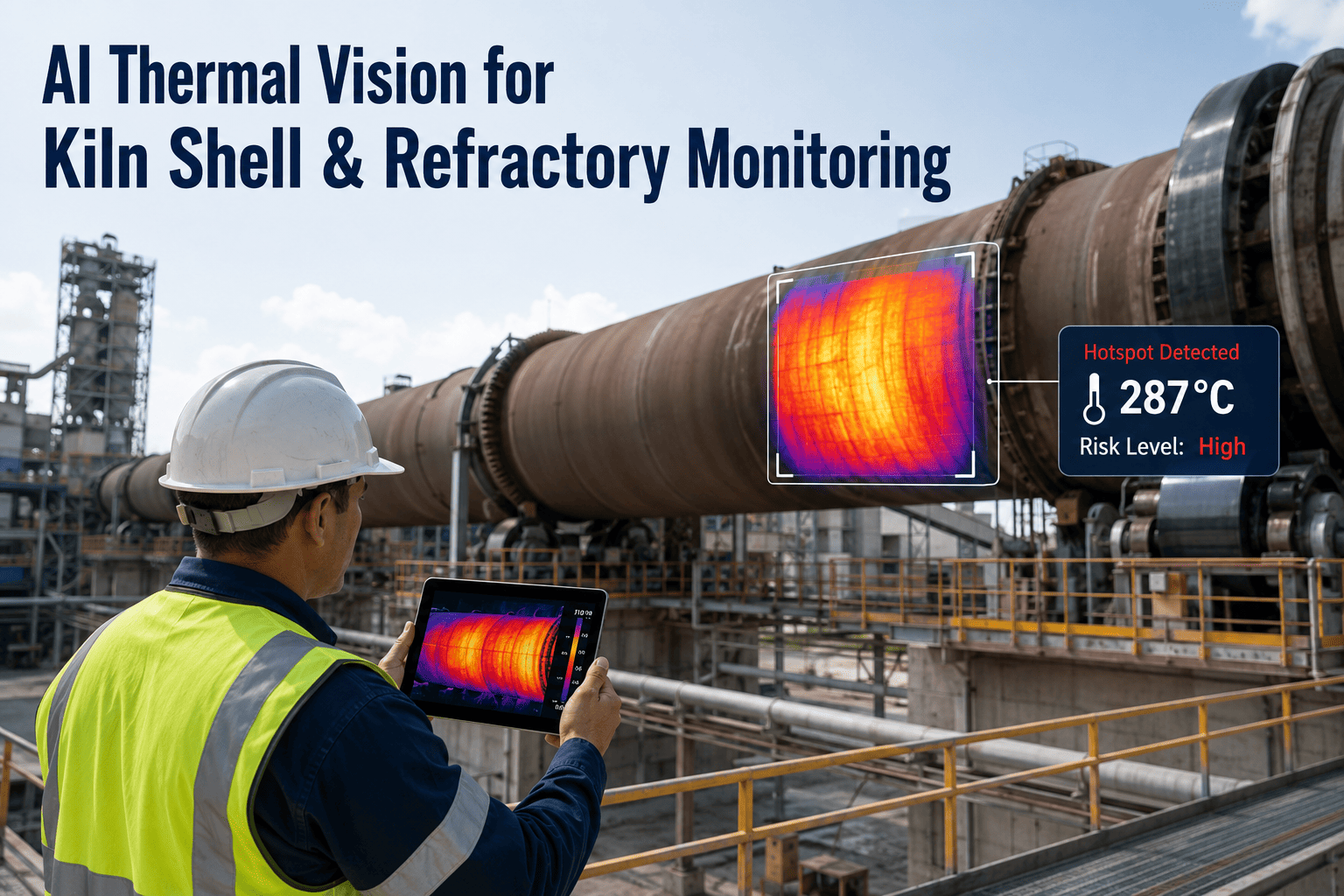
A single refractory brick falling inside a rotary kiln rarely announces itself the way plants expect it to. There is no alarm horn built for it, no single sensor labeled "brick fall," and by the time the exposed shell area shows up as a visible hot spot on a thermal scan, the brick has usually already been gone for hours or days. Acoustic emission and vibration monitoring close that gap by catching the distinct signature a falling brick makes at the moment of impact, giving operators a chance to respond before an exposed shell section turns into an unplanned shutdown. Plants running kilns without any brick fall detection in place are relying entirely on visual inspection and shell temperature drift to catch a failure mode that can progress from first crack to shell damage faster than either method typically reacts. Book a demo to see how acoustic and vibration detection layers into your existing kiln monitoring.
Why a Falling Brick Is a Race Against Time
Refractory brick lines the interior of a rotary kiln specifically to protect the steel shell from the process temperatures inside, which routinely run well above what bare steel can tolerate for any extended period. When a section of brick fails and falls into the kiln bed, the shell underneath that section goes from being thermally protected to being directly exposed to kiln gas and clinker temperatures within a single rotation. The exposed steel begins to lose strength almost immediately, and if the exposure continues without intervention, the outcome can progress from a localized hot spot to a shell deformation or, in the most severe cases, a burn-through that forces an emergency shutdown far more costly than the refractory repair would have been on its own.
The reason this failure mode is so dangerous is the speed mismatch between how fast shell damage can develop and how slowly most plants detect the underlying cause. A thermal scanning system will eventually show the hot spot, but only after the shell temperature has already risen enough to register as abnormal, which can be well after meaningful damage has begun. A brick fall detected at the moment it happens, before the shell has had time to heat up, gives the operator a window to slow the kiln, adjust the burning zone, or in some cases stop and inspect before the exposed shell section reaches a temperature that causes lasting damage.
How Acoustic Emission Detection Works
Every brick fall produces a distinct acoustic signature at the moment of impact, a sharp, high-energy transient that is measurably different from the continuous background noise of kiln rotation, material tumbling, and drive train operation. Acoustic emission sensors mounted at strategic points along the kiln shell or shell-adjacent structure continuously listen for these transients, and dedicated signal processing distinguishes a genuine brick impact from routine process noise using pattern characteristics like amplitude, frequency content, and duration that a simple threshold-based alarm cannot reliably separate.
The processing layer matters enormously here, because raw acoustic data from a kiln environment is noisy by nature. Material cascading through the kiln bed, refractory expansion and contraction sounds during normal thermal cycling, and mechanical noise from the drive system and support rollers all generate acoustic energy that a naive detection system would flag as false alarms constantly. Effective brick fall detection systems are trained on the specific acoustic fingerprint of an actual impact event, which is why systems built on real kiln acoustic data consistently outperform generic vibration alarms borrowed from other rotating equipment applications.
How Vibration Monitoring Complements Acoustic Detection
Vibration sensors add a second, independent confirmation layer to acoustic detection. A brick fall of significant mass striking the kiln shell or internal structure generates a mechanical shock that propagates through the shell and can be picked up by accelerometers mounted at the kiln support stations or shell surface, distinct from the steady-state vibration pattern associated with normal kiln rotation and material movement. When an acoustic event and a corresponding vibration shock are detected within the same short time window, confidence that a genuine brick fall has occurred rises substantially compared to either signal alone.
This dual-signal approach is what allows well-tuned systems to keep false alarm rates low without sacrificing sensitivity to real events. A system relying purely on acoustic detection has to balance the risk of missing quiet impacts against the risk of flagging every loud process noise as a potential brick fall, and a system relying purely on vibration faces a similar tradeoff at the sensor mounting locations available on a rotating shell. Combining both data streams, and requiring reasonable temporal correlation between them before triggering an alert, gives operators a signal they can trust enough to act on immediately rather than one more nuisance alarm to silence.
The Response Timeline: From Detection to Action
Detection alone does not prevent shell damage — what matters is how quickly and consistently the detection translates into an operator response. The timeline below reflects how a well-designed brick fall detection and response process is structured from the moment of impact.
The difference between a five-minute response and a five-day discovery is what separates a routine refractory repair from an emergency shell replacement. Book a demo to see the alert workflow on a live kiln dataset.
Where to Position Sensors for Reliable Coverage
Sensor placement determines how much of the kiln shell falls within reliable detection range, and getting this wrong is one of the most common reasons a brick fall detection system underperforms after installation. The considerations below guide placement decisions on most rotary kiln configurations.
What Chronic Brick Fall Frequency Usually Signals
A single isolated brick fall can happen even on a well-maintained kiln with properly specified refractory, but a pattern of repeated brick falls in the same zone points to an underlying condition that detection alone will not fix. Recurring failures in the burning zone frequently trace back to coating instability, where the protective clinker coating that should be forming over the brick surface is repeatedly forming and then sloughing off, exposing the brick underneath to direct thermal shock each cycle. Recurring failures near the kiln inlet or outlet more often point to mechanical stress from shell ovality or misalignment placing uneven load on the brick lining at those transition points.
Tracking brick fall location data over time, rather than treating each event as an isolated incident, is what reveals these patterns. A detection system that logs the approximate location of every confirmed event builds a map of where the kiln is chronically vulnerable, and that map is often the first hard evidence a plant has that a coating stability issue or an alignment problem exists, well before the pattern would otherwise be recognized through periodic visual inspection alone.
Integrating Brick Fall Data With the Rest of Kiln Health Monitoring
Brick fall detection delivers the most value when it does not operate as an isolated point solution sitting apart from the rest of a plant's kiln monitoring stack. A kiln health program that already tracks shell temperature scanning, shell ovality, drive torque, and refractory inspection history gains a meaningful new data layer when brick fall events are logged into the same system and correlated against those existing signals. A brick fall event that coincides with a period of elevated shell ovality readings, for instance, points toward a mechanical root cause rather than a coating chemistry issue, and that distinction changes what corrective action actually resolves the underlying problem instead of just repairing the immediate symptom.
This kind of correlation is difficult to do manually across separate spreadsheets and separate departmental ownership, which is why plants that get real strategic value from brick fall detection tend to be the ones that have already invested in a unified kiln health view rather than treating each monitoring technology as its own silo. Feeding acoustic and vibration event data into the same platform that already houses shell scanning results and maintenance history turns a single detection alert into part of a larger diagnostic picture that helps the reliability team understand not just that a brick fell, but why it fell and whether the same root cause is likely to produce another failure in the same zone.
What Happens When Brick Fall Detection Is Absent
Plants operating without any dedicated brick fall detection are not necessarily blind to every event, but they are relying on a combination of periodic visual inspection, shell temperature drift, and in the worst cases, an operator or maintenance technician noticing an anomaly by chance. This approach catches the events that happen to align with a scheduled inspection or that progress far enough to produce an obvious visible symptom, while missing the events that occur between inspections and self-resolve into a stable but thinned refractory condition, or worse, progress silently toward shell exposure without any intervening check to catch them.
The cost of this detection gap tends to show up unevenly. Most brick falls that go undetected do not result in catastrophic shell damage, since coating can sometimes re-form over an exposed area before serious harm occurs, which reinforces a false sense that the current inspection approach is adequate. But the small percentage of undetected events that do progress to meaningful shell damage carry a cost disproportionate to the entire population of minor events combined, and it is precisely those high-consequence cases that continuous detection is designed to catch before they escalate.