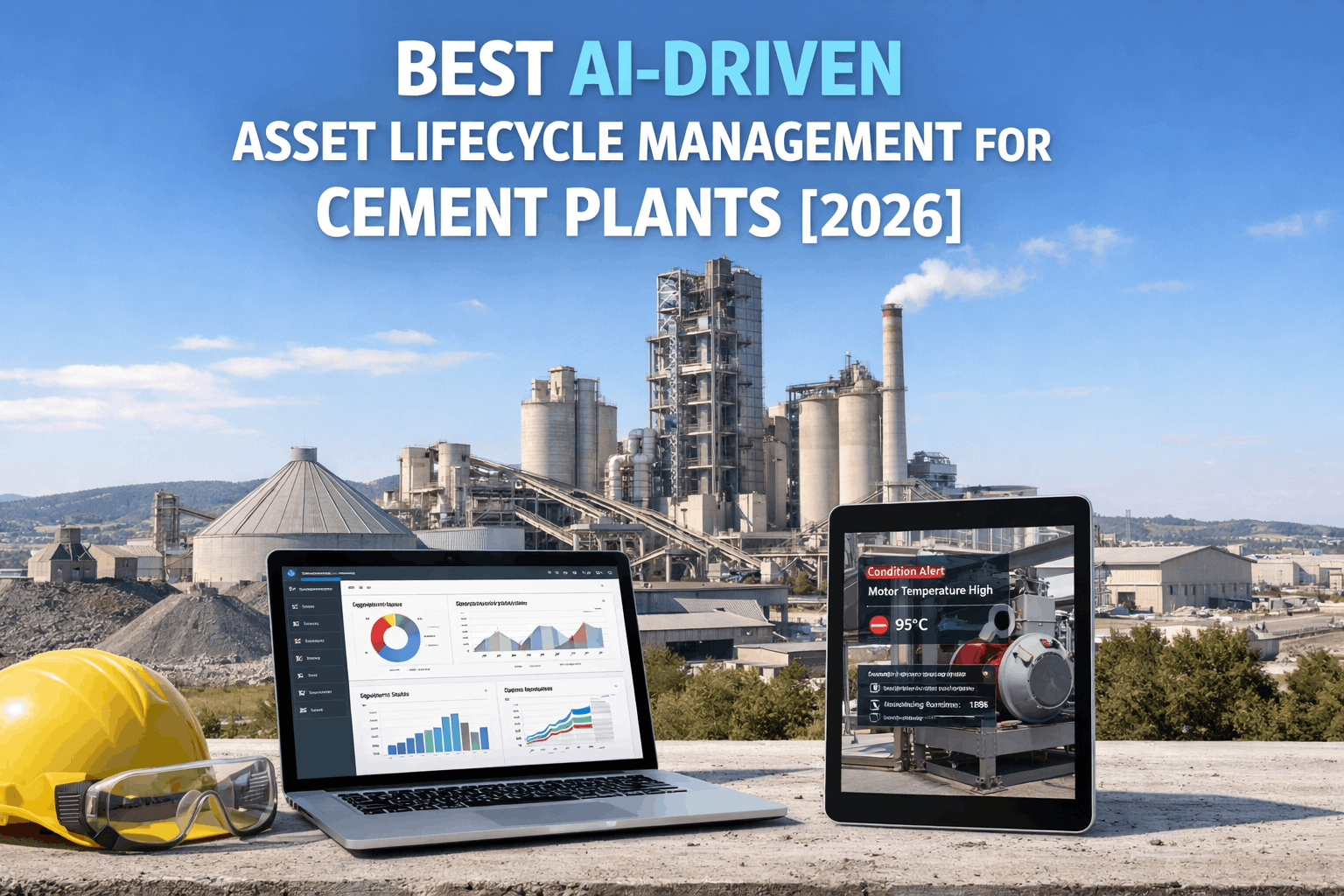
A cement plant running AI in production isn't running a single model — it's orchestrating dozens of specialized models simultaneously across kiln optimization, clinker quality prediction, raw mill blending, energy forecasting, emissions monitoring, and predictive maintenance for every critical rotating asset. Each model moves through a lifecycle: trained on years of historical SCADA data in a development environment, validated against live plant operations in staging, deployed to production GPU servers with 99.99% uptime requirements, and backed by disaster recovery that fails over automatically when the kiln can't wait. Anhui Conch, one of the world's largest cement producers, reported improved process stability and higher first-pass quality rates across multiple plants after deploying AI across their production network. A 3,000 TPD plant typically generates $5.2M-$7.1M in annual AI impact — with 6-9 month payback on an $850K-$1.2M system investment. This guide covers how iFactory manages the complete AI model lifecycle for cement plant operations — from training on on-premise GPU clusters through staging validation to production serving with real-time pipeline monitoring.
The AI Model Lifecycle in Cement Manufacturing
iFactory deploys four distinct server environments for cement plant AI — mirroring enterprise software best practices but purpose-built for industrial process control. Each environment maps to a specific phase of the model lifecycle, ensuring no untested model ever touches live kiln operations.
Experiment & Train
Data scientists train new models on 4x NVIDIA A30 GPUs using 3-5 years of historical SCADA/DCS data. Jupyter notebooks, active experiments, and hyperparameter tuning happen here. Models learn your kiln's unique operating patterns, raw material characteristics, and seasonal variations without consuming production GPU capacity.
Validate & Benchmark
Models run in shadow mode against live plant data — predicting but not acting. Accuracy is benchmarked against operator decisions and lab results. A/B testing compares new model versions against production baselines. No model advances to production without passing validation gates: free lime prediction accuracy, false alarm rate, and response time thresholds.
Serve & Optimize — 99.99% Uptime
Live AI models run on 8x NVIDIA A100 80GB with 640 GB VRAM, processing thousands of sensor readings per second across kiln, mills, cooler, and all monitored assets. Active pipelines automate setpoint recommendations, maintenance work orders, quality alerts, and emissions monitoring. 99.99% uptime (342+ continuous days) matches kiln operating schedules.
Automated Failover — 15 min RPO
Mirror production infrastructure at a secondary data center 180 km away. Active replication syncs every 12 minutes. Automated failover activates within 30 minutes if primary site fails. Cement kilns run 24/7 — the AI system must match that availability. RPO of 15 minutes ensures minimal model state loss during any failover event.
Want to see this lifecycle in action for your cement plant? Book a demo — we'll walk through how iFactory manages model training, validation, and production deployment on your plant's on-premise infrastructure.
Cement-Specific AI Models: What Gets Deployed
Each model below runs simultaneously in production, processing different sensor streams and generating different outputs — all on the same on-premise GPU cluster, all within the plant's air-gapped network. Together they form the intelligence layer that transforms raw SCADA data into automated plant decisions.
Clinker Free Lime Prediction
Neural networks predict free lime content 15-30 minutes ahead based on current burning zone temperature, raw mix chemistry (LSF, silica/alumina modulus), and fuel composition — replacing 4-6 hour lab sample delays.
Kiln Shell Temperature Anomaly Detection
AI monitors 200+ shell scanner readings per revolution, detecting hot spots, coating loss, and refractory degradation patterns. Predicts refractory failure risk weeks before visible damage — preventing $280K+ per campaign in repair costs.
Raw Mix Proportioning
AI analyzes incoming limestone and clay composition from XRF analyzers, automatically adjusting raw mill feed ratios to maintain target chemistry. Reduced cement strength variance by 62% at plants deploying this model.
Energy Consumption Forecasting
Predicts thermal and electrical energy demand per ton of clinker/cement, enabling load scheduling during off-peak tariff windows and identifying inefficiency drift before it impacts cost. Grinding circuits alone consume 60-70% of plant electricity.
Emissions Monitoring (NOx/SO2/CO2)
Continuous inference on stack gas analyzer data detects excursions before they trigger regulatory penalties. AI evaluates lower-carbon operating scenarios — reducing clinker factor, increasing alternative fuel usage — while respecting throughput and quality constraints.
Equipment Failure Prediction
Vibration analysis, temperature trending, and current draw patterns from kiln drives, mills, gearboxes, and fans predict bearing failures, gear tooth wear, and seal degradation. One plant detected a kiln motor bearing failure 18 days before it would have been catastrophic.
Deploy Cement-Specific AI Models on Your Plant's Infrastructure
iFactory trains, validates, and deploys all six model categories on on-premise GPU clusters inside your cement plant. No cloud dependency, no data leaving your network. Book a demo to see the model management dashboard.
Production Model Serving & Pipeline Monitoring
Once models are in production, iFactory provides real-time visibility into every aspect of model health and performance — ensuring the AI system delivers value continuously, not just during the initial deployment honeymoon.
GPU/CPU/RAM Utilization
Live resource tracking across all production GPUs. When utilization exceeds 80%, iFactory alerts the team to rebalance models or scale compute — preventing inference slowdowns during peak production periods.
Model Drift Detection
AI model accuracy degrades over time as raw materials change, equipment wears, and process conditions evolve. iFactory tracks prediction accuracy against actual outcomes, flagging when models need retraining before performance visibly drops.
Pipeline Health & Active Models
Dashboard shows every active model, its inference rate, error count, and pipeline status. Active model count, active pipeline count, and test pipeline metrics are tracked in real time — matching the portal's monitoring interface.
Automated Retraining Triggers
When drift exceeds thresholds, iFactory automatically initiates retraining pipelines in the development environment using recent production data — cycling improved models through QA validation before promoting to production. No manual data science intervention required.
Staging Validation: Testing Models Before Production
No AI model touches live kiln operations without passing through iFactory's staging validation pipeline. This is where models prove themselves against real plant data before they earn the right to influence production decisions.
Shadow Mode Execution
New models predict outcomes on live sensor data but don't influence control systems. Predictions are compared against actual results and operator decisions to measure accuracy before any production control is enabled.
A/B Testing Between Versions
New model versions run alongside current production models on the same data streams. Statistical comparison identifies whether the new version genuinely improves prediction accuracy or just appears to on limited test data.
Accuracy Benchmarking
Free lime prediction accuracy, false alarm rates, response time, and confidence calibration are measured against documented thresholds. AI models must achieve a 4-12 week calibration period before baseline accuracy is established for your specific plant.
Operator Sign-Off Workflow
Before production promotion, process engineers and shift supervisors review staging results and formally approve the model version. This human-in-the-loop gate ensures operational teams trust and understand the AI before it controls their kiln.
Want to see how staging validation prevents bad models from reaching your kiln? Schedule a demo — we'll show you the complete model lifecycle from training through production deployment. Or talk to support for technical details.
Frequently Asked Questions
From Training to Production — AI That Runs Your Cement Plant
iFactory manages the complete AI model lifecycle on on-premise GPU infrastructure inside your cement plant. Training, staging validation, production serving, drift detection, automated retraining, and disaster recovery — all within your air-gapped network, all managed for you.