Cement plants worldwide are sitting on a digital paradox: the industry generates massive volumes of process data — kiln temperatures, mill loads, emission readings, maintenance logs — yet 75% of cement facilities still run operations on disconnected spreadsheets, paper-based maintenance logs, and operator intuition built over decades. The result is $2–5M in annual unplanned downtime per plant, 30–40% of production costs consumed by energy that could be optimized, and maintenance teams stuck in reactive fire-fighting mode instead of predictive asset management. Digital transformation isn't a technology project — it's the systematic rewiring of how a cement plant senses, decides, and acts. The plants that get the sequencing right — starting with quick wins in CMMS and digital checklists, building to MES and predictive analytics, then scaling to AI and digital twin — achieve 300%+ ROI within 3 years. The ones that skip phases or buy technology without a roadmap create expensive digital shelf-ware. This guide gives you the exact phased roadmap that separates successful cement digital transformations from the ones that stall. Book a free transformation assessment and see where your plant sits on the maturity curve.
Cement Plant Digital Transformation Roadmap 2026
From Quick Wins to AI Smart Factory — The Phased Blueprint for Cement Manufacturing
75%
Of Cement Plants Still Operating on Disconnected Manual Systems
$2-5M
Annual Unplanned Downtime Cost per Cement Plant
300%+
ROI Within 3 Years for Plants Following a Phased Transformation Roadmap
Why 2026 Is the Inflection Point for Cement Digital Transformation
The pressure to digitize cement operations is converging from every direction simultaneously — regulatory mandates, energy costs, competitive pressure, and workforce demographics are all accelerating at once. Plants that wait are not standing still; they are falling behind.
The Convergence Forcing Cement Plants to Transform Now
EU CBAM 2026
Carbon border costs demand real-time emissions tracking — manual methods fail
Energy Cost Crisis
Energy is 30–40% of production cost — AI optimization saves $3–8M/yr per plant
Workforce Shortage
Experienced operators retiring faster than replacements — digital knowledge capture critical
Competitive Gap
AI-powered competitors achieve 20–30% lower cost per tonne — manual plants lose market share
8 Critical Pain Points That Block Cement Plant Performance
Before building a transformation roadmap, you must understand exactly where your plant bleeds time, money, and safety. These eight pain points exist in virtually every cement facility that hasn't begun systematic digitization — and each one has a specific digital solution in the roadmap.
1
Reactive Maintenance Culture
82% of cement plants still operate in break-fix mode. Equipment runs until failure, then emergency crews scramble for parts at premium cost. A single unplanned kiln stop costs $50K–$150K per day. Without a CMMS generating predictive work orders from sensor data, maintenance teams cannot escape this cycle.
Cost Impact
$2–5M/year
2
Energy Optimization Blindness
Kilns consume 60–70% of thermal energy and mills consume 60–70% of electrical energy — yet most plants tune these systems on static setpoints and operator experience. Without real-time AI optimization, plants waste 8–15% of energy costs annually — $1.5–3M per year per kiln line.
Annual Waste
$1.5–3M
3
Paper-Based Operations
Shift logs, inspection checklists, quality records, and maintenance requests still live on paper forms in most plants. This creates data gaps, lost records, audit exposure, and zero ability to trend operational patterns across shifts, days, or seasons.
Risk Level
Critical
4
Siloed Production & Maintenance Data
DCS knows process parameters. CMMS (if it exists) knows maintenance history. Quality lab knows test results. ERP knows costs. But none of these systems talk to each other — so no one has a complete picture. When a kiln trips, it takes hours to correlate the process event with the equipment failure because data lives in different systems.
Impact
Decisions Delayed
5
No OEE Visibility
Without a Manufacturing Execution System (MES) tracking availability, performance, and quality in real time, plant managers rely on end-of-month production reports to understand equipment effectiveness — discovering problems weeks after they've already cost hundreds of thousands in lost throughput.
Visibility
Weeks Late
6
Quality Prediction Impossible
Cement strength results come from the lab hours or days after production. By the time an off-spec batch is detected, thousands of tonnes may already be affected. AI quality prediction models can forecast 28-day strength during grinding — but only if the digital data pipeline exists to feed them.
Lag Time
Hours to Days
7
Compliance Documentation Scramble
ISO 50001 energy audits, EU CBAM carbon reporting, environmental permit documentation, and safety inspection records are all assembled manually before each audit — consuming weeks of staff time and invariably producing incomplete records that create regulatory exposure.
Effort
Weeks per Audit
8
Knowledge Drain from Workforce Retirement
When a 30-year kiln operator retires, decades of process intuition walks out the door. Without digital knowledge capture — AI models trained on experienced operator decisions, digital SOPs, and connected workforce platforms — every retirement creates a capability gap that takes years to refill.
Timeline
Accelerating
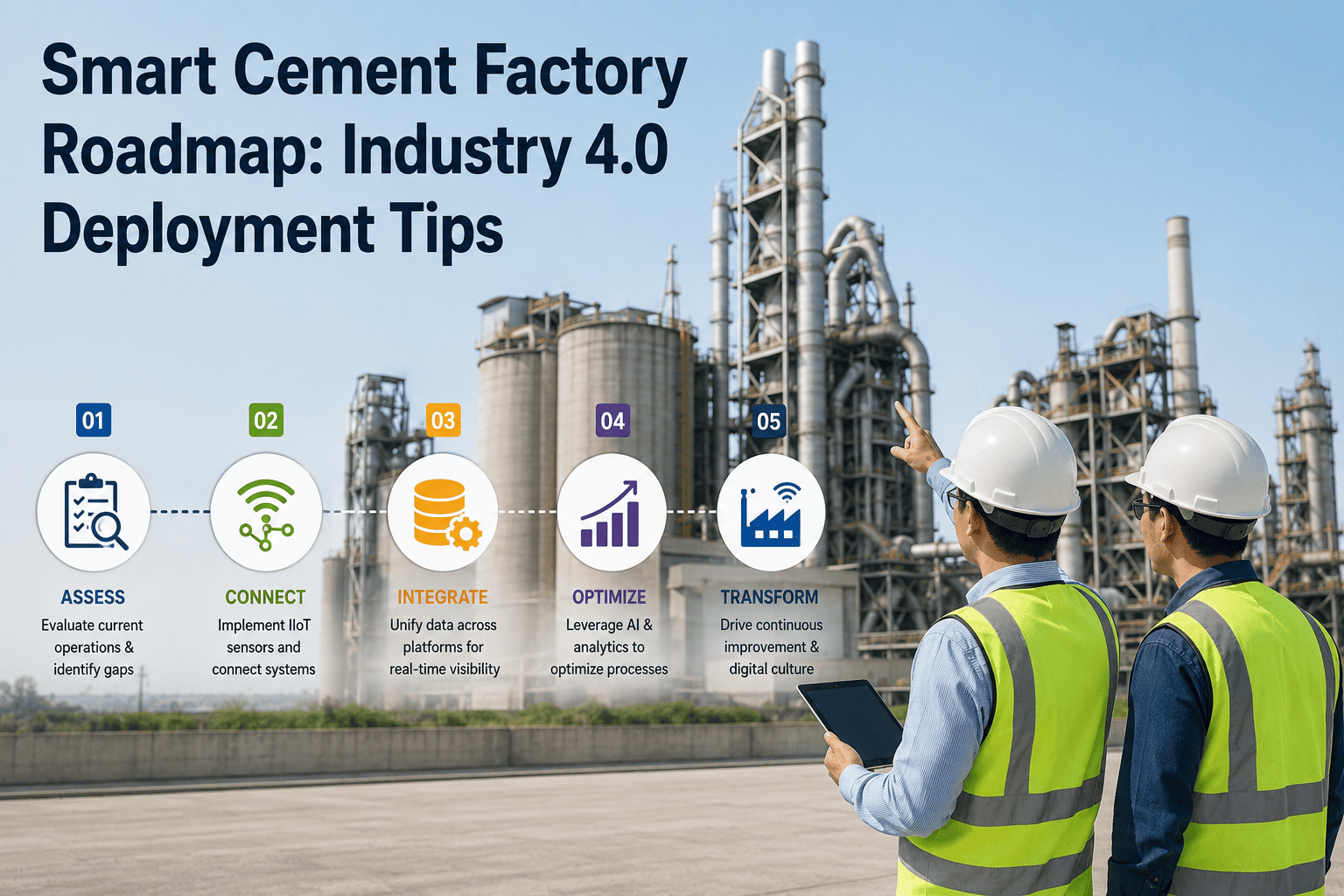
The biggest mistake cement plants make with digital transformation is treating it as a technology purchase instead of an operational change program. You cannot buy a digital twin for a plant that still runs maintenance on paper. The roadmap must be sequenced: first build the digital foundation (CMMS, checklists, asset registers), then connect systems (MES, IoT, data integration), then deploy intelligence (AI, predictive analytics, digital twin). Plants that skip the foundation phase spend 3x more and take twice as long to reach value.
The 3-Phase Digital Transformation Roadmap for Cement Plants
Successful cement plant transformation follows a disciplined 3-phase sequence. Each phase builds the foundation for the next — delivering measurable ROI at every stage while systematically closing the 8 pain points identified above.
Transformation Phases — Quick Wins to AI Smart Factory
Phase 1: Foundation
CMMS + Digital Checklists + Asset Registry — Months 1–4
Phase 2: Connect
MES + IoT Sensors + Predictive Analytics — Months 4–10
Phase 3: Intelligence
AI Optimization + Digital Twin + Autonomous Ops — Months 10–18
Quick Wins — Immediate ROI
✓ Deploy intelligent CMMS across all maintenance operations — eliminate paper work orders
✓ Digitize all inspection checklists, shift logs, and safety rounds on mobile devices
✓ Build complete asset hierarchy — every kiln, mill, fan, motor, and conveyor registered
✓ Activate preventive maintenance schedules based on operating hours, not fixed calendars
✓ Deploy QR-code asset tags for instant mobile access to equipment history and manuals
✓ Establish spare parts inventory with automated reorder points and vendor management
Measurable Results in 90 Days
✓ 25–35% reduction in reactive maintenance through PM scheduling
✓ 100% digital maintenance records — zero paper, instant audit access
✓ 40% faster work order completion with mobile-first workflows
✓ Complete spare parts visibility — no more emergency procurement at premium
✓ Safety compliance documentation automated — inspections never missed
✓ Foundation established for Phase 2 IoT and predictive analytics integration
Integration Layer — Connecting the Dots
✓ Deploy Manufacturing Execution System (MES) for real-time OEE tracking
✓ Install IoT sensors on critical assets — vibration, thermal, current, pressure
✓ Connect DCS/SCADA process data to iFactory platform via OPC-UA bridge
✓ Activate predictive maintenance — AI analyzes sensor trends to forecast failures
✓ Integrate quality lab LIMS data with production records for batch traceability
✓ Deploy energy sub-metering per production zone for consumption visibility
Measurable Results by Month 10
✓ 40–60% reduction in unplanned downtime via predictive maintenance
✓ Real-time OEE dashboard — availability, performance, quality visible per line
✓ First energy savings from visibility — identifying waste immediately on deployment
✓ Unified data platform — production, maintenance, quality, energy in one view
✓ 30-day failure prediction window for critical rotating equipment
✓ Foundation established for Phase 3 AI optimization and digital twin
Autonomous Optimization — The Smart Factory
✓ Activate AI kiln optimization — 200+ parameters tuned continuously for min energy
✓ Deploy AI cement mill optimizer — load, separator, grinding aid auto-adjusted
✓ Build plant-wide digital twin — 3D real-time process replica for scenario simulation
✓ Enable AI quality prediction — forecast 28-day cement strength during grinding
✓ Activate automated carbon tracking and EU CBAM compliance documentation
✓ Deploy connected workforce platform — AI-assisted decisions for every operator
Full Smart Factory by Month 18
✓ 20–30% total energy cost reduction from AI process optimization
✓ 40% fewer off-spec quality batches via AI strength prediction
✓ Digital twin enables what-if testing without disrupting live production
✓ Automated CBAM, ISO 50001, and ESG compliance reporting
✓ Operator knowledge captured in AI models — workforce transition de-risked
✓ 300%+ ROI achieved from combined energy, maintenance, quality, and compliance
See the Full 3-Phase Roadmap Applied to Your Plant
iFactory AI maps your current digital maturity, identifies quick-win opportunities, and builds a phased transformation roadmap that delivers ROI at every stage — from CMMS foundation to AI smart factory.
ROI Timeline: What to Expect at Each Stage
Digital transformation is not a cost — it's an investment with compounding returns. Here's the realistic financial impact timeline based on cement plants that have followed the phased roadmap.
Phase 1: Foundation
Months 1–4
CMMS, digital checklists, asset registry, spare parts
50–100% ROI within 12 months
Phase 2: Connect
Months 4–10
MES, IoT sensors, predictive maintenance, energy metering
150–200% ROI within 18 months
Phase 3: Intelligence
Months 10–18
AI optimization, digital twin, quality AI, carbon tracking
300%+ ROI within 36 months
Combined Program
18 months to full deployment
Full stack: CMMS → MES → IoT → AI → Digital Twin
$3–8M annual savings per plant
Before vs. After: The Transformation Gap
The operational difference between a manually operated cement plant and one running on the iFactory AI platform shows up in every metric that matters — cost, safety, quality, energy, and compliance.
Maintenance Mode
Reactive — break-fix, emergency procurement
Predictive — AI forecasts failures 30 days ahead
40–60% less unplanned downtime
Energy Optimization
Static setpoints, operator intuition
AI optimizes 200+ parameters continuously
20–30% energy cost reduction
Quality Control
Lab results hours/days after production
AI predicts strength during grinding
40% fewer off-spec batches
OEE Visibility
End-of-month reports — weeks late
Real-time MES dashboard per production line
Immediate loss identification
Compliance
Manual audit preparation — weeks of work
Automated ISO 50001, CBAM, ESG reports
Always audit-ready, instant export
Data Integration
Siloed DCS, CMMS, lab, ERP systems
Unified digital twin + MES + CMMS platform
Single source of truth
Change Management: The Hidden Success Factor
Technology implementation without change management is the #1 reason cement digital transformations stall. The platform is only as valuable as the people who use it. Here's the change management framework that separates successful transformations from expensive shelf-ware.
Workforce Engagement
✓ Executive sponsorship with visible plant director commitment
✓ Digital champions identified per shift and per department
✓ Hands-on training — not classroom presentations — on actual plant systems
✓ Quick wins celebrated publicly to build momentum and trust
Operational Redesign
✓ Standard operating procedures rewritten for digital-first workflows
✓ Shift handover digitized — zero verbal-only information transfer
✓ KPI dashboards visible on plant floor — not hidden in manager offices
✓ Feedback loops established — operator input improves AI models
Platform Adoption
✓ Mobile-first interfaces that work in dusty, noisy plant environments
✓ Offline capability for areas with poor connectivity
✓ Role-based dashboards — operators, supervisors, and managers see what they need
✓ Phased rollout that never disrupts active production operations
The iFactory AI Platform: Complete Technology Stack for Cement
iFactory AI provides every layer of the digital transformation stack in a single unified platform — eliminating the integration complexity that kills multi-vendor transformation programs.
Intelligent Maintenance Management
Mobile work orders, preventive scheduling, spare parts inventory, asset lifecycle tracking, compliance documentation, and vendor management — the digital foundation every other layer builds on.
Manufacturing Execution System
Real-time OEE tracking, production scheduling, batch management, downtime classification, and performance analytics — connecting the shop floor to the business layer.
Sensor Networks & Edge Computing
Vibration, thermal, current, pressure, and process sensors connected via edge gateways with sub-second local processing and cloud analytics for long-term trending.
Predictive Analytics & Process AI
Predictive maintenance, kiln thermal optimization, mill energy AI, quality prediction, demand forecasting, and emission tracking — all purpose-trained on cement-specific process physics.
3D Real-Time Plant Replica
A live 3D digital mirror of your entire plant — enabling scenario simulation, AI recommendation validation, and what-if testing without disrupting live production.
Connected Workforce Platform
Mobile apps for operators, technicians, and supervisors — digital SOPs, AI-assisted decisions, real-time alerts, and offline capability for every corner of the plant.
Every Month Without a Roadmap Is a Month Your Competitors Pull Ahead
The plants deploying AI in 2026 will establish a structural cost and quality advantage that manual-operated competitors cannot match. Let iFactory AI assess your current maturity and build the phased roadmap that delivers ROI at every stage — from digital foundation to autonomous smart factory.
Frequently Asked Questions
How long does a full cement plant digital transformation take?
Following the 3-phase roadmap, most cement plants achieve full digital foundation (Phase 1) in 3–4 months, connected operations (Phase 2) by month 10, and AI intelligence (Phase 3) by month 18. Quick wins — digital checklists, mobile CMMS, and PM scheduling — deliver measurable ROI within the first 90 days. The key is phased sequencing: each phase builds the data and process foundation the next phase requires. Plants that try to deploy AI before establishing a CMMS and asset registry spend 3x more and take twice as long.
Book a free assessment to get a timeline tailored to your plant's current maturity.
What ROI can we realistically expect from digital transformation?
Phase 1 (CMMS + digital checklists) typically delivers 50–100% ROI within 12 months through reduced reactive maintenance, faster work order completion, and spare parts optimization. Phase 2 (MES + predictive) adds 40–60% downtime reduction and first energy savings. Phase 3 (AI + digital twin) delivers the largest impact: 20–30% energy cost reduction, 40% fewer quality off-specs, and automated compliance. Combined, plants achieve $3–8M in annual savings and 300%+ ROI within 3 years. The 18-month average payback means the platform funds itself before full deployment is complete.
Do we need to replace our existing DCS and SCADA systems?
No. iFactory AI connects to your existing DCS, SCADA, PLC, and historian systems via standard industrial protocols (OPC-UA, Modbus, MQTT). The platform reads process data from your current automation infrastructure, applies AI analytics, and feeds optimization recommendations back through your existing control systems. No rip-and-replace is required — digital transformation enhances your existing infrastructure rather than replacing it.
How do we handle change management with plant floor workers?
Change management is built into the phased roadmap — not treated as an afterthought. Phase 1 quick wins (mobile CMMS, digital checklists) are deliberately chosen because they make workers' daily tasks easier, not harder. Digital champions are identified per shift. Training happens on actual plant systems, not in classrooms. Quick wins are celebrated publicly. By the time Phase 2 and 3 technologies deploy, the workforce has already experienced the benefit of digital tools — building the trust and adoption that makes AI and predictive analytics stick.
Can iFactory support multi-plant transformation across a cement group?
Yes. iFactory AI provides centralized multi-plant management with standardized SOPs, consistent KPIs, and cross-plant benchmarking — while allowing each plant to maintain local schedules, asset inventories, and team assignments. Cement groups managing multiple plants can deploy the roadmap at one pilot plant, prove ROI, and then accelerate rollout across the portfolio using the pilot as a template. Visit our
Support Center for multi-site deployment case studies.