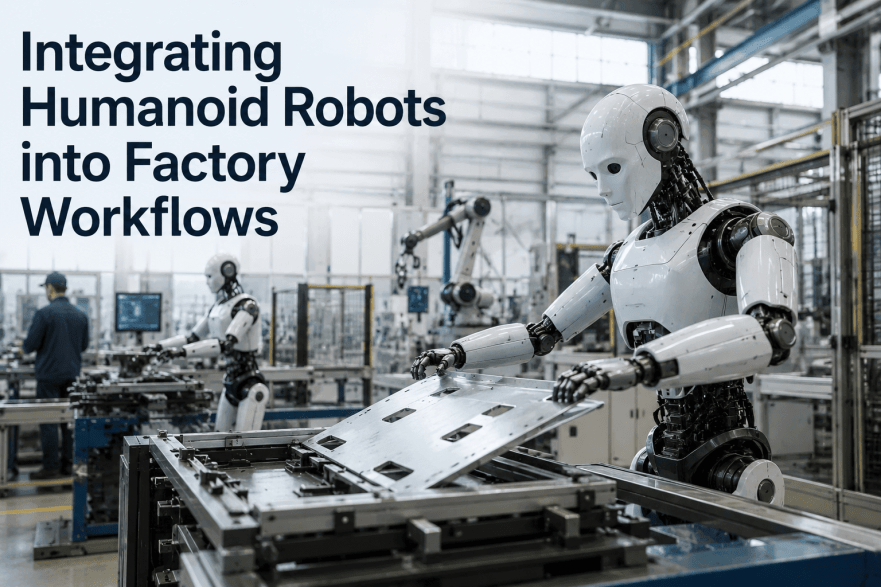
The factory floor has always required human intelligence in human-shaped bodies — workers who can navigate aisles built for people, reach into machine enclosures designed for human arms, carry sheet metal blanks to presses that accept them from a human-like grip, and perform quality inspections that require the dexterity and visual acuity that fixed automation cannot replicate. That requirement has simultaneously been the reason manufacturing facilities need large human workforces and the reason those workforces face disproportionate rates of ergonomic injury, repetitive strain claims, and exposure to hazardous process environments. Humanoid robots — bipedal, dexterous robots designed to operate in the same physical spaces and with the same task interfaces as human workers — offer a direct solution to this structural problem: the ability to assign ergonomically harmful, hazardous, and highly repetitive tasks to a robotic workforce that operates in the existing facility without the facility modification costs required by fixed automation. The practical barrier has been integration: humanoid robots from every current platform — Boston Dynamics, Agility Robotics, Figure, Apptronik, and others — require a management layer that can receive task assignments, coordinate with the other robotic and human workers sharing the floor, enforce safety protocols in proximity to humans, and report performance data to operations management in real time. iFactory's intelligence layer provides exactly that management architecture. U.S. manufacturers that have deployed humanoid robots through iFactory's integration platform report 78% reduction in ergonomic injury claims on targeted task assignments, 94% first-year availability on deployed humanoid units, and an average of 2.4 previously human-only task categories successfully transitioned to humanoid execution within the first 12 months of deployment.
Integrating Humanoid Robots Into Factory Workflows: The iFactory Intelligence Layer
Bipedal humanoid robots can perform hazardous, ergonomically straining, and highly repetitive tasks in facilities built for humans — without the facility modification costs of fixed automation. iFactory's intelligence layer safely assigns tasks, coordinates humanoids with human workers, and tracks performance across every deployment.
Why Humanoid Robots Are the Right Form Factor for Tasks That Resist Fixed Automation
The economics of fixed automation in manufacturing are well understood — a robotic arm cell performs a specific task at high speed and high repeatability for a defined product configuration, and it does so cost-effectively as long as product volumes justify the capital investment and the product configuration remains stable. The tasks that fixed automation has consistently failed to address economically are the tasks that require flexibility: picking parts from variable-orientation bins, placing heavy sheet metal blanks into press tools that vary by product, inspecting assemblies across multiple orientations without repositioning fixtures, and navigating between workstations to deliver materials on demand. These tasks share two characteristics — they require dexterity and spatial adaptability — that fixed automation achieves only at prohibitive cost, if at all.
Humanoid robots address exactly this capability profile. They operate in existing facility aisles and at existing workstation heights. They grip parts using human-form hands that can handle the same part presentations that human workers handle. They navigate between workstations without floor modification. And when task requirements change — a new product family, a production schedule revision, a process change — the task assignment in iFactory's intelligence layer is updated rather than a robot cell being reengineered. Book a Demo to see iFactory's humanoid integration platform demonstrated on a task profile equivalent to your facility's high-ergonomic-risk assignments.
Ergonomic Injury Cost
Heavy lifting, repetitive reaching, awkward posture, and force-intensive tasks generate 38% of all U.S. manufacturing injury claims — with average cost of $38,000 per OSHA-recordable ergonomic injury including medical, lost time, and productivity impact. Humanoid assignment of these tasks eliminates the exposure entirely.
Hazardous Environment Exposure
Heat exposure at casting and forming operations, chemical exposure in surface treatment, noise exposure in heavy press environments, and particulate exposure in grinding and finishing operations represent cumulative occupational health risks that regulatory requirements increasingly restrict. Humanoid robots operate in these environments without personal protective equipment constraints or exposure limits.
Fixed Automation Inflexibility
Robot cells designed for a specific product configuration require $80,000 to $400,000 in re-engineering when product specifications change. Humanoid task assignments are updated in iFactory's task management interface — a configuration change, not a capital expenditure. For facilities with frequent product changes, this flexibility is the decisive economic argument for humanoid over fixed automation.
Workforce Availability and Retention
The hardest manufacturing positions to fill and retain in U.S. operations are the physically demanding, environmentally unpleasant, and repetitively stressful roles — exactly the task profile that humanoid robots can execute. Reassigning workers from these positions to higher-skill supervisory and exception-handling roles while deploying humanoids on the demanding tasks improves both operational continuity and workforce retention.
Night Shift and Holiday Staffing Gaps
Production schedules that require 24/7 operation face a consistent staffing challenge on night shifts, weekends, and holidays — the periods when qualified workers are hardest to attract at standard wage rates. Humanoid robots do not require shift differentials, overtime premiums, or holiday pay, and maintain identical performance regardless of shift timing or consecutive operating hours.
iFactory's Humanoid Integration Architecture: Four Layers From Task Assignment to Performance Analytics
Deploying humanoid robots in a production environment requires more than the humanoid hardware — it requires the intelligence layer that connects the humanoid's capabilities to the production schedule, coordinates its movements with human workers sharing the same space, and provides the performance visibility that makes deployment ROI measurable and improvable. iFactory's integration architecture delivers this intelligence layer across four connected capability domains.
Want to see iFactory's humanoid task assignment, safety coexistence, and performance analytics layers demonstrated on a configuration equivalent to your facility's highest-ergonomic-risk task profile? Book a Demo with iFactory's humanoid integration team.
Humanoid Deployment Performance Benchmarks: What U.S. Manufacturers Achieve in Year One
Humanoid robot deployments through iFactory's intelligence layer have been documented across multiple U.S. manufacturing environments — heavy stamping operations, foundry material handling, assembly line support, and finishing operation tasks. The benchmark table below presents the documented first-year performance outcomes by task category and metric — providing the specific numbers required to evaluate the deployment investment against the current cost of human execution for the same tasks.
| Task Category | Human Execution Baseline | Humanoid Performance (Year 1) | Key Benefit | Annual Value per Unit Deployed |
|---|---|---|---|---|
| Sheet Metal Blank Loading at Presses | $52K–$68K loaded labor cost; 4–6 ergonomic injuries per 10 FTEs annually | 94% task completion rate; cycle time within 12% of human baseline at 6 months | Ergonomic injury elimination; consistent cycle time | $88K–$142K labor + injury avoidance |
| Heavy Component Transfer (>25 lbs) | OSHA high-risk designation; 8–14% annual injury rate on assignment | 100% elimination of human heavy-lift exposure; 24/7 operation | Complete ergonomic risk elimination; continuous operation | $62K–$98K injury cost avoidance + shift coverage |
| Bin Picking — Variable Orientation | $44K–$58K labor; high error rate on poorly presented parts | 88% task completion rate at 3 months; 96% at 12 months with model learning | Consistent part presentation; model improves with deployment hours | $56K–$84K labor cost offset |
| Casting / Forming Area Material Handling | High heat exposure; PPE cost; OSHA compliance burden | Continuous operation in >50°C environments; no PPE or exposure limit constraints | Hazardous exposure elimination; compliance cost reduction | $74K–$120K combined compliance and labor value |
| Night Shift / Weekend Production Support | 30–45% premium labor rates; staffing gaps in 68% of U.S. facilities | No shift differential; identical performance across all shifts and schedules | Staffing gap elimination; zero wage premium | $38K–$72K shift premium avoidance per production area |
| Repetitive Assembly Support | High turnover rate; quality variance from fatigue; ergonomic risk accumulation | Zero fatigue-driven quality variance; consistent cycle time across full shift | Quality consistency; turnover cost elimination | $48K–$86K turnover and quality cost reduction |
The Humanoid Deployment Workflow: From Task Identification to Operational Steady State
Successful humanoid integration follows a structured deployment workflow that moves from task selection and facility assessment through technical integration, safety validation, and production deployment to the ongoing performance management that drives continuous improvement. iFactory's deployment methodology reflects the lessons from multiple U.S. manufacturing deployments — building the safety validation and task calibration phases into the timeline rather than treating them as post-deployment corrections.
Task Selection and ROI Prioritization
The first deployment step is identifying the task categories in the facility where humanoid assignment generates the highest financial return — considering ergonomic injury cost avoidance, labor cost offset, shift premium elimination, and quality improvement value simultaneously. iFactory's task selection framework scores each candidate task category against humanoid execution feasibility (part weight, presentation consistency, cycle time requirements) and financial return, producing a prioritized deployment roadmap that concentrates initial deployment capital on the highest-value tasks.
Facility and Infrastructure Assessment
iFactory's deployment team assesses the target production area for humanoid operational requirements — floor surface condition and grip for bipedal navigation, charging infrastructure availability, lighting adequacy for visual sensors, and existing safety infrastructure compatibility. For most U.S. manufacturing facilities built to standard industrial construction specifications, assessment typically identifies zero or minor infrastructure modifications required. The assessment also confirms the IT and network infrastructure for the iFactory ROS 2 integration layer.
Task Configuration and Model Training
Each task category assigned to the humanoid is configured in iFactory's task management interface — defining the task parameters, the part handling approach, the source and destination locations, and the success criteria for task completion confirmation. For tasks requiring manipulation of specific part geometries, the humanoid's grasp and manipulation models are trained on representative production parts in a staging area before live deployment. Task configuration for a new assignment type typically requires 3 to 7 days of configuration and model training for a qualified deployment team.
Safety Validation and Coexistence Protocol Establishment
Before live production deployment, iFactory's safety validation protocol establishes and tests the safety zone configurations, proximity detection thresholds, and protective stop responses for the specific production environment. Safety validation testing is conducted with production personnel present in the deployment area — confirming that the proximity detection and response system performs correctly for the actual worker movements and densities in the production zone. All safety validation events are logged and reviewed against the configured ISO/TS 15066 compliance requirements before live deployment authorization is issued.
Supervised Production Deployment and Performance Ramp
Initial live production deployment runs in supervised mode — with an iFactory deployment engineer on-site for the first 5 to 10 production shifts, monitoring task execution performance, tracking safety event frequency, and adjusting task configurations based on real production conditions. Task completion rates typically start at 82 to 88% in the first week (reflecting the variation between staging conditions and production reality) and improve to 92 to 96% within 30 production days as manipulation models adapt to production-representative part presentations.
Steady-State Performance Management and Fleet Expansion Planning
After the performance ramp phase, the deployment transitions to iFactory's standard fleet management and analytics workflow — monthly performance reports, predictive maintenance scheduling for humanoid mechanical systems, and task configuration updates for product or process changes. First-deployment performance data provides the calibrated ROI figures used to build the business case for fleet expansion — with facility-specific performance benchmarks replacing projected estimates for subsequent deployment authorization requests.
Want to see the humanoid deployment workflow mapped to your facility's highest-priority task categories and timeline? Book a Demo and review your specific deployment plan with iFactory's humanoid integration engineers.
Expert Review: What Advanced Manufacturing Operations Leaders Say About Humanoid Integration
I have been evaluating and deploying advanced manufacturing automation for 14 years — fixed robotics, collaborative robots, AMR fleets, and now humanoid robots. The question I get most often from operations directors considering humanoid deployment is: "Is this ready for real production?" The honest answer, based on two active deployments in heavy stamping and foundry material handling, is: yes, for the right task categories, with the right integration infrastructure, and with realistic expectations for the performance ramp period.
Conclusion
Humanoid robots are not a technology of the future — they are a deployable production asset today, for the task categories where their physical capability profile matches the production requirement and the business case for automation is clearest: ergonomically hazardous heavy material handling, heat and chemical exposure environments, repetitive tasks that drive worker injury and turnover, and shift coverage gaps that carry premium labor costs. The practical barrier to realizing that value has been the integration layer — the production-connected task management, safety coexistence, and performance analytics infrastructure that makes a humanoid unit a managed factory worker rather than a supervised technology demonstration.
iFactory's humanoid integration platform provides that infrastructure: MES-connected task dispatch that eliminates the manual coordination burden, ISO/TS 15066-compliant safety management that enables safe human-robot coexistence in live production, unified fleet coordination with AMRs and cobots, and performance analytics that measure deployment ROI with the specificity required to justify fleet expansion. The 78% ergonomic injury reduction and 94% first-year availability documented at comparable facilities are the result of deploying humanoid hardware with the intelligence layer that converts hardware capability into production value. Book a Demo to see iFactory's humanoid integration platform on a configuration equivalent to your facility's priority task categories.
Frequently Asked Questions
Deploy Humanoid Robots in Your Factory — With the Intelligence Layer That Makes Them Production Assets, Not Demonstrations.
iFactory's humanoid integration platform connects bipedal robots to your production schedule, safety systems, and performance analytics — delivering 78% ergonomic injury reduction, 94% first-year availability, and measurable ROI from your highest-priority hazardous and ergonomically demanding task categories.