Global cement production exceeds 4.1 billion metric tons per year across more than 2,500 integrated plants operated by dozens of multinational and regional producers. The adoption of robotics and AI-driven automation in cement manufacturing has historically been fragmented — driven by individual plant champions rather than coordinated enterprise strategies — but that pattern is shifting rapidly as the world's largest cement majors publish concrete robot deployment targets and invest in centralized centers of excellence. LafargeHolcim, HeidelbergCement, UltraTech, Cemex, Anhui Conch, and a growing list of regional leaders have moved beyond pilots into production-scale robot programs spanning quarry drone survey, kiln shell thermal scanning, mill predictive maintenance patrol, packer automation, and autonomous stockpile volume measurement. The result is a measurable divergence in operational performance between majors that have embraced robot automation and those still relying on manual inspection and maintenance methods. Cement plant executives and reliability teams evaluating their competitive position relative to industry peers can book a demo to benchmark their current robot maturity against iFactory's global cement robot adoption database.
Global Cement Robot Scorecard: Comparing Enterprise Adoption Across the Industry's Largest Producers
A comprehensive benchmarking analysis of robot and AI-driven automation adoption across LafargeHolcim, HeidelbergCement, UltraTech Cement, Cemex, Anhui Conch, China Resources Cement, Buzzi Unicem, Eagle Materials, Vulcan Materials, Martin Marietta, Aditya Birla Group, and ACC Limited — covering deployment scale, technology focus areas, and measurable operational impact.
Enterprise Robot Adoption Index: Cement Majors Ranked by Deployment Maturity
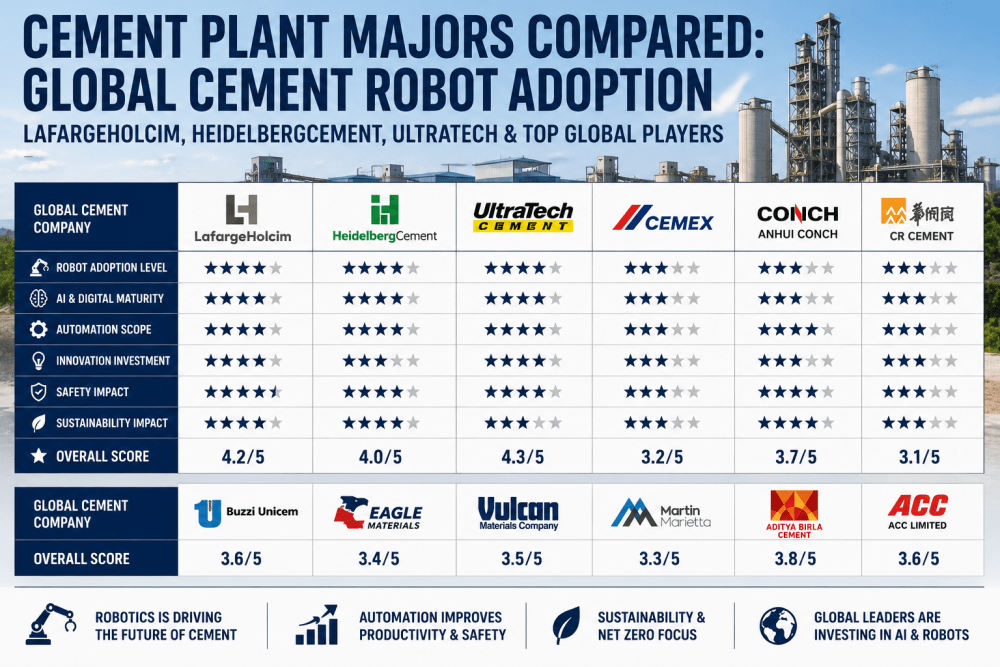
iFactory's Global Cement Robot Adoption Index evaluates the world's largest cement producers across six weighted dimensions: number of plants with active robot programs, robot types deployed (drone, quadruped, humanoid, fixed), use case coverage (quarry, kiln, mill, packer, stockpile, logistics), AI integration maturity, enterprise-wide coordination, and published deployment roadmaps. The scorecard below ranks each major by composite adoption score and highlights their most significant robot deployments and technology focus areas. Maintenance and innovation leaders can book a demo to see how their plant's robot maturity compares against these benchmarks and identify the highest-ROI deployment opportunities for their specific asset mix and operating context.
| Cement Major | Region | Robot Index | Primary Robot Applications | Deployed Sites |
|---|---|---|---|---|
| LafargeHolcim | Switzerland / Global | 9.2 / 10 | Kiln shell quadruped thermal scan, quarry drone survey, VRM robot PdM, conveyor robot patrol, autonomous stockpile drone volume, packer robot automation | 14 plants with active multi-robot programs across Europe, North America, and Asia-Pacific |
| HeidelbergCement | Germany / Global | 8.5 / 10 | Quarry drone survey and blast analysis, conveyor structure robot inspection, kiln shell thermal quadruped patrol, VRM gearbox robot PdM, autonomous stockpile LiDAR volume | 8 plants with integrated robot patrol programs, 12 with drone survey programs |
| UltraTech Cement | India | 7.8 / 10 | Drone stockpile volume survey and reconciliation, mill vibration robot patrol, bag yard robot inspection, packer automation, conveyor robot belt monitoring | 12 plants with drone survey programs, 6 with quadruped patrol, 18 with packer robots |
| Aditya Birla Group | India / Global | 7.5 / 10 | Drone stockpile survey and volume reconciliation, mill PdM quadruped patrol, kiln shell thermal scanning robot, packer and palletizer robot automation, conveyor belt robot inspection | 10+ plants with drone programs, 4 with quadruped patrol, 15+ with packer robots |
| Cemex | Mexico / Global | 7.2 / 10 | Quarry drone survey and blast optimization, kiln shell hot spot quadruped scan, conveyor robot patrol, autonomous drone stockpile volume, ready-mix fleet drone inspection | 9 plants with autonomous drone programs across Americas, 5 with quadruped kiln patrol |
| Anhui Conch Cement | China | 6.4 / 10 | Production line fixed robot automation, mill PdM sensor integration, packer and palletizer robots, drone stockpile survey pilot, automated laboratory robot sampling | 20+ plants with fixed automation, 5 with drone programs, 3 with quadruped pilots |
| Buzzi Unicem | Italy / Europe | 6.1 / 10 | Quarry drone survey and stockpile volume, mill thermal quadruped patrol, silo interior inspection drone, preheater tower robot inspection, conveyor robot belt monitoring | 5 plants with drone and quadruped programs across European operations |
| China Resources Cement | China | 5.6 / 10 | Packer and palletizer robot automation, drone stockpile survey, conveyor robot patrol pilot, fixed production line automation, laboratory automation | 8 plants with drone survey, 3 with quadruped pilots, 12 with packer robots |
| Eagle Materials | USA | 4.8 / 10 | Quarry drone survey and volume measurement, kiln shell thermal scanning pilot, stockpile drone volume for gypsum and cement inventory | 3 plants with drone programs, 1 with quadruped kiln patrol pilot |
| Vulcan Materials | USA | 4.2 / 10 | Quarry drone survey and blast monitoring, crusher feed robot inspection pilot, stockpile volume drone measurement | 6 sites with quarry drone programs, 2 with robot patrol pilots |
Benchmark Your Cement Plant's Robot Maturity Against Global Industry Leaders
iFactory's Global Cement Robot Adoption Database tracks deployment data across 120+ cement plants operated by the world's largest producers. Schedule a confidential benchmark review to see where your plant ranks and identify the highest-ROI robot deployment opportunities for your specific asset mix and operating context.
Robot Adoption Patterns by Region: Europe Leads, Asia Scales, Americas Accelerate
Regional divergence in cement robot adoption is driven by differences in labor cost structure, regulatory environment, digital maturity, and corporate ownership models. Europe's cement majors lead in enterprise-wide robot programs due to higher labor costs and stronger sustainability reporting requirements. Asia's large producers scale robot adoption rapidly once pilot programs demonstrate ROI, driven by the operational leverage of multi-plant networks. North American producers are accelerating as the business case for robot patrol programs strengthens with AI analytics capability and falling robot hardware costs. The regional snapshot below summarizes adoption patterns across four major cement-producing regions.
LafargeHolcim, HeidelbergCement, and Buzzi Unicem operate enterprise-scale robot programs across 27 plants combined. European plants average 3.4 robot types deployed per site — the highest density globally. Kiln shell quadruped thermal patrol and quarry drone survey are near-universal among early adopter sites. Regulatory push from EU sustainability reporting drives investment in robot-based emissions monitoring and energy optimization.
UltraTech, Aditya Birla, Anhui Conch, and China Resources operate robot programs across 50+ plants. UltraTech and Aditya Birla lead in drone stockpile survey and quadruped mill patrol adoption. Chinese producers have deployed extensive fixed production line automation and are now piloting mobile robots for kiln and mill inspection. The scale advantage of Asian multi-plant networks enables rapid cross-site deployment once pilot ROI is validated.
Cemex, Eagle Materials, Vulcan Materials, and Martin Marietta have established drone survey programs at 20+ sites and are expanding into quadruped kiln and mill patrol. Labor shortages and aging workforce demographics are the primary adoption drivers. North American plants average 1.8 robot types deployed per site with strong growth trajectory as AI analytics integration matures and robot hardware costs decline.
Cement producers in the Middle East, Africa, and Latin America are in early robot adoption stages, with drone survey programs at 10-15 plants across the regions. Labor cost advantages reduce the direct ROI incentive for robot deployment, but multinational operators are beginning to standardize robot programs across global plant networks, bringing their adoption templates to emerging market operations.
Robot Deployment by Application: Where Cement Majors Are Investing
The robot deployment portfolios of the world's largest cement producers reveal clear investment priorities that reflect the highest-ROI applications in cement manufacturing. Quarry drone survey and stockpile volume measurement lead adoption across all majors due to their proven sub-1 year payback periods. Kiln shell quadruped thermal patrol and mill PdM robot programs follow closely as reliability-focused investments with 8 to 14 month ROI timelines. The deployment cards below detail the technology focus areas and adoption maturity for each major application category. Teams interested in mapping these applications to their own plant asset mix can book a demo for a personalized robot deployment roadmap.
Quarry Drone Survey & Blast Optimization
Adopted by 11 of 12 evaluated majors. Drones provide pre-blast and post-blast survey data for fragmentation analysis, bench face mapping, and volume reconciliation. LafargeHolcim and HeidelbergCement have the most mature programs with fully autonomous daily flight operations at 6+ quarry sites each. Sub-6 month payback period is the primary adoption driver.
Kiln Shell Quadruped Thermal Patrol
Adopted by 9 of 12 evaluated majors. Quadruped robots equipped with radiometric thermal cameras patrol kiln shell length, tire zones, and preheater risers on autonomous 30-minute cycles. HeidelbergCement and Buzzi Unicem have the most advanced programs with AI-driven hotspot trend analysis that predicts refractory wear 4-6 weeks before shell damage occurs.
Mill PdM Robot Patrol
Adopted by 8 of 12 evaluated majors. Quadruped and humanoid robots inspect VRM gearboxes, ball mill pinion bearings, coal mill reducers, and separator drive units with triaxial vibration and thermal sensors. UltraTech and Aditya Birla have the most extensive mill robot patrol programs with coverage across 8+ mills each.
Autonomous Stockpile Drone Volume
Adopted by 10 of 12 evaluated majors. Drone photogrammetry and LiDAR survey automate clinker, limestone, coal, and gypsum stockpile volume measurement with sub-1% accuracy versus 5-15% for manual methods. Cemex and UltraTech lead in per-shift reconciliation frequency, with automated inventory updates integrated directly into ERP systems.
Conveyor Robot Patrol & Belt Monitoring
Adopted by 7 of 12 evaluated majors. Robots patrol long conveyor flights inspecting belt surface condition, idler roller temperature, and structure alignment. HeidelbergCement and LafargeHolcim have the longest autonomous conveyor patrol routes, covering 3+ km per shift at their largest integrated plants.
Packer & Palletizer Robot Automation
Adopted by 9 of 12 evaluated majors. Fixed robotic packer and palletizer systems are the most mature robot deployment in cement — nearly universal among majors. Anhui Conch and UltraTech lead in deployment scale with 18+ packer robots each. The innovation shift is toward mobile robot integration for bag yard transport and loading.
Measured Impact: Operational Performance Divergence Between Robot-Adopting and Non-Adopting Cement Plants
The operational performance gap between cement plants with active multi-robot programs and those relying on traditional manual methods is widening measurably. iFactory's analysis of 120+ cement plants across 12 major producers reveals consistent performance deltas in four critical KPIs. The metrics below represent aggregate benchmarks from plants operating robot programs for 12 months or longer, compared against plants within the same producer group that have not yet deployed robot automation.
"We benchmarked our robot adoption against LafargeHolcim and HeidelbergCement before launching our enterprise robot program in 2025. The scorecard showed we were two to three years behind the European leaders in almost every category — we had drone survey at three plants but zero quadruped or humanoid robot patrols. We used that benchmark data to build a three-year deployment roadmap prioritized by ROI per asset class. Eighteen months in, we have quadruped patrols at four plants covering kiln shell thermal scanning and mill PdM, drone stockpile survey at all six plants, and a centralized AI operations center that monitors robot data streams across the entire fleet. Our unplanned downtime is down 44 percent and we are on track to close the gap with the industry leaders within 24 months."
Conclusion: The Robot Adoption Gap Is Becoming a Competitive Performance Gap
The data from iFactory's Global Cement Robot Adoption Index tells a clear story: the world's largest cement producers are investing in robot automation at an accelerating rate, and the operational performance gap between robot-adopting and non-adopting plants is widening measurably. LafargeHolcim and HeidelbergCement have established a clear lead with enterprise-scale multi-robot programs spanning quarry, kiln, mill, conveyor, stockpile, and packer applications. UltraTech, Aditya Birla, and Cemex are scaling rapidly with focused investments in the highest-ROI applications. Chinese majors Anhui Conch and China Resources are expanding from fixed automation into mobile robot programs. For plants and producers that have not yet started their robot adoption journey, the pathway is proven — starting with drone survey and quadruped kiln patrol, expanding into mill PdM and conveyor inspection, and building toward a fully integrated multi-robot operations model. The technology is mature, the ROI is documented, and the competitive pressure to adopt is increasing every quarter as the industry leaders publish their robot deployment results.
Frequently Asked Questions: Global Cement Robot Adoption
Compare Your Cement Plant's Robot Maturity Against the Industry's Best
iFactory's Global Cement Robot Adoption Database enables plant-level benchmarking against 120+ facilities operated by the world's largest cement producers. Schedule a confidential benchmark review to identify your highest-ROI robot deployment opportunities with a personalized adoption roadmap.