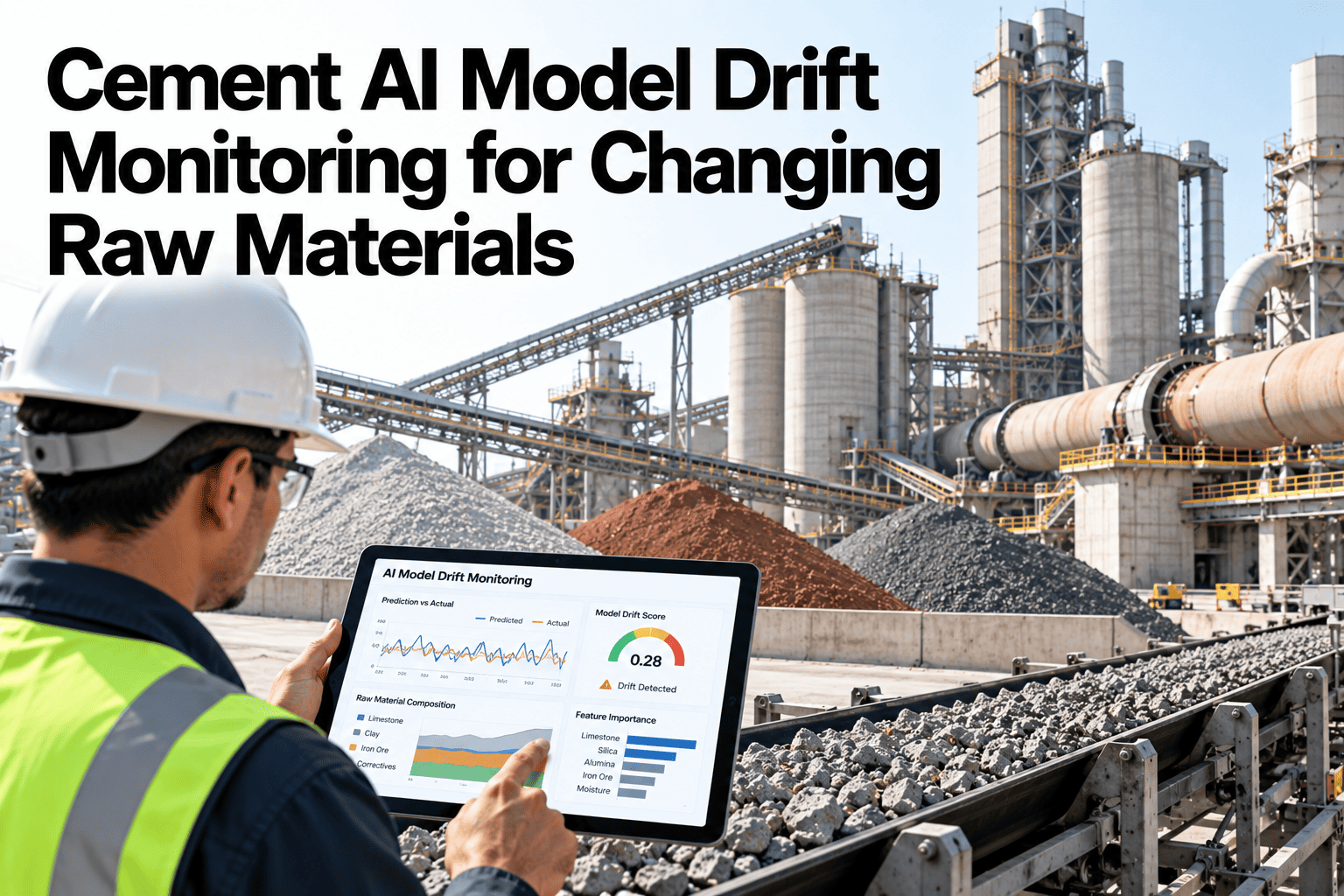
An AI model trained on last year's limestone chemistry will quietly get worse as this year's quarry face changes, and nothing on a dashboard announces the moment it crosses from slightly stale to actively wrong. Raw material variation is one of the most common and least visible causes of model drift in cement plants. This guide covers how to watch for it, what signals catch it early, and how retraining approvals should work once drift is confirmed. Teams building a drift monitoring program can book a demo with the iFactory AI team.
Cement AI Model Drift Monitoring for Changing Raw Materials
A model drifts when the data it sees in production stops resembling the data it was trained on. For cement plants, the most common cause is a shift in limestone, clay or fuel chemistry that the model never saw during training.
Three Kinds of Drift, and Why They Differ
Not all drift looks the same, and the fix depends on which kind is happening. A plant that only watches one signal will miss the other two until they show up as a quality problem.
Input drift
The raw material or fuel chemistry feeding the model has shifted away from the range it was trained on.
Prediction drift
The model's recommended setpoints are shifting in a pattern that does not match historical behavior.
Accuracy drift
The gap between what the model predicted and what actually happened is widening over time.
Input drift usually arrives first and is the easiest to catch, since it can be measured directly against raw material lab results. Accuracy drift is the most damaging and the slowest to confirm, since it needs enough outcome data to separate a real trend from normal process noise.
Raw Material Changes That Commonly Trigger Drift
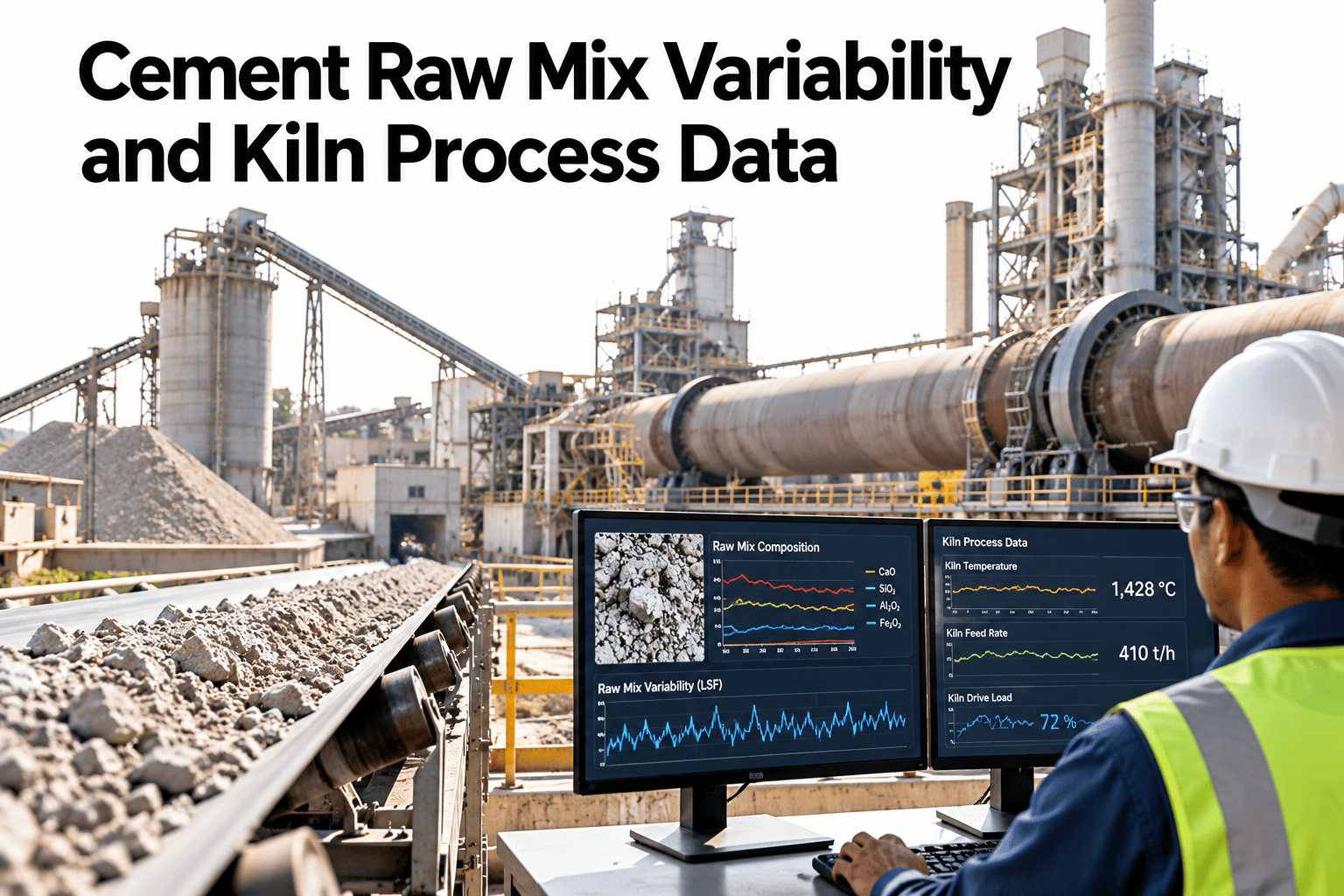
Quarry faces move, suppliers change, and alternative fuel mixes shift week to week. Each of these can push a model outside the range it was trained to handle, well before anyone intentionally changes a recipe.
| Change | What Shifts | Typical Detection Lag |
|---|---|---|
| New quarry face or bench | Limestone CaCO3 content, silica ratio | Weeks, as blending averages it out slowly |
| New clay or additive supplier | Alumina and iron ratios | Days to weeks |
| Alternative fuel mix change | Calorific value, ash content, chlorine | Hours to days |
| Seasonal moisture swing | Raw mix moisture, grindability | Days, often repeats annually |
Watching Model Performance Over Time
The chart below shows an illustrative accuracy trend for a kiln free-lime prediction model across a reporting year, with a clear step down after a quarry change in month seven.
The three-month gap between the quarry change and the retraining is the cost of not monitoring input drift directly. A plant watching raw material chemistry against the model's training range would have flagged the shift in month seven, not discovered it through falling accuracy two months later.
Catch Drift Before It Costs a Quarter
iFactory AI watches raw material chemistry against your model's training range and flags drift before accuracy visibly drops. Book a 30-minute walkthrough.
Setting Alert Thresholds
A threshold that fires on every small chemistry fluctuation trains people to ignore it. A threshold set too loosely misses real drift until it is a quality problem. Both failure modes come from the same mistake: setting one threshold for every input variable rather than tuning each to its own natural variation.
Validation Samples Before Retraining
Before a model is retrained, it is worth confirming the drift is real and not a short-term blip from a single bad lab sample or a sensor fault. A small validation step saves a retraining cycle spent chasing noise.
Retraining Approvals
Retraining a model is itself a change that needs sign-off, since a poorly retrained model can be worse than a slightly stale one. The approval step should confirm the new training data actually covers the drifted range and that performance improves on a held-out validation set before the model goes live.
| Approval Check | Owner |
|---|---|
| New training data covers the drifted input range | Data or process engineering lead |
| Validation accuracy meets or beats the prior model | Model owner |
| No regression on the previously stable input range | Model owner |
| Deployment scheduled outside a peak production window | Shift supervisor |
Plain-Language Glossary
A shared vocabulary keeps the model team and plant operations reading drift signals the same way.
Expert Review
Teams running drift monitoring programs across cement plants keep returning to the same two notes.
Watch input drift first
Input drift tracking pays for itself fastest, since it is the earliest and cheapest signal to catch. Accuracy drift matters too, but by the time it fires the cost is usually already absorbed.
Treat changes as planned
A short notice from quarry or procurement before a known change lets the model team pre-stage a validation sample, rather than reacting after drift already shows up in production.
Frequently Asked Questions
How often should we check for raw material drift?
A quarterly review is a reasonable minimum, with continuous monitoring on key chemistry variables wherever lab or online analyzer data is available. Book a demo to see a continuous drift view for your plant.
What is the difference between input drift and accuracy drift?
Input drift measures whether the data feeding the model has changed. Accuracy drift measures whether the model's predictions are getting worse. Input drift is the earlier, cheaper signal to catch.
Do we need to retrain every time drift is flagged?
No. A flag should trigger validation first, since some apparent drift traces back to a sensor fault or a single bad lab sample rather than a real chemistry shift. Book a demo to see the validation step in practice.
Who should own retraining approval?
A combination of the model owner and process engineering works well, since one confirms model performance and the other confirms the process context is correctly represented. Ask support for a sample approval checklist.
Can drift monitoring work without an online chemistry analyzer?
Yes, though detection will lag to the lab sampling frequency rather than running continuously. Many plants start with lab-based monitoring and add online analyzers later for faster detection.
Keep Your Models Honest as Raw Materials Change
iFactory AI tracks raw material chemistry against your model's training range and flags drift before it becomes a quality problem. Book a walkthrough built around your plant.