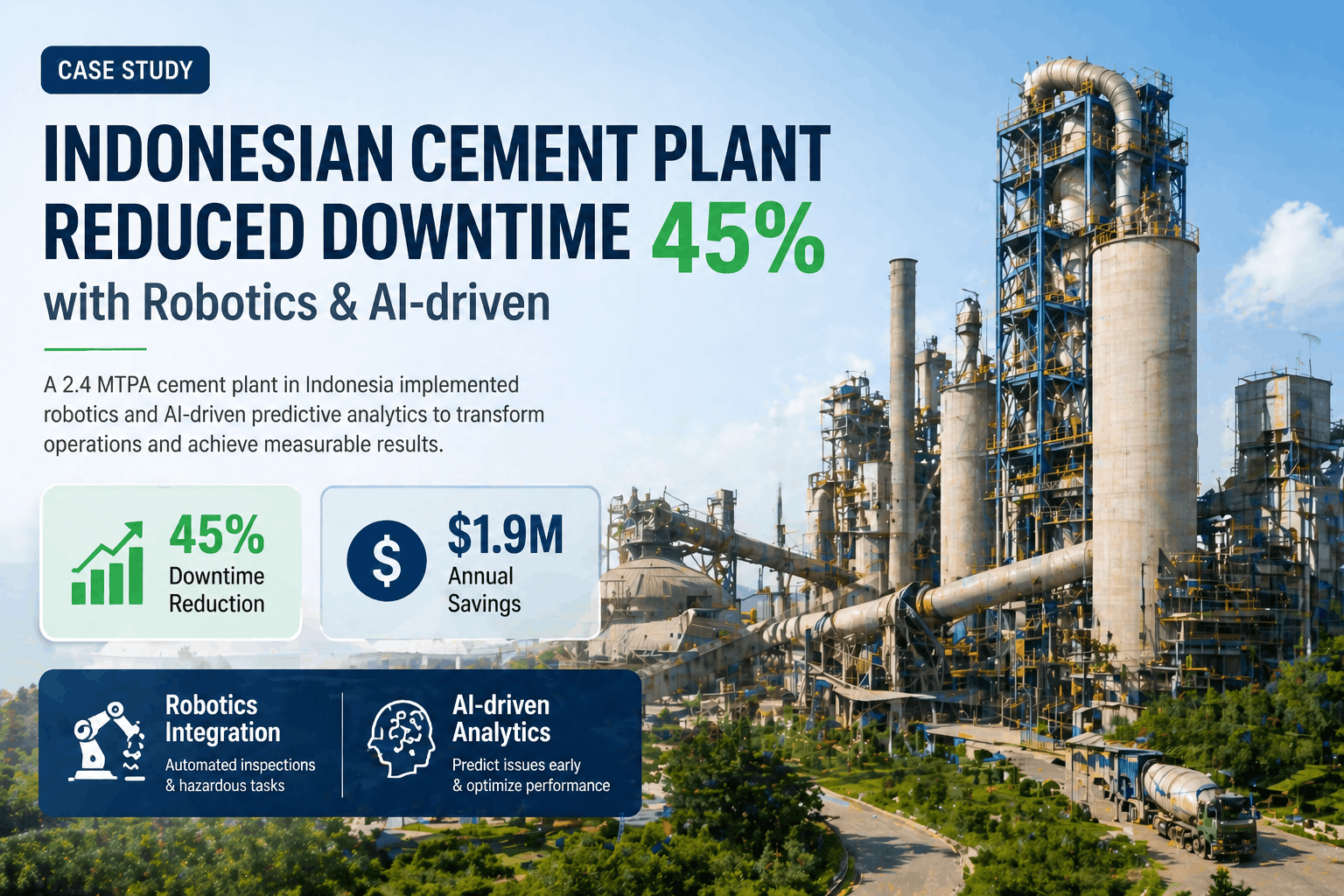
Cement plant operational reliability in Southeast Asia faces unique environmental challenges — from extreme humidity-driven sensor drift to the logistical complexities of remote limestone quarries. In 2026 a 2.4 MTPA cement facility in Indonesia has redefined the regional benchmark by reducing unplanned downtime by 45%. This transformation wasn't achieved through incremental upgrades, but through a fundamental shift to a unified AI control tower that fuses robotic inspection data with multi-sensor telemetry. If your facility is still struggling with "hidden" downtime causes, Schedule a Reliability Audit to see how iFactory's robotics-integrated software delivers measurable ROI.
Download the Full Indonesian Case Study Technical Report
Learn how 2.4 MTPA of production capacity was stabilized using iFactory's autonomous robotic inspection and AI-driven downtime analytics suite.
The Challenge: Tropical Humidity & The "Data Isolation" Barrier
Before implementing iFactory, the Indonesian facility operated in a perpetual state of reactive maintenance. High ambient humidity caused frequent premature bearing failures in the Finish Mill, while manual kiln shell inspections were often delayed due to hazardous conditions, leading to unexpected refractory brick collapses. The "islands of data" problem meant that the SCADA team saw thermal spikes, but the maintenance team didn't receive an actionable work order until the asset had already tripped.
Environmental Impact on Asset Failure Signatures
Robotic Inspection Payloads: Converting Vision to Action
The facility deployed a two-pronged strategy. First, they replaced hazardous manual inspections with autonomous drones equipped with Lidar and Thermal sensors. Second, they ingested all telemetry into iFactory's AI engine. This allowed the plant to cross-reference robotic "visual" data with vibration "auditory" data, creating a complete health profile for every critical asset. Talk to our Engineers about specific payload configurations.
| Robotic Payload | Traditional Method | iFactory Outcome | Production Gain |
|---|---|---|---|
| Lidar Structural Scan | Rope Access (12 hrs) | Drone (15 mins) | Zero Risk Silo Audit |
| IR Kiln Shell Scan | Handheld Scanner | Continuous Crawler | Hot-spot Pre-detection |
| Acoustic Analytics | Manual Ears | Autonomous Rover | Leak Detection (Quarry) |
Data Backhaul Infrastructure: Quarry-to-Control Tower
A critical hurdle in Indonesian operations is connectivity in remote limestone quarries. iFactory implemented a hybrid mesh network that ensures 100% data fidelity from the primary crusher back to the central control tower, even during monsoon conditions.
Starlink & Fiber Hybrid
Redundant backhaul ensuring that AI models in the cloud are updated every 300ms from edge sensors.
Local LoRaWAN Mesh
Connecting over 250 vibration nodes across the conveyor gallery without expensive cabling.
We stopped 'chasing' failures and started 'managing' health. The iFactory platform gave our team the visibility to see a bearing cage fault in the ID Fan three weeks before it would have seized. That single catch paid for the entire system implementation in one afternoon.
Maturity Roadmap: The 12-Month Reliability Transformation
Sensor Fusion & Baseline
Ingesting legacy SCADA feeds and deploying 120 wireless vibration nodes across the Finish Mill.
Robotic Pilot Integration
Launching autonomous drone inspections for kiln shell and pre-heater tower structural audits.
AI-Driven Work Order Scaling
Automating SAP work order triggers based on RUL (Remaining Useful Life) predictive signatures.
Enterprise Fleet Benchmarking
Synchronizing reliability KPIs across multiple Indonesian regional plants for executive visibility.
ESG & Sustainability: Reducing Carbon per Ton via OEE
Efficiency is the first pillar of sustainability. By reducing unplanned stops and optimizing kiln heat profiles, the facility achieved a significant reduction in CO2 emissions per ton of clinker produced.
Key Performance Indicators: Final Benchmark Results
| KPI Metric | Baseline (Pre-AI) | Current (iFactory) | Annual ROI Impact |
|---|---|---|---|
| OEE (Overall Effectiveness) | 74.5% | 86.2% | $850,000 Production Gain |
| Unplanned Downtime Events | 14 per Quarter | 3 per Quarter | $420,000 Maintenance Saving |
| Spare Part "Dead Stock" | $2.4M | $0.9M | $1.5M Capital Freed |
Ready to Achieve Level 4 Reliability?
See how iFactory's integrated intelligence platform can deliver a 45% reduction in your plant's downtime within the first year.
Frequently Asked Questions
How does high humidity affect AI accuracy?
iFactory uses environmental normalization algorithms to filter sensor noise caused by Southeast Asian humidity drifts.
Can this system integrate with SAP?
Yes, iFactory pushes AI-triggered work orders directly into SAP PM, reducing manual data entry to zero.
What robots were used for kiln scans?
The facility utilized autonomous crawler robots for refractory scans and thermal drones for shell imaging.
How many sensors were deployed?
A network of 120 vibration sensors and 45 thermal nodes was installed across all critical sectors.
What was the primary ROI driver?
Recovering lost production tons through downtime reduction contributed $850k in total annual savings.
Did the plant staff require training?
Staff completed a 4-week program focused on using the intuitive AI dashboard for daily decision support.
Is it compatible with legacy machinery?
Yes, non-invasive IoT sensors were retrofitted to motors and fans regardless of their manufacturer or age.
How does AI improve plant safety?
Predictive alerts eliminate emergency repairs and robotics remove humans from hazardous internal inspection zones.
Build the Reliability Strategy Your Enterprise Requires
iFactory transforms raw industrial data into a unified strategic control tower for global cement leaders.