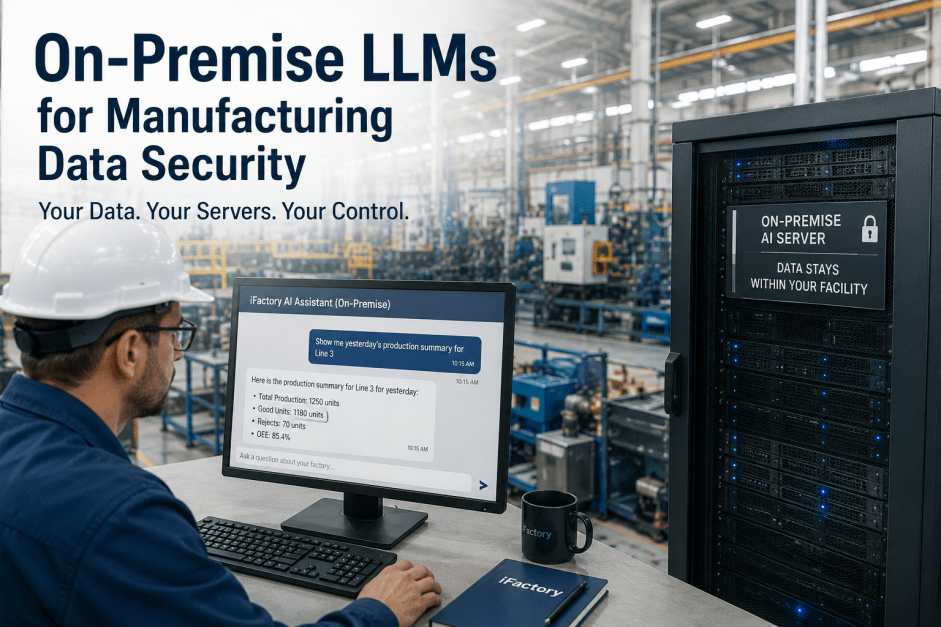
Every time a factory operator asks a cloud-based AI assistant about a production anomaly, a maintenance procedure, or a quality deviation, the question carries proprietary operational data with it — shift logs, sensor readings, equipment serial numbers, process parameters, failure histories. For most U.S. manufacturers, that data is the competitive core of the operation. It encodes the process knowledge, the equipment-specific calibration history, and the production optimization insights that took years to build. Sending it outside the facility boundary to a cloud inference endpoint — even an encrypted one — is a data governance decision that most manufacturing legal, security, and operations teams have not explicitly authorized, and that an increasing number are actively prohibiting as AI assistant usage grows across the plant floor. iFactory's on-premise LLM platform resolves this conflict without sacrifice: a fully local large language model deployment running on your own servers, inside your facility network, with zero data leaving the building — giving operators, maintenance technicians, and engineers the conversational AI assistant capability that improves productivity and decision quality, connected to your actual production data, work order history, and process documentation, and audited on your own infrastructure. U.S. manufacturers that have deployed iFactory's on-premise LLM platform report that operators resolve shift anomalies 38% faster, maintenance technicians complete troubleshooting assessments without waiting for engineering escalation in 64% of cases, and quality engineers reduce root cause investigation time from days to hours — all from a conversational interface that runs entirely on local hardware and never transmits production data externally.
Why Cloud-Based AI Assistants Create an Unacceptable Data Governance Risk for Manufacturers
The appeal of cloud-based AI assistants in manufacturing is real — conversational access to process knowledge, instant answers from documentation, pattern recognition across large datasets. The problem is structural: every cloud-based LLM deployment requires sending query context — the data that makes the answer relevant — to an external inference endpoint. In a manufacturing environment, that context is not abstract. It is the production order number, the sensor reading that preceded the anomaly, the equipment ID that failed, the batch parameters that produced the out-of-spec result, the maintenance history that explains the current failure pattern. This is exactly the data that manufacturing operations teams have spent years protecting from competitors, that legal and compliance teams have categorized as proprietary trade secret, and that IT security teams have built network perimeters specifically to contain.
The data governance gap in cloud AI deployment is not theoretical. Every conversational query to a cloud LLM is a data transmission event. The encryption protects against interception in transit; it does not protect against the inference endpoint's data retention policies, model training data practices, or the jurisdiction-specific legal obligations of the cloud provider. For U.S. manufacturers operating under export control, ITAR, CUI handling, or customer-specific data confidentiality agreements, the cloud AI question is not "is the security adequate" — it is "are we authorized to transmit this data at all." iFactory's on-premise LLM platform answers that question definitively: the data does not leave. Book a Demo to see iFactory's on-premise deployment architecture for your specific network and server configuration.
What iFactory's On-Premise LLM Connects To — and What Operators Can Actually Ask It
An on-premise LLM that only answers generic questions from a static knowledge base is a search engine with a conversational interface. The value of the iFactory platform is that the local LLM is connected to your actual production data in real time — so operators can ask about this shift's anomaly, maintenance technicians can ask about this asset's failure history, and quality engineers can ask about this batch's process parameters — and receive answers that are grounded in actual facility data rather than generic best practices. The four data connection layers that make this possible are the foundation of what iFactory's on-premise LLM delivers.
Production and Operations Data — Real-Time Shift Intelligence
The operations data layer connects the local LLM to the production historian, SCADA, and MES data streams — current and historical production rates, sensor readings, alarm records, shift logs, and downtime events. Operators can query the AI assistant in natural language: "Why did the casting speed drop on line 2 at 0340?" generates a response that synthesizes the concurrent sensor data, the alarm history, and the production log for that time window — not a generic explanation of why casting speed drops, but an analysis of what actually happened on your equipment during that specific event. This real-time data grounding is what makes the LLM a shift management tool rather than a documentation search tool.
Maintenance Data — Asset-Specific Troubleshooting Without Escalation
The maintenance data layer connects the local LLM to the CMMS — work order history, failure codes, PM schedules, condition monitoring alerts, and repair records for every asset in the register. Maintenance technicians can query the AI assistant for troubleshooting guidance that is grounded in this specific asset's actual history: "What are the most common failure modes on pump P-142 and what did the last three corrective work orders find?" returns an answer built from P-142's own maintenance record, not from generic pump troubleshooting guidance. The asset-specific history grounding is what allows the AI assistant to provide guidance that is relevant to the actual equipment condition — and what reduces the engineering escalation rate that consumes senior engineering time on routine troubleshooting decisions.
Quality Data — Root Cause Investigation at Conversational Speed
The quality data layer connects the local LLM to quality inspection records, SPC data, batch parameters, material certifications, and non-conformance reports. Quality engineers can ask questions that previously required hours of multi-system data extraction: "What process parameters were different on the three heats that produced out-of-spec tensile strength results this week compared to the in-spec heats in the same period?" The LLM retrieves the relevant quality and process data, identifies the parameter differences, and presents the comparison in natural language — replacing the manual data extraction, spreadsheet construction, and analysis that would previously have taken half a day with a 30-second conversational query.
Documents and SOPs — Institutional Knowledge Available to Every Shift
The document layer indexes the facility's entire library of standard operating procedures, equipment manuals, maintenance procedures, safety instructions, and engineering specifications into the local LLM's retrieval system — making every document instantly searchable and summarizable through natural language queries. A maintenance technician asking "What is the required torque sequence for the backup roll bearing assembly on the cold mill?" receives the specific procedure from the facility's own SOP library in seconds — not a generic web search result. For facilities with large SOP libraries where finding the right procedure is itself a time-consuming step in maintenance execution, this document AI capability alone reduces technician preparation time by 15 to 25 minutes per work order on procedures that require documentation review.
On-Premise LLM Deployment Architecture: Hardware, Security, and Integration Requirements
Deploying a production-grade large language model on facility hardware is a more accessible infrastructure investment than most manufacturers expect — modern quantized LLMs designed for inference efficiency run effectively on mid-range GPU server configurations that are already present in many industrial computing environments. iFactory's deployment architecture is designed to minimize the infrastructure delta between what most manufacturing facilities already have and what is required for the on-premise LLM platform to operate at production quality. Book a Demo to see the specific hardware and network configuration required for your facility's user count and data connectivity scope.
Server Hardware Requirements — GPU Inference Node
iFactory's on-premise LLM runs on a dedicated GPU inference server — typically a single rack-unit server with 1 to 2 NVIDIA A100 or H100 GPUs for high-concurrency deployments, or an RTX 4090 or A6000 configuration for smaller user counts. The inference hardware requirement scales with the number of concurrent users and the size of the LLM selected. For a facility with 20 to 50 concurrent users, a single A100 80GB server handles the inference load with response latency under 3 seconds for typical manufacturing query complexity. For facilities with existing NVIDIA DGX infrastructure deployed for predictive maintenance or vision AI, the LLM inference workload can typically be scheduled on existing GPU capacity without additional hardware investment.
Data Integration Layer — Connecting to CMMS, Historian, and MES
iFactory's retrieval-augmented generation (RAG) architecture connects the local LLM to structured data sources — the CMMS, production historian, MES, and quality management system — through read-only API connections that retrieve context data on demand at query time. The LLM does not store production data in its model weights; it retrieves the relevant data from the connected systems for each query and generates a response grounded in that retrieved context. This architecture means that production data remains in the authoritative source systems — the CMMS and historian — with the LLM acting as a natural language interface to data that already exists, not a new data storage layer.
Network Security and Access Control
The on-premise LLM platform runs entirely within the facility's existing network perimeter — the inference server, the RAG retrieval layer, and the user interface all operate on the internal network without any external API calls or cloud service dependencies. Access control is integrated with the facility's existing Active Directory or LDAP identity management — operators see only the data their role is authorized to access, with the same permissions model that governs their CMMS and MES access applied to the AI assistant interface. All queries and responses are logged in the local audit system for compliance review — providing the full conversation audit trail that ITAR, CUI, and customer data confidentiality requirements mandate.
Document Indexing and SOP Knowledge Base Setup
iFactory's document indexing pipeline processes the facility's existing document library — PDF procedures, Word SOPs, CAD-linked maintenance instructions, equipment manuals — into the local vector database that the LLM's retrieval system searches at query time. The indexing process runs once at deployment and is updated incrementally when new documents are added to the library. Document access control is enforced at the retrieval layer — a maintenance technician cannot retrieve an engineering design specification their role is not authorized to access, even through a natural language query. The indexing pipeline processes typical manufacturing document libraries of 500 to 5,000 documents within 4 to 8 hours of initial setup.
Model Selection and Continuous Improvement
iFactory supports deployment of multiple open-weight LLM families — Llama 3, Mistral, Phi-3, and custom fine-tuned variants — selected based on the facility's hardware constraints and accuracy requirements for manufacturing domain queries. The model is updated on a scheduled basis from iFactory's validated model release pipeline — updates are tested against manufacturing query benchmarks before release, packaged as offline update bundles, and applied without internet connectivity on air-gapped deployments. For facilities that accumulate sufficient facility-specific query and response data, iFactory's fine-tuning service produces a facility-adapted model variant that achieves higher accuracy on facility-specific terminology, equipment names, and process abbreviations than the base open-weight model.
On-Premise LLM Performance Benchmarks: What Manufacturers Achieve Across Use Case Categories
The productivity and quality outcomes of on-premise LLM deployment in manufacturing have been documented across multiple use case categories. The benchmark table below presents measured performance improvements by user role and use case at comparable manufacturing facilities — giving operations, maintenance, quality, and IT leadership the specific outcomes to build a business case for the on-premise LLM investment. Book a Demo to see a facility-specific value projection based on your user count, data connectivity scope, and current workflow inefficiency baseline.
| Use Case Category | User Role | Before On-Premise LLM | With iFactory LLM | Measured Improvement |
|---|---|---|---|---|
| Shift Anomaly Investigation | Operators / Shift Supervisors | 15–45 min manual data review; frequent engineering escalation | Natural language query returns synthesized analysis in <60 sec | 38% faster resolution; 52% fewer escalations |
| Maintenance Troubleshooting | Maintenance Technicians | Manual CMMS search + OEM manual review; 64% require engineer input | Asset-specific history + SOP retrieved and synthesized in <30 sec | 36% escalation rate; 38% faster MTTR |
| Quality Root Cause Investigation | Quality Engineers | Multi-system data extraction; 4–8 hrs per investigation | Cross-system query returns process parameter comparison in minutes | Days to hours investigation reduction |
| SOP and Procedure Lookup | All Roles | Manual document search; 15–25 min average to locate correct procedure | Natural language procedure query returns relevant SOP section in <10 sec | 15–25 min saved per work order requiring documentation |
| Production Report Generation | Shift Supervisors / Managers | Manual data assembly; 45–90 min per shift report | AI-generated draft report from production and alarm data in <2 min | 80%+ reduction in report preparation time |
| Training and Knowledge Transfer | New Operators / Technicians | Senior staff dependency; inconsistent knowledge transfer across shifts | 24/7 AI assistant with facility-specific knowledge base available to all shifts | Institutional knowledge accessible on night shifts and weekends without senior staff present |
Expert Review: What Manufacturing IT and Operations Leaders Say About On-Premise LLM Deployment
The conversation I have with every manufacturing CIO or VP of Operations about AI assistants follows the same arc. They have seen the productivity demonstrations. They understand the value. And then they ask the question that ends the cloud AI conversation: "What happens to our production data?" The answer from every cloud AI vendor is some variation of "it's encrypted and we comply with all applicable regulations" — which is accurate but not responsive to the actual question. The question is not whether the data is secure in transit. The question is whether we are authorized to transmit it at all. We have ITAR-controlled production data. We have customer-specific data confidentiality agreements that explicitly restrict where production parameters can be processed. We have trade secret protections on our process knowledge that have real legal value we are not willing to put at risk for a productivity improvement, however significant. When I show them the on-premise architecture — the LLM running on their own hardware, no internet dependency, the audit log of every query, the access control integrated with their existing Active Directory — the conversation changes from "we cannot use this" to "when can we deploy this." The technology question and the governance question are both answered simultaneously. That is what makes on-premise LLM deployment the right architecture for manufacturing, not just a technically acceptable alternative to cloud. Manufacturing operations data is fundamentally different from the enterprise data that cloud AI was designed for — it is operationally sensitive, legally constrained, competitively valuable, and operationally critical in ways that make the data governance question inseparable from the deployment decision. On-premise is not a compromise. For manufacturing, it is the right answer.
— Chief Information Officer, U.S. Integrated Manufacturing Operations — Defense and Industrial Sector — ITAR and CUI Compliance — iFactory AI Advisory Reference 2026Conclusion
The case for conversational AI in manufacturing operations is compelling and well-documented — faster anomaly resolution, reduced engineering escalation, shorter root cause investigation cycles, and institutional knowledge available on every shift regardless of who is on the floor. The barrier has never been the technology's capability. It has been the data governance question that cloud AI deployment cannot resolve for facilities with proprietary process data, ITAR obligations, customer confidentiality agreements, or simply a reasonable preference to keep competitive process knowledge inside the facility boundary where it belongs.
iFactory's on-premise LLM platform removes that barrier entirely. The LLM runs on your hardware. The data stays in your network. The audit log is on your servers. The access control uses your existing identity management. And the productivity outcomes — 38% faster anomaly resolution, 64% maintenance escalation reduction, days-to-hours quality investigation improvement — are the same regardless of whether the inference runs locally or in the cloud, because the capability is identical. The difference is that on-premise deployment is a deployment your legal, security, and operations leadership can actually authorize. Book a Demo to see iFactory's on-premise LLM running on a manufacturing-equivalent environment with real production data queries.
Frequently Asked Questions
iFactory supports Llama 3 (8B and 70B variants), Mistral 7B and Mixtral 8x7B, Microsoft Phi-3 Medium, and facility-specific fine-tuned variants derived from these base models. Model selection is determined by the hardware configuration and required response quality for the facility's specific query complexity. For air-gapped or internet-restricted deployments, model updates are packaged as offline update bundles — cryptographically signed archives delivered via secure USB or internal network transfer from iFactory's validated release pipeline — and applied without any internet connection. Update frequency is typically quarterly for base model improvements, with security patches available on an accelerated release schedule when required. Book a Demo to review the model selection for your hardware configuration.
Hallucination in LLM responses is a function of the model generating text from its training distribution when no retrieved context is available — the model "fills in" missing information from pattern memory rather than from retrieved data. iFactory's RAG architecture mitigates this by grounding every facility-specific response in retrieved source data before generation — the LLM is instructed to answer only from the retrieved context and to explicitly state when the retrieved data does not contain sufficient information to answer the query. Responses to facility-specific data queries include source citations (the specific CMMS work order, historian timestamp, or document section from which the answer was derived), enabling users to verify the retrieved source and identify when the LLM's synthesis may have misinterpreted the source data.
Yes. The base LLM models supported by iFactory's platform have strong multilingual capability — Llama 3 and Mistral variants support English, Spanish, Portuguese, French, German, and several other languages natively. For U.S. manufacturing facilities with Spanish-speaking operator populations, the AI assistant accepts queries in Spanish and returns responses in Spanish while retrieving data from English-language source systems — the translation occurs at the LLM layer without any modification to the underlying CMMS or historian data structure. Facilities with document libraries in multiple languages can index documents in their original language — the retrieval system matches query language to document language and retrieves the most relevant content regardless of language match.
iFactory's access control model integrates with the facility's existing Active Directory or LDAP identity management — every user's AI assistant session inherits the data access permissions assigned to their role in the facility's identity system. A maintenance technician cannot retrieve financial cost data from the ERP through the AI assistant because their role is not authorized to access ERP financial tables — the RAG retrieval layer checks permissions before retrieving context data and excludes data sources outside the user's authorized scope from the retrieval query. Role-based access control is configured during deployment to match the facility's existing data governance model, and all access control configuration changes require administrator authorization with full audit logging.
For a U.S. manufacturing facility deploying the on-premise LLM for 20 to 100 concurrent users with CMMS, historian, and document library connectivity, the total deployment investment runs $85,000 to $195,000 over 5 to 9 weeks — covering GPU server hardware (where not already available), LLM model licensing and configuration, RAG pipeline setup and data source integration, document indexing, access control configuration, and user training. The productivity value at comparable facilities — conservatively modeled at 20 minutes per shift per operator and technician from faster data retrieval and troubleshooting — generates $280,000 to $680,000 in annual labor productivity value at typical manufacturing shift staffing levels, producing payback within 2 to 5 months. Book a Demo to see a facility-specific value and investment model.