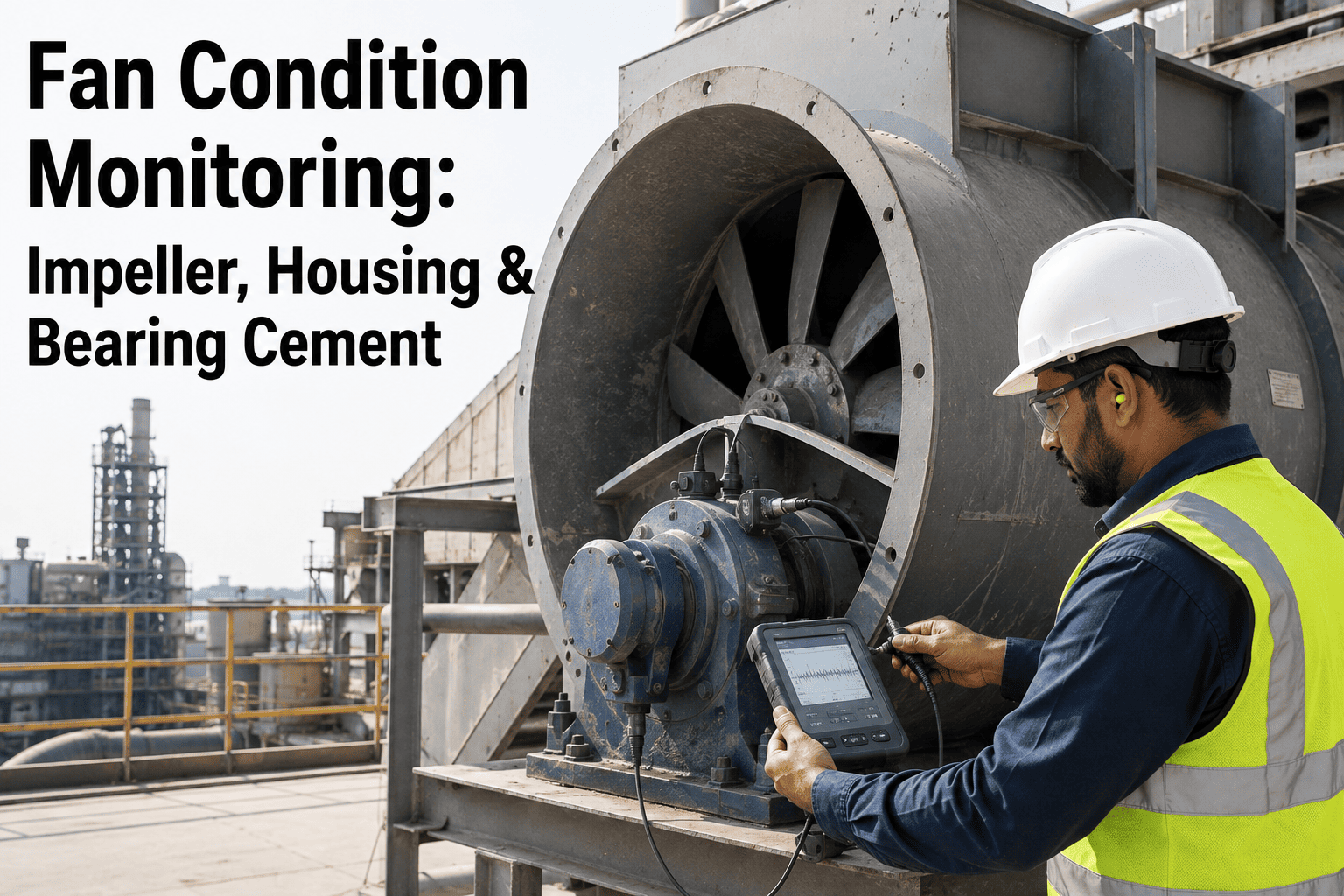
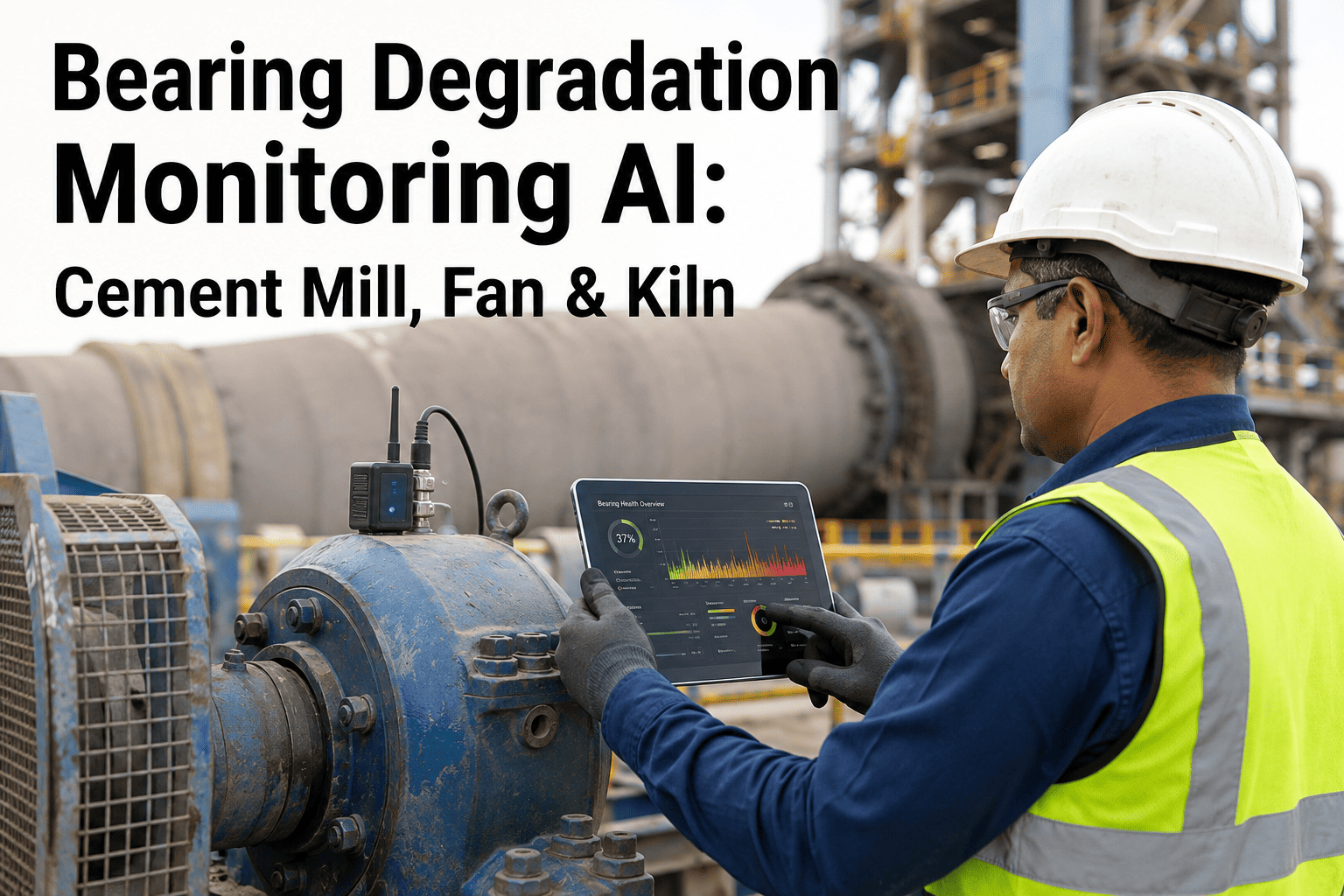
Fans quietly consume twenty to twenty-five percent of the electricity in a typical cement plant, yet they rarely get the reliability attention that kilns and mills do, largely because a fan failure feels less dramatic right up until it takes the preheater string down with it. Induced draft fans run continuously against hot, dust-laden gas streams that erode impeller blades unevenly, which throws the rotor out of balance long before anyone notices a change in sound. Preheater and cooler fans face similar wear from particulate erosion, and a fan bearing running hot for weeks under a growing imbalance eventually fails without much warning at the point of catastrophic vibration. AI-based fan monitoring tracks vibration, balance, bearing temperature, and impeller wear together, catching the drift toward failure while it is still a maintenance decision rather than an emergency shutdown. Reliability engineers can Book a Demo to see live vibration and balance tracking running against a real ID fan dataset.
Why Fans Deserve More Reliability Attention Than They Get
Kilns and mills get the bulk of a plant's condition monitoring budget because their failure modes are dramatic and well understood. Fans get comparatively little attention despite representing a substantial share of total electrical consumption and, in the case of an induced draft fan, sitting directly in the gas path that keeps the entire pyroprocessing line moving. When an ID fan trips unexpectedly, the preheater string typically has to shut down with it, turning a fan bearing issue into a full kiln stoppage.
The failure progression is usually gradual and detectable well in advance. Dust-laden gas erodes impeller blades unevenly over months, gradually shifting the rotor's center of mass and increasing vibration. That vibration accelerates bearing wear, which raises bearing temperature, which further degrades lubrication, and the cycle compounds until a trip occurs. AI monitoring interrupts this cycle early by trending vibration frequency signatures and bearing temperature together, distinguishing normal wear from an accelerating fault pattern.
The Four Signals That Define Fan Health
Rather than watching a single vibration number, AI fan monitoring correlates four signals together, since a fault often shows up in one signal before it becomes visible in the others.
Vibration Trend
Tracked against ISO 10816 severity zones for the specific fan class and mounting type.
Rotor Balance
Impeller erosion patterns are detected through characteristic frequency shifts before imbalance becomes audible.
Bearing Temperature
Trended against load and ambient conditions to separate a genuine fault from a normal seasonal shift.
Efficiency Drift
A drop in airflow per unit of power draw often signals impeller fouling or wear before vibration alone would flag it.
Built for Every Process Fan in the Plant
Induced Draft Fan
The highest-consequence fan in the plant, since a trip typically forces a preheater and kiln shutdown alongside it.
Preheater Fan
Runs against hot, particulate-heavy gas streams that erode blades unevenly and accelerate imbalance over time.
Cooler Fan
Handles high dust loading from clinker cooling air, making impeller wear tracking especially valuable here.
Periodic Vibration Checks vs Continuous AI Monitoring
| Factor | Periodic Manual Check | Continuous AI Monitoring |
|---|---|---|
| Check frequency | Weekly or monthly rounds | Continuous, every operating minute |
| Fault progression window | Can advance between checks | Detected as trend begins to shift |
| Imbalance root cause | Identified after physical inspection | Frequency signature suggests likely cause |
| Bearing temperature context | Single point-in-time reading | Trended against load and ambient conditions |
| Unplanned trip risk | Higher between check intervals | Reduced with early trend detection |
Rolling Out Fan Monitoring Plant-Wide
Prioritize Critical Fans First
Induced draft and preheater fans are typically instrumented first given their impact on kiln continuity.
Sensor Installation & Baseline
Vibration and temperature sensors are installed on bearing housings and baselined against several weeks of normal operation.
Correlated Fault Detection
Vibration, temperature, and efficiency signals are correlated together to distinguish genuine faults from normal seasonal shifts.
Scale to Remaining Fans
Once validated on critical fans, the same monitoring approach extends to cooler fans and secondary process fans across the plant.
ID Fan Predictive Maintenance — Common Questions
How is impeller wear detected before the fan becomes visibly imbalanced?
Impeller erosion changes the fan's characteristic vibration frequency signature well before the imbalance is large enough to be felt or heard. AI monitoring trends this frequency signature continuously, so a gradual shift caused by uneven blade wear is flagged while it is still a small deviation from baseline, rather than waiting until the imbalance is severe enough to show up on a monthly manual check.
Can this distinguish a genuine bearing fault from normal seasonal temperature variation?
Yes, bearing temperature is trended against load and ambient conditions rather than evaluated against a single fixed threshold, since a temperature rise on a hot summer day driven by ambient conditions looks very different from a rise driven by a genuine bearing fault at a constant load and ambient temperature. This context-aware trending is what keeps the alerting accurate rather than noisy.
What happens if the induced draft fan shows a rapid vibration spike?
A rapid spike outside the normal trend triggers an immediate alert to the reliability and operations team, since a sudden change is more likely to indicate a mechanical event such as a blade breakage rather than gradual wear. The alert includes the vibration frequency data so the team can assess severity and decide whether an immediate inspection or controlled shutdown is warranted.
Does this work on fans without existing vibration sensors installed?
Yes, most deployments include installing new vibration and temperature sensors on bearing housings as part of the rollout, since many plant fans were not originally instrumented for continuous monitoring. The installation is typically scheduled during a planned maintenance window so it does not require an unplanned fan stoppage.
How quickly can we get monitoring running on our ID fan?
A single fan can typically be instrumented and baselined within two to three weeks, after which trend-based alerting becomes active. Reliability teams ready to prioritize their ID fan can Book a Demo or reach iFactory Support for an installation walkthrough.