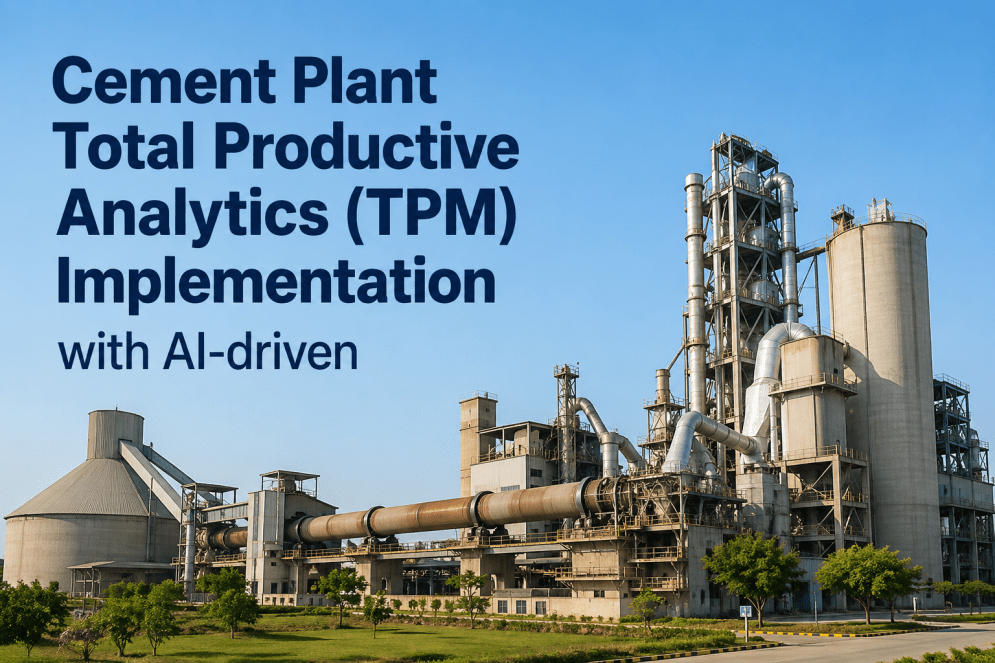
In world-class cement manufacturing, Total Productive Analytics (TPM) has evolved from a Japanese management philosophy into a high-density operational intelligence layer. Every reliability programme depends on the shared ownership of equipment between operators and maintenance teams — and yet most cement facilities still struggle with "Big 6" losses due to paper-based logs, reactive firefighting, and disconnected data silos. The gap between what a world-class OEE (Overall Equipment Effectiveness) target demands and what legacy manual TPM delivers is where chronic breakdowns, quality deviations, and safety risks breed. Understanding how to digitize the 8 pillars of TPM for cement equipment is the foundation of a proactive, zero-loss production programme. If you want to see how leading cement manufacturers close this gap with real-time TPM intelligence, you can book a demo of our TPM module today.
Is Your Cement Plant Achieving World-Class OEE Through TPM?
Deploy autonomous maintenance alerts, planned shutdown optimization, and AI-driven focused improvement — all in one unified reliability platform.
What Digital TPM Analytics Means for Cement Plant Reliability
TPM — Total Productive Maintenance — is a holistic framework for identifying, evaluating, and eliminating all losses in the production process. Within cement operations, TPM analytics extends this framework into the digital domain: continuously capturing, processing, and surfacing equipment data at every critical asset — from the raw mill to the cement silo — to verify that reliability parameters are being met in real time. For manufacturers operating in a high-cost energy environment, the requirements of a TPM programme are non-negotiable. Leading frameworks mandate documented Autonomous Maintenance (AM) checks, planned maintenance schedules, and Focused Improvement (FI) evidence — and the volume of data required at scale makes manual logbooks structurally inadequate.
Modern TPM analytics platforms address this by connecting directly to cement production equipment — Kiln drives, VRM bearings, clinker coolers, and baghouse fans — and delivering continuous OEE verification data that is audit-ready by design. The shift from reactive maintenance to proactive TPM analytics is not just a technology upgrade; it is a structural improvement in how cement manufacturers control and demonstrate reliability at every point in the production process. You can book a demo to explore how real-time TPM monitoring works across different cement asset categories.
Autonomous Maintenance (Jishu Hozen)
Empower operators to perform basic daily checks — lubrication, tightening, and cleaning — with digital prompts and photo-evidence capture that syncs directly with the central reliability database.
Planned Maintenance Optimization
Shift from "Calendar-Based" to "Condition-Based" scheduling. The AI analyzes wear patterns on mill liners and kiln refractories to schedule interventions exactly when they are needed, not a day before.
Focused Improvement (Kobetsu Kaizen)
Identify the "Top 5" loss contributors in your plant automatically. The platform quantifies the financial impact of micro-stoppages and directs engineering resources to the highest-ROI improvements.
Quality Maintenance Integration
Correlate equipment condition with clinker quality. Detect when a subtle bearing vibration in a separator is beginning to impact particle size distribution (PSD) before it causes a quality reject.
Training and Education
Bridge the skills gap by delivering digital work instructions and "Standard Operating Procedures" (SOPs) directly to the operator's tablet at the point of work, ensuring task consistency.
Safety & Environment Alignment
Integrate LOTO (Lockout/Tagout) and safety checklists directly into the TPM workflow. Ensure that every maintenance task is performed safely and that emission limits are never compromised during repair.
TPM OEE Requirements by Cement Asset: Industry Benchmarks
Not all cement equipment carries the same TPM burden. The specific monitoring requirements, critical losses, and OEE targets vary significantly by equipment type and the process bottleneck status. The table below provides a benchmark overview of TPM analytics requirements by asset category, supporting more precise reliability programme design. For any facility where TPM preventive analytics is being formalised, understanding the "Loss Profile" of each asset is essential. You can book a demo to build a TPM configuration mapped to your plant's bottleneck assets.
| Asset Type | Primary TPM Loss | Critical TPM Pillar | OEE Benchmark | Impact Risk |
|---|---|---|---|---|
| Kiln Drive / Shell | Breakdown / Thermal Loss | Planned Maintenance | 94–96% | Extreme |
| Vertical Roller Mill (VRM) | Vibration / Reduced Speed | Autonomous Maintenance | 88–92% | Critical |
| Clinker Cooler Fans | Micro-Stoppages | Focused Improvement | 95%+ | High |
| Baghouse / ESP | Quality Defects (Emissions) | Quality Maintenance | 99% Compliance | Critical |
| Conveyor Systems | Idling / Minor Stops | Autonomous Maintenance | 85% | Medium |
| Packing Machine | Setup / Adjustments | Focused Improvement | 82% | Medium |
| Primary Crusher | Startup Losses | Early Equipment Mgmt | 90% | High |
These benchmarks represent world-class TPM standards and should be validated against your specific equipment age and production intensity. To build a TPM analytics roadmap for your facility, you can book a demo with our reliability engineering team.
How Digital TPM Architecture Works in Cement Production
The architecture of a robust digital TPM programme in cement manufacturing operates across five interconnected layers — from the physical sensor at the asset level to the executive OEE dashboard. Understanding how these layers interact is essential for plant managers and operations directors who are evaluating whether their current maintenance culture is fit for modern competition. Leading cement manufacturers who have implemented data-driven TPM programmes consistently report faster loss identification, fewer unplanned shutdowns, and higher employee engagement. The transformation must be built from the autonomous maintenance layer first.
Asset Health Edge Integration
Sensors at each TPM asset transmit real-time process data — temperature, vibration, current draw, and speed — directly into the TPM analytics platform, eliminating the "lag time" associated with weekly manual inspections.
Big 6 Loss Categorization Engine
Incoming downtime data is automatically categorized into the "Big 6" TPM losses. Micro-stoppages are captured instantly, allowing for a true OEE calculation that manual systems simply cannot replicate with accuracy.
Autonomous Checkpoint Alerts
The platform triggers digital AM (Autonomous Maintenance) tasks for operators based on real-time triggers — such as "100 hours of operation since last grease check" — ensuring tasks are done exactly when needed, not just on a fixed schedule.
Planned Maintenance Alignment
Maintenance tasks are synchronized with the production schedule. If the kiln is down for a refractory patch, the platform automatically pulls forward all secondary AM and PM tasks to maximize the "window of opportunity."
Focused Improvement Analysis (Kaizen)
All TPM data is compiled into Pareto reports — exportable on demand — that identify the root causes of recurring losses. This provides the evidence base for "Focused Improvement" workshops and capital investment proposals.
Autonomous Maintenance Requirements: What Digital TPM Delivers to Operators
Autonomous Maintenance (AM) is the most challenging pillar to implement, yet it delivers the highest reliability gains. Every asset requires a defined check frequency, a standard procedure, and a completion record — all of which must be transparent for management review. Traditional paper-based AM logs fail this requirement: records are missing, "pencil-whipping" is common, and issues identified by operators often get lost before they become work orders. Digital TPM management addresses these failure modes. Scheduled AM tasks are assigned to the operator's mobile device, completion is verified with mandatory photos or sensor confirmations, and any identified issues trigger a maintenance work order automatically — creating a traceable, ownership-driven culture that eliminates chronic losses. You can book a demo to see how digital AM integrates with your existing CMMS.
TPM programmes require 100% adherence to daily CIL (Clean, Inspect, Lubricate) tasks. Digital prompts ensure these tasks are not missed, preventing the minor issues (like low grease) that cause 70% of catastrophic bearing failures.
Each AM task must follow a validated SOP — including safety precautions, tool requirements, and inspection criteria. Digital platforms surface the correct SOP at the point of work, ensuring task quality regardless of operator experience.
When an operator detects an abnormality (unusual heat, noise, or leak), it must be documented immediately. Digital TPM allows for instant photo/video capture of the issue, which is routed directly to the maintenance planner for triage.
Management needs to verify that the person performing the TPM task is competent. Digital systems track operator certifications and only assign complex AM tasks to those with the validated training level, reducing human error risk.
— Plant Manager, Global Cement Co.
Manual vs. Digital TPM: The Reliability Performance Gap
The performance difference between manual TPM documentation and a digital TPM analytics programme is structural. Facilities that have transitioned from binder-based records to real-time digital TPM consistently report measurable improvements across every reliability dimension, from OEE to employee retention. The comparison below helps reliability managers and operations directors articulate the business case for TPM analytics investment to senior leadership teams. When expressed in terms of production uptime, maintenance cost, and workforce engagement, the case for digital TPM is decisive. To understand what a transition to digital TPM would look like for your plant, you can book a demo with our reliability team.
| TPM Performance Dimension | Manual / Binder-Based | Digital TPM Analytics | Reliability Gain |
|---|---|---|---|
| Micro-Stoppage Identification | Poor (often unrecorded) | Excellent (automated capture) | Critical |
| Autonomous Maintenance (AM) Adherence | 50–65% (unverified) | 95%+ (timestamped/verified) | High |
| Focused Improvement (FI) ROI | Intuition-based projects | Data-driven Pareto projects | High |
| OEE Calculation Accuracy | Manual (±15% error) | Real-time (Precise) | High |
| Workforce Engagement | Low — "Filling out forms" | High — "Driving the plant" | Medium |
| Maintenance Cost Recovery | Low — Reactive firefighting | High — Planned interventions | Critical |
| Planned Shutdown Efficiency | Low — Scope creep common | High — Data-driven scoping | High |
Stop Fighting Breakdowns. Start Running a Zero-Loss Cement Plant.
Our TPM analytics platform gives cement manufacturers the 8-pillar digital framework needed to eliminate losses, empower operators, and achieve world-class OEE levels.
Frequently Asked Questions: TPM Analytics in Cement Plants
What is the difference between TPM and standard preventive maintenance?
Standard preventive maintenance is usually the responsibility of the maintenance department alone. TPM (Total Productive Maintenance) involves every employee, from operators to top management, in the shared goal of equipment reliability. It focuses on the "8 Pillars" to eliminate all losses, whereas standard PM often just focuses on completing tasks to prevent failure. Digital TPM makes this shared ownership practical by providing real-time data to all stakeholders.
How do I start a TPM programme in an older cement plant with legacy gear?
We recommend starting with the "Autonomous Maintenance" (AM) pillar on a single pilot line or asset, such as a cement mill. By instrumenting the asset with simple IoT sensors and giving operators digital AM tablets, you can demonstrate immediate "Quick Wins" in uptime and cleanliness. This builds the cultural buy-in needed to roll out the remaining pillars across the rest of the facility.
What are the "Big 6" TPM losses in a cement context?
In cement, the Big 6 losses are: 1) Equipment Breakdowns (e.g., kiln motor failure), 2) Setup and Adjustments (e.g., fuel changes), 3) Idling and Minor Stops (e.g., conveyor trips), 4) Reduced Speed (e.g., mill running at 80% capacity), 5) Quality Defects (e.g., clinker free-lime off-spec), and 6) Startup/Reduced Yield (e.g., heat-up phase losses).
How does OEE (Overall Equipment Effectiveness) apply to a continuous process like a kiln?
OEE is calculated as Availability x Performance x Quality. For a kiln, Availability is the actual running time vs. scheduled time. Performance is the actual clinker output vs. the design capacity. Quality is the percentage of clinker that meets chemical specifications. Even a 1% gain in kiln OEE can translate to thousands of tonnes of additional production and significant energy savings per year.
Does digital TPM replace the need for traditional maintenance technicians?
No. It makes them more efficient. By having operators perform basic "Autonomous Maintenance" (cleaning, lubrication, inspection), the highly skilled technicians are freed from "nuisance tasks" to focus on complex "Planned Maintenance" and technical "Focused Improvement" projects that actually move the needle on plant reliability.
How long does it take to see results from a digital TPM implementation?
Initial results from the Autonomous Maintenance and Focused Improvement pillars are typically visible within 3–4 months. Full cultural transformation and the achievement of world-class OEE levels (above 90%) usually require an 18–24 month journey of continuous improvement and pillar deployment.
Is the platform compatible with TPM standards like the JIPM (Japan Institute of Plant Maintenance)?
Yes. Our TPM module is designed to provide the specific data capture, reporting, and audit trails required for JIPM TPM certification, supporting your plant's journey toward the "TPM Award for Excellence."