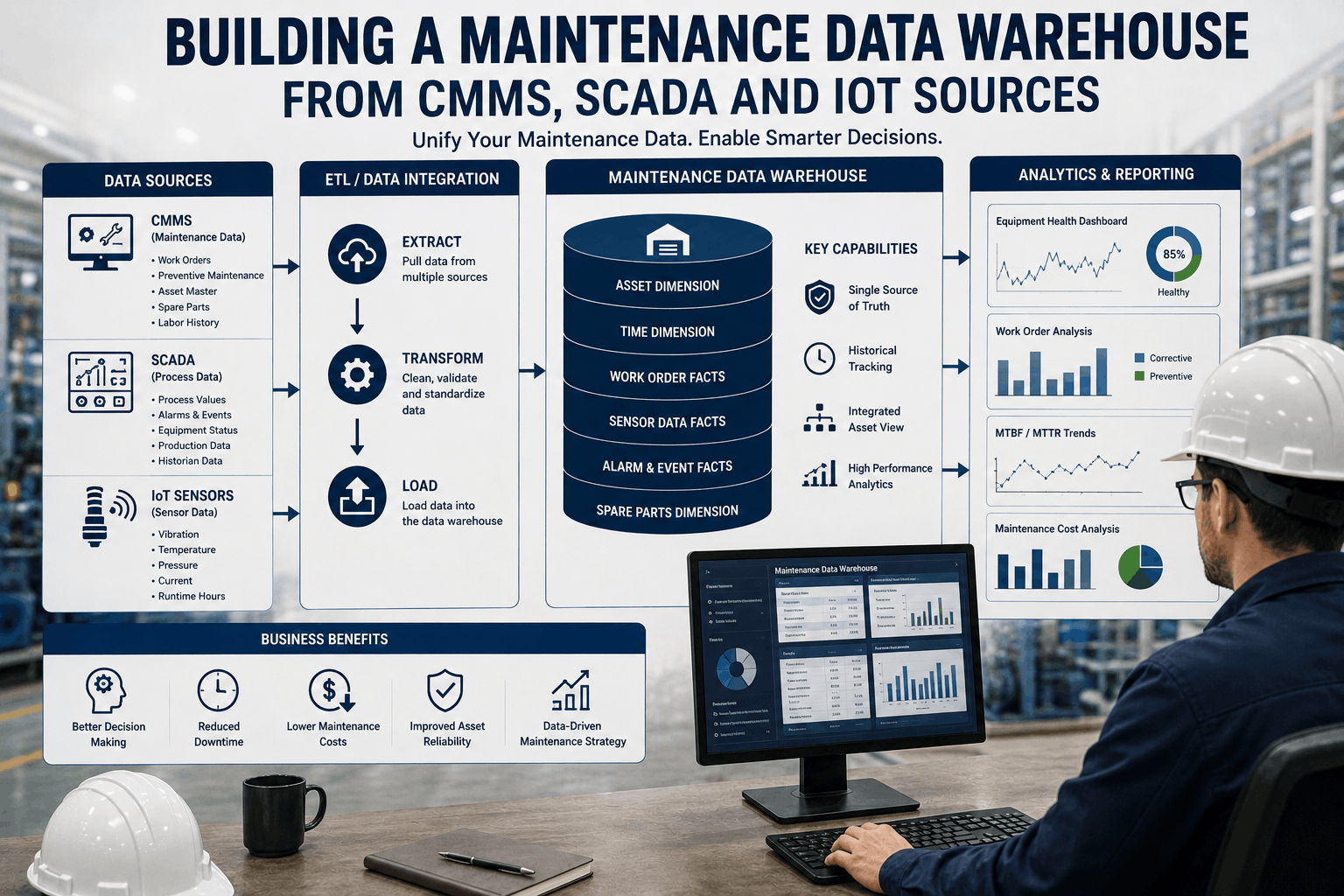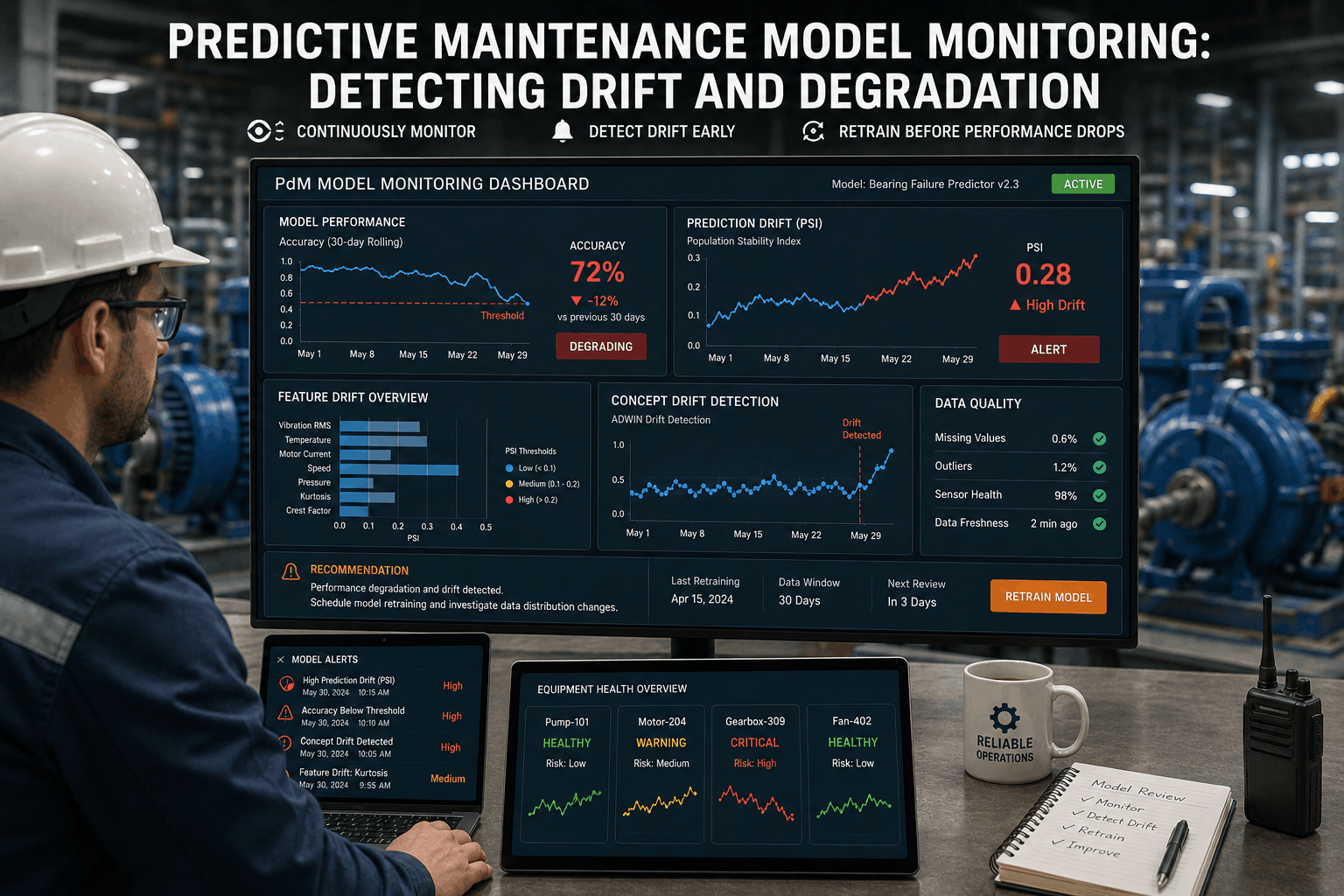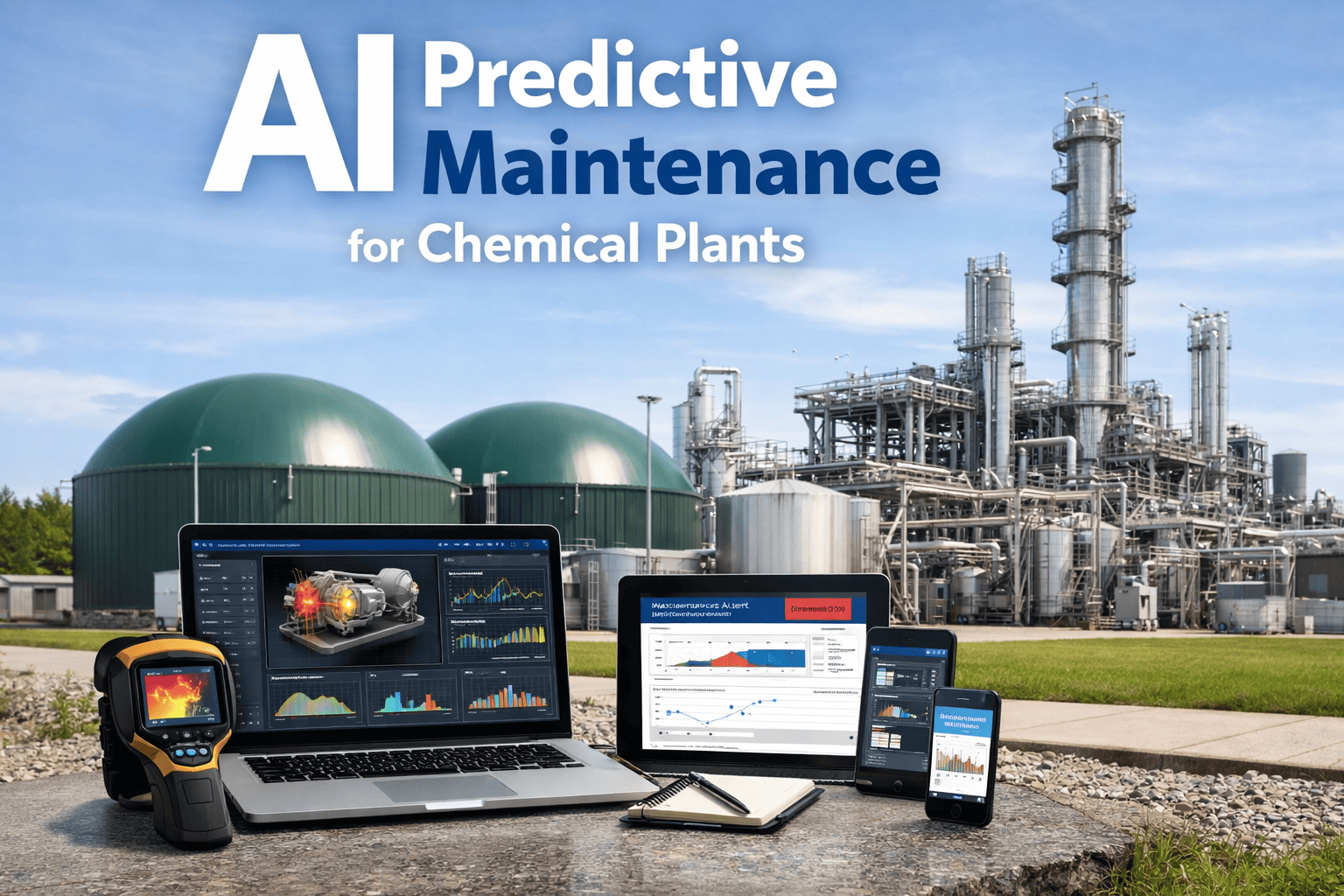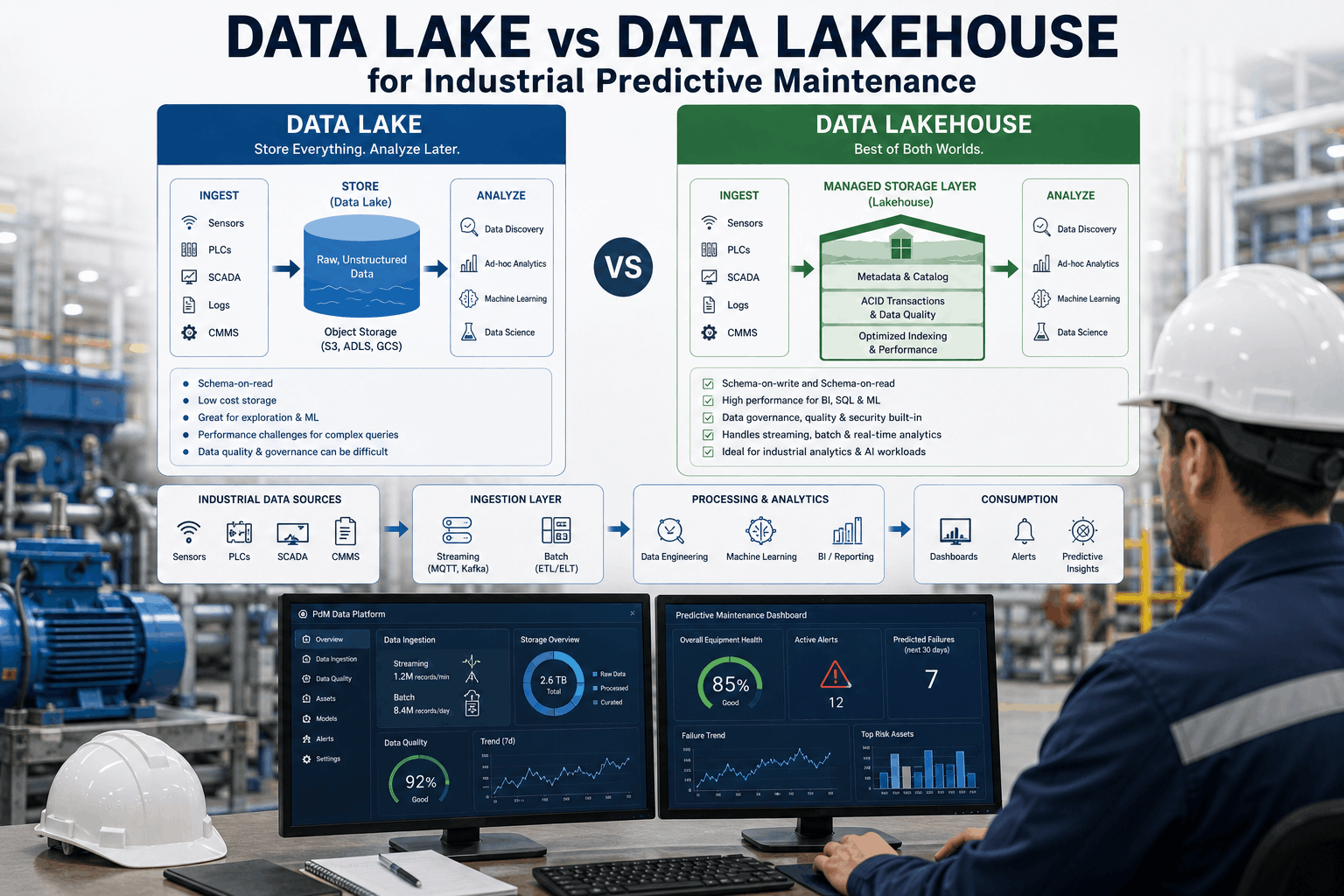
Industrial predictive maintenance demands a data architecture that stores years of high‑frequency sensor data while supporting both SQL analytics and machine learning — a balance that traditional data lakes struggle to achieve. Start Trial Free to see how iFactory’s lakehouse foundation delivers raw data flexibility with the structured performance your PdM models need.
Combine Raw Storage Scale with Structured Query Speed in One Platform
iFactory’s data lakehouse architecture gives reliability teams the flexibility to store any sensor format alongside ACID‑guaranteed feature tables — powering both ad‑hoc analysis and production ML without data duplication.
Why the Data Lake vs. Lakehouse Decision Shapes Your PdM Outcomes
A traditional data lake provides cheap, scalable storage for raw vibration waveforms and unstructured maintenance logs, but lacks the transactional guarantees and indexing needed for reliable feature engineering. A lakehouse adds a structured metadata layer, ACID transactions, and schema enforcement on top of the same low‑cost object storage. This means your PdM team can run point‑in‑time queries on historical sensor data, build versioned feature tables for model training, and serve real‑time inference — all on a single copy of data. Teams that Book a Demo see how iFactory’s lakehouse eliminates the data warehouse bottleneck that slows time‑to‑insight for equipment reliability.
-
Unified Raw and Curated Storage
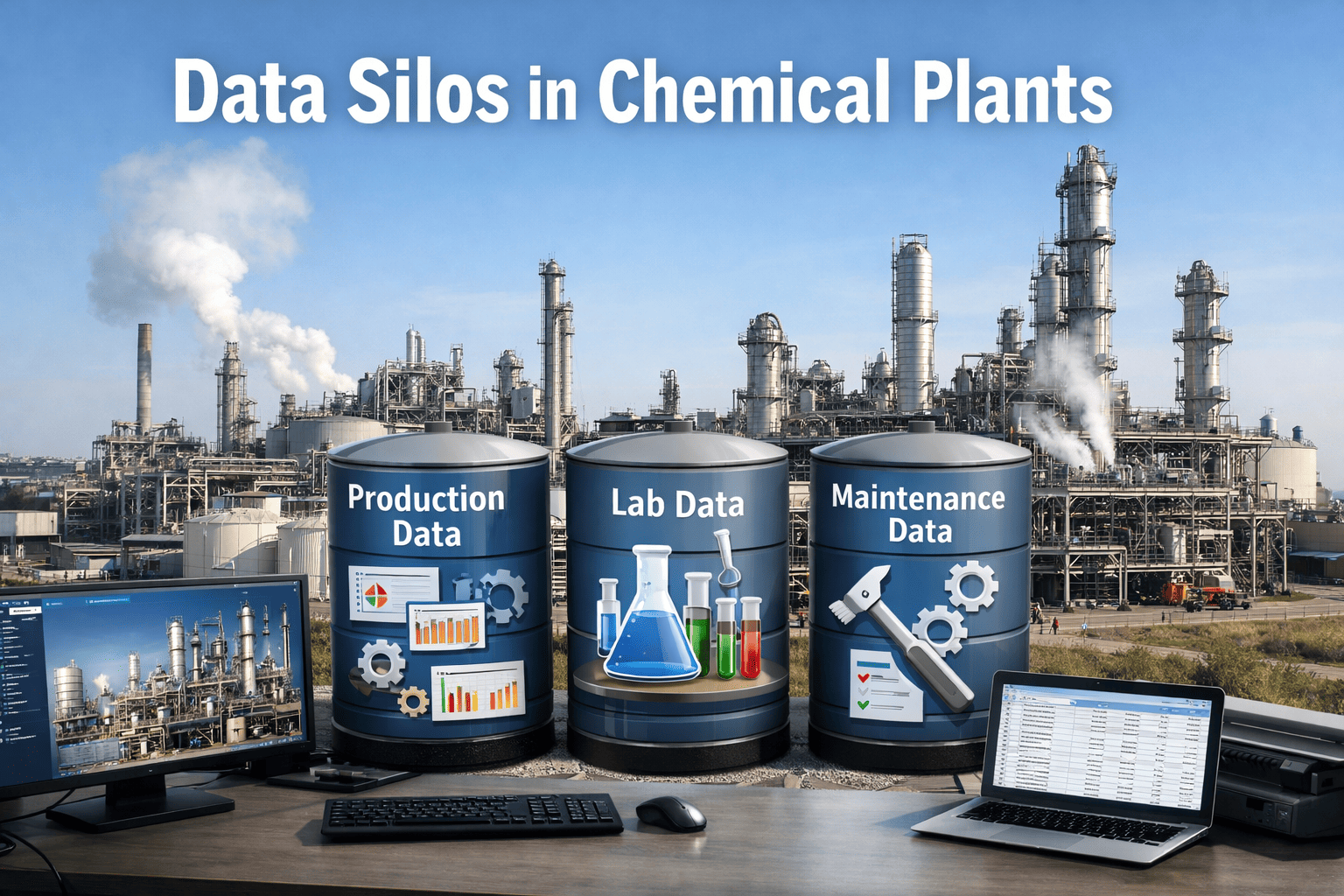
iFactory stores raw sensor streams, failure logs, and structured feature tables in the same lakehouse — no separate silos for analytics and ML, no stale copies between systems.
-
ACID Transactions on Data Lake
Lakehouse table formats like Delta Lake or Apache Iceberg bring serializable isolation to object storage, ensuring that concurrent PdM model training reads never see partial writes.
-
Schema Enforcement and Evolution
iFactory’s lakehouse validates incoming sensor data against defined schemas, catching format drift early while allowing safe schema evolution as new sensor types are added.
-
Time Travel and Data Versioning
Every write creates an immutable snapshot, enabling PdM data scientists to reproduce model training runs from any historical point and audit feature changes over time.
-
High‑Performance SQL and ML
With optimized file layouts and indexing, the lakehouse serves SQL aggregations over billions of vibration readings and feeds the same tables directly into Python‑based ML frameworks.
-
Cost‑Effective Tiered Storage
iFactory automatically moves cold sensor data to low‑cost archive tiers while keeping recent data in high‑performance tiers, balancing query speed with budget constraints.
Critical Lakehouse Capabilities for Industrial PdM Data
-
ACID Transactions and Data Consistency for Feature Tables
Data IntegrityWithout ACID guarantees, a PdM feature engineering job that reads vibration aggregates while another job overwrites the same table can produce inconsistent training data — leading to models that silently diverge from reality. iFactory’s lakehouse uses Delta Lake to provide snapshot isolation, ensuring that every query sees a consistent point‑in‑time view. Failed writes never corrupt existing data, and concurrent readers are never blocked by writes.
Table Format
Delta Lake, Apache Iceberg
Guarantee
Snapshot isolation, serializable writes
iFactory Record
Transaction log and version history per feature table
-
Query Performance for Billion‑Row Time‑Series
Query SpeedA raw data lake on S3 or HDFS requires full‑table scans for every temporal query, making interactive analysis of years of vibration data impossible. The lakehouse adds file statistics, partition pruning, and Z‑ordering on timestamp and asset ID, reducing scan volume by over 90%. iFactory engineers can query the last 30 days of bearing temperature for a specific pump in under two seconds, even when the underlying table holds five years of data.
Optimizations
Partition pruning, Z‑order, compaction
Query Time
Sub‑second aggregates on billion‑row tables
iFactory Record
Query latency and scan volume reduction per job
-
Time Travel for Model Reproducibility and Audits
Audit ReadyRegulatory and internal audits require proof of which data version trained a specific PdM model. iFactory’s lakehouse keeps an immutable transaction log, allowing data scientists to query the exact state of feature tables at any past timestamp. This enables perfect model reproducibility — the training dataset used six months ago can be materialized again bit‑for‑bit, critical for validating model accuracy claims and debugging performance regressions.
Retention
Configurable history length per table
Access
SQL timestamp or version number query
iFactory Record
Data version hash linked to each model training run
-
Unified Batch and Streaming Ingestion
Real‑Time ReadyTraditional architectures use a Lambda design with separate batch and streaming pipelines that drift apart over time. iFactory’s lakehouse ingests sensor data continuously via structured streaming, writing to the same Delta tables used for batch training. This ensures that the feature engineering code applied to historical data is identical to the code running on live inference streams, eliminating training‑serving skew.
Ingest Modes
Batch, micro‑batch, continuous streaming
Consistency
Exactly‑once semantics on streaming writes
iFactory Record
Stream‑batch code parity verification log
-
Storage Tiering and Cost Optimization
Cost EfficiencyStoring all sensor data on high‑performance SSD object storage becomes prohibitively expensive at industrial scale. iFactory’s lakehouse implements multi‑tier storage — recent data on hot tiers for fast queries, older data automatically migrated to cold archive tiers at a fraction of the cost. PdM models that require historical context can still access cold data with slightly higher latency, while interactive dashboards hit only the hot tier.
Hot Tier
SSD‑backed, sub‑millisecond metadata
Cold Tier
Object storage archive, 80% cost reduction
iFactory Record
Storage cost per GB and tier transition audit log
-
Open Format and Tool Interoperability
No Lock‑InProprietary formats trap data inside a single vendor’s ecosystem. iFactory’s lakehouse stores data in open formats (Parquet, Delta, Iceberg) that can be read by any compatible engine — Spark, Presto, Python pandas — without export or migration. Your reliability engineers can analyze PdM feature tables in their tool of choice while the data science team trains models in a different framework, all on the same governed copy of data.
Formats
Parquet, Delta Lake, Apache Iceberg
Engines
Spark, Trino, Python, Dremio
iFactory Record
Format compliance and cross‑engine validation
Lakehouse vs. Data Lake Performance Indicators
Query Latency Reduction
Lakehouse optimizations deliver 93% faster aggregate queries on time‑series sensor data compared to raw data lake scans, making interactive PdM dashboards responsive.
Data Throughput (GB/s)
Ingestion throughput (GB/s).
iFactory’s lakehouse ingests streaming sensor data at 4.2 GB/s — over 5× the throughput of the legacy data lake — with zero data loss and exactly‑once semantics.
Model Training Reproducibility
Time travel capabilities enable 100% reproducible model training — any historical run can be re‑executed on exactly the same data snapshot, satisfying audit and validation requirements.
Storage Cost per TB
Tiered storage management reduces the total cost per terabyte by 62%, while keeping hot data immediately accessible for real‑time PdM inference workloads.
Lakehouse vs. Data Lake Reference Specifications
Scroll for more
| Capability | Traditional Data Lake | iFactory Lakehouse | PdM Benefit | Implementation |
|---|---|---|---|---|
| Transactions | None — eventual consistency | ACID with snapshot isolation | Safe concurrent reads/writes | Delta Lake on object storage |
| Schema Management | Schema‑on‑read, frequent drift | Schema‑on‑write with enforcement | Catch bad data at ingest | Schema registry with evolution |
| Query Performance | Full‑table scans | Partition pruning, Z‑order, indexing | Interactive time‑series dashboards | Optimize and compaction jobs |
| Data Versioning | Manual snapshots | Automatic time travel log | Model reproducibility, audits | Delta transaction log |
| Streaming Ingest | Separate stream layer | Unified batch/stream tables | No training‑serving skew | Structured Streaming writes |
How iFactory’s Lakehouse Delivers Reliable PdM Data at Scale
The lakehouse isn’t just infrastructure — it’s the data foundation that determines how fast your PdM program can move. iFactory’s lakehouse stores raw sensor streams, curated feature tables, and model artifacts in a single governed environment. When a reliability engineer needs to investigate a false alarm, they can run a SQL query directly on the feature table version that fed the model, trace the exact input rows, and reproduce the training state — all without involving data engineering. Data scientists build features once and deploy them identically to streaming inference, eliminating skew. Facilities can Start Trial and configure their first lakehouse table within hours using iFactory’s automated schema discovery from existing sensor streams.
ACID on Object Storage
Get transactional guarantees on cheap, scalable S3‑compatible storage — no more data corruption from concurrent writes.
Time Travel Audits
Reproduce any model training run or audit a maintenance decision with point‑in‑time data queries.
Unified Pipeline
Same code for batch training and streaming inference — eliminate the Lambda architecture and its drift.
Open by Design
Store data in open formats read by any tool. No vendor lock‑in, no proprietary export tax.
Migrating from Data Lake to Lakehouse: Step‑by‑Step
01
Assess Current Data Lake Layout and Formats
Catalog existing raw data directories, file formats, and partitioning schemes to plan the lakehouse migration without disrupting live data ingestion.
02
Choose an Open Lakehouse Table Format
Select Delta Lake, Apache Iceberg, or Apache Hudi based on your existing query engines, streaming requirements, and desired feature set.
03
Convert Existing Data to Lakehouse Tables
Run iFactory’s migration jobs that read raw Parquet/JSON files, apply schema enforcement, and write governed Delta tables with transaction logs.
04
Configure Tiered Storage and Compaction
Set hot/cold tier policies and schedule automatic compaction and optimization to maintain query performance as data volumes grow.
05
Re‑Point Ingestion Pipelines to Lakehouse Tables
Switch streaming and batch sources to write directly into lakehouse tables, enabling ACID guarantees and unified schema enforcement at ingest time.
06
Validate Model Reproducibility and Performance
Test that training jobs produce identical models from time‑traveled snapshots and that query latency meets dashboard SLAs. Book a Demo to see the full lakehouse migration workflow.
Frequently Asked Questions
Can I keep my existing data lake and adopt lakehouse features incrementally?
Yes. iFactory supports a gradual migration where you convert one table at a time. Existing raw files remain accessible, and new data is written in lakehouse format with full ACID — no big‑bang cutover required.
Does the lakehouse add latency to streaming sensor data?
No. Structured streaming writes to lakehouse tables add sub‑second latency while providing exactly‑once guarantees. The same table can be queried interactively within moments of data arrival.
How is the lakehouse different from a traditional data warehouse?
A warehouse requires rigid schemas and often separates compute from storage with proprietary formats. The lakehouse stores data in open formats on low‑cost object storage while providing warehouse‑like query performance and transactions.
Will my existing Python ML scripts work with lakehouse tables?
Yes. iFactory’s lakehouse tables are accessible via standard Spark, pandas, and PyArrow APIs. No code changes are needed to read Delta or Iceberg tables, and you get the benefits of predicate pushdown and partition pruning automatically.
What happens to storage costs as sensor data accumulates over years?
iFactory’s tiered storage automatically moves older data to low‑cost archive tiers while retaining metadata for query planning. You can set retention policies per asset type, ensuring compliance without ballooning costs.
Build Your Predictive Maintenance on a Future‑Proof Lakehouse Foundation
iFactory’s lakehouse gives you the scalability of a data lake with the reliability of a warehouse — so your PdM data is always consistent, queryable, and model‑ready.