The global polymer and plastics industry is the largest chemical industry subsegment — producing 391 million tons of plastics annually across polyethylene (PE), polypropylene (PP), polyvinyl chloride (PVC), polyethylene terephthalate (PET), and advanced engineered polymers. Every plastic bottle, automotive part, electrical housing, and food packaging in the world starts in a polymer reactor or on an extrusion line where temperature, pressure, residence time, and feed composition must remain in narrow tolerance windows. Shift by just 5°C, and molecular weight drifts. Deviate on reactor circulation flow, and polymer degrades. Miss a pelletizer bearing early-warning signal, and a $500K line stops. Robotics and AI monitoring are transforming polymer and plastics plants from reactive firefighting to predictive precision manufacturing — extending reactor run lengths, improving first-pass yield, and cutting waste by 8–15%. Book a demo to see how iFactory monitors polymer plants on-premise or in the cloud.
Polymer & Plastics Manufacturing
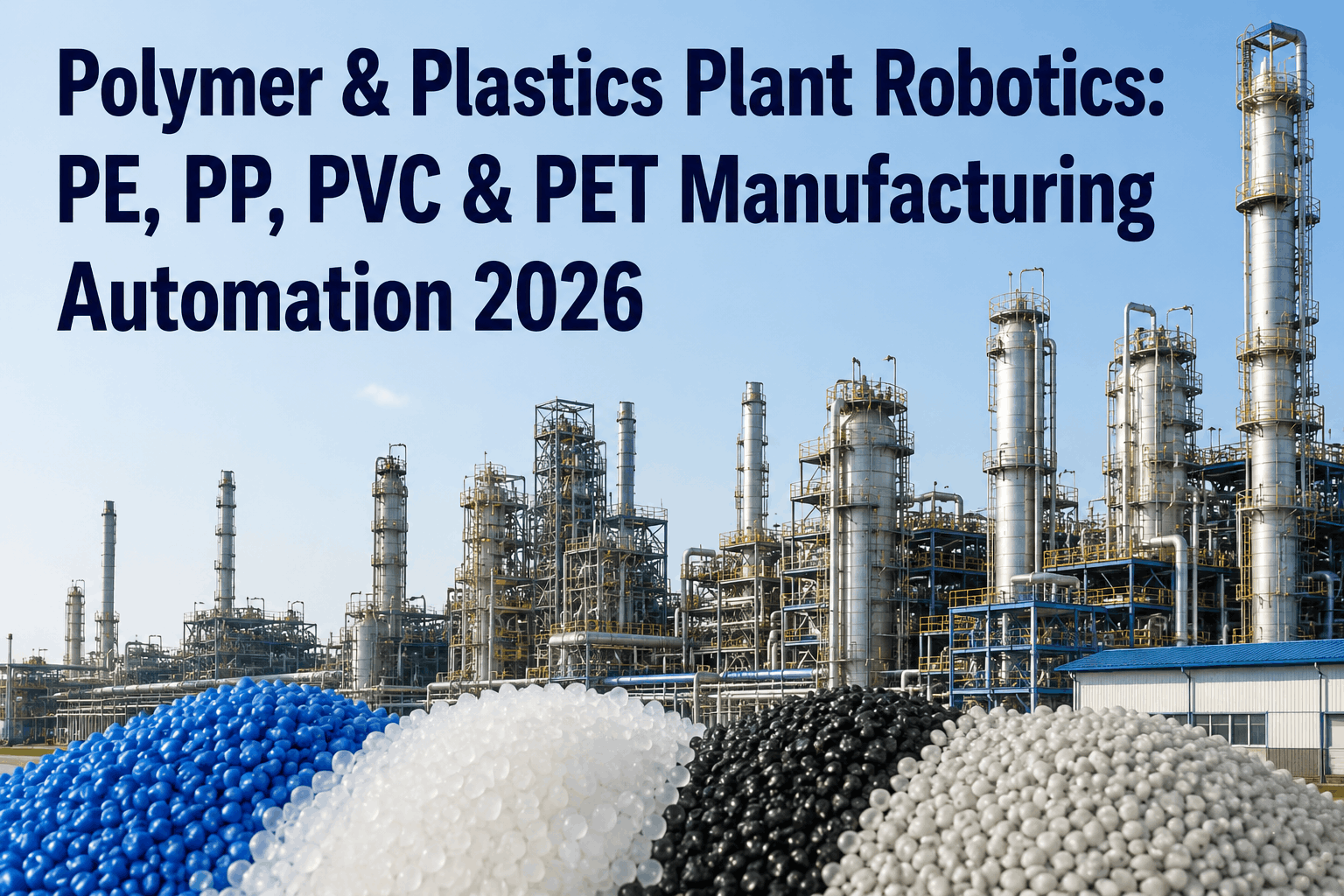
Polymer & Plastics Plant Robotics: PE, PP, PVC & PET Manufacturing Automation 2026
Reactor monitoring. Extrusion line predictive maintenance. On-premise and cloud AI for polymer quality, yield optimization, and waste reduction.
391M
tons of plastics produced globally annually
5°C
Temperature deviation triggers molecular weight drift
8–15%
Waste reduction with AI-driven process control
The Polymer Challenge: Operating in Molecular Window
Polymer manufacturing is a physics problem with razor-thin margins. A polyethylene reactor operating at 250°C and 2,500 bar maintains a specific residence time distribution that controls chain length and molecular weight. Miss that window by 10 minutes, and the entire batch drifts to below-specification. A PP extrusion line melting polypropylene pellets must control barrel temperature zone-by-zone because melt temperature directly affects viscosity, melt flow index (MFI), and stress properties of the finished product. Shift downstream cooling water temperature by 3°C, and part shrinkage increases, triggering dimensional failures in tight-tolerance molded parts. Talk to our polymer specialists about how iFactory catches these drift signals before they cascade into product failure or downtime.
Six Critical Polymer Manufacturing Challenges
1
Reactor Residence Time Drift
Flow rate or pressure changes alter residence time distribution, causing molecular weight variation in the batch. Detectable via circulation pump vibration and outlet temperature signatures before product specification is breached.
2
Extrusion Temperature Profile Imbalance
Multi-zone barrel heaters operate independently; a single zone failure or setpoint drift raises local melt viscosity, reducing throughput and degrading product homogeneity. Early detection requires real-time barrel surface thermal imaging.
3
Screw Wear & Degradation Signals
Extruder screw wear increases melt temperature, reduces melt quality, and increases power consumption. Wear progression takes weeks; early detection via motor current and melt pressure signatures allows planned screw replacement before catastrophic failure.
4
Catalyst Deactivation & Reactor Fouling
Catalyst particles degrade during polymerization, reducing reaction rate and requiring higher reactor temperature to maintain production rate. Undetected fouling causes yield loss, energy waste, and eventual reactor shutdown for cleaning.
5
Pelletizer Bearing & Cutting System Wear
Pelletizer bearings degrade under continuous shear and thermal stress. Cutting blades dull gradually, increasing strand power draw and producing out-of-specification pellet size. Real-time vibration monitoring predicts bearing failure 1–2 weeks in advance.
6
Downstream Cooling Water Temperature Sensitivity
Cooling water temperature controls polymer solidification rate and part dimensional stability. A 3–5°C change causes shrinkage variance of 0.2–0.5%, triggering rejections in tight-tolerance applications. AI detects cooling imbalance before dimensional failures emerge in production.
What Robotics & AI Monitoring Actually Deliver in Polymer Plants
Traditional polymer process control relies on setpoint-based PID loops and periodic operator rounds. If a barrel zone heater drifts 2°C, the operator sees it on the next control room check — which happens every 15–30 minutes. By then, the melt is already degrading. If a reactor circulation pump bearing begins to fail, vibration increases for days before an alarm triggers. If a pelletizer blade dulls, power draw creeps up gradually — invisible to operators until throughput drops noticeably. Schedule a demo to see how iFactory's real-time monitoring integrates with your reactor and extrusion infrastructure.
T
Continuous Thermal Profiling
Infrared cameras mounted on extrusion barrels and reactor jackets capture zone-by-zone temperature every 10 seconds. AI detects heater failure, setpoint drift, or imbalanced heating instantaneously — before PID loops respond or product specification drifts.
V
Vibration & Motor Current Signature Analysis
Accelerometers on extruder motors, reactor circulation pumps, and pelletizer drive shafts detect bearing wear, blade dulling, screw degradation, and coupling imbalance via unique vibration fingerprints. AI recognizes wear progression patterns from day 1, predicting component failure 2–4 weeks in advance.
P
Process Parameter Fusion & Drift Detection
Real-time integration of reactor pressure, circulation flow, outlet temperature, melt temperature, and downstream cooling water temperature creates a unified digital model of polymer state. AI detects multivariate drifts that single-sensor monitoring misses — flagging catalyst deactivation or residence time drift before batch failure.
Q
Molecular Weight & Melt Flow Index Estimation
Soft sensor models trained on historical correlations between process parameters and final product properties predict molecular weight and MFI in real time. AI alerts operators to out-of-spec product 30–60 minutes before material reaches the pelletizer, enabling grade adjustment rather than batch rejection.
On-Premise or Cloud: iFactory Serves Polymer Plants Both Ways
Polymer and plastics manufacturers typically run proprietary formulations, IP-sensitive process recipes, and competitive material specifications. Many are unwilling to transmit detailed reactor parameters to cloud systems. Others operate multi-facility networks requiring centralized monitoring. iFactory supports both architectures — on-premise for data sovereignty, cloud for cross-site consolidation — without feature compromise or performance penalty.
On-Premise
All reactor and extrusion sensor data processes locally
Zero proprietary formulation data leaves facility
Direct DCS and control system integration
Air-gap compatible for high-security environments
Real-time alerts 24/7 — no cloud dependency
OR
Cloud
Real-time monitoring across all polymer facilities
Cross-site benchmarking — PE, PP, PVC yields compared
Mobile access from office or remote location
Automatic model updates without deployment
Scales seamlessly for enterprise rollout
Both models deliver identical real-time monitoring, AI alerting, and predictive maintenance. Talk to our team about which deployment aligns with your corporate IT and compliance requirements.
Real Polymer Plant Results
8–15%
Waste reduction through early off-spec detection and process adjustment
12–18%
Yield improvement via catalyst deactivation early warning
6–10 days
Equipment failure prediction window before catastrophic breakdown
22%
Energy consumption reduction via optimized thermal control
Which Polymer & Plastics Operators Are Deploying Today
The world's largest polymer producers — Borealis (polyolefins), Repsol (PE, PP, PVC), Sasol (polymers), INEOS Styrolution (polystyrene and ABS), Lyondell (polyethylene), and BASF (engineering plastics) — are all investing in advanced process monitoring. Some deploy robots; most integrate multi-sensor networks with AI analytics. The shift from batch testing to real-time quality prediction is accelerating across the industry.
Borealis
Polyethylene (LDPE, HDPE), Polypropylene, Polybutene
Focus: reactor optimization, waste reduction, circular economy
Repsol Industrial
PE, PP, PVC, Engineering Polymers
Focus: specialty polymers, additive integration, quality assurance
Sasol
Polyethylene, Polypropylene, Specialty Polymers
Focus: coal-to-chemicals integration, cost optimization
INEOS Styrolution
Polystyrene (GPPS, HIPS), ABS, SAN
Focus: automotive ABS, appliance-grade materials
Lyondell Basell
PE, PP, PET, Advanced Polymers
Focus: bottle-grade PET, food-packaging PE, circular solutions
BASF
Polyurethanes, Engineering Plastics, Thermoplastics
Focus: automotive thermoplastics, high-performance composites
Common Questions About Polymer Plant Robotics
Can iFactory integrate with existing polymerization DCS systems (AspenTech, Honeywell, Rockwell)?
Yes. iFactory connects via OPC-UA, REST APIs, or direct database reads. Reactor temperature, pressure, circulation flow, feed composition, and product outlet data flow continuously into iFactory's analytics. On-premise deployment keeps all data local; cloud deployment enables multi-site consolidation.
Schedule a technical discussion to confirm DCS compatibility.
How does iFactory predict extrusion screw wear before motor overload?
Screw wear increases melt temperature and motor current draw. iFactory monitors motor current signature, melt outlet temperature, and barrel zone temperatures in parallel. AI recognizes the unique fingerprint of wear progression — rising power draw coupled with rising melt temperature — predicting screw failure 2–3 weeks before motor overload forces line shutdown.
What happens if catalyst deactivation is detected mid-batch?
iFactory alerts operators immediately when catalyst deactivation signals emerge (rising reactor pressure at constant flow, dropping reaction rate despite temperature increase). Operators can increase reactor temperature slightly to compensate and extend reactor run time — or flush and reload catalyst proactively. Manual detection typically happens only after significant yield loss.
Can iFactory monitor both on-premise and cloud deployments from the same dashboard?
Yes. Plants with both architectures (on-premise reactor monitoring + cloud extrusion consolidation) can view unified dashboards showing real-time data from both systems. Data is never transmitted between on-premise and cloud systems; both report separately to the unified view layer.
iFactory Polymer Platform
Know Your Polymer Before It Fails. Monitor at Molecular Resolution.
iFactory integrates reactor sensors, thermal imaging, motor current analysis, and DCS data into unified AI analytics for PE, PP, PVC, PET, and advanced polymer plants. Available on-premise or cloud. Reduce waste by 8–15%, extend equipment life, prevent unplanned downtime.
On-Premise Available
Cloud Available
Reactor Monitoring
Extrusion PdM
Waste Reduction AI
.png)