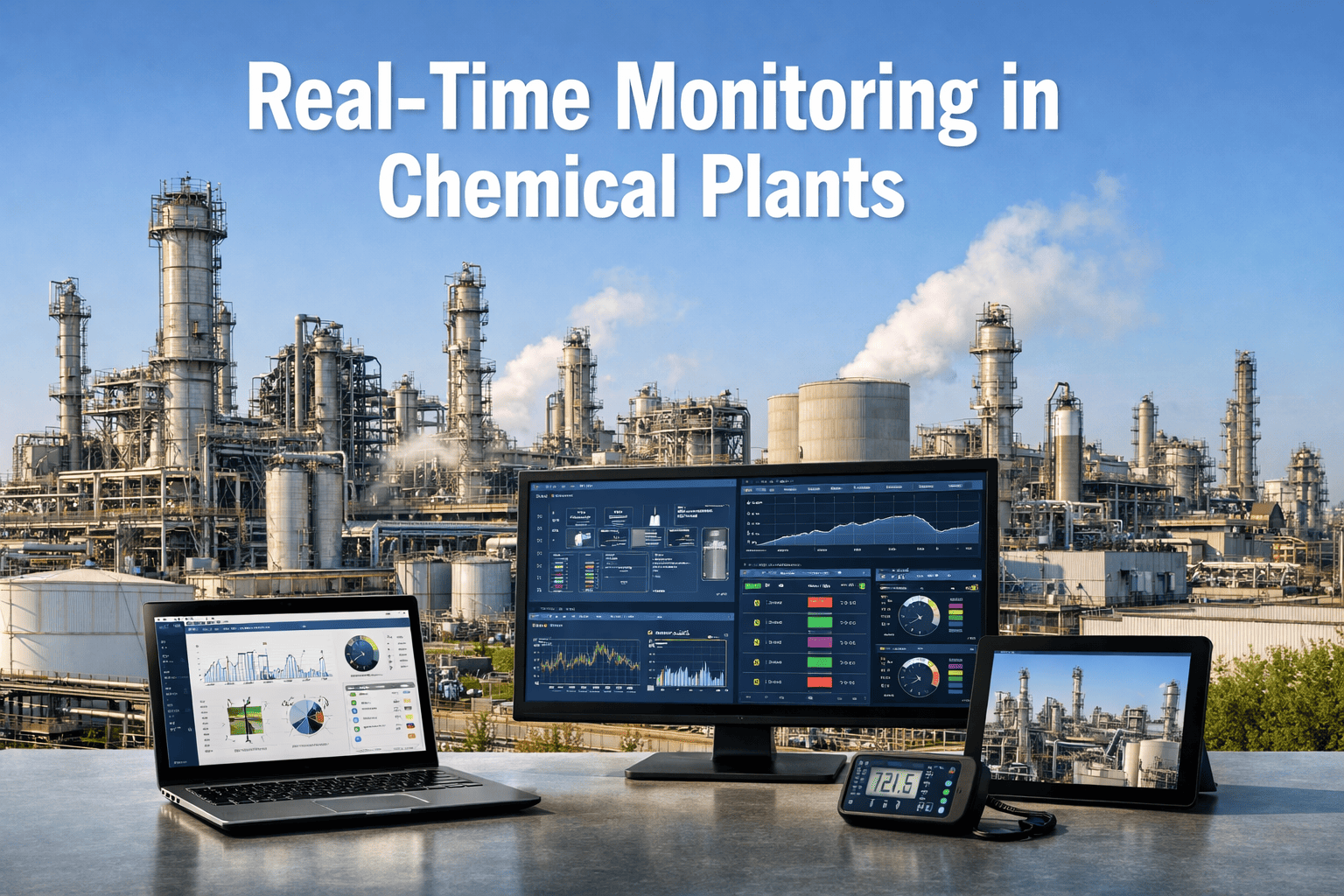
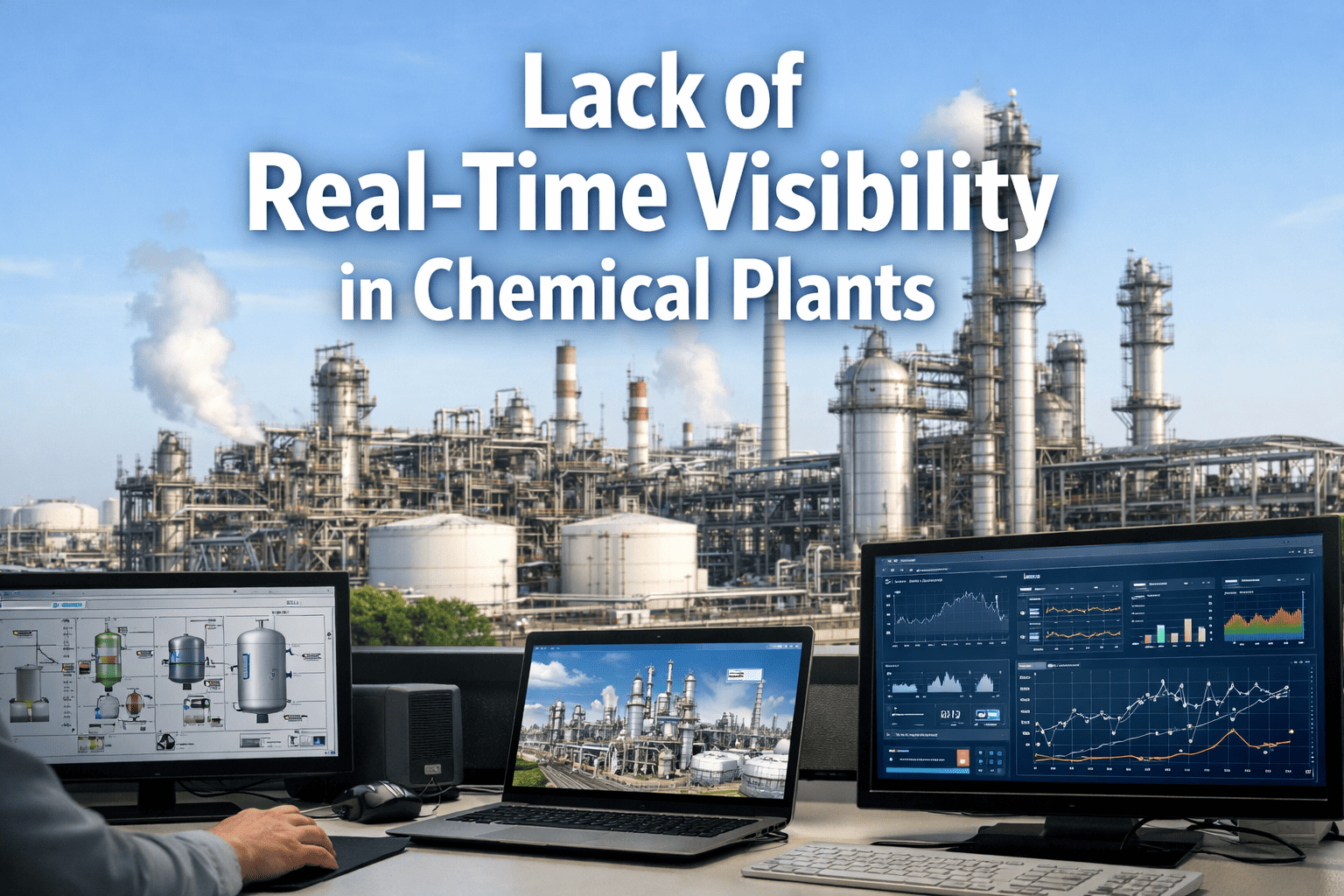
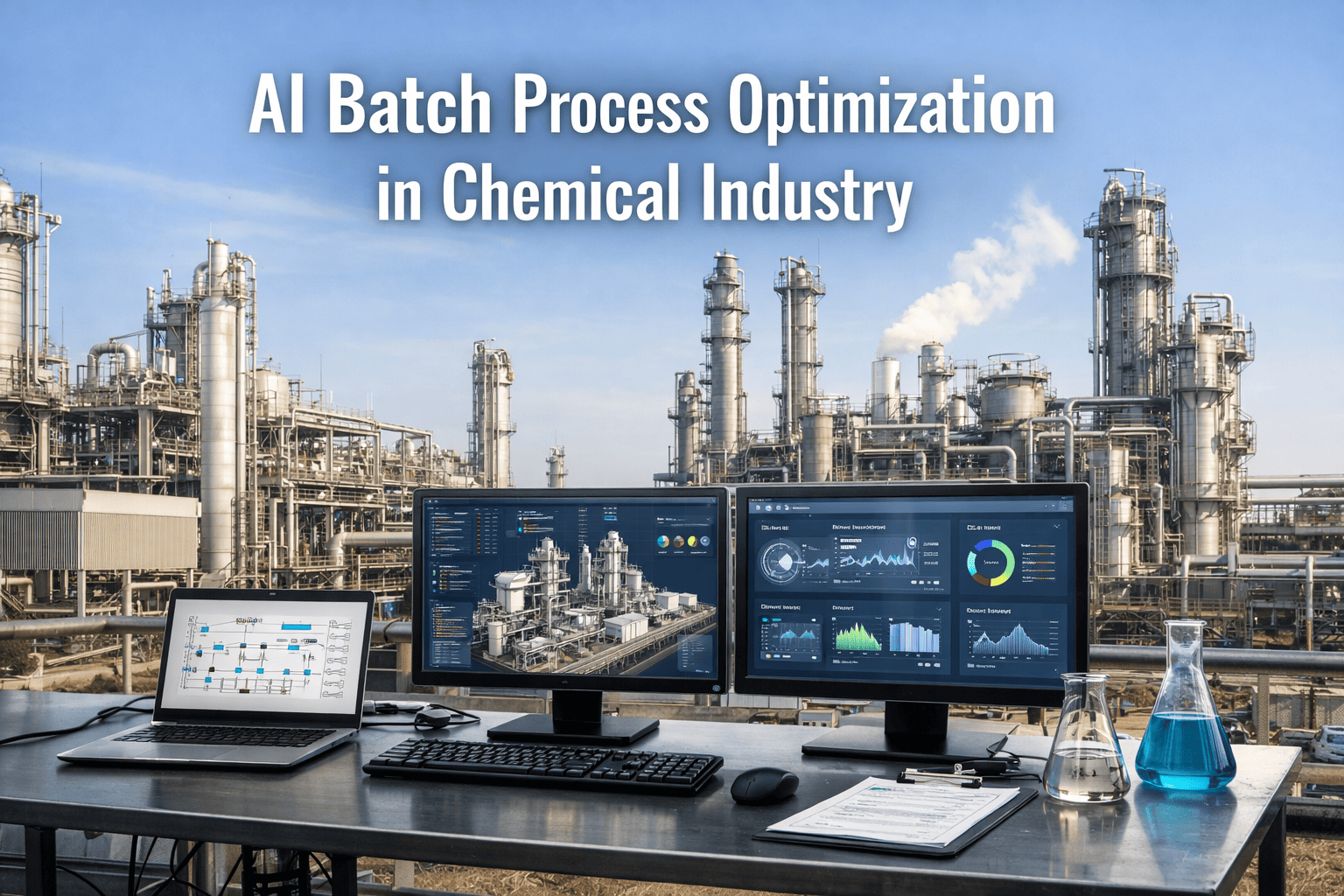
Chemical plant operators managing complex batch reactors, distillation columns, and separation units face a persistent operational challenge: critical process deviations often occur between scheduled control room checks, yet traditional SCADA and DCS systems provide only periodic snapshots of plant performance—by the time an anomaly is detected through manual trend analysis or threshold alarms, product quality has already degraded, energy consumption has increased 12–22%, and potential safety incidents have escalated from manageable deviations to emergency response scenarios costing $28,000–$74,000 per event. iFactory's real-time monitoring platform continuously analyzes reactor temperature profiles, pressure trends, flow rates, composition analyzer data, vibration signatures, and energy consumption patterns across your chemical processes, detecting multivariate anomalies and performance deviations 8–24 hours before they impact product quality, safety, or operational continuity—enabling proactive interventions that maintain optimal efficiency, protect asset integrity, and empower operators with contextual intelligence delivered through intuitive, role-based dashboards accessible from control rooms, mobile devices, or remote command centers. Book a demo to see real-time monitoring capabilities for your chemical plant configuration.
Continuous Process Visibility
Traditional monitoring systems sample process data at fixed intervals, creating blind spots where critical deviations can emerge undetected. iFactory establishes continuous, high-frequency data acquisition from DCS, IoT sensors, and analytical instruments—creating a real-time digital twin of your chemical processes that enables operators to observe, analyze, and respond to process behavior with unprecedented temporal resolution and contextual awareness.
Intelligent Anomaly Detection
Rule-based alarm systems generate excessive false positives while missing subtle multivariate deviations that precede quality excursions or equipment failures. iFactory's AI models analyze correlations across hundreds of process variables to distinguish normal operational variance from emerging anomalies—reducing alarm fatigue by 64% while improving early detection of process upsets, equipment degradation, and safety-critical deviations before they escalate to incidents requiring emergency response.
Actionable Operational Intelligence
Raw process data becomes actionable intelligence through contextual visualization, predictive analytics, and role-based delivery. iFactory transforms high-frequency sensor streams into intuitive dashboards that highlight critical KPIs, surface root-cause insights, and recommend corrective actions—enabling operators, engineers, and managers to make faster, more confident decisions that improve product quality, reduce energy consumption, and strengthen process safety across chemical manufacturing operations.
Quick Answer
iFactory enables real-time chemical plant monitoring through secure integration with existing DCS, SCADA, historians, and IIoT sensors via OPC-UA, MQTT, or API connections—establishing continuous data acquisition without modifying legacy control logic. AI-powered analytics process 250–500 process tags per unit at 15-second to 5-minute intervals, detecting multivariate anomalies, predicting equipment failures, and identifying optimization opportunities. Contextual insights are delivered through role-based dashboards accessible via control room HMIs, web browsers, or mobile devices—enabling operators to maintain situational awareness, engineers to perform rapid root-cause analysis, and managers to monitor KPIs across multiple units. The platform supports hybrid deployment models (cloud, edge, on-premises) that meet chemical industry security requirements while enabling scalable, real-time operational intelligence that compounds value through continuous learning and adaptive threshold optimization.
How Real-Time Monitoring Delivers Measurable Chemical Plant Value
The workflow below shows iFactory's four-stage monitoring approach: comprehensive data integration from existing operational systems, intelligent analytics deployment for anomaly detection and prediction, contextual visualization enablement for cross-functional teams, and continuous value optimization through performance tracking and model refinement.
1
Unified Data Acquisition & Contextual Integration
iFactory establishes secure, high-frequency connectivity to existing DCS, SCADA, historians, and IIoT sensors via OPC-UA, MQTT, or API integrations—acquiring 250–500 process tags per production unit at 15-second to 5-minute intervals without modifying legacy control logic. Platform creates unified time-series data lake with contextual metadata, equipment hierarchies, and process flow relationships. System establishes dynamic baseline models from 30–60 days historical data, identifying normal operating envelopes, seasonal patterns, and multivariate correlations across chemical manufacturing processes.
AI models analyze real-time process data streams to detect multivariate anomalies, predict equipment failures, and identify optimization opportunities invisible to rule-based monitoring. Machine learning algorithms evaluate correlations across temperature, pressure, flow, composition, and vibration parameters to distinguish normal operational variance from emerging deviations. System generates contextual alerts with severity ranking, predicted impact, and recommended actions—delivered through existing operator interfaces to enable rapid response without workflow disruption or alarm fatigue.
8-hour early warning64% fewer false alarmsMultivariate correlation
→
3
Contextual Visualization & Role-Based Delivery
Real-time insights become actionable through intuitive, role-based dashboards that surface critical KPIs, trend visualizations, and diagnostic tools tailored to operator, engineer, and manager workflows. Platform supports customizable views, drill-down analytics, and collaborative annotation capabilities that enable rapid root-cause analysis, cross-shift knowledge transfer, and data-driven decision-making. Mobile-responsive design ensures situational awareness extends beyond the control room to field operators, remote experts, and executive leadership—enabling coordinated response to emerging process deviations or equipment concerns.
Real-time monitoring becomes self-improving through continuous performance tracking, model refinement, and capability expansion. Platform measures actual impact of detected anomalies and implemented interventions: quality deviations reduced 34%, unplanned downtime decreased 41%, energy optimization opportunities identified 22% more frequently. Results logged for operational reporting, continuous learning, and strategic planning—enabling chemical manufacturers to compound monitoring value over time while building organizational capabilities for proactive, data-driven operations management.
Actual vs predictedFinancial impactContinuous learning
iFactory enables real-time chemical plant monitoring through continuous data acquisition, AI-powered anomaly detection, and contextual visualization—delivering measurable improvements in process safety, product quality, and operational efficiency without replacing legacy infrastructure or disrupting production schedules.
Real-Time Monitoring Applications Across Chemical Manufacturing
iFactory delivers capability-specific monitoring modules for the most critical chemical manufacturing use cases, each designed to integrate with existing systems, deliver immediate visibility, and scale toward advanced predictive intelligence.
Batch Process Monitoring
Enable real-time visibility into batch reactor operations through continuous monitoring of temperature profiles, pressure trends, agitation speed, reagent addition rates, and composition analyzer data. AI models compare actual batch trajectories against golden batch references to detect deviations that impact yield, quality, or cycle time—enabling mid-batch corrections that recover value before product specifications are compromised. Historical batch analytics support root-cause investigation, operator training, and continuous improvement initiatives that compound performance gains across production campaigns.
Batch yield consistency:+28% improvement
Quality excursion reduction:34–52%
Batch cycle time optimization:-8–14 minutes
Continuous Process Surveillance
Maintain situational awareness across continuous chemical processes through real-time monitoring of distillation columns, heat exchangers, and separation units. Platform analyzes multivariate process data to detect fouling progression, catalyst deactivation, and feedstock quality variations before they impact product purity or energy efficiency. Predictive analytics forecast optimal intervention timing for maintenance, cleaning, or parameter adjustments—enabling proactive management that preserves throughput, minimizes energy consumption, and extends equipment service life without unplanned shutdowns.
Product purity stability:+41% improvement
Energy intensity reduction:18–29%
Equipment lifespan extension:+22–38 months
Equipment Health Monitoring
Transform reactive maintenance into predictive asset management through continuous monitoring of pumps, compressors, agitators, and critical rotating equipment. Platform integrates vibration sensors, thermal imaging, and process data to detect bearing wear, seal degradation, imbalance, and misalignment 14–45 days before failure. AI models prioritize maintenance interventions based on equipment criticality, production impact, and resource availability—enabling planned interventions during scheduled outages rather than emergency shutdowns that compromise safety and profitability.
Unplanned downtime reduction:41–58%
Maintenance cost optimization:26–42%
Safety incident prevention:52–67% reduction
Energy & Utility Monitoring
Optimize energy consumption and utility efficiency through real-time monitoring of steam systems, cooling water networks, compressed air, and electrical distribution. Platform analyzes energy flow patterns, equipment efficiency trends, and process demand profiles to identify optimization opportunities that reduce utility costs while maintaining production requirements. Predictive analytics forecast energy demand peaks and recommend load-shifting strategies that minimize demand charges and carbon footprint—supporting both operational excellence and sustainability objectives across chemical manufacturing operations.
Utility cost reduction:19–34%
Carbon footprint decrease:24–41%
Energy optimization ROI:4.2 months avg.
Measured Results from Chemical Plant Monitoring Deployments
Performance data from 24-month deployments across specialty chemicals, commodity chemicals, agrochemicals, and pharmaceutical intermediates manufacturing—validated through operational metrics tracking, financial reconciliation, and third-party audit verification.
34%
Quality Deviation Reduction
Measured across 165+ chemical manufacturing facilities through quality management system data analysis. Range 24–52% depending on process complexity, baseline monitoring maturity, and intervention response times.
41%
Unplanned Downtime Decrease
Production interruptions due to equipment failures, process upsets, and quality excursions reduced through early anomaly detection and proactive interventions. Equivalent to 1,840+ hours of additional production capacity annually for typical 50,000 ton/year chemical plant.
$480K
Average Annual Value Creation
Combined impact from quality improvement, downtime avoidance, energy optimization, and maintenance cost reduction. ROI typically 5.1 months based on deployment cost $98,000–$152,000 with phased investment approach that delivers quick wins while building foundation for advanced capabilities.
64%
False Alarm Reduction
Alarm fatigue minimized through AI-powered multivariate analysis that distinguishes normal operational variance from emerging anomalies. Enables operators to focus attention on truly critical deviations while maintaining confidence that subtle but significant process changes will be detected and escalated appropriately.
"As a producer of high-purity specialty chemicals with stringent quality requirements, we struggled with batch-to-batch variability that triggered costly rework and customer complaints. Traditional DCS alarms provided threshold-based notifications but couldn't detect the subtle multivariate deviations that preceded quality excursions. iFactory's real-time monitoring platform established continuous visibility into our reactor operations, analyzing 380 process tags at 30-second intervals to detect emerging deviations 12–18 hours before product specifications were impacted. Operators received contextual alerts with recommended adjustments delivered through existing HMI interfaces—enabling mid-batch corrections that recovered yield and preserved quality. Over 18 months, we reduced quality deviations by 47%, decreased unplanned downtime by 38%, and improved overall equipment effectiveness by 29%. Annual value creation: $520,000 from quality improvement plus $280,000 from downtime avoidance. ROI was 4.6 months. Most importantly, our operations team shifted from reactive troubleshooting to proactive process management—transforming real-time monitoring from a compliance requirement to a competitive advantage."
QDoes real-time monitoring require replacing existing DCS, SCADA, or control systems?
No. iFactory is designed specifically for brownfield chemical manufacturing environments where legacy control systems represent significant capital investments with long service lives. Platform establishes secure, read-only connectivity to existing DCS (Honeywell, Emerson DeltaV, Siemens, Yokogawa), historians (OSIsoft PI, Aspen IP.21), and IIoT sensors via industry-standard protocols (OPC-UA, MQTT, REST APIs) without modifying control logic or operational workflows. Real-time monitoring capabilities are layered on top of existing infrastructure, enabling immediate visibility improvements while preserving operational stability and regulatory compliance.
QHow quickly can chemical plants implement real-time monitoring and see measurable operational improvements?
Phased deployment approach enables value delivery at multiple milestones: Phase 1 (data integration): 3–5 weeks for system connectivity and baseline establishment. Phase 2 (initial analytics): 45–75 days for first anomaly detection or predictive monitoring use cases to deliver measurable improvements. Phase 3 (scaling capabilities): 3–5 months for cross-functional dashboard enablement and multi-unit deployment. Chemical manufacturers typically achieve positive ROI within 5.1 months through quick-win monitoring use cases that fund continued capability development while building organizational proficiency in data-driven operations management.
QCan iFactory support real-time monitoring across multiple chemical manufacturing sites with different legacy systems?
Yes. Platform is designed for enterprise-scale chemical manufacturing operations with heterogeneous technology landscapes. iFactory supports hybrid deployment models: cloud-hosted for scalable analytics and cross-site collaboration, edge-deployed for low-latency process monitoring, and on-premises for facilities with strict data residency requirements. Standardized data models, configuration management, and governance frameworks enable consistent monitoring capabilities across sites while accommodating local system variations, regulatory requirements, and operational priorities. Multi-site monitoring deployments typically deliver 28–42% greater value than single-facility approaches through knowledge sharing, benchmarking, and coordinated capability development.
QWhat security and compliance considerations apply to chemical plant real-time monitoring?
iFactory is designed to meet chemical industry security and compliance requirements: SOC 2 Type II certified infrastructure, ISO 27001 aligned security controls, and support for IEC 62443 industrial security standards. Platform implements zero-trust architecture with role-based access controls, encrypted data transmission, and comprehensive audit trails for all system interactions. Deployment options include air-gapped configurations for facilities with strict network segmentation requirements. Compliance support extends to FDA 21 CFR Part 11 for pharmaceutical intermediates, EPA reporting requirements, and process safety management (PSM) regulations—enabling real-time monitoring that strengthens rather than compromises operational integrity and regulatory standing. Discuss your security and compliance requirements in technical call.
iFactory enables real-time chemical plant monitoring through continuous data acquisition, AI-powered anomaly detection, and contextual visualization—delivering measurable improvements in process safety, product quality, and operational efficiency without replacing legacy infrastructure or disrupting production schedules.