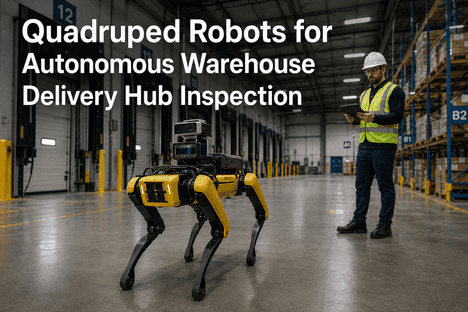
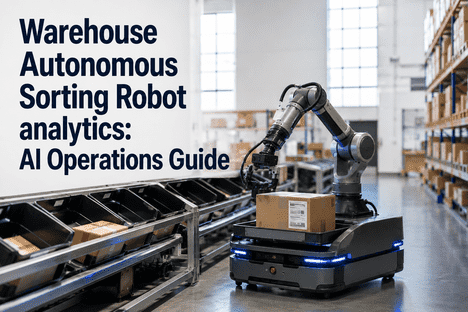
Wheeled drones cannot climb loading docks. They cannot navigate the 36-inch aisle widths between high-bay racking. They cannot step over fallen pallet straps, dock plates, or cable runs without getting stuck and they certainly cannot read a pressure gauge mounted six feet off the floor on a compressor in the cold storage room. Quadruped robots can do all of it. Equipped with 360° perception, dynamic obstacle avoidance, and embodied AI reasoning, today's four-legged inspection robots autonomously patrol every zone of a delivery hub dock bays, pick aisles, AS/RS lanes, refrigeration rooms, mechanical galleries capturing thousands of inspection data points per shift across asset health, safety hazards, and environmental conditions. The real operational leverage comes from what happens next: when connected to AI work order automation, every anomaly the robot finds a leaking dock seal, a temperature drift on a freezer compressor, a missing fire extinguisher, debris in a pick aisle, vibration on a sortation drive auto-generates a work order in the CMMS with location, photo evidence, severity score, and recommended technician. The inspection round that previously took a human 4 hours produces actionable maintenance work in seconds. Boston Dynamics has deployed over 1,500 Spot robots in commercial inspection roles globally. Book a Demo to see how iFactory AI deploys quadruped-driven inspection automation across warehouse delivery hubs in 6 to 8 weeks.
1,500+
Spot quadruped robots deployed in commercial inspection roles globally
4 hrs → 0
Human inspection round time eliminated through autonomous quadruped patrol
360°
Perception coverage on quadruped inspection robots — every angle, every shift
6-8 wks
Deployment timeline from baseline audit to live quadruped + AI work order loop
What Quadruped Inspection Robotics Actually Requires in Warehouse Delivery Hubs
Warehouse delivery hubs are not flat, predictable industrial environments. They contain steps at every loading dock, ramps into staging, narrow aisles between racks, cable trays running across floors, dock plate transitions, and cold storage doorways that wheeled platforms cannot reliably traverse. Inspection drones address ceiling-level surveys but cannot read floor-level gauges, check refrigerant pressure on compressors, or sniff for chemical leaks. Human inspectors walk hours of aisles per shift, miss subtle anomalies due to fatigue, and produce inconsistent reporting. Quadruped robots solve every one of these limitations — combining legged mobility with payload-mounted sensors (thermal, acoustic, gas detection, high-resolution cameras) and AI vision models that flag anomalies in real time.
iFactory's platform turns quadruped robot data into closed-loop maintenance action. Every anomaly the quadruped surfaces visual defect, thermal hot spot, gas leak signal, gauge reading out of range feeds into iFactory's AI work order engine, which cross-references asset history, parts inventory, technician availability, and fulfillment schedules, then auto-creates a fully detailed work order in the existing CMMS. The result is a continuous inspection-to-repair pipeline that operates 24/7 without manual data entry, manual triage, or manual dispatch exactly the automation layer that turns a $150K robot from a video novelty into measurable operational ROI.
Quadruped Fleet Integration with AI Work Orders
Direct integration with Boston Dynamics Spot, ANYbotics ANYmal, Unitree, and Deep Robotics platforms — every anomaly detected during autonomous patrol auto-generates a work order in your CMMS with location, photo, severity, and recommended action.
Autonomous Multi-Zone Patrol Routes
Pre-mapped autonomous patrol routes across dock bays, pick zones, AS/RS aisles, mechanical galleries, and refrigeration rooms — quadruped runs identical inspections at consistent intervals 24/7 without operator intervention.
Multi-Sensor Anomaly Detection
Thermal imaging for refrigeration and motor hot spots; acoustic emission for bearing degradation; gas detection for refrigerant leaks; high-resolution cameras for visual defects and gauge reading — all fused into AI anomaly scoring.
Embodied AI Reasoning Integration
Support for next-gen reasoning models (Gemini Robotics-ER) that allow quadrupeds to interpret site conditions, read complex gauges, detect spills, and answer natural-language inspection queries — moving beyond scripted routes to context-aware patrol.
AI-Powered Shift Logbook Continuity
iFactory's Shift Logbook captures every quadruped inspection pass, anomaly flagged, work order generated, and resolution outcome with AI summaries and photo evidence — ensuring 24/7 facility teams inherit full inspection history across shifts.
Digital Twin Build From Inspection Data
Quadruped inspection scans build a continuously updated digital twin of the facility — asset locations, environmental conditions, historical anomalies, and as-built changes — supporting predictive maintenance and audit-ready documentation.
Why Human Inspection and Wheeled Drones Cannot Match Quadruped Inspection Coverage
The traditional warehouse inspection model — human walks aisles with clipboard, drone flies overhead, fixed sensors monitor specific assets — leaves enormous coverage gaps. Quadruped robots eliminate every gap by combining legged terrain capability with multi-sensor payloads and continuous patrol economics. The following comparison shows where each inspection mode falls short versus what AI-integrated quadruped patrol delivers.
| Inspection Parameter |
Human Walkdown + Wheeled Drone |
iFactory + Quadruped Robot Patrol |
| Terrain Coverage |
Wheeled drones blocked by dock steps, cable runs, ramps, and dock plates. Human inspectors walk 4–6 hours per round, miss areas due to time pressure. |
Quadruped traverses stairs, dock plates, ramps, narrow aisles, and refrigeration doorways without modification. 100% of designated routes covered every shift. |
| Inspection Consistency |
Human inspections vary 15–30% between operators and across fatigue cycles. Subtle anomalies missed during second-half-of-shift fatigue. |
Identical AI-powered inspection at every patrol point, every shift, every day. Consistency at machine-precision levels regardless of time of day. |
| Anomaly Detection Speed |
Anomalies logged manually; work orders drafted hours or days later after supervisor review and CMMS data entry. |
Anomaly detected → AI scored → work order auto-generated in CMMS with location, photo, severity — in under 60 seconds. |
| Multi-Sensor Coverage |
Human inspectors carry visual observation only. Specialized gas, thermal, and acoustic testing requires separate scheduled rounds with handheld tools. |
Single quadruped patrol simultaneously captures thermal, acoustic, gas detection, and visual data — replacing 4–6 separate specialized inspection rounds. |
| Hazardous Area Access |
Cold storage, electrical rooms, energized equipment areas require PPE protocols, lockout procedures, and supervised entry — limiting inspection frequency. |
Quadruped enters hazardous zones autonomously without human risk. Cold storage at -25°C, electrical galleries, and confined spaces patrolled safely. |
| Inspection Documentation |
Clipboard notes, occasional photos, manual CMMS entry. Audit trail incomplete; OSHA/ISO documentation requires post-hoc reconstruction. |
Every patrol step, image, sensor reading, and AI anomaly score logged automatically — fully searchable audit trail ready for OSHA, ISO, and insurance reviews. |
Every Anomaly a Quadruped Finds Should Become an Auto-Generated Work Order in Seconds.
iFactory AI integrates with Boston Dynamics Spot, ANYbotics, Unitree, and other quadruped platforms — turning every inspection anomaly into a CMMS-dispatched repair action without manual data entry.
Book a Demo to see quadruped inspection automation applied to your delivery hub.
How iFactory AI Deploys Quadruped + Work Order Automation Across Warehouse Delivery Hubs
iFactory follows a structured deployment process that delivers live quadruped-driven work orders within the first three weeks and full autonomous inspection automation by week eight. Each stage has defined deliverables so operations teams see measurable change — not a multi-quarter robotics project that produces demo videos instead of dispatched repairs.
Weeks 1–2
Facility Mapping, Patrol Route Design, and CMMS Integration
Quadruped maps the facility autonomously, generating a 3D model of dock bays, pick zones, AS/RS lanes, refrigeration rooms, and mechanical galleries. Inspection points defined per zone. CMMS, WMS, and quadruped fleet platform integrations established via REST APIs and Orbit/equivalent control software. Digital Shift Logbook deployed.
Weeks 3–4
First Autonomous Patrols and Live Work Order Generation
Quadruped begins autonomous patrols on defined routes. Thermal, acoustic, gas detection, and visual sensors active. AI anomaly scoring begins surfacing flags. First auto-generated work orders flow into existing CMMS with location, photo evidence, severity score, and recommended technician.
Weeks 5–6
Multi-Sensor Fusion and Predictive Models Live
Multi-sensor anomaly fusion activates — thermal trends correlated with acoustic patterns and visual changes for high-confidence failure prediction. Predictive models surface emerging faults 4–12 weeks ahead based on quadruped inspection trend data.
Weeks 7–8
Full Autonomous Loop, Digital Twin, and Multi-Site Rollout
Closed-loop inspection-to-repair pipeline fully live. Digital twin of facility built from cumulative inspection data, supporting audit documentation and predictive maintenance planning. Multi-site rollout templates configured for additional fulfillment hubs.
MEASURABLE OUTCOMES FROM WEEK 4: AUTONOMOUS INSPECTION-TO-REPAIR PIPELINE LIVE
Warehouse operators completing iFactory's 6 to 8 week deployment report human inspection labor reduced 65–85%, anomaly detection coverage increased 3–4x through 24/7 patrol economics, and the first quadruped-prevented failure typically detected within 60 days of activation. By month 12, deployments report 40–60% reduction in unplanned downtime attributable to early anomaly capture, with audit-ready documentation generated automatically.
65-85%
Reduction in human inspection labor hours
3-4x
Increase in anomaly detection coverage through 24/7 patrols
40-60%
Unplanned downtime reduction by month 12
Quadruped Inspection Automation: Use Cases from Live Warehouse Deployments
The following outcomes are drawn from iFactory deployments at operating distribution centers and fulfillment hubs running Boston Dynamics Spot, ANYbotics ANYmal, and other quadruped platforms. Each use case reflects 9 to 12 month post-deployment performance.
A frozen food distribution operator deployed a Spot quadruped equipped with thermal imaging and gas detection across its cold storage facility — patrolling 18 compressor stations, 14 condenser units, and the full refrigerant manifold network on hourly autonomous rounds. Within the first 90 days, the quadruped identified two slow refrigerant leaks invisible to scheduled monthly inspections, both flagged via gas sensor signal correlated with thermal hot-spot pattern. iFactory's AI work order engine auto-generated repair tickets within 60 seconds of detection, scheduled during off-peak windows with required parts pre-staged. Cargo loss eliminated, $480K in spoilage risk avoided, and the operator's cold chain insurance carrier reduced premiums based on documented continuous patrol.
Book a Demo to see cold storage quadruped patrol applied to your facility.
2
Slow refrigerant leaks detected in first 90 days, both invisible to manual inspection
$480K
Annual cargo spoilage risk eliminated through continuous patrol
60 sec
Anomaly-to-work-order time from quadruped detection
A regional 3PL operator running 8 distribution facilities was paying $2.1M annually for human facility inspection labor — site walkdowns, dock seal checks, fire safety verification, equipment health rounds. Inspector coverage averaged 1.4 rounds per shift due to time constraints; missed anomalies regularly cascaded into emergency repairs. The operator deployed Spot quadrupeds across 4 priority sites with iFactory's work order automation. Within 9 months, quadrupeds completed 8.7 inspection rounds per day per facility (6x human baseline), human inspection labor dropped 78%, and AI-generated work orders captured 340 anomalies that previously would have been missed — including 26 events that would have escalated into unplanned downtime. Net annual savings exceeded $1.6M across the deployed sites.
Book a Demo to see quadruped inspection economics applied to your network.
$1.6M
Annual savings from inspection labor recovery and prevented failures
6x
Inspection round frequency increase vs human baseline
26
Downtime events prevented through quadruped-flagged anomalies
A high-volume e-commerce fulfillment hub was struggling with safety hazard documentation — missing fire extinguishers, blocked emergency exits, spilled liquids, fallen debris in pick aisles, expired safety signage. OSHA audit findings averaged 14 violations per inspection, with $32K in fines over 18 months. The operator deployed a Spot quadruped with embodied AI reasoning (Gemini Robotics-ER) and iFactory's safety hazard detection module. The quadruped patrolled high-traffic aisles every 2 hours, flagging missing extinguishers, debris, spills, blocked exits, and signage compliance in real time. AI-generated remediation work orders dispatched immediately to maintenance teams. Subsequent OSHA audit found zero violations; insurance premiums adjusted downward based on documented patrol cadence.
Book a Demo to see safety compliance automation applied to your hub.
14 → 0
OSHA violations per audit cycle post-deployment
2 hrs
Quadruped safety patrol interval vs daily manual baseline
$32K+
OSHA fine exposure eliminated annually
Expert Perspective: Why Quadruped Robotics Only Pays Back When Connected to AI Work Orders
Industry Review — Warehouse Robotics Deployment Perspective
"The most common mistake operators make when buying a quadruped is treating it as the deliverable. The robot is not the deliverable. The robot is a sensor platform. The deliverable is what happens after the robot finds something — does the anomaly become a work order, a parts requisition, a scheduled repair during planned downtime, or does it sit in a video file waiting for someone to review it? Operators who deploy quadrupeds without closed-loop AI work order integration get expensive footage. Operators who connect every anomaly to autonomous CMMS action get operational ROI. The difference is whether the inspection round produces dispatched maintenance — or just data."
Warehouse Robotics Director — Multi-Site Fulfillment Network (provided via iFactory deployment reference)
This perspective aligns with what robotics deployment leaders consistently report across iFactory projects: the highest-ROI quadruped programs treat inspection as the input to automated maintenance execution, not as a standalone capability. AI work order integration is what converts robot patrol hours into prevented failures, recovered labor, and audit-ready documentation. Book a Demo to speak with iFactory's quadruped automation specialists about your robotics program.
Autonomous Patrol. AI-Generated Work Orders. 24/7 Inspection Economics. Live in 6 to 8 Weeks.
iFactory gives warehouse operators direct integration with Boston Dynamics Spot, ANYbotics, Unitree, and Deep Robotics quadrupeds — closing the loop from autonomous anomaly detection to dispatched CMMS repair without manual handoffs.
Conclusion: Quadruped Robotics + AI Work Orders Is the Next Inspection Standard
The case for quadruped robotics in warehouse delivery hub inspection has moved beyond demo-video curiosity. With 1,500+ Spot robots in active commercial deployment, Gemini Robotics-ER embodied AI reasoning enabling spill detection and gauge reading at scale, and documented deployments showing 65–85% inspection labor recovery alongside 40–60% downtime reduction within the first year, operators continuing to rely on human walkdowns and wheeled drones are accepting coverage gaps that quadruped patrol eliminates. The strategic question is not whether to deploy quadrupeds — it is whether the inspection data gets connected to closed-loop AI work order automation that converts every anomaly into a dispatched repair action.
iFactory's platform delivers the specific capabilities warehouse delivery operations require: direct integration with Spot, ANYbotics, Unitree, and Deep Robotics quadruped platforms; autonomous multi-zone patrol routes with thermal, acoustic, gas, and visual sensor fusion; AI anomaly scoring with auto-generated CMMS work orders; embodied AI reasoning integration for context-aware inspection; AI-powered Shift Logbook continuity; digital twin construction from cumulative inspection data; and integration with existing CMMS, WMS, and ERP through OPC-UA, MQTT, BACnet, Modbus, and REST APIs. The 6 to 8 week deployment program means autonomous inspection-to-repair pipelines go live within weeks. Book a Demo to receive a quadruped inspection assessment specific to your warehouse delivery operations.
Frequently Asked Questions About Quadruped Robot Inspection Automation
Which quadruped robot platforms does iFactory integrate with?
iFactory integrates with Boston Dynamics Spot (via Orbit fleet platform), ANYbotics ANYmal, Unitree Go2 and B2, Deep Robotics X20, and other major quadruped platforms via REST APIs and standard fleet management protocols. The integration adds AI work order automation on top of existing robotics infrastructure.
Can quadrupeds operate in cold storage and other harsh warehouse environments?
Yes. Modern quadruped platforms operate reliably across temperature ranges from -25°C cold storage to industrial outdoor conditions, in low-light environments, on slippery dock surfaces, and across stair and dock-plate transitions. They are specifically designed for environments that wheeled platforms cannot traverse.
How does the quadruped + iFactory integration generate work orders automatically?
When the quadruped's onboard AI vision or sensor payload flags an anomaly during autonomous patrol — thermal hot spot, gas leak signal, visual defect, gauge out-of-range — the alert streams to iFactory's work order engine. AI scores severity, cross-references asset history and parts inventory, and auto-generates a CMMS work order with location, photo evidence, and recommended technician within 60 seconds.
Do quadrupeds replace human inspectors completely?
No. Quadrupeds replace routine inspection rounds — repetitive walkdowns, gauge checks, visual scans — that consume the majority of human inspector time. Human operators shift to higher-value work: anomaly investigation, complex repairs, root-cause analysis, and inspector oversight of the autonomous program. Documented deployments recover 65–85% of routine inspection labor for redeployment.
How does the AI-powered Shift Logbook support quadruped inspection programs?
The Shift Logbook auto-captures every quadruped patrol, anomaly detected, work order generated, and resolution outcome with AI-generated summaries and photo evidence. Operations teams running 24/7 warehouses inherit full inspection history at every handover — supporting OSHA, ISO, and insurance documentation requirements without manual data assembly.
Deploy Quadruped Inspection + AI Work Order Automation in 6 to 8 Weeks.
iFactory connects Boston Dynamics Spot, ANYbotics, and other quadrupeds to autonomous CMMS work order generation — integrated with existing systems.
65–85% inspection labor recovery
3–4x increase in anomaly detection coverage
40–60% unplanned downtime reduction by month 12