AI-Powered Delivery Forecasting: Predicting Demand and Optimizing Resources

By Katty Rino on March 5, 2026

ai-powered-deliveries-forecasting

Factory dispatch supervisors are making million-dollar sequencing decisions using whiteboards, gut feel, and spreadsheets updated manually after every truck movement. The result is visible in every morning gate queue: vehicles arriving in the wrong order, dock bays misallocated, production lines stalling because the right material arrived two hours late while the wrong vehicle cleared the gate first. In 2026, this is no longer a resource planning limitation — it is a choice. AI-driven dispatch forecasting models now predict inbound volumes 72 hours ahead, sequence outbound loads by SLA priority automatically, and flag resource bottlenecks before the shift begins. Talk to our support team to see what AI forecasting looks like running inside a live factory dispatch operation.

AI · Factory Dispatch · 2026 Guide

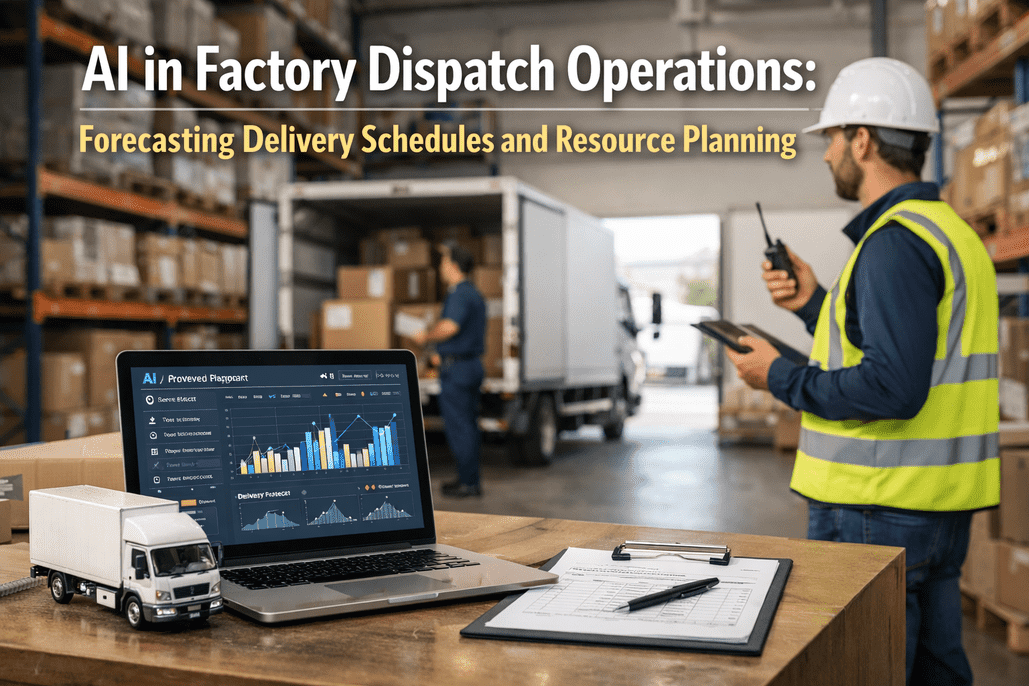
AI in Factory Dispatch Operations: Forecasting Delivery Schedules and Resource Planning

97% of manufacturers now have AI embedded in core workflows — yet the factory dispatch department still runs on manual sequencing, estimated arrival windows, and reactive dock management. This guide explains what AI dispatch forecasting actually does inside a factory environment, what it costs not to deploy it, and how iFactory delivers it in under 14 days.

97%Of manufacturers report AI embedded in core workflows — dispatch departments lag every other function (2026 State of Manufacturing Report)
24×Agentic AI adoption in manufacturing expected to grow 4× by end of 2026 — from 6% to 24% (Deloitte)
280+Minutes of dock capacity lost daily at a 20-vehicle/day factory running manual gate and dispatch sequencing
$47.9BAI in manufacturing market projected by 2030 — growing at 46.5% CAGR from $5.3B in 2024
The Forecasting Gap

What Factory Dispatch Departments Are Running On Right Now — And What the Data Says It Costs

Manual dispatch management has a predictable failure pattern. The problems are not random — they are structural. Every factory running manual dispatch experiences the same set of recurring losses in the same sequence.

Problem 01
No Inbound Arrival Forecast
Inbound vehicles arrive at the gate with no pre-registered manifest, no estimated arrival window, and no dock pre-assignment. The security team processes each vehicle from scratch — 15–20 minutes per vehicle — while subsequent vehicles queue outside the gate. A factory receiving 20 vehicles/day loses 280+ minutes of dock time daily on this single process gap.
280+ min lost daily · 20-vehicle/day factory · manual gate processing
Problem 02
Reactive Dispatch Sequencing
Dispatch supervisors sequence outbound loads based on what is physically ready at the dock at the time of loading — not based on SLA priority, customer commitment windows, or production schedule dependency. Manual dispatch error rates run 2–3%, and critically, SLA misses under manual sequencing are frequently undetected until a customer complaint surfaces them 24–48 hours after departure.
2–3% manual dispatch error rate · SLA misses undetected until complaint
Problem 03
Zero Resource Pre-Allocation
Receiving staff, dock bay assignments, yard vehicle availability, and fork truck allocation are managed by experience and informal communication — not by data. Peak arrival periods overwhelm dock capacity while quiet periods leave resources idle. Staff overtime is a symptom of failed resource forecasting, not unavoidable operational pressure.
Staff overtime driven by demand peaks forecasting failure — not unavoidable volume
Problem 04
Production Stoppages from Dispatch Misalignment
When dispatch sequencing is not aligned with production schedule requirements, the wrong inbound material is prioritized at the receiving dock while production-critical components sit in the gate queue. 30–40% of "material unavailability" production stoppages are locating failures or sequencing failures — not genuine stock-outs. AI forecasting eliminates both categories.
30–40% of production stoppages are sequencing and locating failures, not stock-outs
How AI Works

How AI Forecasting Transforms Factory Dispatch — From Reactive to Predictive in 5 Operational Layers

iFactory's AI dispatch engine does not replace your dispatcher. It gives your dispatcher 24–72 hours of forward visibility they currently cannot access — and automates the sequencing decisions that do not require human judgment.

Layer 01
Inbound Volume Forecasting — 24 to 72 Hours Ahead
iFactory ingests historical inbound arrival data, supplier lead time patterns, PO due dates, and production schedule requirements to generate a rolling 72-hour inbound volume forecast. The dispatch supervisor sees how many vehicles are expected in each 4-hour window, which suppliers are likely to arrive late based on historical patterns, and which inbound shipments are production-critical for the next shift. Dock bay pre-assignments are generated automatically from the forecast — receiving staff know tomorrow's schedule today.
72-hr arrival forecastDock bay pre-assignmentSupplier reliability scoringProduction-critical prioritization

Layer 02
AI-Priority Dispatch Sequencing — SLA-Driven Outbound Order
Outbound dispatch orders are sequenced automatically by SLA deadline, customer priority tier, load volume, vehicle availability, and route. iFactory flags any dispatch order approaching its SLA window with an alert to the supervisor — not a missed delivery complaint from the customer. Manual dispatch error rates of 2–3% drop to under 0.3%. Each dispatch event automatically captures vehicle ID, departure time, load manifest, and driver attribution — creating a complete dispatch audit trail as a byproduct of normal sequencing operations.
SLA-priority auto-sequencingReal-time SLA alertsUnder 0.3% error rateDispatch audit trail

Layer 03
Resource Demand Forecasting — Staff, Dock Bays, and Yard Equipment
The inbound volume forecast feeds directly into resource demand calculations — how many receiving staff are needed per shift, which dock bays need to be operational at what times, and when yard tractors and fork trucks need to be available and fueled. Shift supervisors receive a resource plan 24 hours before each shift begins, built from actual forecast data rather than the previous week's roster. Overtime triggered by unanticipated peak periods drops significantly because peaks are no longer unanticipated — they are predicted from the PO pipeline.
Shift-level staff forecastDock bay schedulingYard equipment pre-stagingOvertime reduction

Layer 04
Exception and Disruption Management — Early Warning, Not Late Reaction
When supplier data or GPS tracking indicates an inbound vehicle will arrive late, iFactory recalculates dock bay utilization and flags production lines that will be impacted by the delayed material. The production supervisor receives the alert 2–4 hours before the scheduled arrival — not when the vehicle fails to appear. The same logic applies to outbound: if a vehicle is delayed in the yard due to an inspection failure or loading issue, iFactory re-sequences the dispatch queue automatically and alerts the affected customer SLA owner before the commitment window closes.
Inbound delay early warningProduction impact alertAuto dispatch re-sequenceSLA owner notification

Layer 05
Continuous Learning — Accuracy Improves With Every Shift
iFactory's forecasting engine uses machine learning models that improve with each completed cycle. Every actual arrival time, dispatch completion, and resource utilization outcome is fed back into the model — improving forecast accuracy for your specific facility, supplier base, and production patterns over time. Factories typically see forecast accuracy improve 8–12 percentage points between month 3 and month 9 of deployment as the model learns your operation's specific patterns and seasonal rhythms.
ML model continuous learningFacility-specific tuningSeasonal pattern recognition8–12 pt accuracy improvement by month 9
Is your dispatch team still sequencing loads from a whiteboard?

iFactory gives your dispatch supervisor the 24–72 hour forecast window they need to pre-allocate resources, sequence loads by SLA priority, and alert production before delays hit the floor — not after. Talk to our support team to map this against your current dispatch workflow.

8 AI Dispatch KPIs

The 8 AI-Driven Dispatch KPIs iFactory Generates — Manual vs. Digital Benchmark

KPI 01
Inbound Forecast Accuracy
AI forecasting delivers up to 85% more accurate delivery schedule predictions than manual estimation. iFactory's model ingests PO data, supplier history, and production dependencies to generate hourly arrival forecasts for the next 72 hours.
Manual: no forecast — arrival unknown until gateAI: 72-hr forecast · 85% accuracy uplift
KPI 02
Gate Pass Cycle Time
Pre-registered vehicles clear the gate in under 2 minutes. Pre-arrival forecasting drives dock pre-assignment, so receiving teams are positioned before the vehicle arrives — not scrambling after. A 20-vehicle/day operation recovers 280+ minutes of dock time daily.
Manual: 15–20 min/vehicleDigital: under 2 min — 87% reduction
KPI 03
Dispatch SLA Compliance Rate
AI sequencing prioritizes outbound loads by SLA deadline and customer priority tier automatically. SLA misses are flagged in real time — not discovered via customer complaint 24–48 hours post-dispatch. Target: 99.7%+ compliance under iFactory sequencing.
Manual: misses undetected until complaintDigital: real-time SLA alert · 99.7%+ target
KPI 04
Dispatch Error Rate
Manual dispatch sequencing based on whiteboard status and informal communication generates 2–3% error rates. AI-sequenced dispatch with PO-linked load verification drops this to under 0.3% — a 90% error rate reduction that eliminates re-dispatch costs and SLA penalty exposure.
Manual: 2–3% error rateDigital: under 0.3% — 90% reduction
KPI 05
Dock Bay Utilization Rate
AI resource forecasting pre-assigns dock bays based on expected inbound volume — eliminating the simultaneous arrival overloads that leave multiple vehicles queued while idle bays exist elsewhere in the yard. Target utilization: 85–92% vs. typical 55–65% under manual allocation.
Manual: 55–65% utilization · peak overloadDigital: 85–92% target · pre-assigned bays
KPI 06
Production-Critical Inbound Prioritization
iFactory links inbound PO data to production schedule requirements — flagging which arriving shipments contain materials needed within the next 4 hours on the production floor. These vehicles receive priority gate processing and dock assignment, preventing the sequencing failures that cause production stoppages.
Manual: no production-schedule linkageDigital: PO-to-production priority flag
KPI 07
Receiving Staff Forecast Accuracy
Resource demand forecasting generates shift-level staffing requirements 24 hours in advance — reducing unplanned overtime driven by unanticipated peak arrivals. Factories typically reduce receiving department overtime by 25–35% within 60 days of AI forecast deployment.
Manual: reactive staffing · overtime spikesDigital: 24-hr staff forecast · 25–35% OT reduction
KPI 08
Exception Resolution Lead Time
AI exception management detects inbound delays, vehicle inspection failures, and SLA-at-risk dispatches 2–4 hours before impact rather than at moment of failure. Each exception generates an auto-escalation to the correct stakeholder — supervisor, production team, or customer SLA owner — with a resolution recommendation already populated.
Manual: discovered at failure pointDigital: 2–4 hr early warning · auto-escalation
Visibility Gap

Where AI Dispatch Intelligence Exists in Your Factory — And Where It Doesn't Yet

AI Already Working in Your Factory
Production schedule optimization — 40%+ of manufacturers deploying AI scheduling by 2026 (IDC)
Predictive maintenance on production equipment — 48% AI adoption, up 12 pts in 2026
Quality control and vision inspection on production lines
Energy consumption forecasting and optimization
Demand planning and finished goods inventory forecasting
Supplier risk scoring and procurement intelligence
OEE tracking and production throughput analytics
ERP-connected MRP and materials requirements planning
Still Running Without AI Forecasting
Inbound arrival forecasting — vehicles arrive with no pre-registered window or dock pre-assignment
Dispatch SLA sequencing — still managed by whiteboard priority and verbal supervisor instruction
Dock bay utilization optimization — assigned reactively as vehicles arrive, not pre-planned
Receiving staff demand forecasting — overtime driven by unanticipated inbound peaks
Production-critical inbound prioritization — no PO-to-schedule linkage at the gate
Exception early warning — disruptions discovered at the moment of failure, not 2–4 hours ahead
Gate dwell time measurement — no record of vehicle queue time or dock processing duration
Internal material location — no chain of custody after dock entry
Before vs. After

Factory Dispatch Operations — Manual Sequencing vs. iFactory AI Forecasting

Dispatch Function
Manual Operations — Current State
iFactory AI Forecasting
Inbound Scheduling
Vehicles arrive unannounced · no dock pre-assignment · 15–20 min gate processing per vehicle
72-hr arrival forecast · dock pre-assigned · gate cleared in under 2 min
Dispatch Sequencing
Whiteboard priority · 2–3% error rate · SLA misses undetected until complaint
SLA-priority AI queue · under 0.3% errors · real-time SLA alert before miss
Resource Planning
Staffed from last week's roster · overtime spikes from unanticipated peaks
24-hr shift demand forecast · dock bays and staff pre-allocated from PO pipeline
Exception Management
Delays discovered at gate · production stoppage notification after material fails to arrive
2–4 hr early warning · production alert generated · auto-escalation to SLA owner
Production Linkage
No connection between inbound PO and production schedule at the gate or dock
PO-to-production priority flag · critical material fast-tracked at gate automatically
Compliance Documentation
Manual assembly from paper logs · hours per audit event · frequent gaps
Auto-generated from dispatch operations · 100% trail coverage · retrievable in 60 seconds
Forecast Improvement
No learning — same errors repeated across shifts and seasons
ML model learns your operation — 8–12 pt accuracy improvement by month 9
Deployment Timeline
Legacy systems: 6–18 months · heavy IT project · high upfront cost
iFactory: 7–14 days · cloud-based · no IT infrastructure project
Measurable Results

What AI Dispatch Forecasting Delivers — Industry-Verified Outcomes

87%
Gate Processing Time Reduction
Pre-arrival forecast drives dock pre-assignment and pre-registration — cutting gate processing from 15–20 minutes to under 2 minutes per vehicle. A 20-vehicle/day factory recovers 280+ minutes of dock capacity daily.
90%
Dispatch Error Reduction
AI-priority sequencing drops manual dispatch error rates from 2–3% to under 0.3% — eliminating re-dispatch costs, SLA penalty exposure, and the management overhead of error resolution after departure.
85%
Forecast Accuracy Improvement
AI-driven delivery schedule forecasting delivers up to 85% more accurate inbound arrival predictions vs. manual estimation — enabling dock bay pre-assignment and resource planning the shift before, not during.
25–35%
Receiving Overtime Reduction
Resource demand forecasting from the PO pipeline generates shift-level staffing requirements 24 hours in advance — reducing unplanned overtime driven by unanticipated peak arrival periods within 60 days of deployment.
100%
Dispatch Audit Trail Coverage
Every gate pass, dispatch event, dock assignment, vehicle inspection, and exception is timestamped and person-attributed automatically. Compliance records retrievable in under 60 seconds — not hours of manual assembly.
3–6 mo
Full Platform Payback
Recovered dock time, eliminated dispatch errors, overtime reduction, and compliance overhead savings combine to deliver full platform payback within 3–6 months of go-live. Deployment in 7–14 days. No IT infrastructure project.
FAQ

AI Factory Dispatch Forecasting — Detailed Questions Answered

Questions specific to your facility's setup? Talk to our support team directly.

What data does iFactory's AI dispatch forecasting model actually use — and do we need to have clean data to start?
iFactory's forecasting model is designed to start generating useful output from the data most factories already have — not from the perfectly structured dataset that rarely exists in practice. The primary data inputs are: purchase order records with expected delivery dates and supplier IDs (available from any ERP or purchasing system), historical inbound arrival records (even paper-based logs can be imported at setup), production schedule requirements linked to material codes, and vehicle and driver registration data. The model begins generating inbound volume forecasts within the first week of deployment using this baseline data. Forecast accuracy is initially moderate — typically 60–70% in the first month — and improves as iFactory collects actual vs. predicted arrival time data from live gate operations. By month 3, most factories see forecast accuracy in the 75–85% range. By month 6–9, accuracy typically reaches 85–92% as the model has learned your specific supplier patterns, seasonal rhythms, and production schedule linkages. Clean data is not a prerequisite for starting — starting is the prerequisite for clean data. Book a demo to see the data onboarding process in detail.
How does AI dispatch sequencing handle urgent production-critical inbound shipments — can it override the standard SLA queue?
Yes — and this is one of the most operationally significant capabilities in iFactory's dispatch module. iFactory maintains a real-time linkage between the inbound PO list and the production schedule. When a production planner flags that a specific material batch is required on the production floor within the next 4 hours, iFactory automatically elevates that vehicle to priority-1 gate processing and dock assignment — overriding standard FIFO arrival sequencing. The security team and receiving staff see the priority flag on their mobile devices before the vehicle arrives at the gate. If the vehicle is running late, iFactory triggers an exception alert 2–4 hours before the scheduled arrival time — giving the production supervisor advance warning and time to adjust shift priorities rather than discover the shortage when the line stops. This production-to-dispatch linkage is the single most impactful feature for factories running JIT production models, where a 2-hour inbound delay can cascade into a 6–8 hour production disruption if not managed proactively. Talk to our support team to map this workflow against your specific production schedule structure.
What is the difference between AI dispatch forecasting in a factory context versus supply chain planning tools like SAP IBP or Oracle SCM?
Enterprise supply chain planning tools like SAP IBP and Oracle SCM operate at the strategic and tactical level — they forecast demand across quarters and months, optimize procurement volumes, and manage supplier contract terms. They are powerful but fundamentally oriented toward planning cycles of weeks to months, not operational windows of hours to days. iFactory's AI dispatch forecasting operates at the operational execution layer — the 0–72 hour window where production decisions actually need to happen. It answers the questions that enterprise SCM tools cannot: which vehicle is arriving in the next 4 hours, which dock bay should it go to, is that material production-critical for today's second shift, and is any outbound dispatch approaching its SLA window right now. These two layers are complementary, not competitive. iFactory integrates with SAP, ERP, and MES systems to receive production schedule data and PO records as inputs — then adds the gate-level operational intelligence that enterprise systems are not designed to provide. The practical implication: if your factory already has SAP, iFactory does not replace it — it closes the execution gap between what SAP plans and what actually happens at the gate every shift. Book a demo to see the SAP integration in action.
How does AI dispatch forecasting reduce overtime in the receiving department — the peaks seem unavoidable given supplier delivery windows?
The assumption that inbound arrival peaks are unavoidable is the key insight that AI forecasting challenges. In most factories, inbound arrival peaks are not random — they are predictable from the PO pipeline data that already exists in the purchasing system. Supplier delivery windows, carrier route schedules, and historical arrival time distributions create a forecastable pattern that manual planning cannot leverage because the data is never analyzed systematically. iFactory's resource demand forecasting ingests the next 72 hours of expected inbound POs, maps them against historical supplier on-time performance, and generates an hourly arrival volume forecast for the next 3 shifts. The shift supervisor receives a staffing recommendation 24 hours before each shift — how many receiving staff are needed per 4-hour window, which dock bays need to be open, and when yard vehicle availability will be at peak demand. Overtime driven by unanticipated peaks drops by 25–35% within 60 days because peaks are no longer unanticipated — they are forecast from data that already existed but was never systematically used. The overtime that does remain is genuinely unforeseeable — which is the only overtime that should ever be unplanned. Talk to our support team for a staffing analysis based on your facility's inbound volume profile.
How does iFactory handle the compliance documentation requirements generated by AI dispatch operations — especially for DOT and regulatory audits?
iFactory generates compliance documentation as an automatic byproduct of AI dispatch operations — no separate compliance workflow required. Every gate pass record captures vehicle type, driver ID, cargo manifest, arrival timestamp, dock assignment, and dwell time — creating a complete regulatory record at the moment of vehicle entry. Every outbound dispatch event captures vehicle ID, load manifest, departure time, driver attribution, and SLA status — satisfying DOT carrier record requirements and internal audit trail standards. Vehicle inspection records capture timestamped digital checklist completion with failed item documentation and repair verification — with vehicles failing inspection auto-blocked from dispatch until a repair work order is completed and closed. If a DOT inspector or internal auditor requests 90 days of gate entry records, inspection logs, or dispatch SLA compliance data, iFactory's audit dashboard generates the complete report in under 60 seconds. For factories in regions with specific regulatory frameworks — CARB and FMCSA in the USA, Schedule M in India, LkSG in Germany — iFactory's compliance templates can be configured during setup to ensure every relevant data field is captured from day one of operations. Book a demo to see the compliance dashboard and audit report generation in a live factory environment.
What does iFactory deployment actually look like — and how do dispatch supervisors and security staff adapt to AI-assisted workflows?
iFactory goes live within 7–14 days for a standard factory dispatch deployment. The process has four phases. Days 1–3 cover data onboarding: importing the vehicle registry, driver roster, supplier list, and PO templates from your existing ERP or purchasing system. Days 4–7 cover workflow configuration: setting up gate pass pre-registration flows, inspection checklists, SLA priority rules for dispatch sequencing, dock bay layout, and user access for security staff, receiving teams, dispatch supervisors, and operations managers. Days 8–10 cover training: a 2–4 hour guided mobile app walkthrough for each role group — security gate process, receiving dock process, dispatch sequencing interface for supervisors. The app is designed for operational staff, not software users — most roles are productive within their first shift. Days 11–14 cover live operations with iFactory support monitoring data quality and resolving any workflow gaps in real time. On the adoption question: dispatch supervisors typically respond positively within the first week once they experience the difference between reacting to problems at shift start and having a forecast at shift briefing. The most common feedback is that the AI sequencing does not replace their judgment — it handles the routine priority decisions and surfaces only the genuine exceptions for human decision-making. This distinction — AI handles routine, humans handle exceptions — is fundamental to iFactory's design philosophy and is what drives high adoption rates among operational staff rather than the resistance common with over-automated systems. Talk to our support team to discuss your specific facility layout and deployment requirements.
iFactory · AI Dispatch Operations · Factory Delivery Department

Your production floor has AI. Your dispatch department deserves the same forecasting intelligence.

iFactory's AI dispatch module gives your operations team the 24–72 hour forward visibility they need to pre-allocate resources, sequence loads by SLA priority, and alert production before delays hit the floor. Deploy in 7–14 days. No IT project. No hardware procurement. Forecasting accuracy improves every shift.
87%Gate processing time reduction

90%Dispatch error reduction

100%Audit trail coverage

14 DaysFull deployment timeline
Book A Demo

Share This Story, Choose Your Platform!