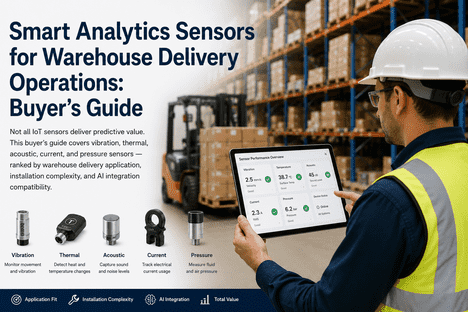
Selecting the right analytics sensors for warehouse delivery operations is the most consequential procurement decision in any predictive maintenance program. Vibration sensors on conveyor bearings, thermal probes on motor windings, acoustic microphones on sortation gearboxes, current transformers on drive systems, and pressure transducers on hydraulic dock equipment each serve distinct failure detection purposes and deploying the wrong sensor type, frequency range, or mounting method can render an entire IoT investment useless. A mid-size warehouse hub deploying 200 sensor nodes across conveyors, sortation systems, dock equipment, and material handling equipment typically invests $80,000–$120,000 in hardware, installation, and analytics platform access. Facilities that match sensor modalities to specific asset failure modes recover their entire investment within the first quarter through a single prevented catastrophic failure. Those that deploy sensors without a structured selection framework risk alert fatigue, false positives, and maintenance teams that learn to ignore the very system designed to protect them. This buyer's guide ranks every sensor category by warehouse delivery application, installation complexity, AI integration compatibility, and documented payback timeline so your team selects the right sensor for every asset, the first time.
SMART ANALYTICS SENSORS BUYER'S GUIDE
Select the Right Sensors for Every Asset in Your Warehouse Delivery Operation.
iFactory's sensor integration platform connects vibration, thermal, acoustic, current, and pressure sensors from any OEM — ifm, Banner, Sick, Balluff, Fluke — and converts raw readings into work order triggers, trend charts, and OEE-linked ROI reports. Pre-configured sensor templates for conveyor, sortation, dock, and MHE assets deploy in weeks.
Total installed cost for 200-node warehouse sensor deployment
Hardware + installation + gateway + 12-month analytics
Payback period for vibration sensors on primary sortation assets
Single prevented failure recovers entire deployment cost
Blended ROI across full sensor stack within first 18 months
Vibration + thermal + acoustic + current on conveyor, dock, AS/RS, MHE
Time to first measurable value with iFactory sensor integration
Sensor deployment to live anomaly detection and work order generation
THE FIVE CORE SENSOR TYPES
Vibration, Thermal, Acoustic, Current, and Pressure Sensors Ranked by Warehouse Delivery Application
Each sensor modality addresses a specific set of failure modes across warehouse delivery equipment. Deploying a single sensor type universally is one of the most common and costly mistakes in IoT implementations. The framework below ranks each sensor type by application fit, installation complexity, AI integration compatibility, and documented payback timeline from real warehouse deployments. Book a Demo to see iFactory's sensor selector tool configured for your specific asset base and failure history.
1. Vibration Sensors Highest ROI for Rotating Assets
Accelerometers mounted on motor housings, bearing blocks, and gearbox casings capture frequency-domain signatures that reveal bearing race defects, imbalance, misalignment, and gear mesh anomalies 2–6 weeks before failure. Optimal frequency range: 0.5 Hz–10 kHz for industrial motors. Sensitivity: 100 mV/g standard. IP67 minimum for washdown environments. Mounting options: stud mount (highest accuracy on critical assets), magnetic base (portable surveys), adhesive pads (non-ferrous or curved surfaces). Cost: $50–$300 per point. Payback: 30–90 days on primary sortation assets. Best for: conveyor drives, sorter bearings, AS/RS crane wheels, motor bearings.
Frequency range: 0.5 Hz–10 kHz · Sensitivity: 100 mV/g · IP67 · Stud/magnetic/adhesive mount
▼
2. Thermal Sensors — Critical for Electrical and Drive Systems
RTD (PT100/PT1000) probes, thermocouples (Type K/J), and infrared sensors monitor motor winding temperature, bearing housing heat buildup, electrical panel hot spots, and gearbox oil temperature. Continuous thermal monitoring detects overheating caused by overload, cooling failure, or lubrication breakdown before insulation damage creates a replacement-level failure. Surface-mount with thermal paste for bearing housings; immersion thermowell for fluid process lines; non-contact IR for moving parts or hazardous areas. Cost: $20–$200 per point. Payback: 3–6 months. Best for: motor windings, electrical panels, gearbox oil, refrigeration systems, drive electronics.
RTD PT100/PT1000 · Thermocouple K/J · Infrared · Surface/immersion/non-contact
▼
3. Acoustic / Ultrasonic Sensors — Earliest Detection for High-Speed Bearings
Ultrasonic microphones tuned to bearing frequency ranges (20–100 kHz) mounted on high-speed sortation wheels, gearboxes, and pneumatic systems. Detect bearing pitting, lubrication degradation, and air leaks 8–16 weeks before vibration sensors register change — making them the earliest-warning modality for rotating equipment. Particularly effective on crossbelt and tilt-tray sorter carrier bearings where rotational speeds exceed 1,800 RPM. Cost: $200–$600 per point. Payback: 3–5 months on high-speed sortation. Best for: high-speed bearings >1,800 RPM, gearboxes, pneumatic systems, compressed air leak detection.
20–100 kHz range · Ultrasonic microphones · 8–16 week lead time · High-speed rotation
▼
4. Current Monitoring Sensors — Non-Invasive Motor Health Intelligence
Current transformers (CT) and motor current signature analysis (MCSA) sensors detect rotor bar defects, winding faults, coupling misalignment, and mechanical load anomalies without physical access to running equipment. Split-core CT design allows retrofit without shutdown — clamp-on installation requires no wiring modifications. Accuracy class: 0.5 or better for energy metering. Cost: $30–$150 per point. Payback: 6–12 months on motor-intensive assets. Best for: conveyor drive motors, sorter induction motors, compressor motors, pump drives, fan motors.
Split-core CT · Clamp-on installation · 0.5 accuracy class · No wiring modification required
▼
5. Pressure Sensors — Hydraulic and Pneumatic System Integrity
Pressure transducers (4–20 mA analog or IO-Link digital) monitor hydraulic dock leveler systems, pneumatic divert actuators, and filter condition across warehouse equipment. Range selection: 0–10 bar typical for industrial hydraulics. Media compatibility critical for aggressive fluids. Threaded process connection minimizes leak points; snubbers recommended for high-pulsation environments. Cost: $60–$400 per point. Payback: 8–14 months. Best for: dock leveler hydraulics, pneumatic divert systems, filter condition monitoring, pump cavitation detection, seal integrity tracking.
4–20 mA / IO-Link · 0–10 bar range · Threaded connection · Snubbers for pulsation
SENSOR COMPARISON BY APPLICATION
Which Sensor Modality for Which Warehouse Asset? A Decision Matrix
Every warehouse asset class has a recommended primary sensor modality, a secondary confirmation modality, and a minimum viable configuration. The matrix below maps each asset category to its optimal sensor stack based on failure mode physics, installation feasibility, and documented detection lead time from real deployments.
C
Conveyor Systems
Primary: Vibration · Secondary: Thermal · Tertiary: Current
Bearing wear detection (2–4 wk lead time), belt misalignment, drive motor degradation, gearbox oil temperature monitoring. Recommended sensor density: 1 node per 20 ft of conveyor on critical zones.
S
Sortation Systems
Primary: Acoustic · Secondary: Vibration · Tertiary: Current
High-speed bearing pitting (8–16 wk lead time), divert actuator latency, carrier wheel degradation, induction motor signature analysis. Acoustic sensors essential for crossbelt and tilt-tray sorters.
D
Dock Equipment
Primary: Pressure · Secondary: Thermal · Tertiary: Vibration
Hydraulic seal wear (1–3 wk lead time), door actuator fatigue, leveler structural stress, pump cavitation detection. Pressure transducers on every leveler circuit.
R
AS/RS & Robotics
Primary: Vibration · Secondary: Acoustic · Tertiary: Current
Shuttle motor bearing degradation (12–21 d lead time), lift chain wear, robotic arm gearbox fatigue, rail guidance drift. Multi-modal coverage recommended for each crane/robot.
M
MHE Fleet
Primary: Vibration · Secondary: Current · Tertiary: Thermal
Forklift/AGV traction motor wear, hydraulic system leaks, battery thermal runaway detection, drive train degradation. Fleet-wide vibration coverage on 30–100+ units.
E
Electrical Systems
Primary: Thermal · Secondary: Current · Tertiary: N/A
Panel hot spot detection, switchgear thermal management, motor control center monitoring, transformer winding temperature. Infrared and RTD sensors on all critical electrical infrastructure.
P
Pneumatic Systems
Primary: Acoustic · Secondary: Pressure · Tertiary: N/A
Compressed air leak detection, actuator valve wear, pneumatic supply pressure stability, filter blockage. Ultrasonic sensors identify leaks at ranges beyond human hearing.
COMMUNICATION PROTOCOLS
Matching Sensors to Your Warehouse Infrastructure — Protocol Selection Guide
The right sensor with the wrong communication protocol is an integration failure waiting to happen. Protocol selection determines latency, range, power consumption, and compatibility with your existing automation layer. The wrong choice forces gateway replacements or complete sensor swaps within the first year. iFactory's platform supports all major industrial protocols, enabling sensor selection based on failure detection requirements rather than connectivity constraints.
MQTT
Lightweight publish-subscribe protocol
Wireless
Best For
Wireless sensor networks, cloud-connected deployments, multi-site rollouts where minimal bandwidth consumption is critical. Native integration with most IIoT platforms and cloud services.
Specs
QoS levels ensure delivery guarantees for critical alerts. Constrained device optimized. Ideal for battery-operated sensors where power efficiency is paramount.
iFactory Integration
Native MQTT broker integration with automatic sensor discovery and data normalization. Pre-configured topic structures for warehouse asset categories.
IO-Link
Point-to-point digital communication
Wired
Best For
Smart sensor integration where bidirectional communication enables remote parameter configuration without rewiring. Device identification and diagnostics included in protocol.
Specs
Replaces 4–20 mA analog with digital communication. Plug-and-play replacement accelerates maintenance swap-outs. Supports parameter adjustment, event generation, and device status monitoring.
iFactory Integration
IO-Link master integration with automatic device profile detection. Pre-built function blocks for vibration, temperature, and pressure sensor data streams.
Modbus RTU/TCP
Industrial serial/Ethernet protocol
Wired
Best For
Integration with existing PLC, SCADA, and DCS infrastructure. Most deployed industrial protocol globally — compatible with virtually every automation platform.
Specs
RS-485 (RTU) for multi-drop serial connections up to 1,200m. TCP for Ethernet-based networks. Supports up to 247 devices per segment. Deterministic timing for critical control applications.
iFactory Integration
Modbus gateway support with automatic register mapping for common sensor profiles. Read/write access for configuration and data acquisition across all connected devices.
WirelessHART / ISA100
Industrial wireless mesh protocol
Wireless
Best For
Assets in difficult-to-wire locations — rotating equipment, crane systems, mobile equipment, and high-bay storage areas where running conduit is cost-prohibitive.
Specs
Self-healing mesh network with 99.9%+ data reliability. Time-synchronized channel hopping for interference resistance. Battery life: 2–5 years per node. Range: 200m per hop.
iFactory Integration
WirelessHART gateway integration with network manager for route optimization. Pre-validated sensor profiles for Emerson, Endress+Hauser, and Pepperl+Fuchs devices.
SENSOR SELECTION CHECKLIST
Define Your Sensor Requirements Before Procurement — Avoid the Top Five IIoT Failure Modes.
Rushed sensor procurement without a defined specification process is one of the top five reasons IIoT projects stall. iFactory's implementation engineers review your current sensor infrastructure, identify critical monitoring gaps, and deliver a prioritized sensor deployment plan — at no cost. Most facilities achieve first measurable value within 6 weeks of deployment.
SENSOR DEPLOYMENT ARCHITECTURE
How iFactory's Sensor Integration Platform Connects Hardware to Actionable Intelligence
Sensor hardware is only as valuable as the analytics platform that converts raw readings into maintenance decisions. iFactory's platform provides the complete integration stack — from edge processing for real-time anomaly detection to cloud analytics for trend correlation and CMMS work order automation. Each layer serves a specific function within the sensor-to-action pipeline.
E
Edge Processing Layer
Local data normalization and noise filtering
Real-time anomaly detection without cloud dependency
Protocol conversion — MQTT, Modbus, IO-Link, WirelessHART
Local alert generation for latency-critical faults
A
AI Analytics Engine
Multi-signal correlation across sensor modalities
Failure mode classification with confidence scoring
Remaining useful life prediction per asset
Trend analysis and seasonal baseline drift detection
W
Work Order Automation
Auto-generated work orders from AI-validated alerts
Asset ID, fault type, severity, and parts list pre-populated
CMMS integration — IBM Maximo, SAP PM, Infor EAM
Technician feedback loop for continuous model improvement
iFactory Sensor Platform Core
200+ pre-validated sensor profiles
Multi-protocol gateway support
Real-time health scores per asset
Automated work order generation
ROI and payback analytics dashboard
OEE and throughput correlation
D
Deployment Methodology
Week 1–2: Sensor installation on critical assets
Week 3–4: Baseline learning and shadow mode calibration
Week 5–6: Live anomaly detection and work order generation
Post-deployment: Fleet-wide expansion planning
R
ROI Analytics Dashboard
Payback tracking per sensor and per asset class
Cost avoidance calculations per prevented failure
Maintenance cost trend vs baseline comparison
Executive-ready reports for program expansion approval
S
Sensor Profiles Library
Pre-configured profiles for 200+ sensor models
Vendor-agnostic — ifm, Banner, Sick, Balluff, Fluke, Emerson
Automatic data normalization and unit conversion
Plug-and-play integration without custom development
FREQUENTLY ASKED QUESTIONS
What Warehouse Operations Leaders Ask About Sensor Selection and Deployment
How many sensors does a typical warehouse need for comprehensive predictive coverage?▼
A mid-size warehouse hub (200,000–400,000 sq ft) typically requires 150–250 sensor nodes for comprehensive coverage of all critical and semi-critical assets. The distribution by modality is approximately: 40–60 vibration nodes on rotating equipment, 10–20 thermal sensors on electrical and refrigeration, 30–50 acoustic nodes on high-speed bearings and gearboxes, 60–100 current sensors on motor drives and compressors, and 10–20 pressure transducers on hydraulic and pneumatic systems. iFactory models optimal sensor count and placement based on your specific hub layout, throughput profile, and failure history — avoiding over-instrumentation while ensuring no critical asset is left unmonitored.
What is the total installed cost for a warehouse sensor deployment?▼
For a 200-node deployment, total installed cost including sensors, gateways, installation labor, and 12 months of iFactory analytics platform access ranges from $80,000 to $120,000. Per-node cost decreases significantly at scale — a 500-node deployment drops to $350–$450 per node all-in. The analytics platform cost is typically $1,000–$3,000 per month depending on data volume, user count, and integration scope. Most operations recover the entire investment within the first two quarters — often within the first quarter on primary sortation assets alone where a single prevented catastrophic failure at $260,000 per hour exceeds the full sensor program cost.
Can we deploy sensors without shutting down warehouse operations?▼
Yes. In the majority of deployments, sensor installation is completed within the first two weeks without system shutdown. Vibration sensors on motor housings and gearbox bodies use magnetic base or adhesive mounting — no drilling or permanent modification required. Current transformers are split-core clamp-on design and install without wiring modifications. Thermal sensors are surface-mount with thermal paste or non-contact IR. Only pressure transducer installations on dock leveler hydraulics may require brief planned stops during low-activity periods. Full warehouse shutdown is not required for any phase of sensor deployment.
How do I know which sensor modality is right for each asset type?▼
The decision matrix is driven by three factors: failure mode physics, detection lead time requirement, and installation feasibility. For rotating assets (conveyor drives, sorter bearings, AS/RS wheels), vibration sensors provide the best balance of cost, lead time (2–6 weeks), and accuracy. For high-speed rotating assets above 1,800 RPM, acoustic sensors provide the earliest detection (8–16 weeks). For electrical systems, thermal sensors are non-negotiable. For hydraulic systems, pressure transducers are the primary modality. iFactory's sensor selection tool maps each asset category to its optimal sensor stack based on these criteria — and our implementation engineers review your specific asset base at no cost during the initial consultation.
What communication protocol should we use for warehouse sensor networks?▼
Protocol selection depends on existing infrastructure, asset distribution, and latency requirements. For new installations with existing PLC/SCADA infrastructure, Modbus RTU/TCP provides the most reliable integration path. For smart sensor deployments requiring remote configuration, IO-Link is the recommended choice. For wireless deployments on rotating or mobile equipment, WirelessHART or MQTT over LoRaWAN provide battery-efficient connectivity. Most mid-size warehouses benefit from a hybrid approach — wired Modbus or IO-Link for fixed conveyor and sortation zones, wireless for AS/RS cranes, robotic systems, and MHE fleet. iFactory's platform supports all major protocols simultaneously, enabling sensor selection based on detection requirements rather than connectivity constraints.
START YOUR SENSOR DEPLOYMENT
Deploy the Right Sensors for Every Asset in Your Warehouse — With an Analytics Platform That Converts Raw Data Into Maintenance Action.
iFactory's sensor integration platform connects vibration, thermal, acoustic, current, and pressure sensors from any OEM into a unified analytics engine that auto-generates work orders, tracks ROI per sensor, and correlates equipment health with throughput performance. Pre-configured sensor templates for conveyor, sortation, dock, AS/RS, and MHE assets deploy in weeks.