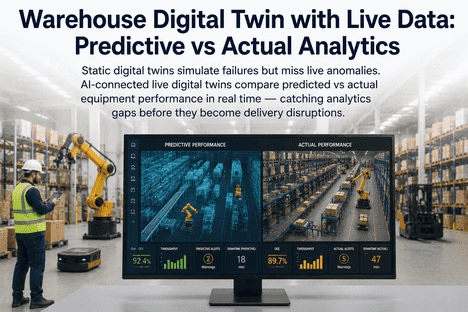
Static digital twins simulate failures but miss live anomalies. AI-connected live digital twins compare predicted vs actual equipment performance in real time — catching analytics gaps before they become delivery disruptions.
Warehouse Digital Twin · Live Data Analytics · Predictive vs Actual
Your Warehouse Digital Twin Predicted 30 Days. Reality Gave You 3.
iFactory AI connects live IoT sensor data to your warehouse digital twin — comparing predicted vs actual equipment performance in real time, so anomalies are caught before they become delivery shutdowns.
Why a Static Digital Twin Is No Longer Enough for Modern Warehouses
A warehouse digital twin built on historical data tells you what used to happen — not what is happening right now. When a conveyor system begins vibrating at failure thresholds today but your predictive model says bearing replacement is still 30 days away, that gap between prediction and reality is precisely where unplanned downtime originates. In 2026, leading warehouse operators are moving beyond simulation-only digital twins to live-connected models that continuously ingest real-time sensor data, compare it against predictive benchmarks, and flag divergence before it escalates into an emergency shutdown.
The Static vs Live Digital Twin Gap — Where Disruption Begins
Static Digital Twin
Runs on historical baseline data only
Cannot detect live sensor anomalies
Predictions drift from reality over time
Maintenance triggered reactively after failure
GAP
Disruption
starts here
Live AI-Connected Digital Twin
Continuously updated by IoT sensors in real time
Compares predicted vs actual performance every second
Flags model drift before it becomes equipment failure
Auto-schedules maintenance before disruption occurs
In 2026, digital twins are increasingly integrating live data — allowing warehouse operators to compare predicted vs. actual performance in real time. The shift from static simulation to live-connected models is the defining upgrade of this generation of warehouse technology.
Source: Logistics Viewpoints, Future of Warehouse Automation Report, 2026
How iFactory AI Powers Predictive vs Actual Analytics in Your Warehouse Digital Twin
iFactory AI's digital twin platform connects directly to your warehouse IoT sensors, SCADA systems, AGV telemetry, conveyor monitoring hardware, and CMMS records — creating a continuously updated virtual replica of your physical warehouse operations. The platform's core capability is the real-time comparison engine: every second, it evaluates what your predictive models say should be happening against what sensors report is actually happening, and triggers action when the two diverge beyond configurable thresholds.
01
Real-Time Sensor Ingestion
iFactory connects to your warehouse IoT infrastructure — vibration sensors, temperature probes, motor current readings, conveyor belt speed monitors, and AGV position telemetry — ingesting live data streams at millisecond intervals for high-frequency equipment and multi-second intervals for positional or event-based assets. Every data point feeds the live digital twin continuously.
What this replaces
Periodic manual inspection rounds and batch data uploads that leave your predictive models operating hours or days behind physical reality.
02
Predictive vs Actual Comparison Engine
The platform continuously evaluates the delta between what your predictive maintenance models forecast and what sensors report is actually occurring. When a conveyor bearing vibration reading exceeds the model's predicted degradation curve ahead of schedule, iFactory flags the divergence instantly — not on your next quarterly inspection cycle.
Operational impact
Planned downtime costs a fraction of emergency shutdowns. Catching model drift before equipment failure converts a potential disruption into a scheduled maintenance window.
03
Automated Work Order Triggering
When the comparison engine detects a divergence threshold crossing, iFactory automatically generates a work order in the CMMS — assigning priority, technician, parts requirement, and time window based on the asset's criticality to your delivery operation. No manual interpretation, no delay between anomaly detection and maintenance action.
The closed loop this creates
Sensor anomaly → digital twin divergence flag → automated work order → scheduled maintenance → updated model baseline. The system learns from every intervention.
04
What-If Scenario Simulation
Beyond live monitoring, iFactory's digital twin environment enables peak planning simulations — running dozens of operational scenarios before implementation. Test the impact of a new AGV route, a conveyor resequencing, or a shift pattern change against your current performance baseline before a single physical change is made.
Planning value
Warehouse managers can evaluate process improvements and test their impact before executing them — reducing risk on operational changes that previously required trial-and-error in the live environment.
What iFactory AI Monitors Across Your Warehouse Asset Fleet
iFactory's live digital twin platform connects to the full range of warehouse automation assets — not just individual machines, but the interdependencies between them. Because most warehouse disruptions cascade from one asset failure across connected systems, the platform monitors at both the asset and system levels simultaneously.
Asset Type
What iFactory Monitors
Predictive Signal
Actual vs Predicted Alert
Conveyor Systems
Belt speed, motor current, vibration amplitude, temperature at drive units
Bearing replacement timeline, belt wear curve
Vibration exceeding model forecast triggers immediate alert
AGV / AMR Fleet
Battery state, travel time per route, collision proximity events, mission completion rate
Route efficiency baseline, battery degradation model
Route time drift or battery depletion deviation flagged in real time
AS/RS Systems
Cycle time per transaction, error rate, crane motor load, shuttle position accuracy
Mechanical wear timeline, cycle time forecast
Cycle time degradation vs model predicts component stress ahead of failure
Sortation Equipment
Throughput rate, divert accuracy, jam frequency, motor temperature
Jam probability model, throughput degradation curve
Jam rate exceeding model baseline triggers upstream flow adjustment
Environmental Systems
Temperature zones, humidity, HVAC unit performance, cold chain compliance
HVAC load model, temperature stability forecast
Zone temperature drift vs forecast triggers compliance alert before product impact
Live Data · Predictive vs Actual · Automated Maintenance Triggers
Is Your Digital Twin Seeing What Your Sensors Are Saying Right Now?
iFactory AI connects your warehouse sensor data to a continuously updated digital twin — comparing predicted vs actual performance every second and triggering maintenance before delivery disruptions occur.
The Delivery Operations Impact: Why Predictive vs Actual Accuracy Directly Affects SLA Performance
Every warehouse disruption has a downstream effect on delivery. When a sortation system goes down unexpectedly, it is not just a maintenance event — it is a cascade through dispatch scheduling, carrier coordination, and customer-facing SLA commitments. iFactory's live digital twin analytics break that cascade at the earliest possible point: the moment sensor data begins diverging from the predictive model, before the equipment fails and before the delivery impact materialises.
Without Live Digital Twin Analytics
Prediction drift goes undetected
Predictive models trained on historical data gradually misalign with current equipment condition. The model says 30 days; the equipment gives you 3. Neither your maintenance team nor your operations dashboard sees the difference until failure occurs.
Reactive maintenance at full disruption cost
Emergency maintenance costs 3–5x more than planned interventions — in parts, labour premium, and the operational cost of halted throughput during peak dispatch windows.
Delivery SLA breaches cascade from one asset
A single conveyor failure can halt an entire dispatch sequence. Without early warning, the first indicator of the problem is orders sitting unprocessed and carriers waiting at dock doors.
With iFactory AI Live Digital Twin
Model drift caught before failure threshold
When sensor readings begin diverging from the predictive model's expected trajectory, iFactory flags the drift immediately — giving your maintenance team hours or days to intervene rather than minutes to react.
Planned interventions scheduled around dispatch windows
With advance warning, maintenance can be scheduled during low-throughput periods — protecting peak dispatch windows and avoiding the SLA exposure that comes with emergency shutdowns during high-volume operations.
Delivery performance protected end-to-end
iFactory's digital twin monitors not just individual assets but the flow interdependencies between them — detecting when one system's degradation is creating downstream pressure on connected equipment and carrier scheduling.
"
We had predictive maintenance models that said our main sortation line was healthy. The live digital twin told us the motor current was trending 18% above the model's forecast for that operating cycle. We scheduled a bearing inspection three days later — found a failure in progress. That one early catch saved us an estimated 11 hours of emergency shutdown during our peak dispatch week. The difference between a 2-hour planned stop and an 11-hour unplanned one is the difference between hitting SLA and missing it across 4,000 orders.
— Head of Engineering, Regional Fulfilment Centre — 200,000 sq ft Automated Warehouse Operation
How iFactory AI Connects to Your Existing Warehouse Infrastructure
Deploying a live digital twin does not require replacing your existing sensor hardware or warehouse management systems. iFactory AI connects to your current data infrastructure using standard integration protocols — SCADA systems, PLC sensor feeds, WMS APIs, and maintenance management databases — and layers the predictive vs actual analytics engine on top of your existing data streams.
Asset inventory and data source mapping
iFactory maps your warehouse asset fleet — conveyors, AGVs, AS/RS, sortation systems, HVAC — and identifies the existing sensor feeds, PLC outputs, and operational data sources available for each asset class. This creates the data schema the live digital twin will use to build and continuously update each asset's virtual replica.
Predictive baseline model configuration
Historical asset performance data is used to establish the predictive baseline each asset is measured against. iFactory supports existing predictive models your team has already built, or configures new baselines from your historical CMMS and sensor records. The platform defines the divergence thresholds that trigger alerts — configurable per asset type and criticality level.
Live twin activation and dashboard access
The digital twin goes live — ingesting real-time sensor data, running continuous predictive vs actual comparisons, and surfacing results in a unified operations dashboard accessible to maintenance engineers, warehouse managers, and operations leadership. Role-based views ensure each team sees the data relevant to their decision-making scope.
Closed-loop CMMS integration and model refinement
Every maintenance intervention triggered by a digital twin alert feeds back into the predictive baseline — continuously refining the model's accuracy with real-world outcome data. Over time, the gap between predicted and actual performance narrows as the system learns the true degradation patterns of your specific asset fleet under your specific operating conditions.
Conclusion
The warehouse digital twin has moved from planning tool to operational infrastructure. In 2026, the organisations gaining the most from this technology are those that have connected their twins to live sensor data — and built the predictive vs actual comparison layer that turns real-time readings into maintenance triggers before equipment failure reaches the delivery schedule. The gap between what your models predict and what your sensors report is where disruption begins. iFactory AI closes that gap continuously, automatically, and at the asset level across your entire warehouse operation.
iFactory AI's digital twin platform connects to your existing warehouse infrastructure and delivers real-time predictive vs actual performance analytics — giving your maintenance and operations teams the visibility to act before disruptions happen. Book a Demo to see live predictive vs actual tracking on your warehouse asset data, or Talk to an Expert about connecting your first data source.
Frequently Asked Questions
The gap between what your models predict and what sensors report is where delivery disruptions begin. iFactory AI closes it in real time.
iFactory connects to your existing warehouse sensor infrastructure and delivers a continuously updated live digital twin — comparing predicted vs actual equipment performance every second and triggering maintenance before anomalies become shutdowns that cost you SLA performance and customer trust.