Reducing FMCG operational costs is no longer a periodic finance exercise — it is a continuous, data-driven discipline that separates high-performing consumer goods manufacturers from those perpetually squeezed by margin pressure. With raw material volatility, rising energy costs, tightening labor markets, and increasingly complex supply chains, cost reduction in manufacturing demands more than blanket budget cuts. It demands precise, systemic strategies that eliminate waste, accelerate throughput, and unlock the hidden productivity your plant already contains. This guide presents 15 proven strategies to achieve manufacturing cost optimization — from foundational operational fixes to AI-driven performance platforms. Book a Demo to see how iFactory's operational analytics platform delivers measurable cost reduction across FMCG production environments.
Why FMCG Operational Cost Reduction Requires a Systemic Strategy
Consumer goods manufacturers face a structural profitability challenge unlike most other industries. FMCG operations are defined by high-volume, low-margin production cycles where a 1% improvement in operational efficiency can translate into millions of dollars of annual savings — or loss. Yet most facilities approach cost reduction reactively, addressing symptoms rather than root causes.
The manufacturing plants consistently achieving 15–25% operational cost reductions are not doing so through isolated initiatives. They are deploying industrial analytics platforms, restructuring their energy management approach, redesigning supply chain flows, and implementing predictive maintenance frameworks that prevent the expensive unplanned downtime that silently erodes profitability. The 15 strategies in this guide are organized to deliver compounding improvements — each layer building on the last.
Strategies 1–5: Analytics and Digital Transformation Foundations
The first category of FMCG cost reduction strategies centers on building the data infrastructure that makes all other improvements measurable and sustainable. You cannot systematically reduce what you cannot accurately measure — and most FMCG plants are operating with visibility gaps that mask their largest cost drivers.
Deploy an Industrial Analytics Platform Across All Production Lines
Real-time operational analytics platforms provide the single most impactful lever for FMCG cost reduction. By connecting sensor telemetry, PLC outputs, quality data, and ERP transactions into a unified analytics layer, plant managers gain visibility into micro-inefficiencies — speed losses, minor stoppages, yield deviations — that individually appear negligible but collectively consume 8–14% of available production capacity. Deploying manufacturing intelligence software across all lines creates the baseline for every downstream cost improvement strategy in this guide. You can book a demo to see exactly how an operational analytics platform surfaces hidden costs within your production environment.
Implement OEE Tracking as the Core Profitability KPI
Overall Equipment Effectiveness (OEE) is the most financially meaningful metric in production optimization software deployments. A 1% improvement in OEE in a high-volume FMCG plant typically represents hundreds of thousands of dollars in recovered productive capacity. Tracking OEE at the machine, line, and plant level — with real-time visibility and shift-over-shift trend analysis — enables operations teams to identify exactly where availability, performance, and quality losses are consuming margin. Facilities that move from monthly OEE reporting to real-time OEE dashboards consistently achieve 10–15% OEE improvement within the first two quarters.
Use Digital Transformation to Eliminate Manual Data Collection Costs
Digital transformation in manufacturing removes the labor overhead, accuracy gaps, and decision latency created by paper-based and spreadsheet-driven operations. When line operators spend 15–30 minutes per shift recording data manually, that time is not available for value-adding activities — and the data collected is often incomplete, inconsistent, or too delayed to drive real-time decisions. Automating data capture through industrial IoT monitoring and connected device integration eliminates this cost while simultaneously improving data quality and auditability.
Establish Cost-Per-Unit Tracking at the Line and SKU Level
Most FMCG manufacturers track cost per unit at an aggregated plant or category level — which masks the significant cost variation between production lines, shifts, and SKUs. Granular cost-per-unit analytics, built on real-time production data, reveal which specific products are systematically over-consuming labor, materials, or machine time. This intelligence directly informs pricing decisions, SKU rationalization initiatives, and targeted process improvement investments. Facilities implementing SKU-level cost visibility routinely identify 3–7% cost reduction opportunities that were previously invisible.
Leverage AI-Driven Anomaly Detection for Proactive Loss Prevention
AI models trained on historical production data can identify subtle deviations in process parameters — temperature drift, speed variation, weight fluctuation — seconds or minutes before they produce a quality failure or equipment fault. This profitability optimization software capability converts reactive quality and maintenance workflows into proactive ones, reducing the volume of rework, waste, and unplanned downtime that are among the largest cost drivers in FMCG manufacturing. Early anomaly detection systems typically deliver 12–20% reductions in quality-related waste within the first year of deployment.
Strategies 6–9: Energy Management and Utilities Cost Reduction
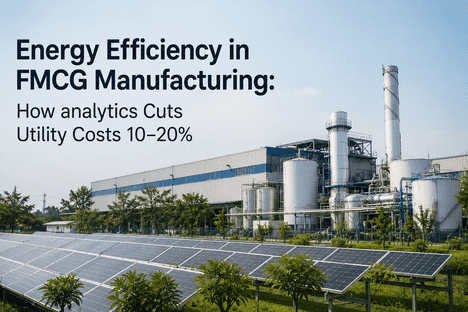
Energy is consistently among the top three operational cost categories for FMCG manufacturers — and among the most underoptimized. Energy management software combined with operational behavior change can reduce energy spend by 25–40% without capital investment in new equipment. These four strategies address the energy efficiency opportunities most accessible to food and consumer goods facilities.
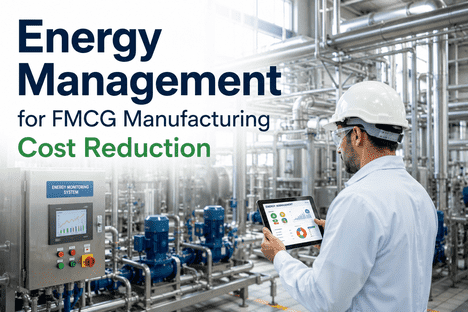
Deploy Energy Management Software with Real-Time Demand Monitoring
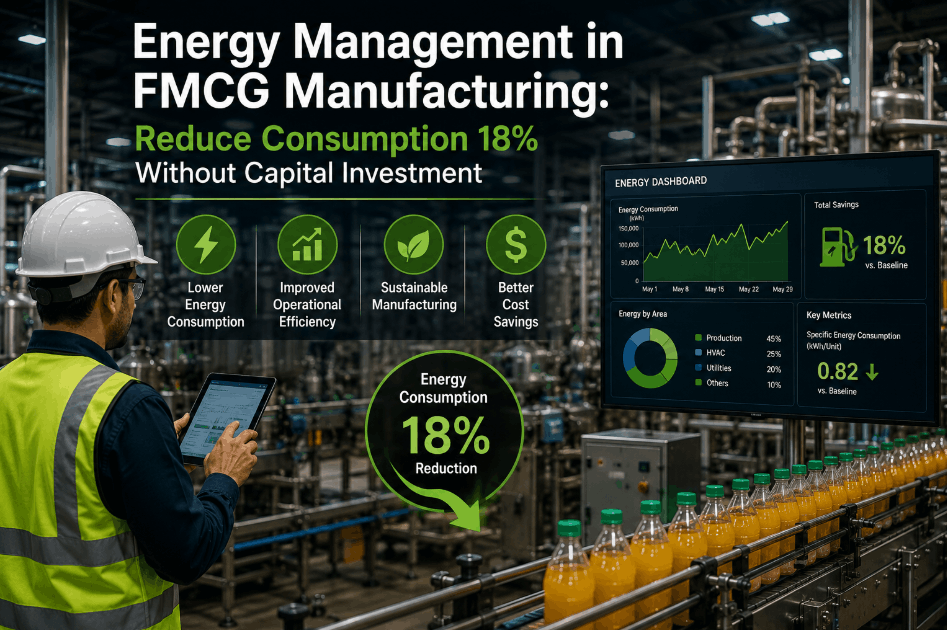
Real-time energy consumption monitoring by line, zone, and utility type reveals the behavioral and operational patterns driving peak demand — the primary driver of energy cost in manufacturing environments. Energy management software that connects to smart meters, sub-metering infrastructure, and building management systems enables operations teams to shift non-critical loads away from peak demand windows, reducing demand charges by 15–25% without changing production output.
Implement Compressed Air System Optimization
Compressed air is the most expensive utility in most FMCG plants — and the most wasted. Studies consistently find that 20–30% of compressed air in industrial facilities is lost to leaks, pressure mismatches, and inefficient distribution. Combining leak detection programs with pressure optimization analytics and usage scheduling eliminates this waste systematically. Compressed air optimization initiatives in FMCG plants typically deliver 18–28% reductions in compressed air energy spend within 90 days.
Optimize HVAC and Refrigeration Energy Consumption
For food and beverage FMCG manufacturers, refrigeration and HVAC often represent 35–50% of total facility energy consumption. AI-driven setpoint optimization, predictive demand adjustment based on ambient conditions, and automated scheduling of defrost cycles can reduce refrigeration energy costs by 20–35%. These improvements require no capital investment in new refrigeration hardware — only intelligent control and monitoring software integrated with existing systems.
Eliminate Idle and Standby Energy Waste Through Automated Scheduling
Production equipment left running in idle or standby states between runs, during breaks, and during unplanned stoppages consumes 15–40% of its rated power without producing output. Automated equipment shutdown and startup sequencing — triggered by production schedule data and sensor status from industrial IoT monitoring systems — eliminates this waste category entirely. Facilities implementing automated idle management report 8–14% reductions in total energy consumption within the first 60 days.
Strategies 10–12: Predictive Maintenance and Asset Performance Management
Unplanned equipment downtime is one of the single largest hidden costs in FMCG manufacturing — consuming not just the direct cost of repair, but the compounding cost of lost throughput, rescheduled production, expedited raw material orders, and customer service failures. Predictive maintenance software and asset performance management platforms transform this reactive cost center into a proactive savings driver.
Replace Scheduled Maintenance with Condition-Based Predictive Maintenance
Time-based preventive maintenance schedules are systematically inefficient — replacing components before failure regardless of actual wear state, while still allowing unexpected failures to occur between scheduled intervals. Predictive maintenance software using vibration analysis, thermal imaging, and motor current signature analysis identifies emerging equipment degradation 2–6 weeks before failure, enabling maintenance teams to plan interventions precisely. Facilities transitioning from scheduled to predictive maintenance consistently report 40–60% reductions in unplanned downtime and 25–35% reductions in total maintenance spend.
Deploy Asset Performance Management to Extend Equipment Lifecycle
Asset performance management platforms provide a comprehensive view of equipment health, utilization, and total cost of ownership across the full machinery fleet. By tracking mean time between failures, repair frequency, parts consumption, and performance degradation trends, operations and maintenance teams can make informed decisions about repair-versus-replace thresholds, capital investment timing, and spare parts inventory optimization. APM-driven decisions on equipment lifecycle management typically reduce capital expenditure requirements by 12–18% annually.
Optimize Spare Parts Inventory to Reduce Carrying Costs and Stockout Risk
Spare parts inventory is a significant but often overlooked operational cost. Overstocked parts tie up working capital; understocked critical parts extend downtime when equipment fails. AI-driven spare parts optimization — informed by equipment failure prediction data from predictive maintenance software — right-sizes inventory levels for each component category. This eliminates both excess carrying costs and emergency procurement premiums, delivering 15–25% reductions in maintenance materials spend for most FMCG facilities. You can book a demo to see how iFactory's asset performance management module connects predictive failure data to inventory optimization workflows.
Strategies 13–15: Waste Reduction, Supply Chain, and Profitability Optimization
The final three strategies address the cost reduction opportunities that span beyond the four walls of production — connecting material efficiency, supply chain optimization software, and cross-functional profitability analysis into a coherent operational improvement system.
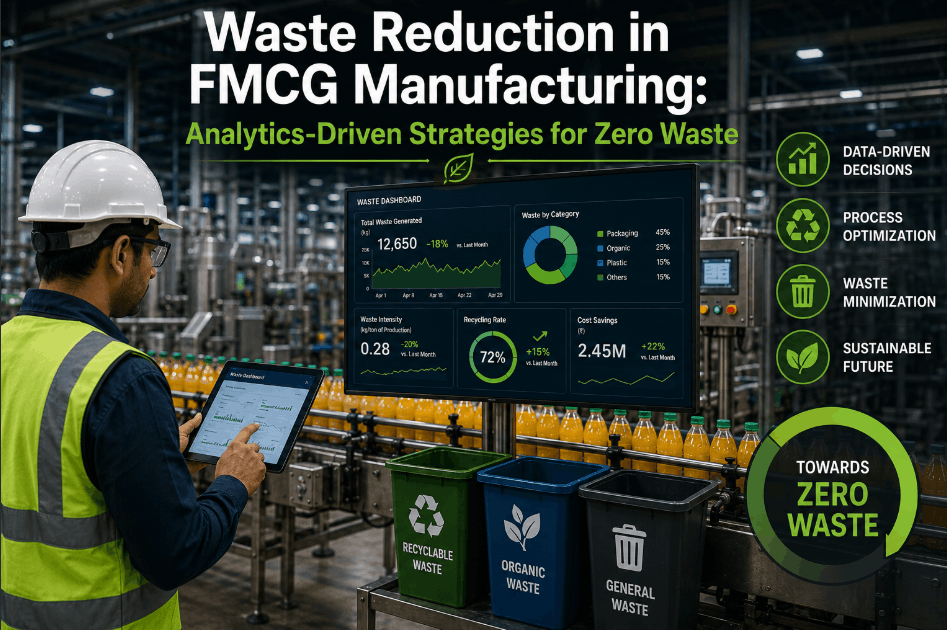
Implement Data-Driven Waste Reduction in Manufacturing Processes
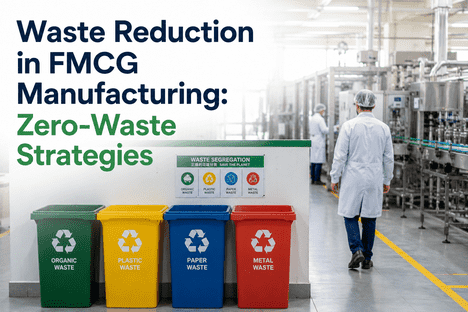
Waste reduction in manufacturing requires granular visibility into where material losses occur — not just total waste weight at the end of a production run. Real-time yield tracking at each process step, combined with root cause analysis tooling in your production optimization software, identifies exactly which process parameters, operators, shifts, or equipment conditions drive above-baseline waste rates. Systematically closing the gap between actual and theoretical yield across high-volume FMCG lines delivers material cost savings of 8–18% depending on the product category and current waste baseline.
Deploy Supply Chain Optimization Software to Reduce Procurement and Logistics Costs
Supply chain optimization software connects production planning data, supplier performance metrics, and logistics cost analytics into a unified decision platform. In FMCG environments where raw material costs represent 40–65% of total cost of goods, even marginal improvements in procurement timing, supplier selection, and inventory positioning have an outsized impact on profitability. AI-driven supply chain optimization identifies demand pattern shifts earlier, enables more accurate raw material planning, and surfaces supplier substitution opportunities before cost pressures become critical. Typical supply chain optimization initiatives deliver 5–12% reductions in total procurement and logistics spend.
Build a Continuous Profitability Optimization Framework
Sustainable FMCG cost reduction is not a project — it is an operating discipline. The facilities achieving the deepest and most durable improvements are those that have embedded profitability optimization software into their daily management system: reviewing cost drivers in daily operations meetings, setting line-level cost targets alongside throughput targets, and closing the loop between analytics insights and operational actions. This framework ensures that gains achieved through the previous 14 strategies are not eroded over time but compounded — building a manufacturing operation that becomes structurally more efficient with each operating period.
Performance Impact: Legacy Operations vs. AI-Optimized FMCG Manufacturing
The combined impact of these 15 cost reduction strategies is most visible when comparing operational benchmarks before and after implementation of an integrated manufacturing intelligence software platform. The performance gaps below represent typical outcomes for FMCG facilities transitioning from siloed, reactive operations to AI-driven, data-informed manufacturing.
| Cost Category | Legacy Operation | AI-Optimized Operation | Typical Saving |
|---|---|---|---|
| Unplanned Downtime Cost | 8–14% of production time lost | 2–4% with predictive maintenance | 60% reduction |
| Energy Spend per Unit | Unmonitored peak demand cycles | Demand-optimized real-time scheduling | 25–40% savings |
| Material Waste Rate | 4–9% above theoretical yield | 1–3% above theoretical yield | 18% improvement |
| Maintenance Labor Cost | Reactive repair model | Condition-based planned interventions | 30% reduction |
| Quality Rework and Reject Rate | Post-process defect detection | Real-time anomaly detection and response | 45% reduction |
| Total Operational Cost Index | Baseline | AI-optimized operations | 15–23% overall |
Each of the 15 strategies above delivers standalone value — but their most powerful impact is realized when implemented as a connected system. Real-time analytics data from strategy 1 enables the anomaly detection in strategy 5. Predictive maintenance intelligence from strategy 10 informs spare parts optimization in strategy 12. Supply chain data from strategy 14 feeds the profitability framework in strategy 15. FMCG manufacturers that approach cost reduction as an integrated, data-connected initiative consistently outperform those pursuing isolated improvements by a factor of 2–3x in total realized savings. The infrastructure that connects all 15 strategies is a purpose-built industrial analytics platform — and deploying it is the first decision that makes all others possible. Book a demo to assess your plant's cost reduction potential across all five strategy categories.
Frequently Asked Questions: FMCG Operational Cost Reduction
What is the fastest way to reduce operational costs in an FMCG manufacturing plant?
Deploying real-time OEE tracking and energy demand monitoring typically delivers the fastest measurable cost reduction — often within 4–8 weeks of implementation. These two capabilities surface the highest-impact improvement opportunities without requiring process changes or capital investment, creating immediate savings while longer-term structural improvements are developed.
How much can predictive maintenance software reduce maintenance costs?
Facilities transitioning from scheduled to predictive maintenance typically achieve 25–35% reductions in total maintenance spend and 40–60% reductions in unplanned downtime costs. The exact savings depend on current equipment age, maintenance maturity, and production complexity — but predictive maintenance consistently ranks as one of the highest-ROI investments available to FMCG manufacturers.
Can supply chain optimization software reduce FMCG procurement costs?
Yes. Supply chain optimization platforms typically deliver 5–12% reductions in total procurement and logistics spend by improving demand forecasting accuracy, enabling smarter supplier selection, and reducing emergency procurement events. In FMCG environments where raw materials represent 40–65% of COGS, supply chain optimization has an outsized impact on total operational profitability.
What role does industrial IoT monitoring play in cost reduction?
Industrial IoT monitoring provides the real-time data foundation that makes all other cost reduction strategies measurable and actionable. Without connected sensor data, cost optimization relies on lagging indicators and incomplete manual records. With IoT-connected production assets, teams can detect inefficiencies as they occur, attribute costs to specific machines, operators, and products, and close the improvement loop in near-real-time.
How does digital transformation reduce labor costs in FMCG manufacturing?
Digital transformation reduces labor costs primarily by eliminating non-value-adding activities — manual data collection, paper-based reporting, reactive problem-solving — and redirecting operator and supervisor time toward higher-value tasks. It also improves labor productivity by giving operators real-time visibility into performance targets, enabling them to self-correct rather than waiting for end-of-shift reports to identify problems.
How does production optimization software improve yield rates in FMCG plants?
Production optimization software tracks real-time yield at every process step, identifying exactly where material losses exceed baseline thresholds. By correlating yield deviations with specific equipment conditions, operators, or process parameters, operations teams can close the gap between actual and theoretical output — typically recovering 8–18% in material cost savings within the first year.
What is the ROI timeline for implementing an industrial analytics platform in FMCG?
Most FMCG facilities begin seeing measurable ROI within 6–12 weeks of deploying an industrial analytics platform — primarily through OEE improvement and energy demand reduction. Full payback on platform investment is typically achieved within 9–18 months, with ongoing compounding savings as more cost reduction strategies are layered on top of the analytics foundation.