AI-Native SPC Modernization for Food & Beverage Batch Quality Control
By Riley Quinn on May 27, 2026
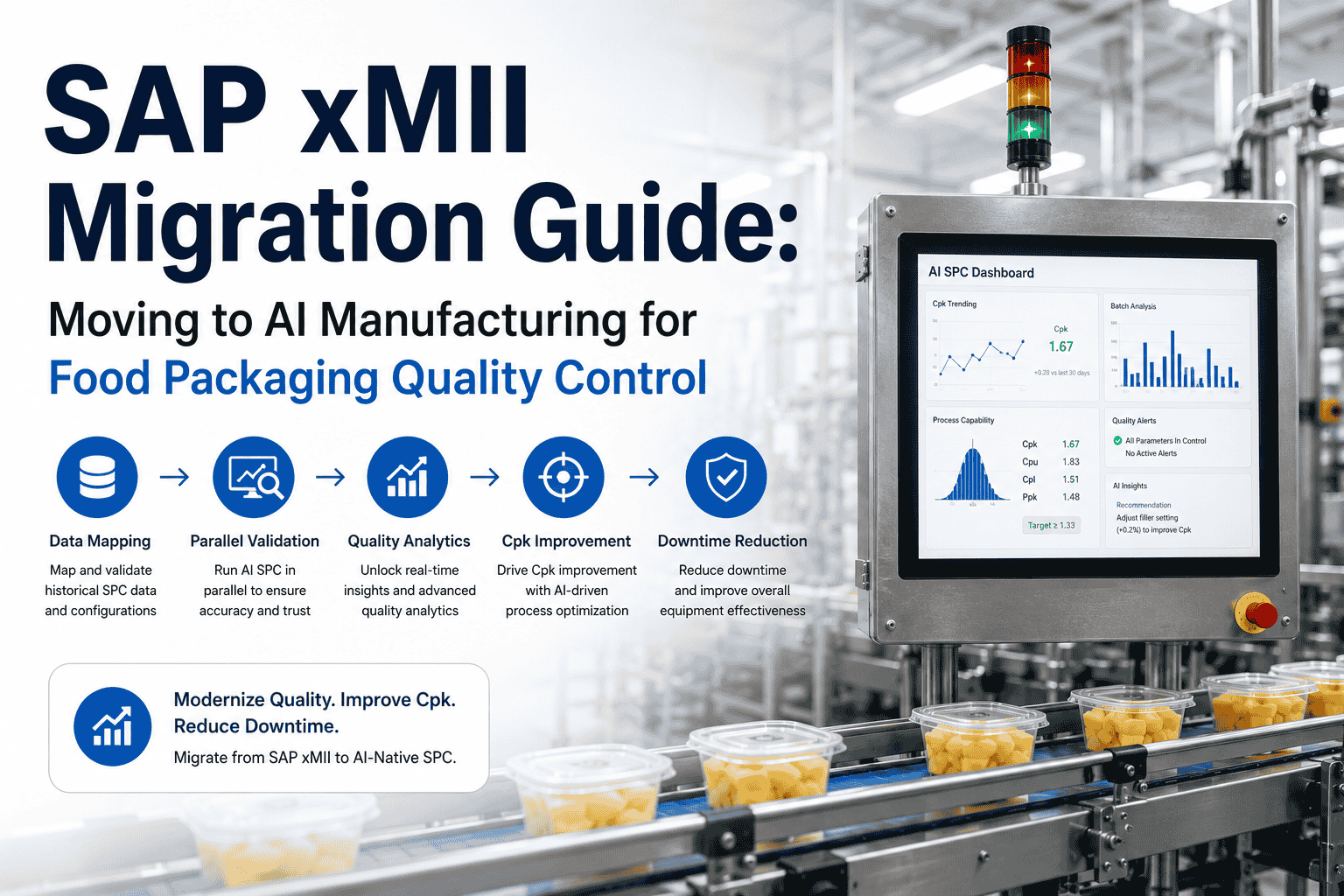
Most food and beverage plants running SAP QM and SAP xMII today aren’t failing because the stack doesn’t work — they’re failing because the stack was designed for a different decade of quality control. SAP xMII’s Business Logic Services (BLS) transactions handle SPC charts well, write quality notifications to SAP QM, and integrate cleanly with the ERP. But BLS transactions can’t learn. They follow rules an engineer wrote in 2014. They generate alerts when a Nelson Rule fires, not when an LSTM model recognizes a drift signature 15 minutes before the rule would trip. And they reduce discovery-to-containment time from one week to four hours, which used to be world-class but is now table stakes. The next quality plateau requires AI-native SPC layered onto (or replacing) the existing SAP stack — multivariate models, autoencoder anomaly detection, confidence fusion across statistical and machine-learning signals, and natural-language operator interfaces. This guide is for quality leaders, plant IT, and operations heads evaluating the modernization — what AI-native SPC actually adds to a SAP QM + xMII baseline, the “keep / retire / transform / replace” decision matrix per artifact, three migration paths, vendor evaluation, and the 8–12 week playbook. Book an AI SPC migration workshop to map the keep/retire/transform decisions against your current SAP landscape.
The Modernization Landscape
Your SAP Stack Today · The AI-Native Stack Tomorrow
Migration isn’t rip-and-replace. It’s a structured transition where some components stay, some retire, and a new intelligence layer sits above the existing data infrastructure.
Why the SAP QM + xMII Stack Is Hitting Its Ceiling
The architectural gap isn’t about what SAP xMII does badly — it’s about what xMII was never designed to do. BLS transactions execute orchestration and rule-based analysis exactly as authored. They don’t learn from operator confirmations. They don’t fuse statistical signals with deep-learning anomaly scores. They don’t adapt confidence thresholds to changing soil loads, SKU mixes, or seasonal variation. Four specific ceilings are now visible in every mature F&B SAP deployment.
01
Rule-Based Detection Only
BLS SPC engines fire when Nelson Rules trigger — after the process has visibly drifted. AI-native models recognize drift signatures 5–30 minutes before any rule fires, using multivariate correlation across 80+ tags.
Gap: Reactive vs Predictive
02
No Self-Updating Models
xMII rules require engineering intervention to update. Operator confirmations don’t flow back to improve detection. The platform doesn’t learn from your specific plant’s deviation patterns over time.
Gap: Static vs Adaptive
03
Single-Signal Alerts
Each BLS transaction evaluates one signal at a time. Modern F&B quality requires confidence fusion — combining Nelson Rules with LSTM trend models and autoencoder anomaly scores to reduce false positives.
Gap: Univariate vs Fused
04
Legacy UX Layer
xMII display templates were built for desktop browsers a decade ago. Modern operators need mobile-responsive dashboards, natural-language queries, and conversational AI copilots grounded in plant data.
Gap: Desktop-only vs Mobile-native
What AI-Native SPC Actually Adds to the SAP Foundation
The misconception some plants carry into the modernization conversation: AI-native SPC replaces SAP QM. It doesn’t. SAP QM continues handling quality notifications, batch certificates, and CAPA workflows exactly as today — this is one of SAP’s strongest capabilities and there’s no business case to replace it. What changes is the intelligence layer that feeds SAP QM. xMII’s BLS-based analysis migrates to AI-native SPC. The query and display templates retire in favor of modern responsive UX. Historian connections get reused, not rewired.
Swipe horizontally to compare BLS SPC vs AI-Native SPC
Capability
SAP xMII BLS SPC
AI-Native SPC
Detection method
Nelson Rules + threshold alarms
Nelson Rules + LSTM + Autoencoder confidence fusion
Lead time before deviation
After rule fires (reactive)
5–30 min predictive lead time
Variables analyzed per event
1–3 univariate signals
80+ tags multivariate correlation
Model evolution
Engineer rebuilds rules manually
Self-updating from operator confirmations
SKU changeover
Per-SKU rule reconfiguration
Auto-adapts to SKU profile from historian context
Output to SAP QM
Quality notification (post-event)
Quality notification + confidence score + root cause hypothesis
The Keep / Retire / Transform / Replace Decision Matrix
Migration discipline starts here. Every SAP artifact in your current quality stack falls into one of four categories — what to keep, what to retire, what to transform, and what to replace. Getting the categorization right in week one of the workshop saves quarters of debate later. Here’s the matrix iFactory uses with every F&B customer.
Keep
Core SAP foundations
SAP QM quality notifications
SAP QM batch certificates
CAPA workflow engine
Material master & batch genealogy
Identity & authorization objects
SAP’s strongest capabilities. No business case to replace. AI-native SPC writes back to these systems.
Retire
Legacy UX & query layers
xMII display templates
Custom SSCE pages
Most query templates
Desktop-only dashboards
Per-SKU manual rule configs
Replaced by modern responsive UX and historian federation. 70–90% reduction in custom rebuild scope.
Transform
Analysis transactions
BLS SPC violation detection
BLS OEE calculations
BLS yield analytics
BLS multivariate calculations
Custom action blocks
Become AI model invocations grounded in time-series data. Logic preserved, intelligence upgraded.
Want this matrix applied to your specific xMII inventory in a working session? Book an AI SPC migration workshop to walk through every artifact.
Three Migration Paths — Pick the One That Fits Your Risk Posture
Same starting point, three valid destinations. The right path depends on regulatory exposure, IT change appetite, executive sponsorship strength, and current xMII customization depth. Plants that pick the wrong path for their context spend 18 months in migration purgatory. Plants that pick the right path land at 8–12 weeks.
Path A
Augment in Place
6–8 weeks
AI-native SPC runs alongside existing xMII. Shadow mode for 4 weeks. Confidence fusion outputs flow to SAP QM via OData. No xMII transactions retired in this phase.
Best fit
Heavy regulatory environments · risk-averse IT · first AI deployment in the plant
Wk 1–2 Historian federation
Wk 3–5 Shadow mode AI
Wk 6–8 SAP QM write-back live
Path B
Hybrid Migration
8–12 weeks
AI-native SPC replaces xMII analysis layer. xMII orchestration retained. Display templates retire in favor of modern UX. Historian federation preserved.
Best fit
Mature SAP plants · moderate customization · executive sponsor with budget authority
Wk 1–3 Discovery · matrix
Wk 4–8 Transform analysis layer
Wk 9–12 UX migration · cutover
Path C
Full Modernization
10–14 weeks
xMII retired entirely. AI-native platform provides feature parity plus AI brain. SAP QM retained. All BLS transactions reviewed against keep/retire/transform/replace matrix.
iFactory’s SAP modernization practice runs a focused workshop against your specific xMII inventory, SAP QM customization level, regulatory exposure, and executive sponsorship strength. You leave with a defended path recommendation, a 12-week deployment plan, and a yield improvement projection grounded in your historian data.
Generic AI SPC vendors handle the SPC math. SAP-aware AI SPC vendors handle the integration reality — OData/REST APIs, authorization object inheritance, historian federation, SAP QM write-back, and zero-ABAP customization commitments. Eight criteria separate vendors who’ve done F&B SAP modernizations from vendors selling the demo.
01
SAP QM integration depth
Ask:
"How does your platform write quality notifications, defect codes, and confidence scores back to SAP QM?"
Native OData/REST API integration with SAP QM is non-negotiable. Vendors using flat-file exports or screen-scraping aren’t SAP-aware. Demand: confidence scores in custom Z-fields, defect code mapping, batch genealogy preservation.
02
Historian federation, not migration
Ask:
"Does your platform federate to existing PI / InSQL / Proficy / PHD, or require historian migration?"
Migration-required platforms add 6–12 months to deployment. Federation-capable platforms reuse the existing historian connection through wk 1–2 of deployment. The right answer is federation, full stop.
03
Confidence fusion architecture
Ask:
"What models does your platform combine for SPC alert generation?"
Production-grade AI SPC combines Nelson Rules (statistical) + LSTM (time-series prediction) + Autoencoder (anomaly detection) with confidence fusion. Single-model platforms generate false positives at rates that erode operator trust within 30 days.
04
Zero-ABAP customization
Ask:
"Does deployment require ABAP development on the SAP side?"
The right answer is no. ABAP customization adds change-control overhead, SAP Basis dependency, and ongoing maintenance burden. AI-native SPC platforms should work through standard OData/REST without touching your SAP ABAP codebase.
05
Authorization object inheritance
Ask:
"Do AI agents respect existing SAP authorization objects?"
Critical for regulated F&B (FDA, GFSI, HACCP). Users should see only what their existing SAP role permits. Every AI action — prediction, work order trigger, QM posting — must log with user, timestamp, and SAP transaction reference.
06
Pre-configured F&B templates
Ask:
"What SPC templates ship out of the box for F&B processes?"
Pasteurization, separation, homogenization, filling, CIP, packaging templates pre-configured. Vendors building from scratch add 8–16 weeks. Templates reduce custom rebuild scope by 70–90% per the iFactory deployment benchmarks.
07
Data residency & on-prem option
Ask:
"Can the AI brain run fully on-premise inside our plant?"
Process recipes, batch genealogy, supplier pricing, and equipment failure history shouldn’t leave the plant without explicit policy. On-prem deployment with cloud opt-in per data class is the right architecture for F&B with regulatory and competitive sensitivity.
08
Migration timeline commitment
Ask:
"When does first AI SPC alert flow to SAP QM in production?"
8–12 weeks is the production-grade benchmark for hybrid migration. Path A (augment in place) is 6–8 weeks. Path C (full modernization) is 10–14 weeks. Vendors quoting 6+ months are building custom development, not deploying a product.
The Yield Improvement Math — What Modernization Actually Delivers
The business case for AI-native SPC modernization isn’t about software cost — it’s about yield improvement on batch quality. F&B plants moving from BLS-based SPC to AI-native SPC see measurable improvements across four metrics in the first quarter post-deployment. The math is documented across recent deployments, not theoretical.
+3–7%
First-pass yield lift
Multivariate detection catches process drift before it produces off-spec batches. Yield gain compounds quarter over quarter.
−60–75%
Deviation investigation time
AI surfaces root cause hypothesis with the alert. Investigation becomes verification, not reconstruction.
−40–55%
SPC false positive rate
Confidence fusion across Nelson + LSTM + Autoencoder filters single-rule false alarms that erode operator trust.
6–12 mo
Typical ROI payback
Full investment recovery through yield gain, deviation cost reduction, and inspector redeployment to higher-value work.
Expert Perspective
"The single biggest mistake F&B plants make in SAP QM modernization is treating it as a software replacement project. It isn’t. SAP QM’s quality notification engine, batch certificate generation, and CAPA workflows are among the strongest capabilities in the SAP ecosystem — there’s no business case to replace them. What needs to change is the intelligence layer feeding SAP QM. BLS transactions running rule-based SPC migrate to AI model invocations running confidence fusion across LSTM, Nelson Rules, and autoencoder anomaly detection. The architectural decision isn’t SAP-or-AI — it’s SAP-plus-AI. Plants that frame it correctly land at 8–12 week deployments. Plants that frame it as rip-and-replace spend 18 months in migration purgatory."
— F&B SAP Modernization Practice, 2026 industry insight
8–12 wk
hybrid migration timeline with pre-configured F&B templates
70–90%
reduction in custom rebuild scope using AI-native templates
Zero ABAP
customization required for OData/REST integration approach
Conclusion: The Modernization Decision Has Three Right Answers
SAP QM and SAP xMII aren’t failing in F&B plants — they’re hitting an architectural ceiling that BLS-based analysis can’t cross. AI-native SPC adds the multivariate intelligence layer that xMII was never designed to deliver: LSTM models, autoencoder anomaly detection, confidence fusion, self-updating learning from operator confirmations, and natural-language operator copilots grounded in plant data. The modernization conversation has three valid answers depending on regulatory exposure and IT change appetite — augment in place (6–8 weeks), hybrid migration (8–12 weeks), or full modernization (10–14 weeks). All three keep SAP QM intact and reuse the existing historian connections. None require ABAP customization. All three deliver +3–7% first-pass yield lift within the first quarter. The decision worth making in 2026 isn’t whether to modernize — it’s which of the three paths fits your specific F&B plant context. Book an AI SPC migration workshop to walk through your specific xMII inventory and SAP QM landscape.
Run the Migration Workshop Built for Your SAP Landscape
iFactory’s F&B SAP modernization practice runs a 90-minute workshop against your real xMII inventory, SAP QM customization, and historian topology. You leave with a defended path recommendation (A, B, or C), the keep/retire/transform/replace matrix applied to your artifacts, and a yield improvement projection grounded in your batch quality history.
No. SAP QM is retained in all three migration paths (augment in place, hybrid migration, full modernization). SAP QM’s quality notification engine, batch certificate generation, CAPA workflows, batch genealogy, and integration with the broader SAP ecosystem are among SAP’s strongest capabilities — there’s no business case to replace them. What changes is the intelligence layer feeding SAP QM. AI-native SPC writes quality notifications, defect codes, root cause hypotheses, and confidence scores back to SAP QM via OData/REST APIs. The downstream workflows you’ve built in SAP QM continue working exactly as today — they just receive higher-quality, earlier, more accurate input from the AI-native SPC layer instead of from BLS transactions.
What happens to existing SAP xMII BLS transactions during migration?
Each BLS transaction gets categorized in the keep/retire/transform/replace matrix during workshop week 1. Pure orchestration BLS transactions (sequence A, then B, then write to SAP) get replaced by event-driven workflows. Analysis BLS transactions (calculate OEE, detect SPC violation, predict failure) get transformed into AI model invocations grounded in time-series and historian data. Most query templates retire entirely because the underlying historian connection (PI, InSQL, Proficy, PHD, Exaquantum) gets reused with iFactory’s federation layer replacing the query layer. Display templates rebuild as modern responsive UI with SPC charts, OEE dashboards, and SQC analysis shipping out of the box. The custom rebuild scope typically drops 70–90% from what plants initially estimate.
Does deployment require ABAP development or SAP Basis support?
Production-grade AI-native SPC platforms commit to zero ABAP customization. Integration happens through standard OData/REST APIs that already exist in your SAP landscape. AI agents inherit existing SAP authorization objects, so users see only what their SAP role permits — no Basis configuration required. Every AI action (prediction, work order trigger, QM posting) logs with user, timestamp, and SAP transaction reference. This matters because ABAP-required deployments add change-control overhead, SAP Basis team dependency, and ongoing maintenance burden — the kinds of cost that often turn 8–12 week migrations into 18-month projects. Demand zero-ABAP commitment in vendor selection.
How does confidence fusion across LSTM, Nelson Rules, and Autoencoder actually work?
Three independent models evaluate each SPC event and produce confidence scores. Nelson Rules (statistical SPC) check the classical Western Electric pattern violations — points beyond control limits, runs above/below center, trending sequences. LSTM (long short-term memory neural networks) evaluate the time-series trajectory and predict drift signatures 5–30 minutes ahead. Autoencoder (unsupervised anomaly detection) flags multivariate patterns that don’t match the learned normal envelope across 80+ correlated tags. The platform fuses all three confidence scores into a single alert with explicit contribution per model. Alerts firing on all three models indicate high-confidence real events worth immediate operator action. Alerts firing on only one model get filtered or queued for review. The result: 40–55% reduction in false positive rate compared to single-model SPC, which is what preserves operator trust in the platform after deployment week 30.
Which migration path fits a heavily regulated F&B plant best?
Path A (Augment in Place) is the right starting point for heavily regulated environments — FDA, GFSI, HACCP, BRCGS Issue 9, FSSC 22000. The platform runs alongside existing xMII for 4 weeks in shadow mode, generating alerts logged for review but not posting to SAP QM. Quality and validation teams compare AI alerts against the existing BLS-based alerts, document the equivalence and improvement, and approve cutover with full traceability. Confidence fusion outputs then start flowing to SAP QM via OData. No xMII transactions retire in Path A — the legacy stack continues running as a control comparison. This satisfies validation rigor without introducing rip-and-replace risk. After 6–12 months of Path A operation, most plants progress to Path B (hybrid migration) to capture the deployment efficiency and UX modernization benefits.