Cold chain management is the backbone of food safety — and in today's food and beverage industry, a single temperature deviation can trigger regulatory action, product recalls, and permanent damage to brand reputation. Whether you operate a processing facility in the UK, a distribution network across Germany, a food manufacturing plant in Canada, or a rapidly scaling food logistics business in the UAE, maintaining cold chain integrity from receiving dock to final shipment is no longer optional — it is a competitive necessity. This complete guide covers every stage of cold chain management, the role of AI-powered IoT sensor integration, and how modern software platforms are replacing guesswork with real-time intelligence.
What Is Cold Chain Management — And Why Does It Fail?
Cold chain management refers to the end-to-end system of maintaining temperature-controlled conditions across the entire food supply journey — from raw material intake, through storage and processing, to finished product dispatch. Despite advances in refrigeration technology, cold chain failures remain one of the top causes of food spoilage globally. The Food and Agriculture Organization estimates that over 1.3 billion tonnes of food is wasted annually — a significant portion attributable to inadequate temperature management.
The Four Critical Failure Points in a Food Cold Chain
Incoming shipments spend 18–45 minutes at ambient temperature during unloading. Without automated logging at intake, excursions go undetected and unrecorded. Book a Demo
Walk-in coolers develop thermal stratification — hot and cold zones that single-point sensors miss entirely. Product in warm zones may appear compliant. Book a Demo
Transfer to processing is the highest-risk transition. Manual timing checks and process delays introduce temperature excursions that are rarely captured in traditional systems.
Loading dock temperature at dispatch is frequently below required pre-cool. Without automated verification, product ships out of specification — transferring liability downstream. Book a Demo
Receiving Dock Cold Chain Protocols — The First Line of Defense
A robust receiving dock protocol is the foundation of food cold chain integrity. Every incoming load represents a potential break — and the receiving dock is where most facilities have the least automation and the most manual process risk.
Require electronic pre-delivery temperature logs from all suppliers. AI platforms automatically validate these against specs and flag non-conformances before the vehicle reaches your dock.
Deploy fixed IoT temperature probes at dock doors that begin continuous logging the moment a vehicle connects. This eliminates manual probe checks and operator errors.
Bluetooth-connected probe thermometers push readings directly into your cold chain management system, eliminating transcription errors and creating auditable digital records.
When intake temperature exceeds specification, the system automatically quarantines the lot, notifies supervisors, and initiates hold-and-test workflows instantly. Book a Demo
Cold Storage Analytics — Moving Beyond Single-Point Monitoring
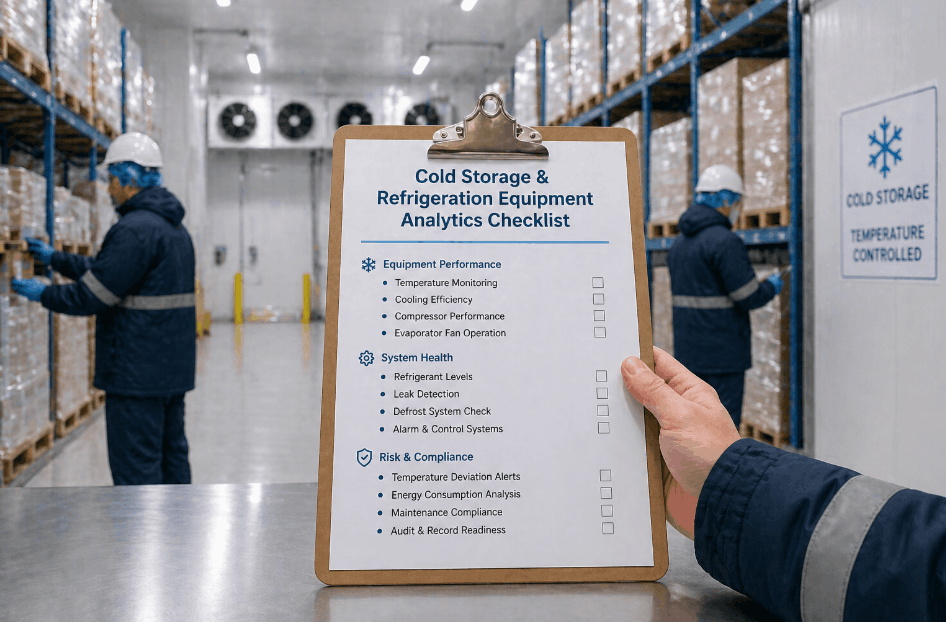
IoT-enabled cold storage management platforms deploy a network of wireless sensors and build a continuous thermal model of each storage space. This approach, widely adopted in the UK, Germany, Canada, and the UAE, transforms static compliance logging into dynamic operational intelligence.
| Capability | Basic Monitoring System | iFactory AI Platform |
|---|---|---|
| Thermal mapping | Single-Point Only | Full 3D Thermal Modelling |
| Excursion alerts | Reactive alerts | AI-Driven Predictive Alerts |
| Failure prediction | Fixed thresholds only | 4–8 Weeks Advance Warning |
| Vision integration | Not available | Natively Supported |
| Audit readiness | Manual data export | Automated, Audit-Ready Records |
Key Cold Storage Metrics
The single most important metric — MKT accounts for the cumulative thermal effect on product quality over time. Book a Demo
Tracking frequency and duration identifies process inefficiencies and equipment wear on gaskets and seals, reducing energy waste and temperature spikes.
After loading, how quickly does the room return to set point? Declining rates indicate compressor wear or insulation degradation, detectable before failure occurs. Book a Demo
AI Vision Enhancements for Cold Chain Control
AI vision cameras observe behaviour, product condition, and process compliance in real time. For food facilities seeking to move beyond simple data logging, computer vision delivers capabilities that transform operational intelligence.
Detects damaged packaging and visible condensation as pallets pass through dock doors, reducing intake inspection time by 60% with higher accuracy.
Detects open door events and correlates with temp spikes — alerting supervisors when doors stay open beyond dwell time, reducing energy waste by up to 25%.
Computer vision models inspect product at conveyor speeds for discoloration or ice crystal formation (indicating freeze-thaw cycles) during processing.
Identifies when product is loaded against evaporator coils or stacked too high, which restricts air circulation and creates unnecessary thermal risk zones. Book a Demo
Regulatory Requirements & Audit Readiness
Requires documented temperature monitoring at all CCPs. iFactory automates this audit trail. Book a Demo
Mandates preventive control plans with detailed temperature monitoring and 2-year record retention. iFactory provides CFIA-preferred digital records.
Strict storage temperature rules for animal-derived products. Automated reporting satisfies IFS Food Standards required by major German retailers.
Rapidly evolving standards requiring digital temperature records. iFactory supports the 40% growth in IoT adoption across UAE cold logistics. Book a Demo
Cold Chain ROI — Financial Justification
Early excursion detection prevents cascading spoilage events. Facilities report a 60–85% reduction in product loss within the first year.
Predictive analytics reduce unplanned failures by 52%. Avoid emergency repairs and product damage during major compressor outages.
AI-optimised set points and defrost cycles deliver consistent energy savings of 18–30% across large cold storage sites.
Automated monitoring typical saves 1.5 FTE equivalents per facility, improving audit readiness and eliminating manual logging shifts.
Frequently Asked Questions
It is the end-to-end system of maintaining temperature-controlled conditions across the food supply journey, ensuring safety and quality from raw materials to final shipment.
AI Vision identifies behavioral and environmental risks that sensors miss, such as doors left open too long or pallets stacked in ways that block essential airflow.
Mean Kinetic Temperature (MKT) accounts for the cumulative effect of temperature on microbial growth, providing a more scientifically accurate basis for safety decisions.
Yes, the platform automates record capture and generates audit-ready reports that meet the stringent documentation requirements of BRCGS, SQF, and SFCR schemes.
Most facilities achieve a full return on investment within 6–10 months through significant reductions in energy consumption, product spoilage, and manual oversight costs.
Eliminate guesswork with real-time IoT monitoring and predictive analytics. From receiving dock validation to outbound shipment verification — iFactory manages the complete food cold chain in a single AI-powered platform.