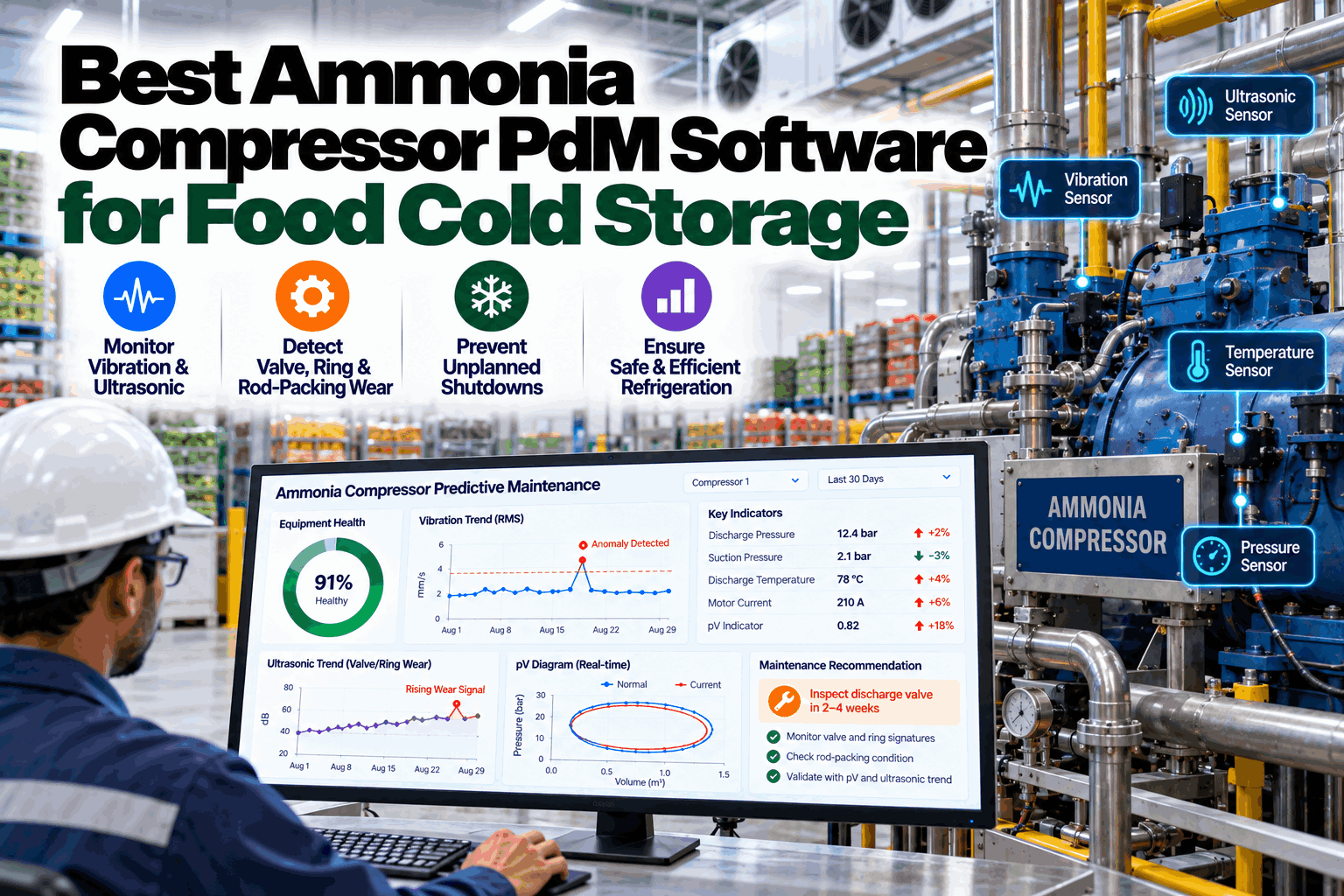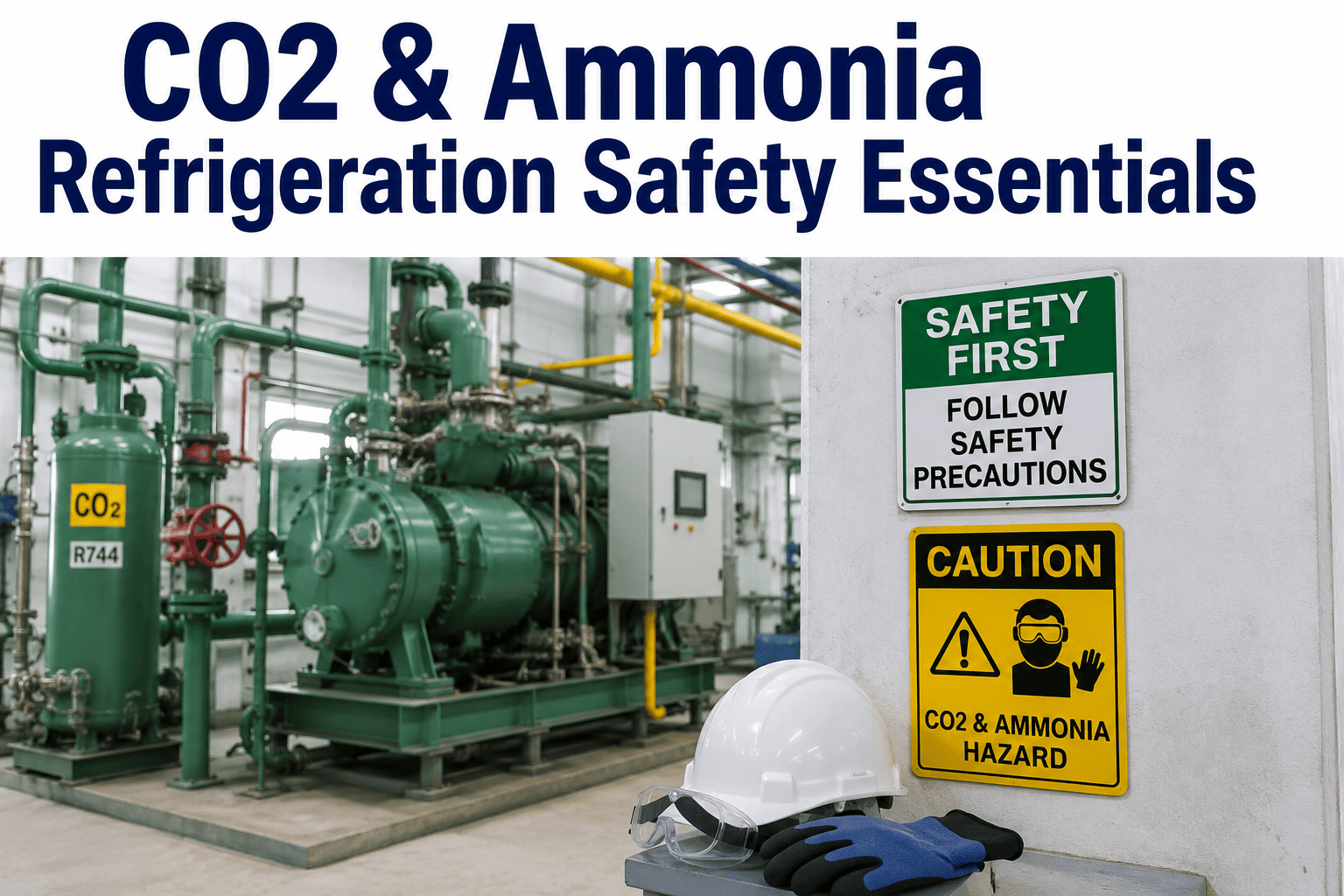
Cold storage warehouses are the backbone of the global food supply chain, preserving perishable goods from farm to fork. Maintaining these facilities requires meticulous oversight of ammonia refrigeration systems, which are both highly efficient and potentially hazardous. Process Safety Management (PSM) compliance is non-negotiable, and any downtime can lead to massive product loss, regulatory fines, and safety risks. Traditional preventive maintenance approaches often fall short, relying on fixed schedules that miss early signs of compressor wear, evaporator frost buildup, or refrigerant leaks. Enter AI-driven predictive maintenance: a transformative methodology that leverages real-time sensor data, machine learning algorithms, and digital twins to optimize refrigeration PM, detect ammonia leaks instantaneously, and ensure PSM compliance. This guide provides an enterprise-grade, deeply technical roadmap for maintenance managers seeking to elevate cold storage reliability, reduce energy costs, and achieve operational excellence. For a personalized strategy, Book a Demo today.
Transform Your Cold Storage Reliability
Eliminate unplanned downtime and ensure PSM compliance with AI-driven predictive maintenance.
Ammonia Refrigeration PM
Predictive maintenance for ammonia compressors, condensers, and evaporators using vibration analysis and oil debris monitoring to prevent catastrophic failures.
PSM Compliance Automation
Automated documentation of mechanical integrity tests, relief device inspections, and management of change (MOC) processes to meet OSHA 1910.119 requirements.
Compressor Monitoring
Real-time monitoring of discharge temperature, oil pressure, and vibration signatures to detect early-stage bearing wear and valve leakage.
Evaporator Defrost Optimization
AI-driven defrost scheduling based on coil temperature, humidity, and frost accumulation patterns, reducing energy consumption by up to 30%.
Ammonia Leak Detection
Continuous monitoring of ammonia concentration using electrochemical sensors and AI pattern recognition to differentiate between background and leak events.
Cold Warehouse Analytics
Unified dashboard showing OEE, energy intensity, refrigerant loss trends, and compliance calendar for holistic facility management.
Ammonia Refrigeration Systems: Core Components and Failure Modes
Ammonia refrigeration systems in cold storage warehouses typically consist of screw or reciprocating compressors, shell-and-tube condensers, high-pressure receivers, thermosyphon oil coolers, and forced-draft evaporators. The most common failure modes include compressor bearing wear due to oil degradation, valve plate fatigue leading to reduced volumetric efficiency, and evaporator coil frosting that impairs heat transfer. PSM compliance requires documented mechanical integrity programs for each pressure vessel, including thickness testing and relief valve certification. AI monitoring of discharge temperature trends can predict valve failures up to 14 days in advance, while vibration analysis on compressor bearings can detect spalling with 95% confidence. Implementing a digital twin of the refrigeration system allows for what-if analysis of load changes and defrost strategies without disrupting operations.
Implementation Roadmap for AI-Driven Cold Storage Maintenance
Sensor Deployment and Data Acquisition
Install vibration sensors on compressor bearings, temperature probes on discharge and suction lines, pressure transducers on oil and refrigerant circuits, and ammonia detectors at strategic points. Data is collected at 1-second intervals and streamed to the cloud.
Baseline Modeling and Anomaly Detection
Machine learning models are trained on six months of historical data to establish normal operating envelopes. Any deviation beyond 3 sigma triggers an alert, with false positive rates below 2%.
Predictive Analytics and Prescriptive Actions
Algorithms predict remaining useful life (RUL) of compressors and recommend optimal defrost schedules. Integration with CMMS generates work orders automatically.
Continuous Improvement and Compliance Reporting
Monthly reports show MTBF improvements, energy savings, and PSM compliance status. The system adapts to seasonal load variations and equipment degradation.
Process Safety Management (PSM) Compliance in Cold Storage
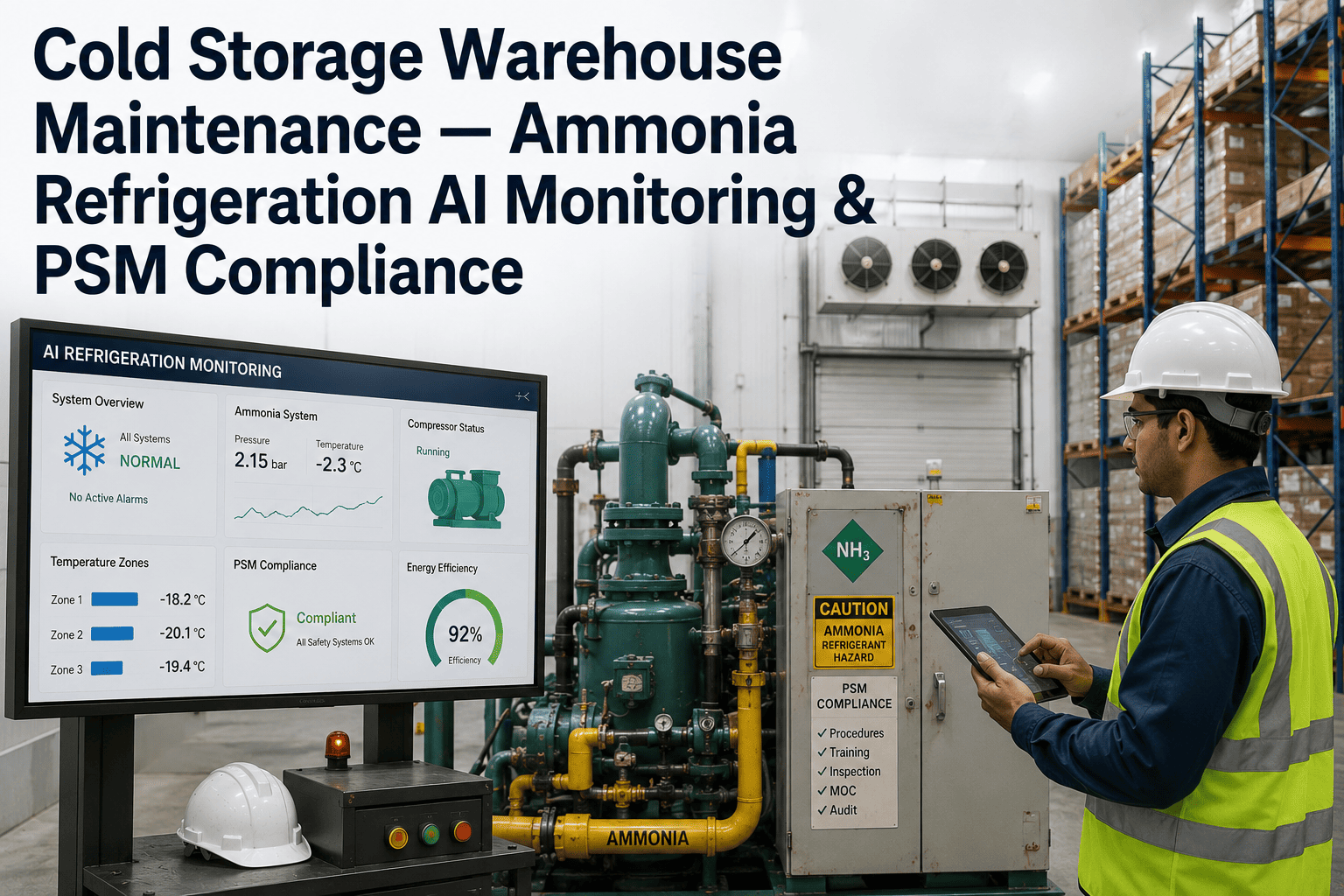
OSHA's PSM standard (29 CFR 1910.119) applies to any facility with more than 10,000 pounds of anhydrous ammonia. Key requirements include process hazard analysis (PHA), mechanical integrity procedures, hot work permits, and incident investigation protocols. AI systems can automate the tracking of mechanical integrity tests, ensuring that pressure vessels are inspected at intervals not exceeding 10 years. Relief device calibration records are automatically updated, and any overdue inspection triggers an alert. Management of change (MOC) is streamlined by requiring digital approval workflows for any modification to the refrigeration system. By integrating AI monitoring with PSM documentation, cold storage facilities can reduce audit preparation time by 70% and eliminate compliance gaps.
Traditional vs. AI-Driven Cold Storage Maintenance
| Parameter | Traditional PM | AI-Driven Predictive |
|---|---|---|
| Maintenance Scheduling | Fixed calendar intervals | Condition-based, dynamic |
| Leak Detection | Manual sniffing, monthly | Continuous, real-time AI |
| Defrost Control | Timer-based, wasteful | AI-optimized, energy efficient |
| Compliance Documentation | Paper-based, error-prone | Automated, digitized |
| Downtime Impact | Reactive, high cost | Predictive, minimal |
Optimize Your Cold Storage Operations Today
Implement AI-driven monitoring to reduce energy costs, prevent leaks, and ensure PSM compliance.
Compressor Monitoring: Vibration Analysis and Oil Debris Detection
Screw compressors are the workhorses of ammonia refrigeration, but they are prone to bearing wear, rotor contact, and oil degradation. Vibration analysis using accelerometers mounted on the compressor casing can detect early signs of bearing spalling, misalignment, and imbalance. Frequency-domain analysis (FFT) reveals characteristic peaks for each defect type. Oil debris monitoring using inline particle counters and ferrography provides early warning of wear before vibration levels rise. AI algorithms fuse vibration and oil data to predict remaining useful life with an accuracy of +/- 5% of actual failure time. This enables maintenance managers to schedule overhauls during planned shutdowns rather than emergency repairs, saving up to $200,000 per compressor event.
Evaporator Defrost Optimization
Evaporator coils in cold storage accumulate frost due to moisture ingress during door openings and from product respiration. Traditional defrost methods rely on fixed timers that cycle regardless of actual frost buildup, wasting significant energy. AI-driven defrost optimization uses coil temperature, humidity, and historical frost accumulation patterns to initiate defrost only when necessary. This reduces defrost cycles by up to 70% and saves 30% on refrigeration energy. Additionally, the system can predict when defrost is needed based on weather forecasts and door usage patterns, further improving efficiency.
Ammonia Leak Detection Systems
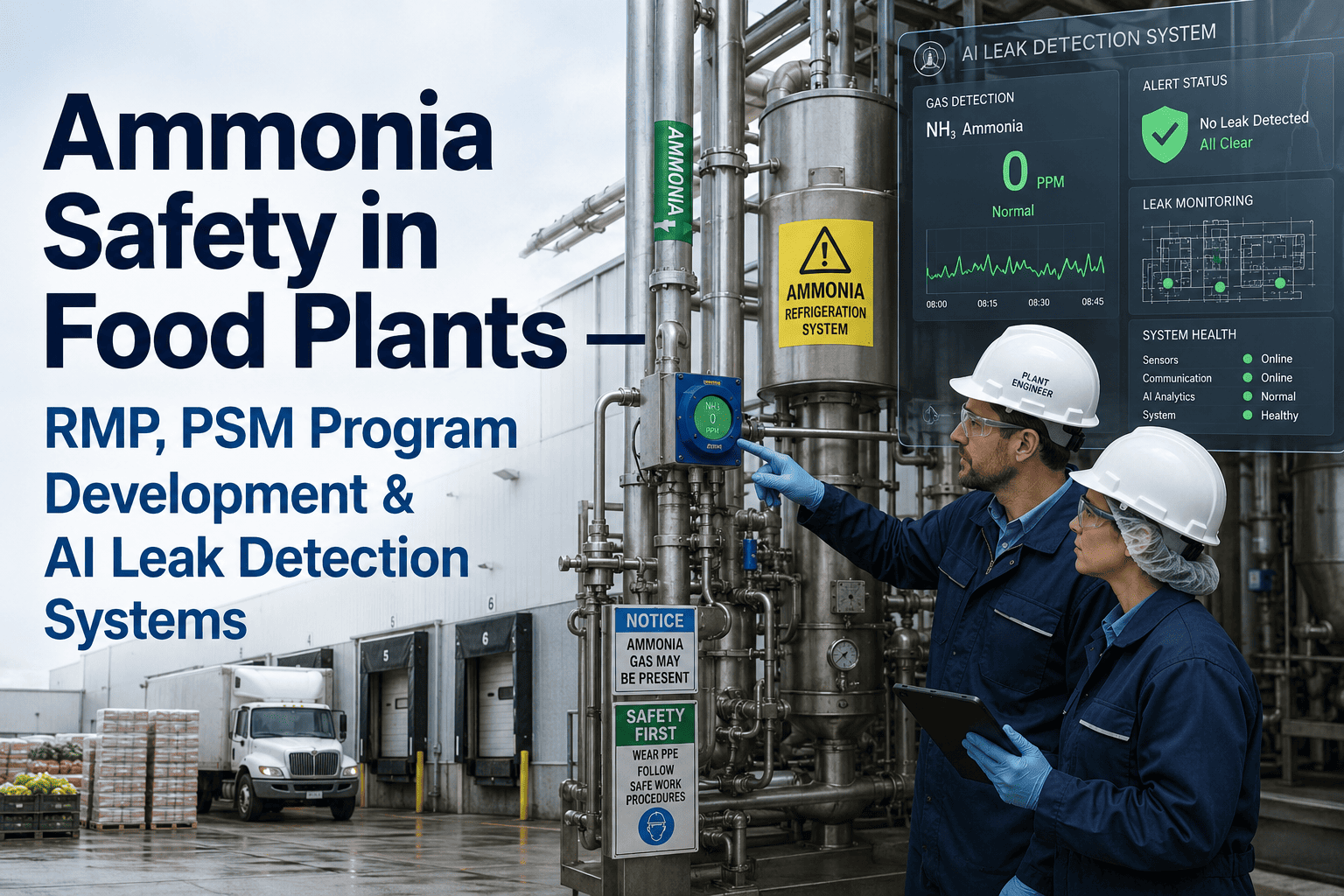
Ammonia leaks pose serious safety and environmental risks. Traditional detection relies on electrochemical sensors that can drift and produce false alarms. AI enhances detection by analyzing sensor readings in context with temperature, pressure, and airflow patterns. Machine learning models can distinguish between background ammonia levels (from normal operation) and actual leaks, reducing false alarms by 90%. In the event of a leak, the system automatically isolates valves, activates ventilation, and alerts emergency response teams. Integration with PSM documentation ensures that leak events are recorded and analyzed for root cause.
Cold Warehouse Analytics: Unified Dashboard for Facility Management
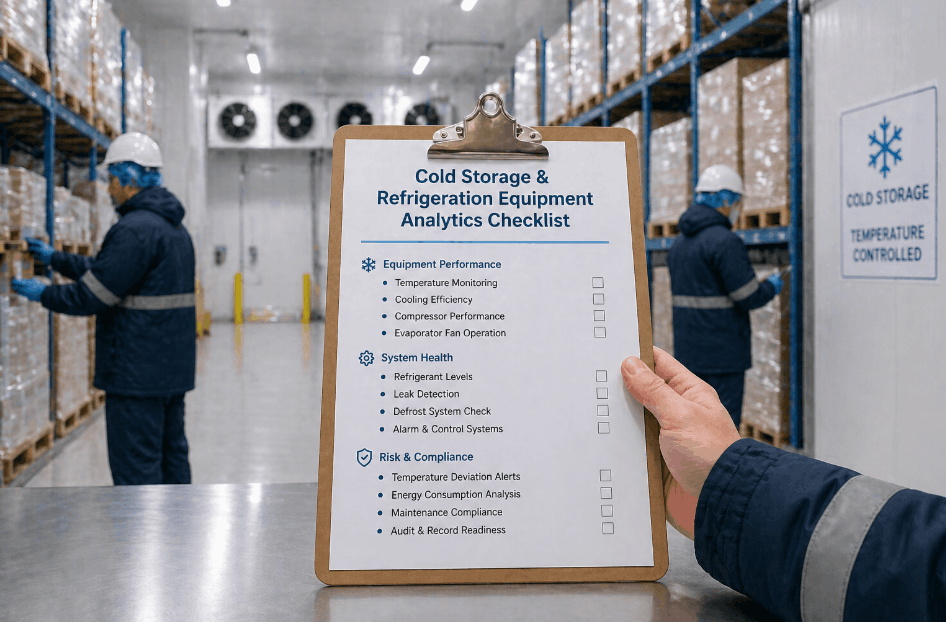
A comprehensive cold storage analytics platform aggregates data from all refrigeration components, energy meters, and environmental sensors into a single pane of glass. Key performance indicators include overall equipment effectiveness (OEE) for each compressor, energy intensity (kWh per ton of refrigeration), refrigerant loss rate (pounds per day), and compliance calendar showing upcoming inspections. AI algorithms provide predictive insights such as 'Compressor #3 will require bearing replacement in 45 days' and 'Defrost energy savings potential of 15% by adjusting setpoints.' The dashboard also supports drill-down to individual sensor readings and historical trends, enabling maintenance managers to make data-driven decisions.
Frequently Asked Questions
How does AI improve ammonia leak detection in cold storage?
AI enhances ammonia leak detection by continuously analyzing sensor data from multiple points and correlating it with operational parameters like temperature, pressure, and airflow. Machine learning models are trained to recognize the unique signature of a real leak versus background fluctuations caused by door openings or defrost cycles. This reduces false alarms by up to 90% and ensures that true leaks are detected within seconds. The system can also predict potential leak sources by monitoring pressure decay trends, allowing proactive maintenance. For more details, contact our support team.
What are the key components of PSM compliance for ammonia refrigeration?
PSM compliance under OSHA 1910.119 requires a written process safety information document, process hazard analysis (PHA), operating procedures, training, mechanical integrity programs, management of change (MOC), pre-startup safety reviews, incident investigation, emergency planning, and compliance audits. For ammonia refrigeration, mechanical integrity includes thickness testing of pressure vessels, relief valve calibration, and inspection of piping and fittings. AI systems can automate the tracking of these activities, sending reminders for overdue inspections and generating audit-ready reports. Learn more about our PSM automation features by booking a demo.
Can AI optimize defrost cycles without compromising temperature control?
Yes, AI-driven defrost optimization uses real-time data on coil temperature, humidity, and frost accumulation to initiate defrost only when necessary. The system maintains product temperature within safe limits by predicting the optimal defrost duration and timing. Machine learning models consider factors like door opening frequency, product load, and ambient conditions to ensure that defrost cycles are both energy-efficient and temperature-safe. Studies show that this approach can reduce energy consumption by 30% while maintaining or improving temperature stability. For a detailed case study, visit our support page.
What sensors are required for compressor monitoring in cold storage?
Typical sensors for compressor monitoring include accelerometers (vibration), thermocouples (temperature on discharge, suction, and oil), pressure transducers (oil and refrigerant), and oil debris monitors (particle counters and ferrography). For screw compressors, additional sensors may include current transformers for motor power and proximity probes for rotor position. Data from these sensors is collected at high frequency (1 kHz for vibration) and processed by edge devices before being sent to the cloud. AI algorithms analyze the data to detect anomalies and predict failures. Our team can help you design the optimal sensor suite; book a demo to discuss your needs.
How long does it take to implement an AI-driven cold storage maintenance system?
Implementation typically takes 8 to 12 weeks, depending on the size of the facility and the number of refrigeration systems. The process includes sensor installation, network setup, data integration, model training, and user training. Pilot projects can be completed in 4 weeks for a single compressor system. After go-live, the AI models continue to learn and improve over time, with full optimization achieved within 6 months. For a detailed implementation plan, contact our support team.
Ready to Revolutionize Your Cold Storage Maintenance?
Achieve 100% PSM compliance, eliminate leaks, and reduce energy costs with AI-driven predictive maintenance.