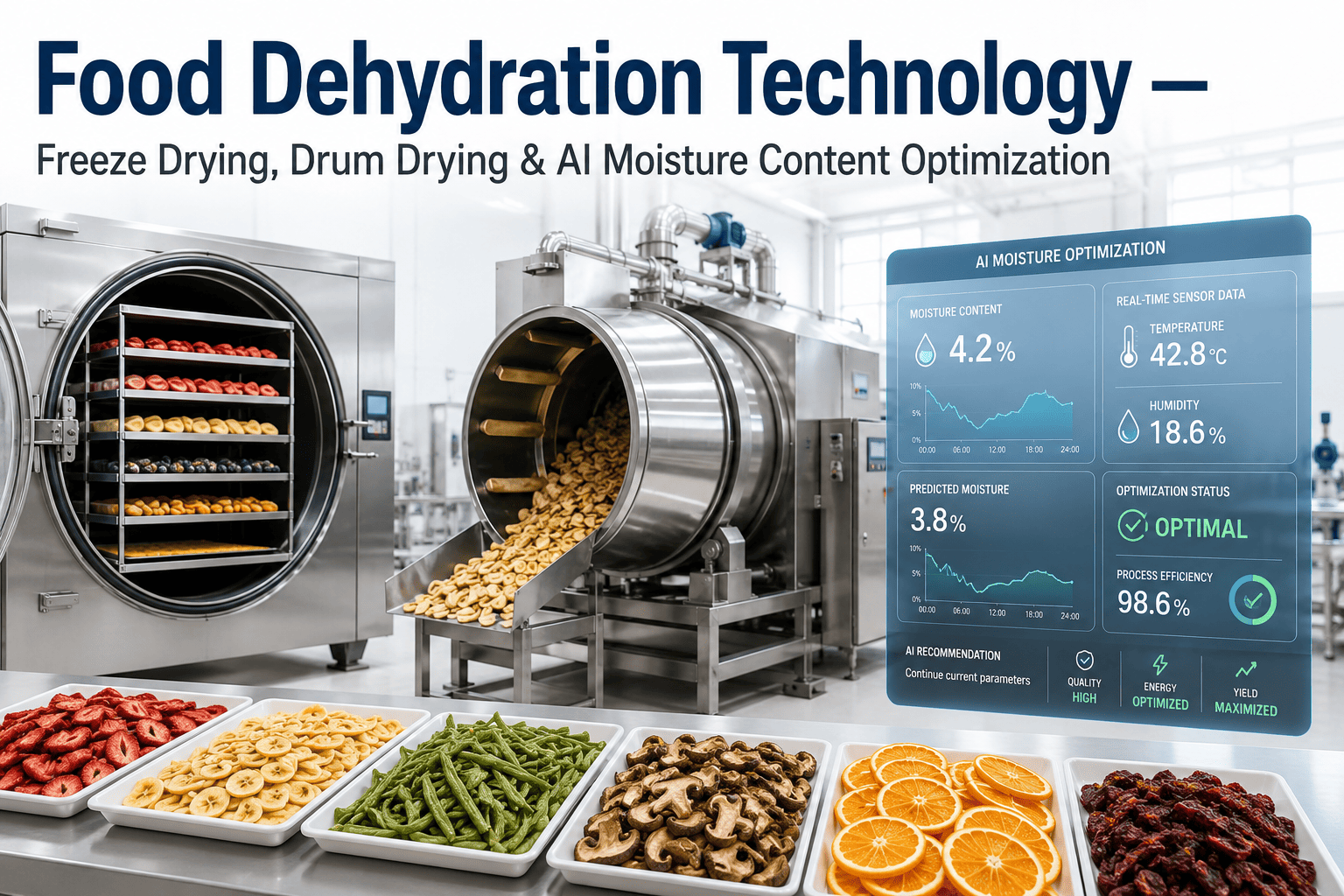
Drying is one of the most energy-intensive steps in food manufacturing, and it is also one of the easiest to over-run out of caution — running a dryer an extra thirty minutes "to be safe" on moisture content quietly burns energy budget and shortens equipment life across thousands of batches a year. Process engineers optimizing freeze dryers, drum dryers, and spray dryers know the textbook endpoint, but predicting exactly when a specific batch reaches it, given real variability in feed moisture and ambient humidity, is where manual control leaves real money on the table. iFactory AI applies real-time moisture modeling to food dehydration optimization, cutting both energy waste and over-drying.
Why Fixed-Time Drying Schedules Waste Energy on Most Batches
A drying schedule set once based on worst-case feed moisture protects against under-drying every batch, but it does so by over-drying the majority of batches that started with lower moisture than the worst case assumed. That built-in buffer is invisible on any single batch's paperwork, but multiplied across thousands of cycles a year it represents a meaningful, recurring energy cost that a fixed schedule can never optimize away, because it is not designed to react to the batch actually in the dryer.
Drying Methods Compared
Preserves structure and nutrients best but is the slowest and most energy-intensive method; AI-optimized sublimation rate control shortens cycles without risking product collapse.
Fast and efficient for liquid or paste products, but drum speed and temperature must be matched precisely to feed viscosity to avoid scorching or incomplete drying.
Ideal for producing powders at scale; inlet and outlet air temperature control directly affects both moisture endpoint and particle quality.
Common for solid pieces like fruit and vegetables; airflow uniformity across the tray bed is the most common source of inconsistent moisture endpoint.
Energy Cost and Quality Trade-Offs by Method
| Method | Relative Energy Cost | Product Quality Impact | Best Fit |
|---|---|---|---|
| Freeze Drying | Highest | Best structure and nutrient retention | Premium, shelf-stable, or ingredient products |
| Drum Drying | Low to moderate | Higher heat exposure, some nutrient loss | Liquid or paste feeds at high volume |
| Spray Drying | Moderate | Good for powders, sensitive to inlet temperature | Powdered ingredients and instant products |
| Convective Tray Drying | Moderate to high | Depends heavily on airflow uniformity | Solid pieces like fruit, vegetables, jerky |
Drying Optimization Readiness Checklist
Real-time endpoint prediction depends on continuous moisture data, not just inlet and outlet temperature readings.
Understanding how much feed moisture actually varies reveals how much energy the current fixed schedule is wasting.
Optimization needs a target range to work within, not just a single point value that leaves no room for legitimate variation.
Line-level energy data makes the savings case concrete instead of estimated from a facility-wide utility bill.
Process Engineer Perspective
We ran our spray dryer on a fixed cycle time built around the wettest feed lot we had ever seen, which meant on a typical day we were drying well past the point our powder actually needed. When we added real-time moisture tracking and let the model determine cutoff per batch instead of the clock, our average cycle time dropped by close to 15 percent and our energy cost per ton followed almost exactly. The part that surprised our plant manager most was that product consistency actually improved, because we stopped over-drying the easy batches just as much as we stopped under-drying the occasional difficult one.
— Process Engineer, Powdered Ingredient ManufacturerConclusion
Drying schedules built around worst-case assumptions protect quality but quietly waste energy on every batch that did not need the full buffer, and that waste compounds into a real, recurring cost across a full year of production. Process engineers who move to real-time moisture endpoint prediction consistently find both energy savings and more consistent product quality, since the two goals turn out to reinforce each other rather than compete. Book a demo to see real-time drying optimization modeled against your own dryer data.
Frequently Asked Questions
Most facilities moving from fixed-time schedules to real-time moisture endpoint prediction see energy savings in the range of 10 to 20 percent, with the exact figure depending on how much feed moisture naturally varies for that product line. Lines with highly consistent feed moisture see smaller gains since the fixed schedule was already closer to optimal. Book a demo to estimate savings for your specific dryers.
In-process moisture sensors or near-infrared moisture analyzers positioned to sample product during the drying cycle are the core requirement, supplemented by existing temperature and airflow data most dryers already collect. Retrofitting older dryers with these sensors is usually the main implementation cost rather than the software itself.
No, properly implemented endpoint prediction targets the defined quality specification range, not just the fastest possible cycle, so it stops the dryer at the correct moisture target rather than cutting the cycle short. The savings come from eliminating unnecessary over-drying, not from relaxing the quality standard. Contact support to review specification-safe optimization for your products.
Freeze drying and spray drying tend to see the largest relative energy savings because they are the most energy-intensive per unit of product, making even a modest percentage improvement financially significant. Drum drying and convective tray drying still benefit, particularly where feed moisture or airflow uniformity varies significantly batch to batch.
If moisture sensors are already installed, model deployment and validation typically takes a few weeks; if sensors need to be added, timelines extend to account for installation and calibration before the optimization model can be trained and validated against your specific product lines.