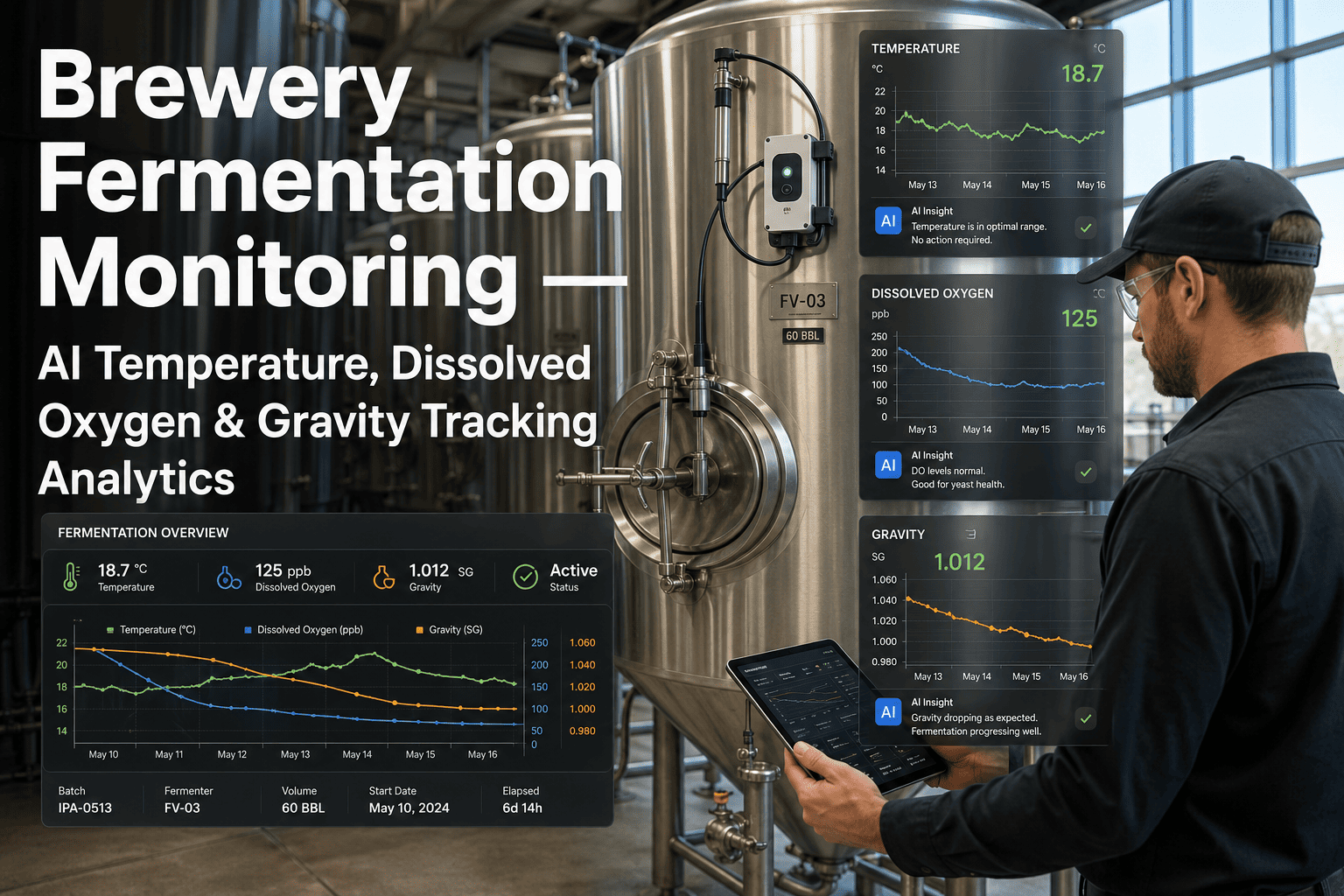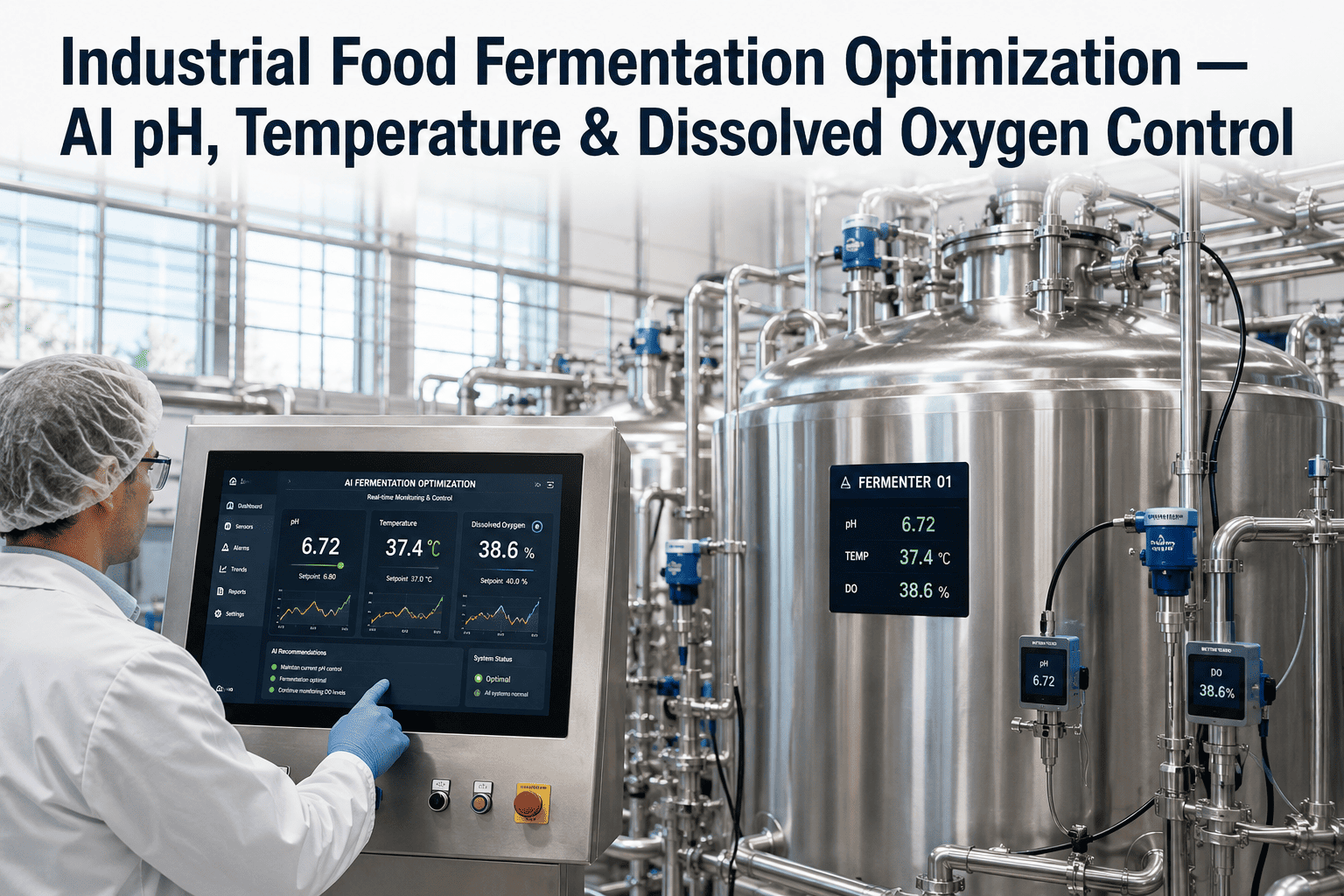
Fermentation is one of the few food processes where the product is still alive and changing while it sits in the tank, which means a pH drift of a few tenths or a temperature swing of two degrees can turn a perfect batch into an off-flavor loss overnight. Process engineers running industrial fermentation know the textbook parameters, but holding them tightly across every batch, every shift, and every raw material lot is a continuous balancing act that manual spot-checks were never precise enough to manage. iFactory AI applies continuous monitoring and predictive modeling to industrial fermentation optimization, catching drift before it becomes a batch loss.
Why Fermentation Punishes Slow Detection More Than Any Other Process
Most food manufacturing processes are mechanical — a filler either dispenses the right weight or it does not, and the deviation is instantly visible. Fermentation is biological, which means a small parameter deviation does not cause an immediate visible defect; it shifts the trajectory of a living culture, and by the time the deviation shows up as an off-flavor or failed batch hours or days later, the window to correct it closed long ago. Spot-check monitoring every few hours simply cannot catch a drift that compounds continuously in between checks.
The Four Parameters That Determine Fermentation Outcome
Governs enzyme activity and culture health; even brief excursions outside the target band can shift the metabolic pathway and change flavor development permanently.
Different growth phases often require different temperature setpoints, and a static single-setpoint approach leaves yield and consistency on the table compared to a phased profile.
Aerobic and anaerobic phases require precise oxygen management, and getting the transition timing wrong can stall fermentation or promote unwanted microbial competition.
Culture density at inoculation affects lag phase length and overall cycle time, and raw material lot variability means the "right" timing shifts batch to batch.
From Raw Material to Finished Batch: The Optimization Flow
Incoming substrate variability is measured and factored into the batch recipe before inoculation, rather than assumed constant.
Culture density and early pH trajectory are tracked continuously to confirm the batch is tracking toward its expected curve.
pH, temperature, and dissolved oxygen are held within tolerance through automated adjustment, with deviations flagged in real time.
A predictive model estimates when the batch will reach target completion, reducing both under-fermentation and unnecessary extended cycle time.
Fermentation Types and Their Control Sensitivity
| Fermentation Type | Most Sensitive Parameter | Typical Tolerance |
|---|---|---|
| Lactic Acid (Dairy, Vegetables) | pH and temperature | Tight — narrow band determines texture and flavor |
| Alcoholic (Beverage) | Temperature and dissolved oxygen transition | Moderate — wider band but critical transition timing |
| Acetic Acid (Vinegar) | Dissolved oxygen throughout | Tight — process is fully aerobic and oxygen-dependent |
| Solid-State (Koji, Tempeh) | Temperature and moisture | Moderate — spatial variation across substrate bed matters most |
Process Engineer Perspective
Our lactic acid fermentation process had a batch failure rate that hovered around 8 percent for years, and every failed batch looked different enough on paper that we never connected them to a single cause. Once we had continuous pH and temperature logging feeding a model that flagged early-phase deviations, we found that nearly all of our failures traced back to a slow pH drop in the first two hours that spot-checks every four hours simply could not catch in time to intervene. Tightening our monitoring interval around that early window cut our failure rate by more than half within two fermentation cycles.
— Process Engineer, Fermented Dairy Products ManufacturerConclusion
Fermentation rewards continuous attention more than almost any other food process, precisely because its biological nature hides small deviations until they have already compounded into a bigger problem. Process engineers who move from periodic spot-checks to continuous parameter monitoring consistently catch drift early enough to correct it, turning fermentation from an unpredictable variable into a controlled, repeatable process. Book a demo to see continuous fermentation monitoring applied to your own process.
Frequently Asked Questions
Manufacturers moving from periodic spot-checks to continuous monitoring typically see batch loss rates fall by half or more, since most failures trace back to early-phase drift that goes undetected between manual checks. The exact improvement depends on how sensitive the specific fermentation type is to the parameter being monitored. Book a demo to review your current batch loss patterns.
Yes, when the model incorporates raw material characterization data alongside real-time process parameters, it adjusts endpoint predictions for lot-to-lot substrate variability rather than assuming every batch behaves identically. This is a key advantage over fixed-time fermentation schedules that ignore input variability entirely.
At minimum, continuous pH and temperature probes are needed, with dissolved oxygen sensors added for aerobic processes; many industrial fermentation tanks already have these installed for manual logging and simply need to be connected to a continuous data pipeline rather than read periodically. Contact support to assess your current sensor setup.
No, the opposite is typically true — tighter control combined with accurate endpoint prediction usually shortens average cycle time because batches are harvested exactly when ready rather than held longer out of caution or restarted after a failed run. Fewer failed batches also means fewer full cycle re-runs, which has a larger impact on throughput than the monitoring itself.
Lactic acid and acetic acid fermentations, which have narrow tolerance windows and are highly sensitive to early-phase deviation, tend to see the largest improvement from continuous monitoring. Solid-state fermentation processes also benefit significantly since spatial variation across the substrate bed is difficult to catch with manual spot-checks alone.