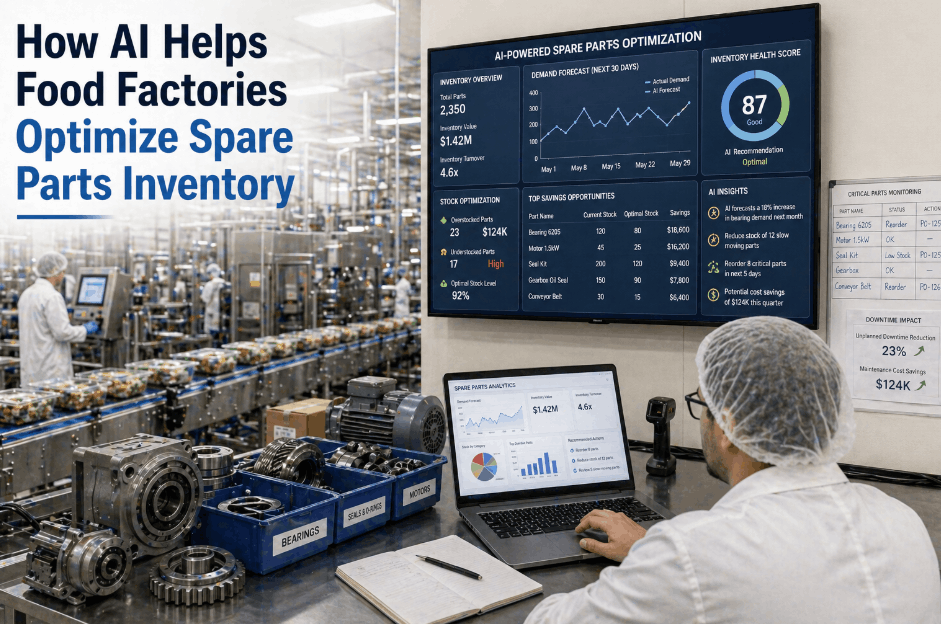
Zero-stockout manufacturing was once considered a financial trade-off — a choice between carrying millions in excess capital or risking $50k-per-hour halts. In the food industry, where specialized gaskets and sanitation parts have 12-week lead times, the margin for error is non-existent. Traditional "Min/Max" levels are static, yet production demand is dynamic, leading to 15% stockouts exactly when critical motors fail. iFactory’s AI-Driven Inventory platform transforms this reactive cycle into a predictive advantage Book a Demo. By correlating real-time equipment wear data with global lead times, iFactory ensures the right part is in the right bin exactly 48 hours before it is needed. This synchronized 'Parts-as-a-Service' model reduces carrying costs by 22% while guaranteeing 99.9% availability for zero-failure spares.
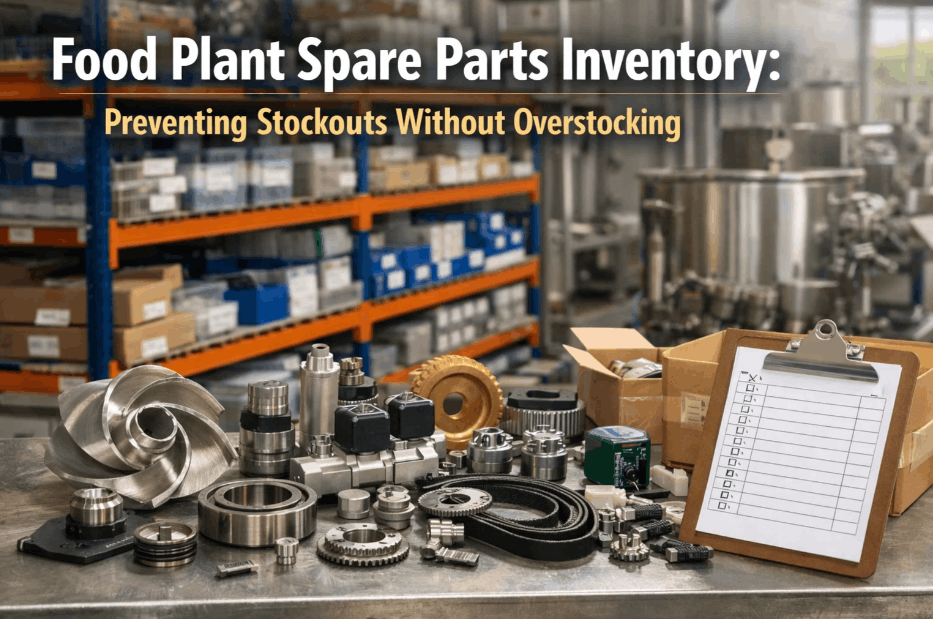
Food Plant Spare Parts: Preventing Stockouts Without Overstocking
Eliminate $50k-per-hour downtime. The AI-driven MRO system that connects equipment health, lead-time volatility, and automated procurement in one platform.
The MRO Maturity Journey — From Excel to Predictive Spares
Optimizing food plant inventory is a journey from reactive "firefighting" to data-driven precision. Most facilities start with manual clipboards and "gut-feel" ordering. World-class plants use iFactory to automate the entire lifecycle, ensuring compliance, sanitation, and zero-defect maintenance. Audit your current stockroom — iFactory assessment in 3 days.
Deploy mobile-first digital stockroom. Real-time consumption tracking via QR/RFID tagging. Achieve 100% visibility immediately.
Enable Dynamic Reorder Points. iFactory adjusts stock levels based on vendor performance and production schedules.
Activate Automated Procurement Sync. iFactory sends reorder requests directly to SAP/Oracle within 15 seconds of a low-stock trigger.
Predictive Part Reservation. iFactory reserves or orders parts based on equipment vibration and thermal "wear signatures" before the machine fails.
World-class food plants operating at near-zero stockout rates for critical USDA/FDA-compliant components Book a Demo.
The AI-Driven Spares Loop — From Wear Detection to Bin Replenishment
Inventory optimization only works when it is connected to the shop floor. iFactory closes the loop between asset condition and part availability, ensuring your storeroom is an engine of uptime, not a graveyard of capital.
Wear Detection
iFactory AI monitors motor vibration and thermal drift. When a "failure signature" is detected, the system automatically checks the Bill of Materials (BOM) for the required bearing or seal.
Dynamic Allocation
The system checks current stock and "soft reserves" the part for the identified maintenance window. If stock is low, iFactory initiates a priority reorder request to the vendor.
Lead-Time Sync
iFactory tracks vendor delivery performance in real-time. If a supplier's lead-time for washdown-rated parts increases, the system automatically adjusts "safety stock" levels to compensate.
Uptime Assurance
Technicians are alerted via the iFactory mobile app when the part arrives and is kitted. Repair happens *before* the component fails, preserving batch quality and machine health Book a Demo.
Synchronize Your Storeroom with Real-Time Asset Wear
Join 180+ food manufacturers that use iFactory to automate their spare parts lifecycle and eliminate downtime. Book a Demo
The Transformation Trajectory — 12 Months of AI Inventory Control
Verified data from a Tier-1 Beverage Plant across 12 months of iFactory implementation. Total Stockout rate vs. Carrying Cost reduction.
Manual Maintenance vs AI-Driven Spares Management
What the Maintenance Manager Said After Month 12
Our 'Stockroom stress' has disappeared. In the past, every motor failure felt like a gamble—did we have the spare or would it be an 8-week wait? iFactory has synced our storeroom with our floor vibrations Book a Demo. We don't just 'have' parts anymore; we have them exactly when the machines start showing the first sign of fatigue. It's the difference between firefighting and engineering.
Frequently Asked Questions
How does iFactory track 'sanitation-grade' shelf life for rubber and seals?
Every seal and rubber component is tracked via a lot-specific expiration date in iFactory. The system sends a 'First-In-First-Out' (FIFO) alert to technicians and automatically triggers a fresh reorder request before a batch of gaskets reaches its safety shelf-life limit.
Can this integrate with our local Indian steel and component suppliers?
Yes. iFactory provides a supplier-specific portal where your local vendors can update their current lead times directly, or the system can automatically infer lead times based on the 'PO-to-Arrival' historical data for each supplier.
Does it work for plants with multiple stockrooms and decentralized storage?
Absolutely. iFactory provides 'Global-to-Local' visibility. If Stockroom A is out of a critical fuse but Stockroom B (20km away) has it in surplus, the system will suggest an internal transfer before placing an external order.
What happens if our internet or cloud connection goes down?
iFactory uses 'Edge-Sync' technology. The mobile inventory app works offline, caching all transactions until the device reconnects, ensuring that your parts tracking never stops, even in the middle of a reinforced concrete storeroom.
How do you handle 'Critical Spare' prioritization?
iFactory uses an AI-driven 'Criticality Matrix' that automatically prioritizes parts based on their impact on production uptime and lead-time risk. High-criticality parts are flagged for 'Zero-Zero' stocking—meaning zero stockout risk at zero overstock cost Book a Demo.
Can iFactory predict failure for legacy equipment without built-in sensors?
Yes. We deploy non-invasive, clamp-on 'Hygienic IoT' sensors that retrofit onto legacy motors, pumps, and gearboxes. Our AI models then learn the specific wear patterns of those assets to predict when a replacement part will be needed.
What is the typical reduction in emergency freight costs?
Food plants using iFactory typically see a 70–85% reduction in 'Next Day Air' shipping charges because the system identifies the need for parts 2–3 weeks before a critical failure occurs.
Stop Lost Production Due to Missing Parts
Join the world's most resilient food plants. We'll show you exactly how many 'ghost' parts are costing you capital today.