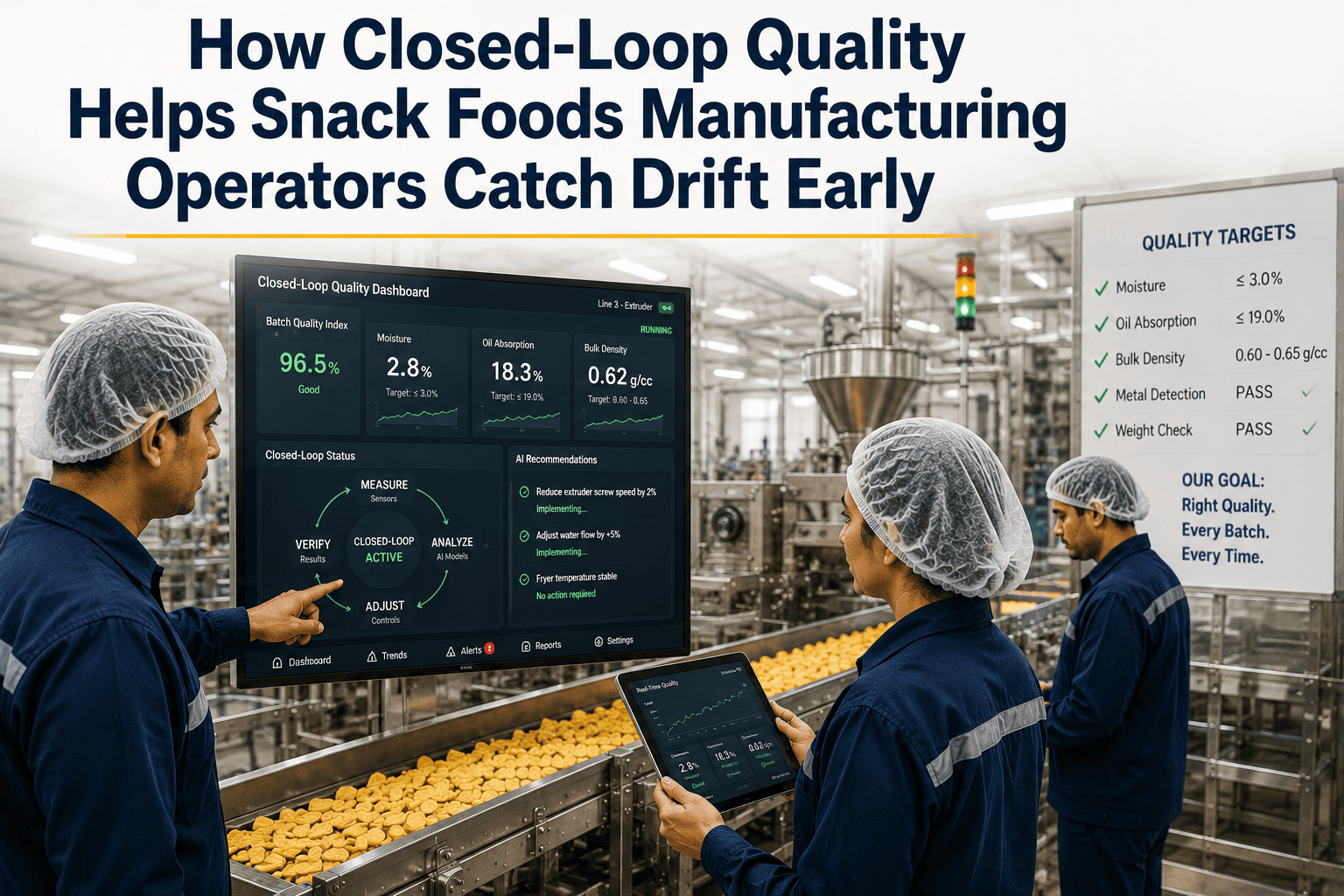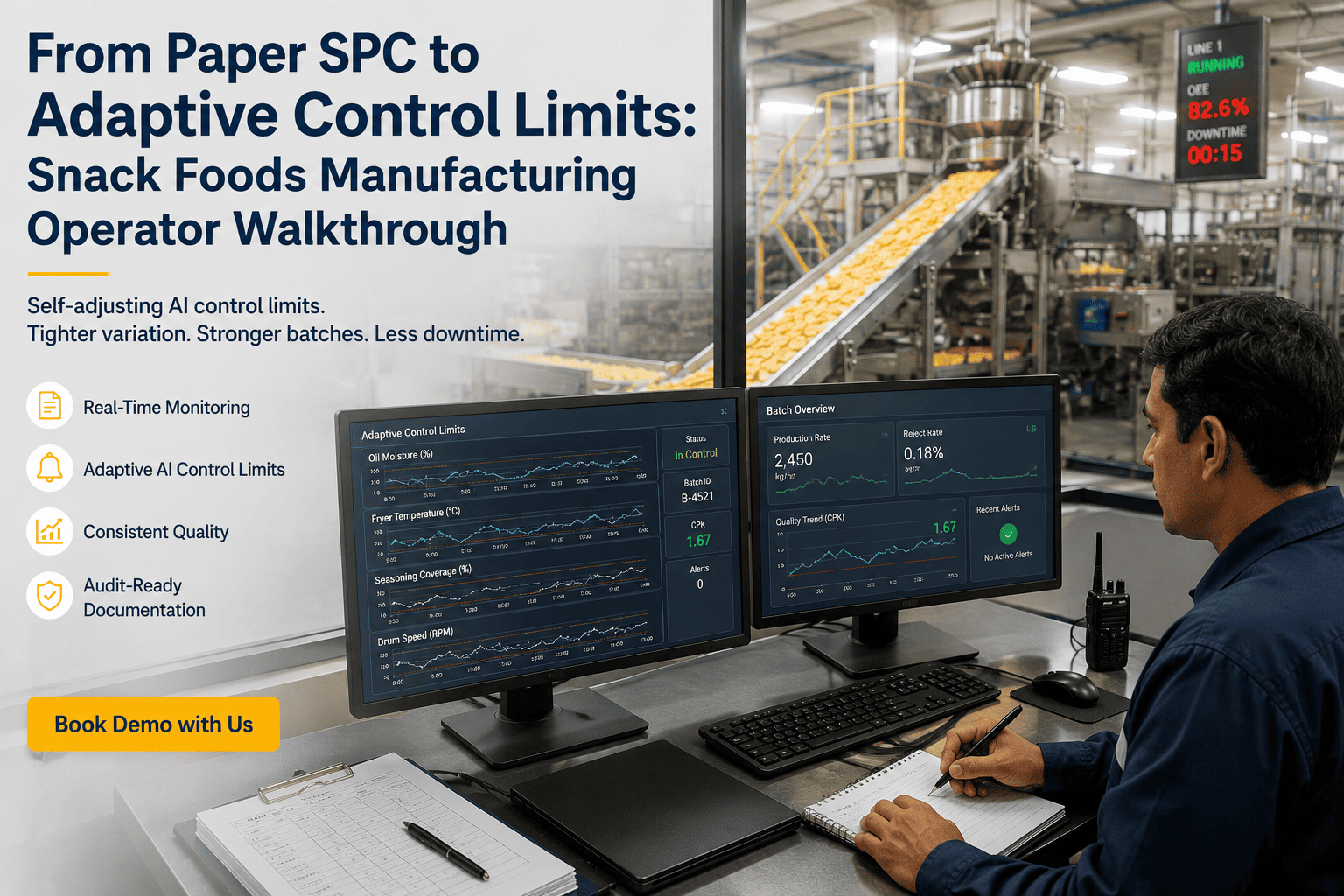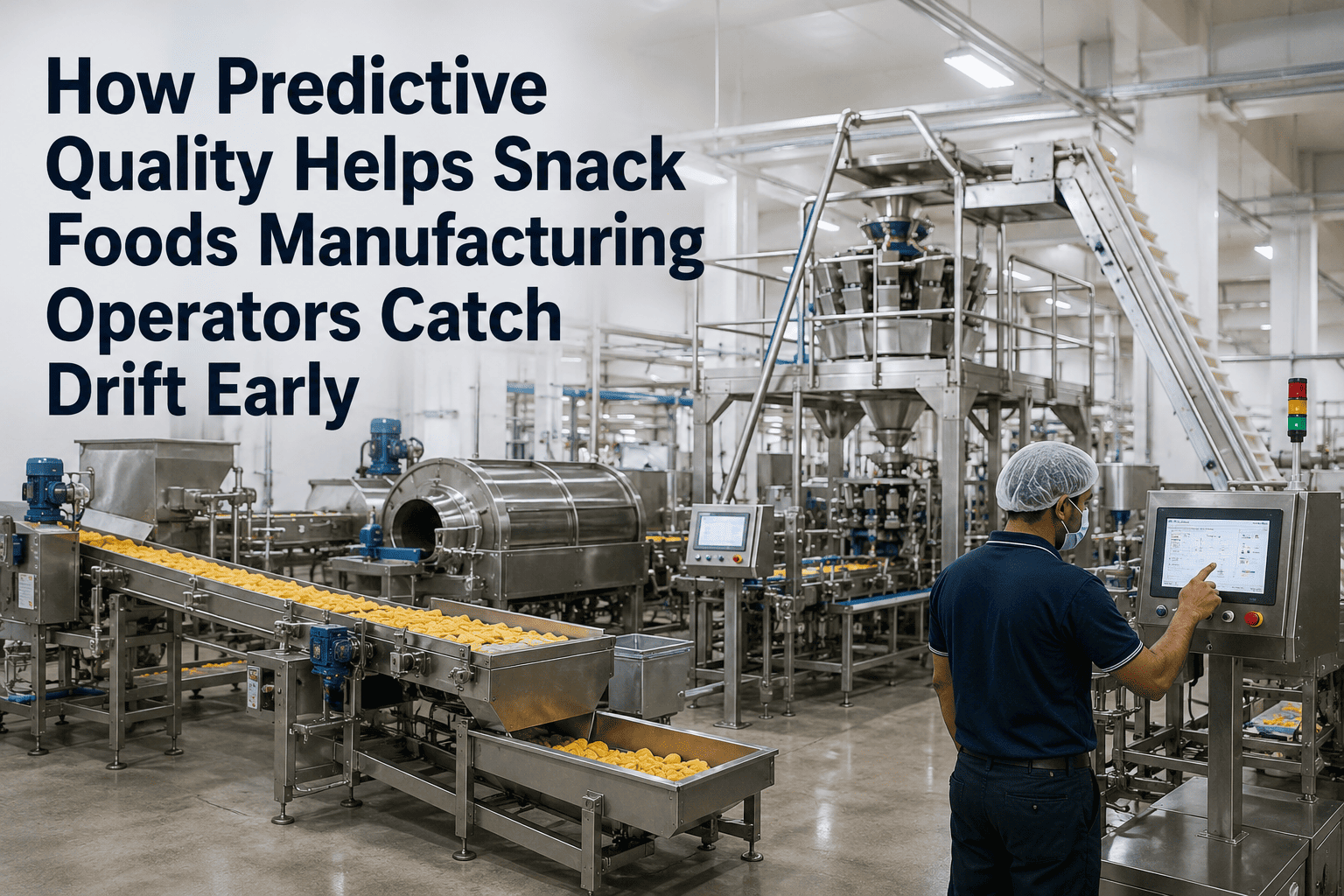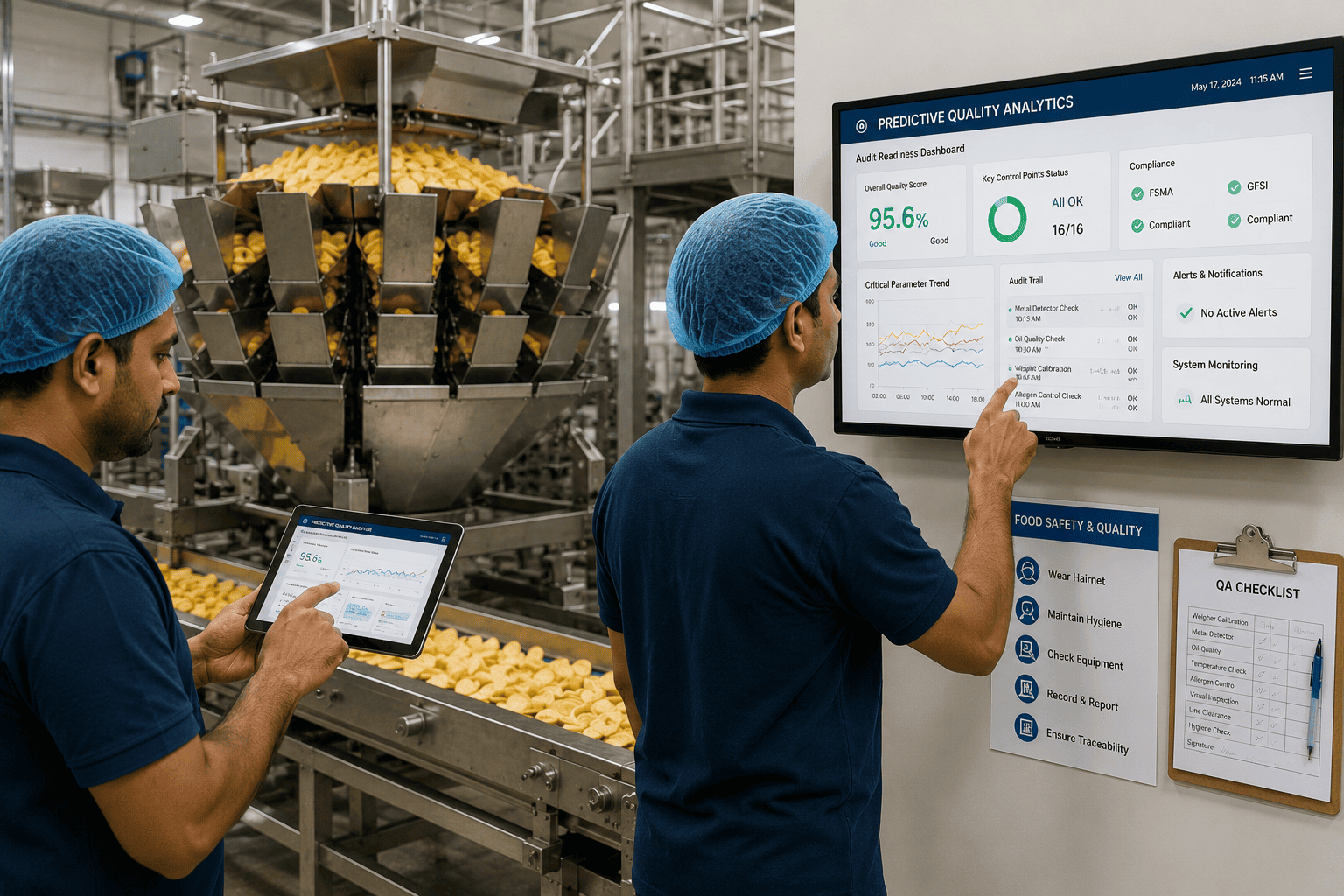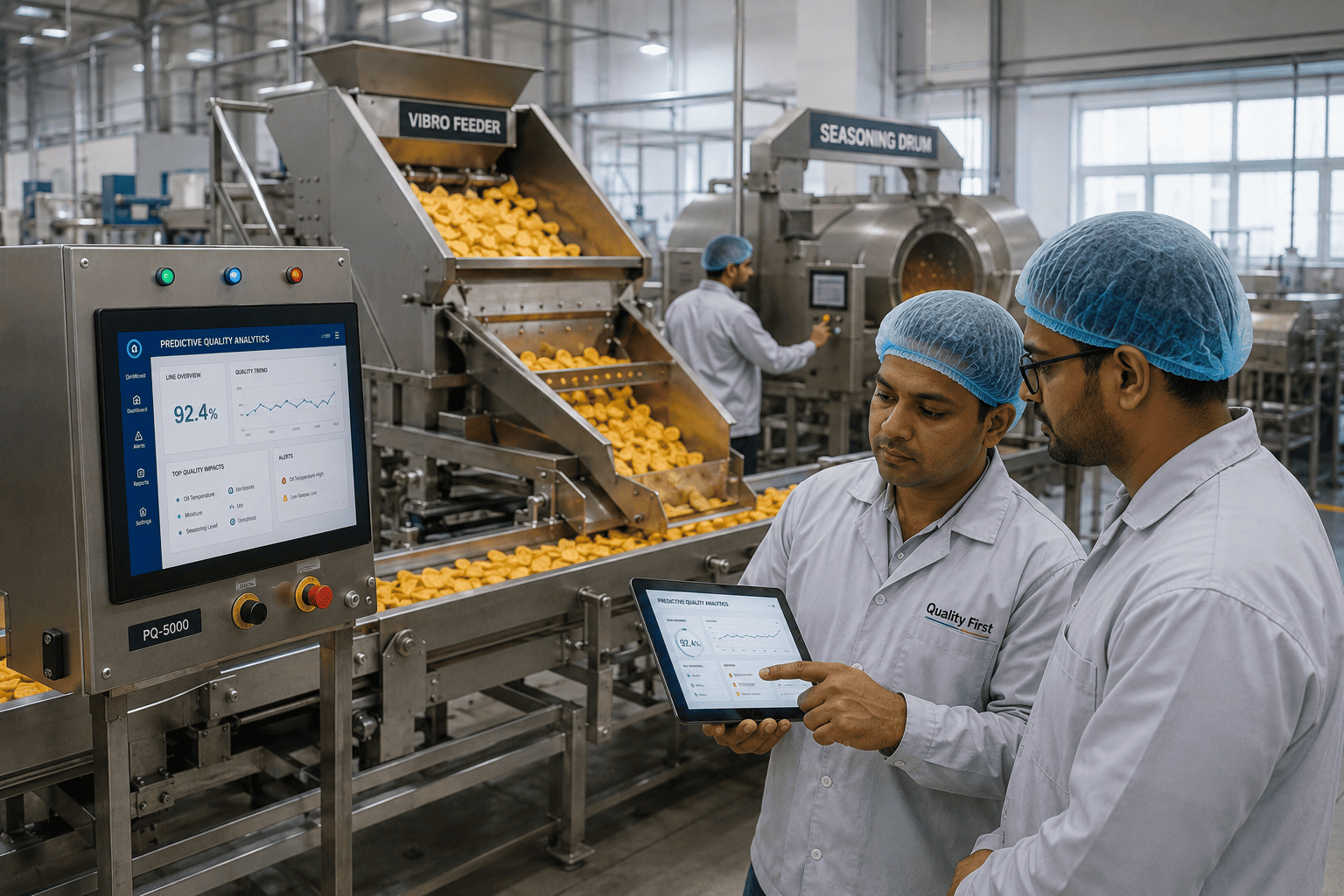
The line 2 operator at a mid-size snack foods plant watches the SPC chart on the wall — a paper trace pinned to a corkboard, updated by hand every 15 minutes. At 10:47 AM, the chip fryer temperature drifted 3°F past the upper control limit. By the time the operator finished the walk to the fryer, checked the thermocouple, and adjusted the burner, 47 pounds of product had already crossed the metal detector reject chute. At $1.42 per pound, that's $67 in scrapped corn chips before lunch. The SPC chart will show the excursion in three days, when the QA supervisor initials it. By then, the root cause — a fouled heat exchanger — will have caused the same drift on every shift for 72 hours. The plant quality manager estimates 2.3% of annual throughput goes to rework or landfill, costing $1.4M a year. Paper SPC doesn't prevent defects. It just documents them after the fact.
From Paper SPC to Predictive Quality: Stop Defects Before They Happen in Snack Foods
Replace reactive quality control with AI that predicts fryer temperature drift, moisture excursions, and seasoning variability 8–12 minutes before they exceed spec — on your plant network, with zero cloud dependency.
Why Paper SPC Costs You $1.4M a Year in Scrap & Rework
Every snack foods plant runs SPC — but most run it on paper, whiteboards, or disconnected spreadsheets. By the time a control chart shows an excursion, the defect has already been produced, packaged, and sent to the reject bin. Here's how that breaks down on your line.
15–30 Minute Lag Between Drift and Detection
An operator checks fryer temperature every 15 minutes and plots it by hand. A 4°F drift in the first 3 minutes after a check goes unseen for 12 more minutes — long enough to produce 180 pounds of off-spec product at a typical 15 lb/min line speed. At $1.42/lb, that's $255 per excursion.
Root Cause Buried in 72-Hour Paper Trails
When QA finds a moisture spec failure in the finished product lab, the paper SPC chart shows the event happened 3 days ago. The heat exchanger was cleaned on Tuesday; the drift appeared Wednesday night. By Friday, the correlation is lost. The same root cause triggers repeats every 2–3 weeks, costing $18,000 per month in lost throughput.
Seasoning Variability Gores Customer Contracts
A major retailer audits your seasoning application at ±2% of target weight. Your manual checks every 30 minutes catch the drift after 4–5 bags. With a 200 bag/min line, that's 800–1,000 bags of off-spec product per audit failure. Each failure triggers a corrective action report and a 2% pricing penalty on the next quarter's contract.
Operator Time Wasted on Data Entry, Not Improvement
Each shift, a line operator spends 45 minutes filling out SPC charts by hand. That's 273 hours per year per line — time that could be spent on preventative maintenance, CIP optimization, or line speed adjustments. For a plant with 4 lines, that's over 1,000 hours of lost productivity annually, valued at $42,000 in labor.
No Predictive Capability — Only Post-Mortem Alarms
Paper SPC gives you a control limit violation after the fact. It can't tell you the fryer temperature will drift in 10 minutes because the burner pressure is oscillating. It can't flag that the seasoning drum speed is degrading. You're always reacting to defects that already happened, never preventing them.
Paper SPC documents defects. iFactory predicts them 8–12 minutes before they happen. Book a 30-min walkthrough and we'll show you live on your data.
How iFactory Replaces Paper SPC With Predictive Quality in 4 Steps
iFactory connects directly to your plant's PLCs, sensors, and SCADA systems — no cloud, no data leaving your network. In 6–12 weeks, you move from paper charts to an AI that alerts operators before a defect occurs.
Connect to Existing Sensors
iFactory ingests data from fryer thermocouples, seasoning drum load cells, moisture analyzers, and metal detectors — whatever you already have on the line.
Train a Digital Twin of Your Line
Our AI learns the normal operating envelope from 30 days of historical data — temperature ranges, moisture bands, seasoning application rates — and builds a predictive model of when they drift.
Deliver 8–12 Minute Advance Alerts
When the model detects a pattern that precedes a spec violation — burner pressure oscillation, heat exchanger fouling, seasoning drum bearing wear — it alerts the operator via the HMI or mobile device.
Close the Loop With Root Cause Correlation
Every alert links to the sensor data that triggered it. Operators see "Fryer temp drift predicted — burner pressure unstable — check gas valve." No more 3-day paper trail hunts.
Predictive Quality Features Built for Snack Foods
iFactory's AI-native platform gives you capabilities that paper SPC can't touch — all running on-premise on an NVIDIA appliance, with zero cloud dependency.
Fryer Temperature Prediction
iFactory models the thermal dynamics of your fryer — oil flow rate, burner pressure, product load — and predicts temperature drift 8–12 minutes before it exceeds spec. Operators adjust the burner or schedule a heat exchanger cleaning before a single pound of product is lost.
Moisture Content Forecasting
By correlating dryer temperature, belt speed, and ambient humidity, iFactory predicts moisture excursions 10 minutes before they hit the final product analyzer. No more waiting for lab results that come 4 hours after the defect run.
Seasoning Application Monitoring
Load cells on the seasoning drum feed data to iFactory's model. When drum speed or vibration patterns signal bearing wear, the system alerts maintenance before seasoning weight variability triggers a customer audit failure.
Metal Detector Correlation
iFactory links metal detector reject data to upstream process parameters — fryer belt speed, product thickness, oil quality — to identify root causes of foreign material contamination patterns. No more guessing.
Zero Cloud Data Egress
The entire platform runs on an NVIDIA appliance inside your plant network. No data leaves your facility. No cloud subscription. No IT security review for data privacy compliance.
6–12 Week Pilot to Live Model
iFactory's team connects to your data sources, trains the model, and delivers a working pilot in 6–12 weeks. No custom development. No data scientists on your payroll.
What Predictive Quality Delivers in 90 Days
Plants that deploy iFactory see measurable improvements within the first quarter. Here's what a typical snack foods line achieves.
Why iFactory Is the Only Turnkey Predictive Quality Solution for Snack Foods
No consultants. No data scientists. No cloud migration. Just a working predictive model on your network in one quarter.
End-to-End Delivery — You Provide Data Access, We Deliver the Model
iFactory's engineers connect to your PLCs, SCADA, and sensors. We train the model. We validate it against your SPC limits. You get a live alerting system in 6–12 weeks.
On-Premise NVIDIA Appliance — Zero Cloud Dependency
The entire platform runs on your plant network. No data egress. No cloud subscription. No IT security review. Compliant with food safety audit requirements.
24x7 Managed Service — We Monitor, You Operate
iFactory's operations team monitors model performance and retrains as your line changes. You get alerts. We handle the AI.
Pilot-to-ROI in One Quarter
Most plants see scrap reduction within 60 days of go-live. The pilot pays for itself before the second quarter starts.
No Custom Development — Works With Your Existing Sensors
iFactory ingests data from any OPC-UA, Modbus, or MQTT source. No new sensors required. No integration headaches.
Scalable Across All Lines and Plants
Once the model works on one line, iFactory replicates it across your entire network. Standardized predictive quality across every site.
Common Questions About Moving From Paper SPC to Predictive Quality
Stop Documenting Defects. Start Predicting Them.
Book a 30-minute walkthrough with our operations team. We'll connect to your data, show you what iFactory predicts on your line, and give you a custom ROI estimate — all before you commit a dollar.