Multi-site food manufacturing analytics is no longer a competitive advantage reserved for the largest enterprise operations—it is the operational baseline that modern food and beverage manufacturers need to survive. As food companies scale from single-facility operations to multi-plant portfolios, the ability to standardize performance data, unify maintenance workflows, and benchmark cross-plant efficiency from a single dashboard determines whether operations scale cleanly or accumulate compounding risk. Book a Demo to see how iFactory's Multi-Site Dashboard centralizes analytics across every plant in your portfolio in real time.
Unified Multi-Plant Analytics for Food & Beverage Manufacturers
iFactory's Multi-Site Dashboard gives enterprise F&B teams a single AI-powered view of OEE, PM compliance, sanitation completion, calibration currency, and audit readiness—standardized and comparable across every facility in your network.
Why Multi-Site Food Manufacturing Analytics Is a Strategic Priority in 2025
The core challenge of managing a multi-plant food manufacturing network is not data volume—it is data fragmentation. Each facility often runs its own CMMS instance, maintains its own PM templates, and tracks KPIs against internally defined targets that cannot be meaningfully compared across sites. When leadership tries to answer the question "which plant is performing best, and why?"—the answer requires weeks of manual consolidation rather than seconds of dashboard navigation.
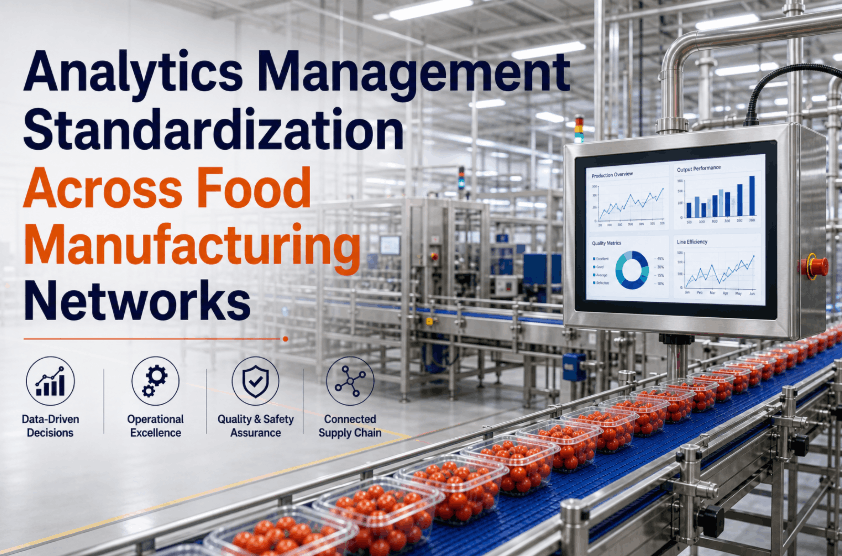
Food manufacturing standardization at the analytics layer solves this at the source. By deploying a unified data model across all plants—with consistent KPI definitions, shared PM template libraries, and centralized calibration tracking—multi-site food manufacturers create the operational foundation that makes cross-plant benchmarking actionable rather than aspirational. Plants that have achieved this level of analytics maturity report measurably faster audit cycles, lower unplanned downtime, and significantly reduced variance in quality outcomes across facilities. Book a demo to understand how iFactory structures this data unification across your specific plant network.
The Five Core Pillars of Multi-Plant Analytics Standardization
Scaling food manufacturing analytics across multiple facilities requires a deliberate standardization architecture—not simply replicating a single-site setup. The following five pillars represent the highest-impact areas where enterprise F&B analytics teams must achieve consistency before cross-plant benchmarking delivers reliable insights.
Unified KPI Taxonomy
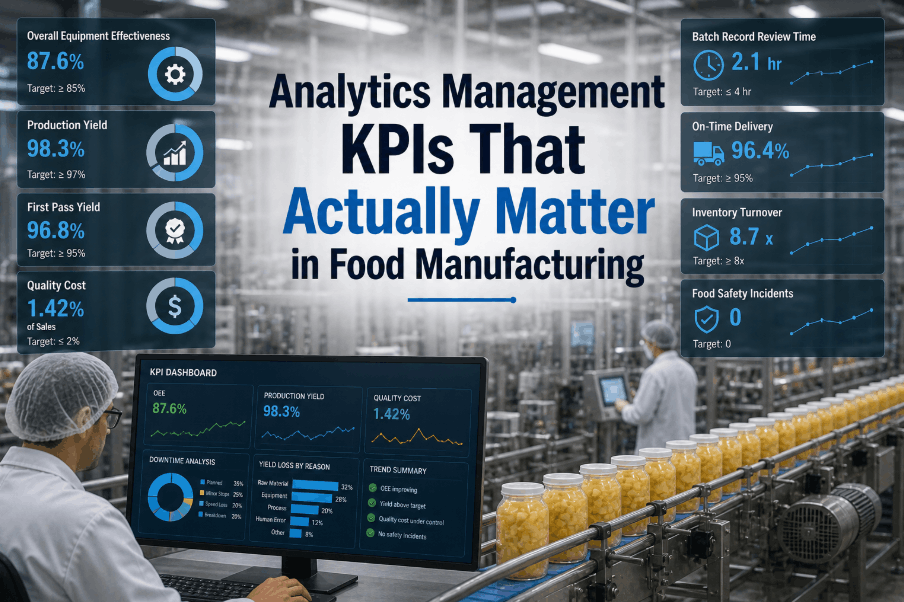
Before any meaningful cross-plant benchmarking can occur, every facility in the network must calculate OEE, MTTR, PM compliance, sanitation completion rate, and calibration currency using identical formulas and data sources. Discrepancies in how downtime categories are assigned, or how PM completion windows are defined, make inter-plant comparisons statistically invalid. A unified KPI taxonomy, enforced at the platform level, eliminates this measurement variance permanently.
Centralized PM Template Libraries
In multi-site food manufacturing operations, equipment of the same class should follow the same preventive maintenance procedures regardless of which facility it operates in. Centralized PM template libraries—maintained at the enterprise level and pushed to individual plants—ensure that maintenance quality standards are consistent, regulatory compliance is uniform, and best practices discovered at one site propagate automatically to all others. This also dramatically reduces the administrative burden on individual plant maintenance managers.
Cross-Plant Performance Benchmarking
Cross-plant benchmarking in food manufacturing is the mechanism through which enterprise analytics teams identify the gap between the best-performing and worst-performing facilities, and direct improvement resources accordingly. When every plant reports against the same KPI definitions and targets, a plant-by-plant OEE ranking, MTTR comparison, or sanitation compliance heatmap becomes an immediately actionable strategic tool rather than an academic exercise. iFactory's multi-plant benchmarking module surfaces these comparisons on a rolling 30/60/90-day basis.
Enterprise-Wide Audit Readiness
For food manufacturers operating under BRC, SQF, FSMA, or major retailer audit frameworks, audit readiness cannot be managed at the individual plant level alone. An enterprise audit readiness score—aggregating PM compliance, calibration currency, sanitation completion, and documentation completeness across all facilities simultaneously—allows corporate quality teams to identify which plant in the portfolio represents the highest audit risk and mobilize resources before an unannounced inspection occurs. Book a demo to see iFactory's enterprise audit readiness dashboard in action.
Centralized Calibration Management
Managing calibration currency across a multi-site food manufacturing network is one of the most administratively intensive compliance tasks an enterprise quality team faces. When calibration records are maintained in separate systems at each plant, the enterprise-level view requires manual consolidation that is both time-consuming and error-prone. Centralized calibration management—tracking every instrument across every facility against a unified calibration schedule—ensures that no out-of-calibration asset goes undetected regardless of which plant it resides in.
Best Practice Propagation
One of the most underutilized benefits of multi-site food manufacturing analytics is the ability to identify and systematically replicate high-performance patterns. When analytics reveal that Plant C consistently achieves 20% lower MTTR than Plants A, B, and D for the same equipment class, that insight should trigger an operational review, a procedure update, and a training deployment—not simply appear as a number on a leaderboard. Enterprise analytics platforms that surface these cross-plant learnings and facilitate structured knowledge transfer create compounding performance improvements across the entire portfolio.
How iFactory's Multi-Site Dashboard Standardizes Food Plant Operations at Scale
iFactory's Multi-Site Dashboard is built specifically for the operational complexity of enterprise food and beverage manufacturing networks. Rather than treating each plant as a standalone reporting unit, the platform creates a shared analytics layer that spans every facility—enabling corporate operations teams to manage performance at portfolio scale while still giving individual plant managers the granular visibility they need to run daily operations.
From Plant-Level Silos to Portfolio-Wide Intelligence
Multi-System Data Unification
iFactory connects to every plant's existing CMMS, ERP, SCADA, and IoT infrastructure via REST APIs and standard industrial protocols. Data from disparate source systems is normalized into a unified schema at ingestion—so Plant A's SAP PM data and Plant B's IBM Maximo data both populate the same KPI models without requiring manual data harmonization from the analytics team.
Standardized KPI Calculation Across All Plants
Once data is unified, the platform applies identical KPI calculation logic to every facility simultaneously. OEE, MTTR, PM compliance, sanitation completion rate, calibration currency, and audit readiness scores are computed using the same formulas, the same downtime categorization rules, and the same performance thresholds—making every cross-plant comparison statistically valid and immediately actionable for enterprise operations leadership.
Portfolio-Level AI Anomaly Detection
AI models trained on multi-plant historical data detect cross-site patterns that single-plant systems cannot surface. When a recurring failure mode appears across three different facilities in the same equipment class, or when a sanitation compliance dip at one plant correlates with a formulation change that is about to roll out to two others, the enterprise AI layer identifies and escalates these patterns before they produce plant-level KPI breaches. Book a demo to see the multi-plant AI alerting system in a live environment.
Enterprise Reporting and Audit Package Generation
Corporate quality and operations teams export structured, audit-ready reports spanning the entire plant network in under 20 seconds. PM compliance trend comparisons across all sites, portfolio-level calibration status exports, and multi-plant sanitation completion audit trails are generated in formats directly compatible with BRC, SQF, FDA, and major retailer requirements—eliminating the multi-week manual compilation process that enterprise teams previously relied on before each audit cycle.
Cross-Plant Benchmarking: Industry Performance Ranges for Multi-Site Food Manufacturers
The table below provides cross-plant benchmarking reference ranges for the core KPIs tracked by enterprise food manufacturing analytics teams. Performance gaps between a network's best and worst facilities on these metrics represent the clearest prioritization signal for corporate operations investment.
| KPI | Underperforming Plant | Network Average | Best-in-Network Target | Risk if Not Standardized |
|---|---|---|---|---|
| OEE | <55% | 62–74% | ≥85% | Capacity allocation decisions based on inaccurate comparisons |
| PM Compliance Rate | <72% | 78–88% | ≥92% | Equipment degradation concentrated in specific plants |
| MTTR (Hours) | >7 hrs | 3–5 hrs | <2 hrs | Extended stoppages at high-volume facilities |
| Sanitation Completion Rate | <86% | 90–95% | ≥97% | Uneven food safety exposure across the network |
| Calibration Currency | <88% | 93–97% | 100% | Automatic major non-conformance at weakest plant |
| Audit Readiness Score | <76% | 82–90% | ≥94% | Reactive compliance firefighting at portfolio scale |
Common Operational Failures in Multi-Site Food Manufacturing Analytics
Understanding the most common failure modes in enterprise food plant analytics is as important as knowing the best practices. The following patterns consistently undermine multi-site performance management and audit readiness across food manufacturing portfolios.
What Breaks Down Without a Standardized Analytics Platform
Incompatible KPI Definitions Across Sites
When plants independently define what constitutes a PM "completed on time" or how OEE downtime categories are assigned, cross-plant comparisons become misleading. A plant reporting 91% PM compliance under a lenient internal definition may actually be underperforming against a site reporting 87% under a stricter standard. Enterprise analytics without a unified taxonomy produces false rankings and misdirects corporate improvement investment.
Shadow Spreadsheets at the Corporate Level
When no single platform aggregates multi-plant data automatically, corporate operations teams resort to spreadsheet-based consolidation—manually pulling exports from each plant's CMMS, reformatting data, and stitching reports together on a monthly cycle. This process is slow, error-prone, and consistently produces a version of performance truth that is 3–6 weeks out of date. Decision-making at that lag level cannot prevent compliance events—it can only document them after the fact.
Best Practice Isolation
In organizations without a unified analytics platform, performance improvements achieved at one plant rarely propagate to others. A maintenance team that reduces MTTR on a specific asset class through procedure redesign has no structural mechanism to share that improvement with sister facilities. Over time, this isolation creates increasing performance divergence across the network—where the gap between the best and worst plant widens quarter by quarter rather than narrowing through shared learning. Book a demo to explore how iFactory's cross-plant knowledge sharing module solves this operationally.
Uneven Audit Risk Concentration
Without enterprise-level audit readiness visibility, corporate quality teams often discover that one facility in their network has materially lower compliance scores than the others—but only after an unannounced audit has already occurred. A portfolio-level audit readiness score, updated in real time as PM work orders close and calibration records are validated, gives corporate teams the advance warning they need to allocate audit preparation resources where the risk is highest before an inspector arrives.
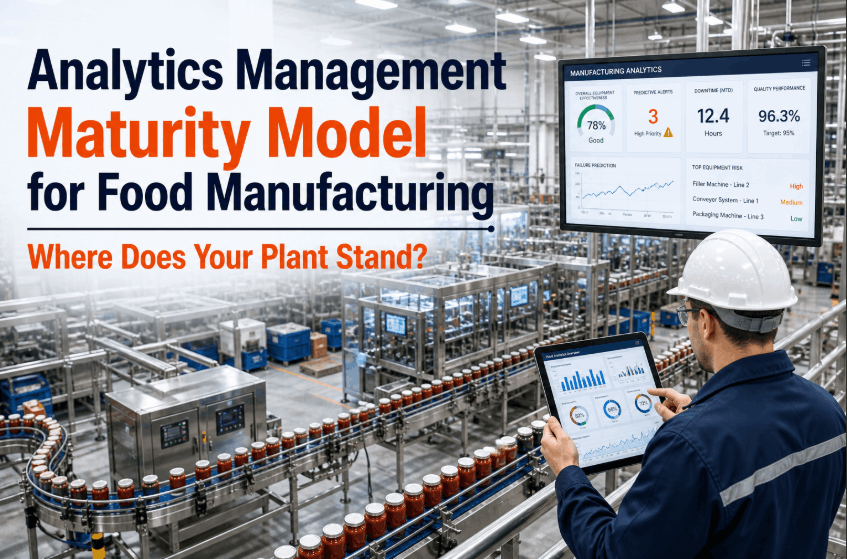
Multi-Site Analytics Maturity Model: Where Is Your Food Manufacturing Network?
Enterprise food manufacturing organizations progress through distinct analytics maturity stages as they move from plant-level siloed reporting toward fully integrated, AI-driven portfolio intelligence. Identifying your network's current stage is the prerequisite for building a realistic roadmap toward standardized multi-plant analytics. Book a demo to benchmark your network's analytics maturity against peer multi-site food manufacturers.
Frequently Asked Questions: Multi-Site Food Manufacturing Analytics
What is multi-site food manufacturing analytics?
Multi-site food manufacturing analytics refers to the practice of tracking, comparing, and managing operational performance KPIs—including OEE, PM compliance, MTTR, sanitation completion, and calibration currency—across multiple food production facilities from a unified analytics platform. The core objective is to replace plant-level data silos with a single enterprise-wide operational picture that enables centralized performance management, cross-plant benchmarking, and portfolio-level audit readiness.
How does cross-plant benchmarking improve food manufacturing performance?
Cross-plant benchmarking enables enterprise operations teams to identify which facilities in their network are outperforming or underperforming on specific KPIs, understand the operational root causes behind performance gaps, and systematically replicate high-performance practices from leading plants to lagging ones. When benchmarking is based on standardized KPI definitions and real-time data, it becomes a continuous improvement mechanism rather than a periodic reporting exercise.
Can iFactory integrate with different CMMS systems across multiple plants?
Yes. iFactory is designed specifically for the heterogeneous IT environments common in multi-site food manufacturing networks. The platform connects to SAP PM, IBM Maximo, Infor EAM, and other leading CMMS systems via REST APIs and standard industrial connectors. Each plant's data is normalized into a unified schema at ingestion, so different source systems at different facilities all populate the same cross-plant KPI models without requiring manual data harmonization.
What is the most common challenge in standardizing analytics across food plants?
The most common challenge is KPI definition inconsistency—where different facilities calculate the same metric using different rules, making cross-plant comparisons statistically invalid. The second most common challenge is data source fragmentation, where maintenance, calibration, and sanitation records exist in separate systems at each plant with no automated aggregation layer. iFactory addresses both by enforcing a unified KPI taxonomy and automating multi-system data ingestion across the entire plant network.
How quickly can iFactory deploy a multi-site analytics platform across a food manufacturing network?
Deployment timelines depend on the number of facilities and the complexity of existing source systems, but most multi-site food manufacturing networks achieve full dashboard deployment within 15–30 days. AI anomaly detection models are active within the first full production cycle at each plant. Historical data migration from existing CMMS systems can accelerate cross-plant baseline establishment to under 14 days in data-rich environments.
How does enterprise audit readiness work across multiple food plants?
iFactory's enterprise audit readiness score aggregates PM compliance, calibration currency, sanitation completion, and documentation completeness from every facility in the network into a single composite index, updated in real time. Corporate quality teams can drill from the enterprise score down to individual plant scores, and from there to specific asset or task-level compliance gaps—giving them a complete, drill-down view of audit risk across the entire portfolio at any moment.
Stop Managing Your Food Plant Network Without Portfolio-Level Visibility
iFactory's Multi-Site Dashboard gives enterprise F&B operations teams a unified, AI-driven view of OEE, PM compliance, MTTR, sanitation completion, calibration currency, and audit readiness—standardized and comparable across every plant in your network.