SAP xMII Modernization for Food & Beverage Quality Management
By Riley Quinn on May 27, 2026
SAP xMII modernization in food and beverage is no longer a technology question — it’s a regulatory compliance project that happens to involve technology. FDA, BRCGS Issue 9, SQF Edition 9, FSSC 22000, and 21 CFR Part 11 expectations have all tightened in the last 24 months. Auditors no longer accept “we’re modernizing” as a placeholder for missing audit trails or unvalidated data flows. Every BLS transaction retired, every historian connection reused, every quality notification path rebuilt — each one needs documented validation evidence that survives inspector scrutiny. The plants getting this right in 2026 follow a disciplined 5-stage migration playbook anchored in a Validation Master Plan, rigorous data mapping, mandatory parallel validation, controlled cutover, and ongoing CSV maintenance. The plants getting it wrong treat migration as IT and discover the compliance gap during the first post-cutover audit. This guide is the step-by-step playbook for SAP xMII modernization in F&B batch quality control — the data mapping discipline, the parallel validation protocol, the regulatory evidence matrix, and the vendor evaluation criteria that determine whether your audit posture survives the migration intact. Book an AI SPC migration workshop to walk through the playbook against your specific xMII landscape.
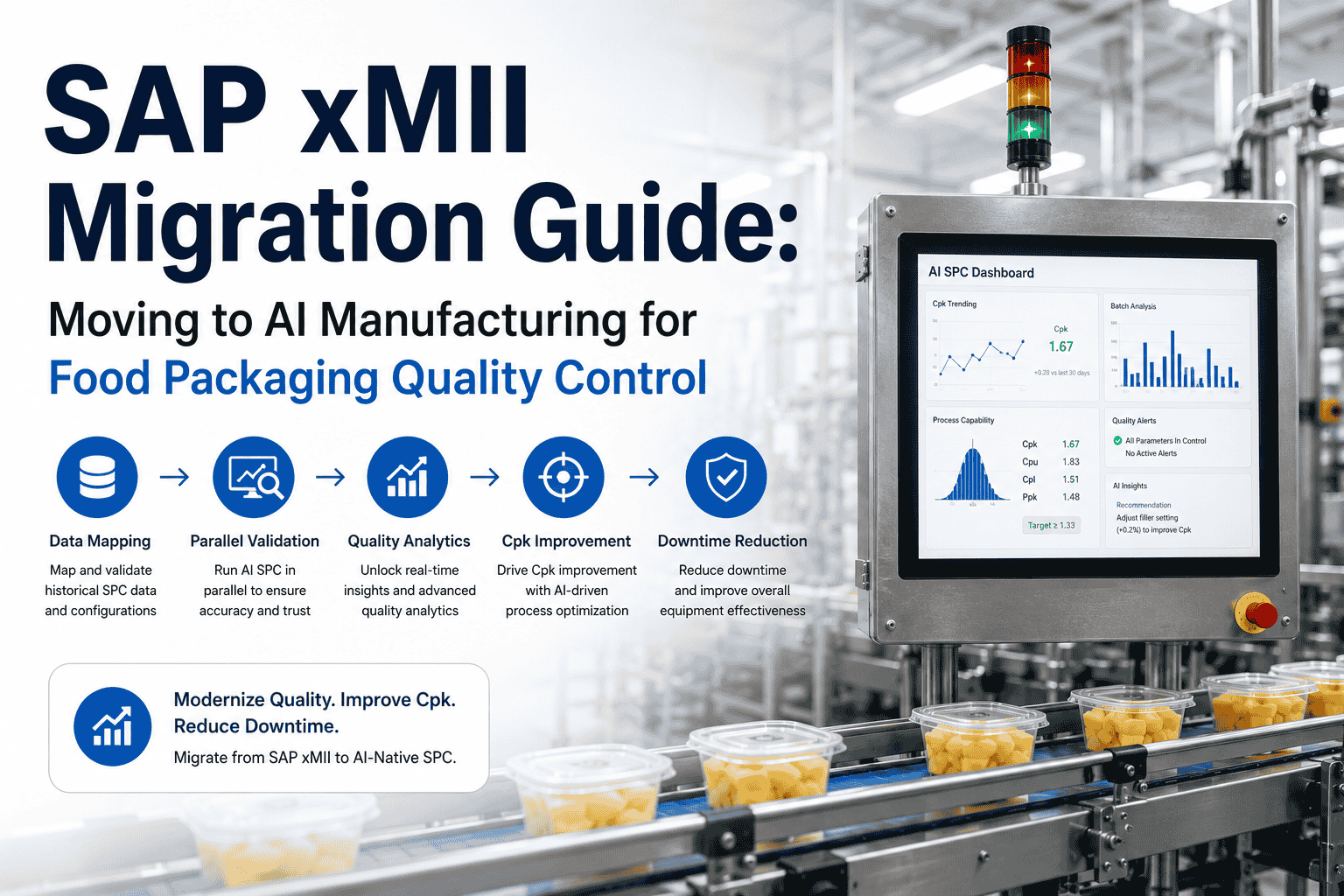
The 5-Stage Migration Playbook
From SAP xMII to AI-Native SPC — Step by Step
Each stage produces audit-defensible evidence. None can be skipped. The 8–12 week timeline only holds when the stages run in sequence.
01
VMP
Validation Master Plan
Wk 1–2
02
Data Mapping
Schema & Tag Inventory
Wk 2–4
03
Parallel Validation
Concurrent Operation
Wk 4–8
04
Cutover
Controlled Switch
Wk 8–10
05
CSV Ongoing
Post-Migration Verification
Wk 10–12+
Every stage generates 21 CFR Part 11-compliant audit trail evidence inspector-ready on day 1 post-cutover.
Stage 01 — The Validation Master Plan (VMP) Sets the Compliance Floor
Migration discipline starts before any technical work begins. The Validation Master Plan defines the scope of the regulated system, identifies GMP-critical processes, names the validation lifecycle deliverables, and locks the acceptance criteria. Without a VMP, the migration produces working software that fails the first audit. With a VMP, the same migration produces a defensible regulatory record from week one.
Scope Definition
Which SAP xMII transactions, queries, and integrations fall inside the regulated system boundary. Every artifact tagged: GxP-critical, GxP-impacting, or non-GxP.
User Requirements Spec
URS captures every GMP-critical process the new system must satisfy — batch genealogy, e-signatures, CCP monitoring, deviation handling, audit trail capture.
Validation Lifecycle
IQ / OQ / PQ deliverables defined per artifact. Test scripts written before implementation. Traceability matrix linking URS line items to test cases established.
Stage 02 — Data Mapping Is Where Most Migrations Fail Quietly
Data mapping determines whether the new system inherits the trustworthy historical record or breaks the chain of custody auditors expect. Every PLC tag, historian point, BLS transaction output, and SAP QM field flowing through the legacy stack needs an explicit mapping to its target equivalent — with documented transformation logic, validation rules, and audit trail preservation. Plants that rush this stage discover the gap during the first post-cutover audit when an inspector asks for the same data they had pre-migration.
Swipe horizontally to see each data mapping category
Data category
Legacy source
Target destination
Validation rule
Real-time tags
PI / InSQL / Proficy / PHD
Federated (no migration)
100% tag-count parity verified daily
Historical batch records
xMII batch tables + historian
Time-series store + S/4HANA QM
100% batch genealogy preserved
Quality notifications
SAP QM (via BLS)
SAP QM (retained, via OData)
Defect codes mapped 1:1, no orphans
SPC rule configurations
xMII BLS Nelson Rules
AI-native + Nelson hybrid
Per-rule equivalence proven in parallel
User authorization
SAP authorization objects
Inherited (no remapping)
Same role = same access verified
Audit trail records
xMII log files + DB tables
21 CFR Part 11 tamper-evident store
Cryptographic chain-of-custody preserved
E-signature records
xMII signature transactions
21 CFR Part 11.10(e) compliant store
Re-signing not required, original preserved
Want this mapping table populated against your specific xMII inventory? Book an AI SPC migration workshop — the data mapping exercise is the most valuable single output of the session.
Stage 03 — Parallel Validation Is the Audit-Defensible Heart of the Migration
Parallel validation is the period when both the legacy xMII system and the new AI-native SPC layer run concurrently. Both systems receive identical input data. Both generate quality notifications, SPC alerts, and audit trail entries. Statistical comparison proves equivalence between them — or surfaces gaps before cutover. This is the stage auditors will ask about in detail post-cutover. Plants that skip parallel validation or shorten it below 4 weeks expose themselves to findings that take quarters to remediate.
System A
Legacy SAP xMII
BLS SPC engine running
Nelson Rules firing as today
Quality notifications to SAP QM
All operator workflows unchanged
Production-of-record during validation
Statistical Comparison
Alert equivalence per rule
False positive delta
Lead time gain measured
Audit trail completeness
4–6 weeks
minimum parallel period
System B
AI-Native SPC
LSTM + Nelson + Autoencoder fused
Multivariate alerts logged
Shadow mode — no QM posting
Operators see both system outputs
Candidate — pending equivalence proof
Stage 04 — Controlled Cutover with Rollback Plan
Cutover only proceeds after parallel validation proves statistical equivalence and the change control board approves. Even then, cutover is staged — not flipped. AI-native SPC writes quality notifications to SAP QM live, but legacy xMII continues running in observation mode for 2–4 additional weeks as the rollback safety net. The first audit cycle after cutover often surfaces edge cases that benefit from the legacy comparison still being available.
Step 01
Change Control Board Approval
CCB reviews parallel validation report, signs off on equivalence proof, approves cutover date. Validation report becomes part of permanent audit record.
Step 02
AI-Native SPC Goes Live to SAP QM
Quality notifications, confidence scores, root cause hypotheses, and audit trail entries flow live from AI-native SPC to SAP QM via OData. Operators receive new alerts on modern HMI.
Step 03
Legacy xMII Observation Mode
xMII continues running in observation mode for 2–4 weeks. BLS alerts logged for comparison. Rollback to xMII remains possible if unexpected behavior surfaces.
Step 04
Legacy xMII Sunset
After 2–4 weeks of stable operation, xMII transactions retire formally. CCB documents the sunset. Production-of-record officially transitions to AI-native SPC.
Walk the 5-Stage Playbook Against Your Real xMII Landscape
iFactory’s F&B SAP modernization practice runs a 90-minute workshop against your real xMII inventory, validation history, and audit posture. You leave with the VMP scope draft, data mapping template applied to your artifacts, and a defensible parallel validation protocol — ready to take to your CCB.
The Regulatory Evidence Matrix — What Each Stage Produces
Auditors don’t accept “we’re modernizing” as a substitute for evidence. Each stage of the playbook must produce specific artifacts that survive inspector scrutiny. The matrix below maps the four major F&B regulatory frameworks (FDA 21 CFR Part 11, BRCGS, SQF, FSSC 22000) to the evidence each stage produces.
FDA 21 CFR Part 11
Electronic Records & Signatures
VMP StageScope statement covering all Part 11 records
Mapping StageE-signature continuity documentation
Parallel StageAudit trail equivalence proof
Cutover StageCCB sign-off with timestamped evidence
BRCGS Issue 9
Management Review Evidence
VMP StageURS lines tied to management review requirements
VMP StageHACCP plan integration confirmed in scope
Mapping StageCCP monitoring record continuity
Parallel StageCCP alert equivalence proven
Cutover StageSQF audit trail validated complete
FSSC 22000
Documented PRPs & OPRPs
VMP StageISO 22000 PRP coverage confirmed
Mapping StagePRP monitoring data continuity
Parallel StageOPRP equivalence demonstrated
Cutover StageFSSC documentation refresh
Vendor Evaluation — The Validation-Documentation Lens
Generic AI SPC vendors handle the math. Compliance-aware vendors handle the validation documentation. The difference between the two shows up in audit week. Eight criteria separate vendors who’ve done validated F&B SAP migrations from vendors selling the demo without the paperwork.
01
Validation documentation library
Ask:
"What pre-built validation documentation ships with the platform?"
Production-grade vendors ship IQ/OQ/PQ test scripts, traceability matrices, and validation summary reports as baseline deliverables. Vendors expecting you to write all validation docs from scratch add 8–16 weeks to migration timeline.
02
21 CFR Part 11 native compliance
Ask:
"Is your audit trail Part 11.10(e) compliant out of the box?"
Computer-generated, time-stamped, tamper-evident audit trails for every record creation, modification, or deletion. Cryptographic chain-of-custody is non-negotiable. Vendors logging to flat files don’t meet the standard.
03
Parallel validation toolkit
Ask:
"Does the platform include side-by-side comparison tooling for parallel validation?"
Statistical equivalence proof requires automated comparison of legacy vs new system outputs over the 4–6 week parallel period. Vendors expecting you to build this from scratch make parallel validation impractical.
04
Historian federation documentation
Ask:
"How is historian connection re-use documented for validation purposes?"
Reusing PI / InSQL / Proficy / PHD connections avoids re-validating the data source. Vendors need to provide explicit validation guidance for the federation pattern, not just “we connect to it.”
05
E-signature continuity
Ask:
"How are historical e-signatures preserved through migration?"
Re-signing legacy records is impractical and often impossible (signatories may have left). The platform must accept legacy e-signature records as-is with cryptographic continuity proof. Vendors requiring re-signature have not done F&B validation work.
06
GAMP 5 alignment
Ask:
"Is the platform GAMP 5 category 4 or 5 ready?"
Configured-product vendors (category 4) reduce validation effort 50%+ vs custom-built systems (category 5). Demand explicit categorization documentation. Vendors avoiding this question are typically category 5 in disguise.
07
Change control integration
Ask:
"How does the platform handle change control post-cutover?"
Every model update, threshold change, or workflow modification must flow through documented change control with CCB approval. Vendors offering “auto-updating models” without change control integration create regulatory exposure.
08
Validated migration timeline
Ask:
"Have you completed validated F&B migrations in 8–12 weeks?"
Demand references with documented timelines including parallel validation. Vendors who’ve only deployed in unregulated environments don’t know how validation extends timeline. The benchmark: 8–12 weeks including the 4-week parallel period.
Expert Perspective
"The single most common reason SAP xMII modernization projects exceed timeline in F&B isn’t technical complexity — it’s underestimating the validation documentation burden. A migration that takes 8–12 weeks technically takes 18–24 weeks when validation discipline is treated as a Phase 5 afterthought rather than an embedded throughline. Plants that succeed in 2026 build the VMP in week one, run data mapping with documented validation rules in weeks 2–4, commit to a real 4–6 week parallel validation period, and treat cutover as a CCB-approved event rather than an IT milestone. The discipline isn’t harder than the technology — it’s just more administrative, and the plants that respect that finish on time with a defensible audit record."
— F&B SAP Validation Practice, 2026 industry insight
5 stages
VMP · Mapping · Parallel · Cutover · CSV ongoing
4–6 wk
minimum parallel validation period for audit defensibility
50%+
validation effort reduction with GAMP 5 category 4 platforms
Conclusion: The Playbook Is the Migration Plan, Not a Layer On Top of It
SAP xMII modernization in F&B is a compliance project that produces technology output, not the other way around. The 5-stage playbook — VMP, Data Mapping, Parallel Validation, Cutover, CSV Ongoing — isn’t a regulatory wrapper around the technical work; it is the technical work, just disciplined. Plants that follow the playbook finish in 8–12 weeks with an audit record that survives FDA, BRCGS, SQF, and FSSC 22000 scrutiny on day one post-cutover. Plants that don’t follow it deliver working software in 8–12 weeks then spend 12–18 months remediating audit findings. The vendor evaluation criteria, data mapping discipline, parallel validation protocol, and regulatory evidence matrix in this guide are the same playbook iFactory uses with every F&B customer running SAP QM + xMII. The right starting point isn’t the technology demo — it’s the workshop that produces the VMP scope draft against your real xMII inventory. Book an AI SPC migration workshop to start with stage 01 properly.
Start with Stage 01 of the Playbook
iFactory’s F&B SAP modernization practice runs the workshop that produces your VMP scope draft, data mapping template, and parallel validation protocol — everything you need to take to your Change Control Board before week one of the technical migration.
Why does parallel validation need 4–6 weeks specifically?
Statistical equivalence between legacy xMII and AI-native SPC requires enough operational data to cover the full range of plant behavior: weekday and weekend shifts, multiple SKU changeovers, multiple CIP cycles, planned maintenance windows, and at least one full quality audit cycle. Four weeks is the floor for capturing this variety in a typical F&B plant; six weeks is the comfortable benchmark. Shorter parallel periods produce equivalence claims that auditors can challenge as statistically insufficient. The 4–6 week period also gives the AI-native SPC platform time to learn plant-specific patterns through the failure-pattern library, which is the differentiator that produces measurable improvement over the legacy BLS rules.
What happens to historical e-signatures during migration?
They’re preserved as-is with cryptographic continuity proof, not re-signed. Re-signing legacy records is impractical (signatories may have left the company, been re-assigned, or simply not remember the original signing context) and often regulatorily problematic. The right architectural pattern: import the legacy e-signature records with their original timestamps, signatory identities, and cryptographic hashes intact, then preserve those records in the 21 CFR Part 11.10(e) tamper-evident store of the new system. Auditors can verify continuity by checking the hash chain. New e-signatures generated post-cutover follow the new system’s native Part 11-compliant flow. Vendors requiring legacy record re-signature have not done F&B validation work and create regulatory risk.
How does GAMP 5 categorization affect validation effort?
GAMP 5 categorizes computerized systems by their nature and validation rigor required. Category 1 is operating systems and infrastructure (minimal validation). Category 3 is non-configured products. Category 4 is configured products — commercial software where the validation effort focuses on the configuration choices rather than the underlying code. Category 5 is custom-built systems — full lifecycle validation required. AI-native SPC platforms shipping pre-configured F&B templates and standard configuration interfaces fit category 4, which reduces validation effort 50%+ versus custom development (category 5). Demand explicit GAMP 5 category documentation from vendors. Vendors who avoid the question are typically category 5 in disguise, which converts your 8–12 week migration into an 18–24 week validation lifecycle project.
What does the rollback plan look like if parallel validation fails?
The rollback plan exists because parallel validation sometimes does fail to prove equivalence within the 4–6 week window — not because the AI-native SPC is worse, but because the equivalence threshold wasn’t met for specific edge cases. The plan: if statistical equivalence isn’t proven by week 6 of parallel operation, the CCB defers cutover, the vendor extends the parallel period by 2–4 weeks to tune confidence thresholds, and validation re-runs. Legacy xMII continues as production-of-record throughout. If equivalence still isn’t proven by week 10, the scope of cutover is reduced — some BLS transactions retire while others remain. This is a feature of the playbook, not a failure mode. Plants that lock themselves into a hard cutover date regardless of validation outcome create compliance exposure that the staged playbook avoids.
How does post-migration CSV maintenance work?
CSV (Computer System Validation) doesn’t end at cutover — it’s ongoing for the regulated life of the system. Every model update, threshold change, workflow modification, or new SKU template addition flows through documented change control with CCB approval. The AI-native SPC platform must integrate with your existing change control system (typically a QMS module or a dedicated CCB workflow) and produce the documentation each change requires automatically — impact assessment, test plan, validation report, training record. Vendors offering “self-updating models” without change control integration create regulatory exposure: every model update is technically a system change requiring documented validation. The right architecture: model updates queue, CCB reviews and approves with one click, validation documentation auto-generates, deployment happens with full audit trail.