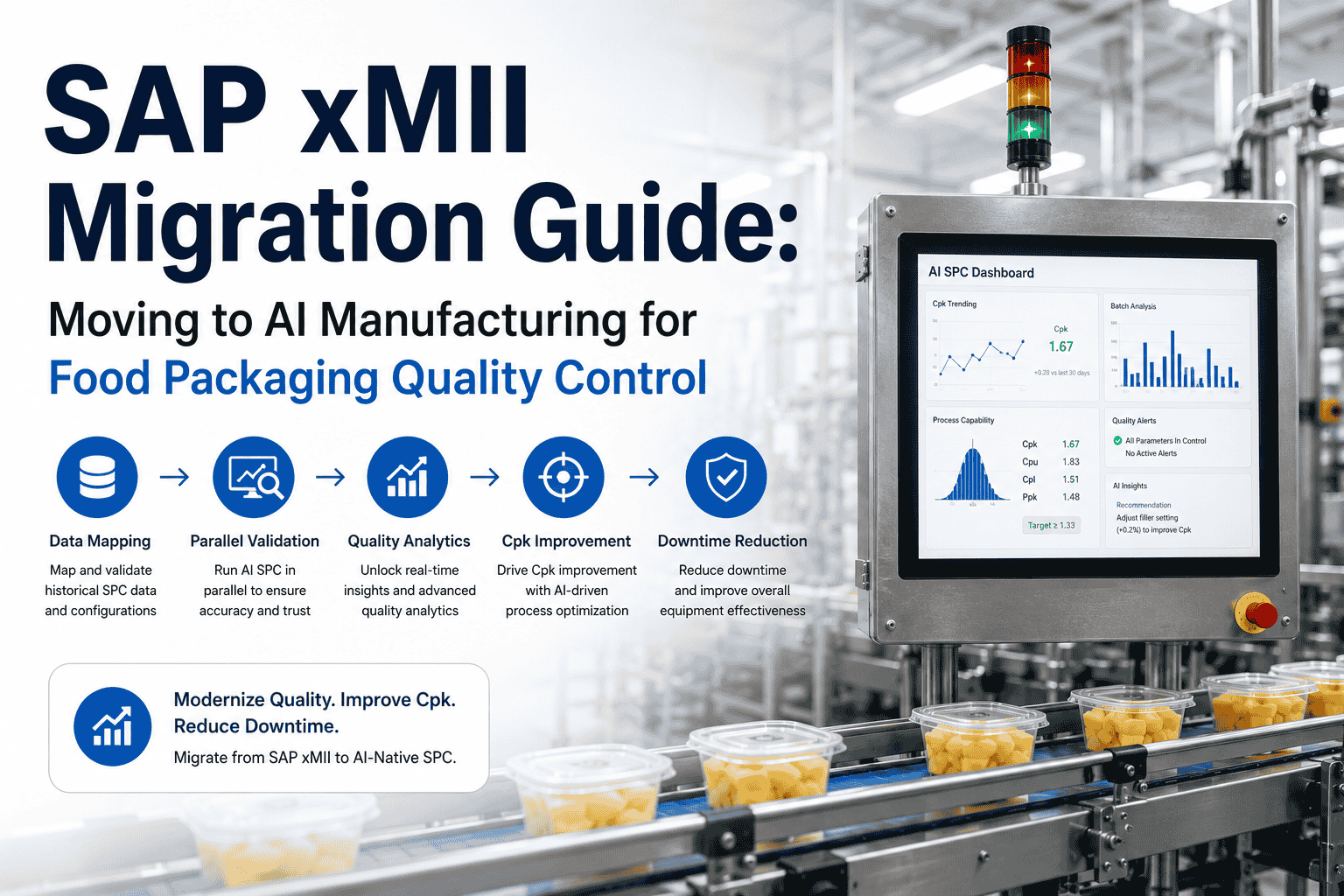
SAP QM Modernization: Future of Food & Beverage Quality Management
By Riley Quinn on May 29, 2026
Three forces are reshaping F&B quality management simultaneously in 2026: SAP ECC support ends at the close of 2027, the ISO 9001:2026 revision now rewards predictive risk management and AI-supported quality, and 50% of F&B manufacturers have plans for significant AI investment this year. The plants that modernize SAP QM through this convergence window land 3–7% first-pass yield lift within the first quarter. The plants that defer get stuck rebuilding integrations under deadline pressure with senior leaders turning over mid-migration. Book an AI SPC migration workshop to map your QM modernization against the convergence window.
Strategic Outlook 2026–2028
The Future of F&B Quality Management
SAP QM modernization is no longer a technology question — it’s a timing question. Three forces converging through the next 18 months are redrawing what QM looks like — and what it delivers for yield.
+4–7%
First-year yield
4 pillars
Modern QM
18 mo
Window open
Convergence window open
2028+
AI-Native QM
Predictive · Autonomous · Vision-Integrated
01
SAP ECC Sunset
End 2027
02
ISO 9001:2026
Predictive Required
03
AI Investment
50% of F&B
The Four Pillars of Modern F&B Quality Management
SAP QM modernization isn’t about replacing a module — it’s about evolving four foundational capabilities that legacy QM doesn’t support. Each pillar contributes a distinct dimension of yield improvement. Together they define what production-grade F&B quality management looks like in 2026 and beyond.
Pillar 01
Real-Time Quality Visibility
Every PLC tag, historian point, batch parameter, and lab result visible in one fabric — not seven systems.
Yield contribution
+1–2%
Plant-wide dashboards · Cpk trending live
Per-batch genealogy view in seconds
Mobile-responsive HMI for floor operators
Pillar 02
Predictive Quality Analytics
Multivariate models forecast drift 30–60 minutes before specification failure — replacing reactive Nelson Rules alone.
Yield contribution
+1–2.5%
LSTM + Nelson + Autoencoder confidence fusion
80+ correlated tags per alert
Self-updating from operator confirmations
Pillar 03
Autonomous Root Cause
RCA chains generated automatically with auditable evidence — investigation becomes verification, not reconstruction.
Yield contribution
+0.5–1.5%
Ranked hypotheses with confidence scores
Cross-system correlation (PLC, QM, CMMS)
60–75% reduction in deviation investigation time
Pillar 04
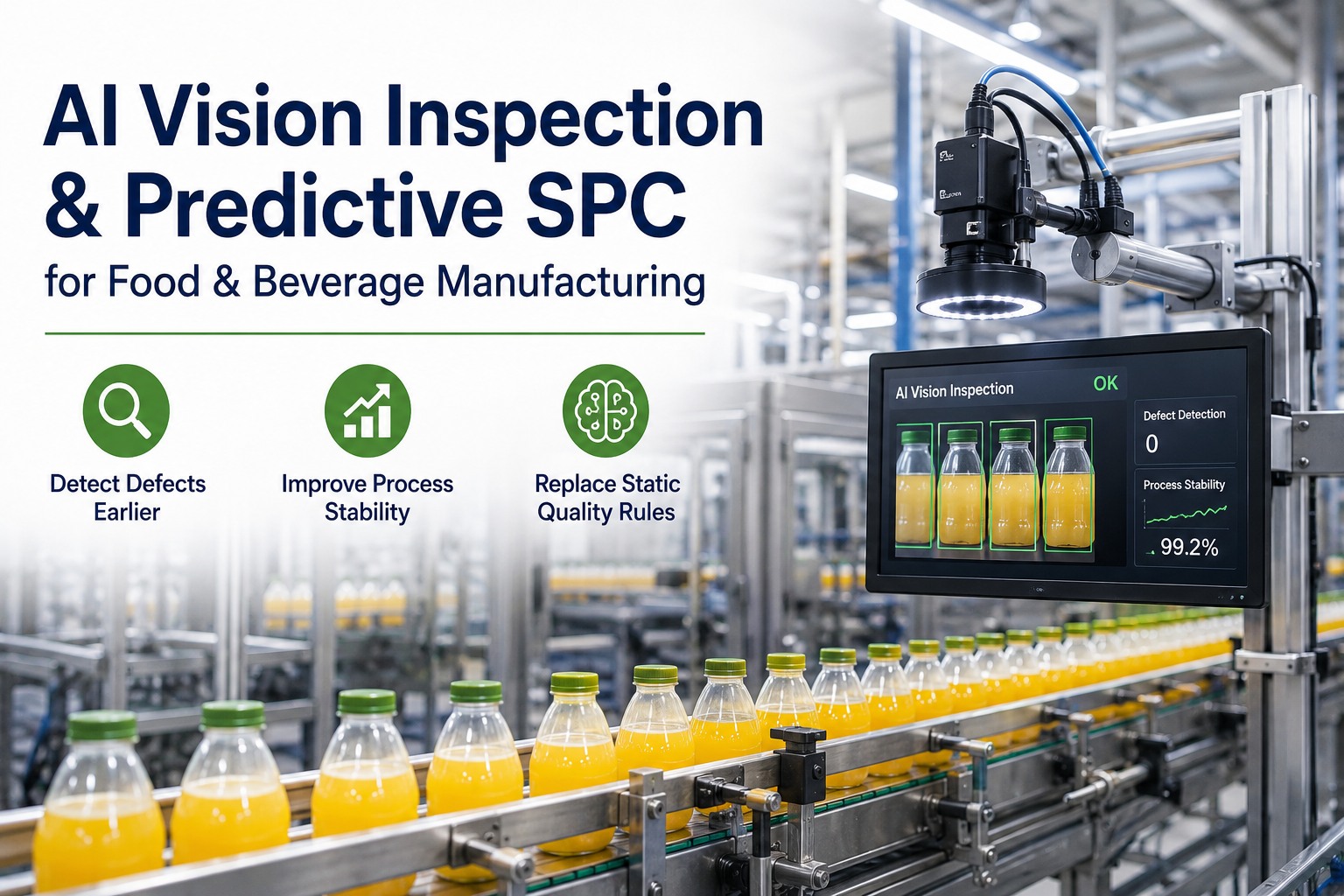
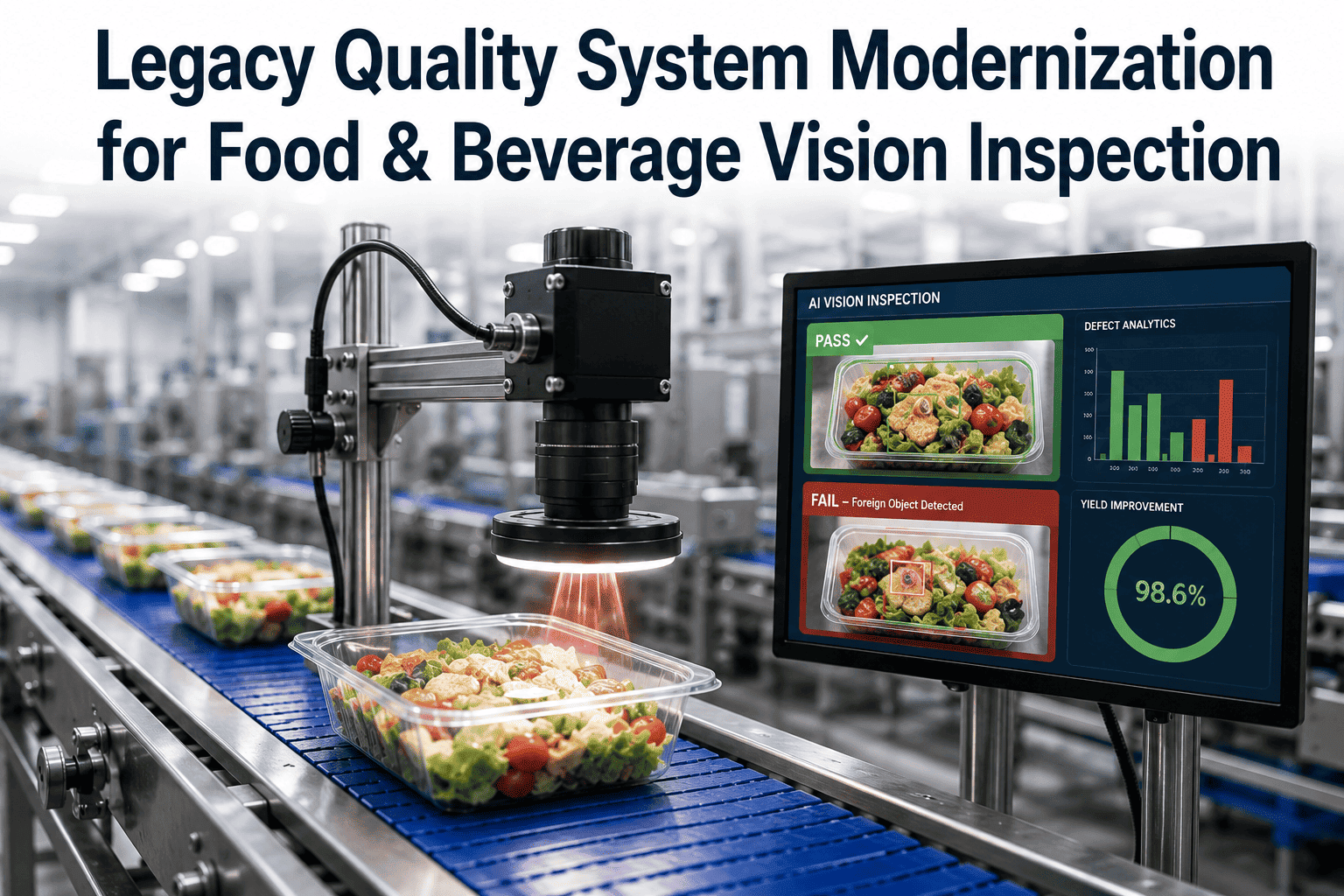
AI Vision Inspection
Per-unit inspection at 10,000+ units/hour — 99% catch rate vs 85% manual, producing 14× fewer defect escapes.
Yield contribution
+0.5–1%
Sub-100ms edge inference at line speed
6 defect categories pre-trained for F&B
FSMA 204 per-unit traceability built-in
The Three-Horizon Maturity Roadmap
Modernization isn’t a single project — it’s a sequenced capability journey. Plants that try to deliver all four pillars simultaneously in month one create change-management failure. Plants that sequence the work through three horizons land each capability with operator buy-in and demonstrable yield gain before adding the next layer.
Horizon 1
Foundation
Weeks 1–12
Establish the data fabric
SAP QM retained, BLS SPC migrates to AI-native engine
AI recommendations auto-applied within safe ranges
Failure pattern library matures across all SKUs
Supplier quality predictions feed procurement
ISO 9001:2026 compliance automation complete
Yield delta
+1–2%
Want a horizon-by-horizon roadmap mapped to your specific plant’s starting point and ECC sunset timeline? Book an AI SPC migration workshop.
Today vs Future — What Modernization Actually Changes
The future state of F&B quality management isn’t a faster version of today’s SAP QM. It’s a structurally different operating model where the quality team spends time on process improvement rather than data assembly. Six specific behaviors transform across the modernization journey.
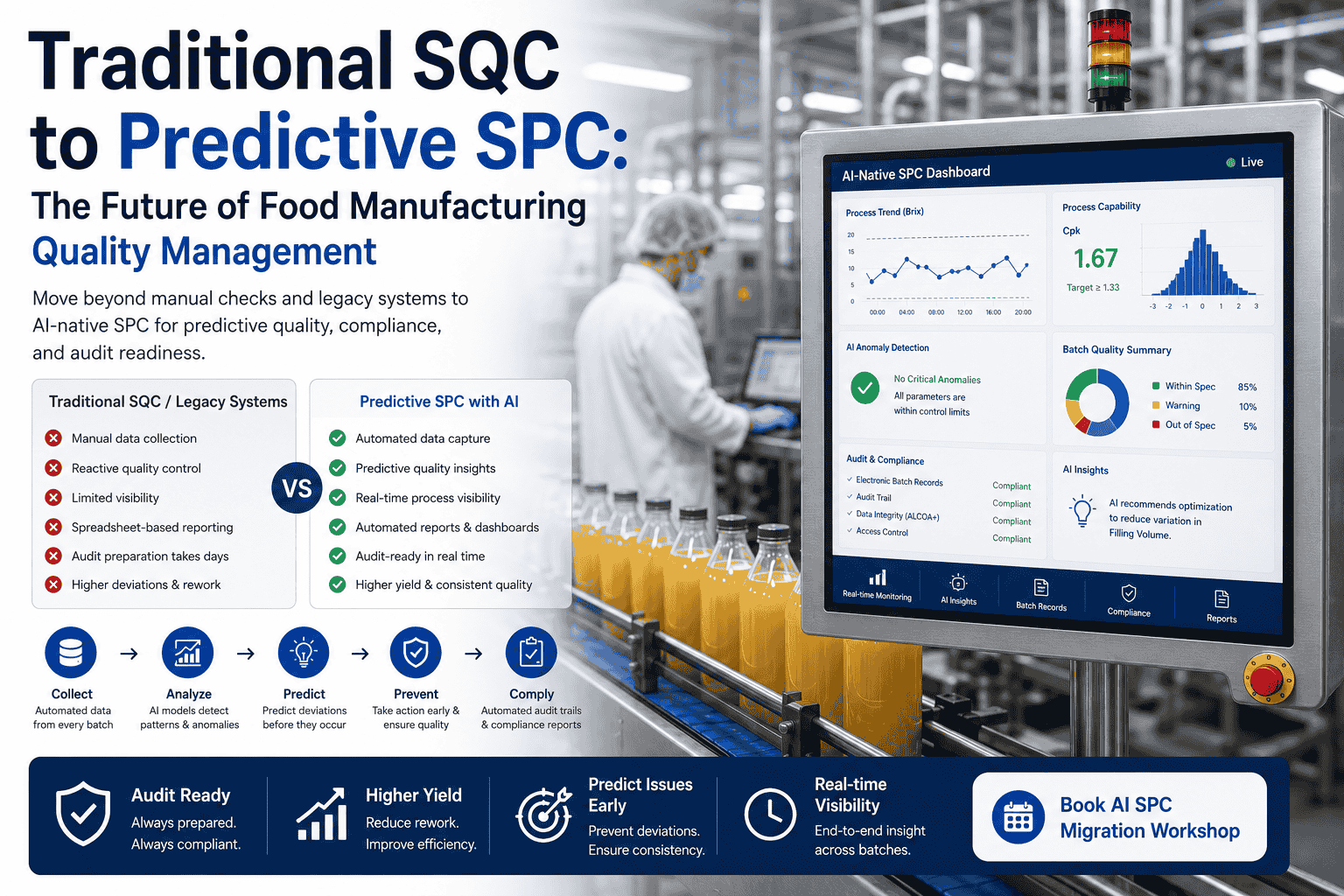
Defect detection
Reactive Nelson Rules after drift visible
Predictive 30–60 min before specification failure
Root cause analysis
Operator manually reconstructs from 5+ systems
Auto-generated ranked hypotheses with evidence chain
5–10 minutes — ISO 9001:2026 audit packs auto-generated
Supplier quality
Manual lot-by-lot incoming inspection
Predictive supplier scoring based on yield correlation
Map the Modernization Against the 2027 Sunset Window
iFactory’s F&B SAP modernization practice runs a 90-minute workshop applying the four pillars, the three-horizon roadmap, and the yield compounding math to your specific plant. You leave with a phased deployment plan aligned to your ECC sunset timeline and a yield improvement projection grounded in your historian data.
Yield improvement from QM modernization isn’t a single jump — it’s a compounding curve across four quarters. Each pillar contributes to the curve at a different stage. Understanding how the math compounds is the difference between a credible CFO presentation and a vendor sales pitch.
LSTM forecasts catch drift 30–60 min early; operators intervene before scrap manifests
Q3
Autonomous RCA
+3.5–5.5%
Failure pattern library matures; same drift signatures get prevented across SKUs
Q4
Closed Loop
+4.5–7.0%
Vision + SPC + RCA + copilot integrated; quality team focused on improvement vs assembly
Vendor Evaluation — The Future-Readiness Lens
Vendor evaluation for SAP QM modernization in 2026 isn’t about feature checklists — it’s about future-readiness. Eight criteria separate vendors who’ll still be relevant at Horizon 3 from vendors who’ll require a forklift replacement when ISO 9001:2026 enforcement matures and S/4HANA migrations close out.
01
Four-pillar architecture
Ask:
"Does the platform deliver visibility + predictive + autonomous RCA + vision as one architecture or four projects?"
Vendors who deliver one or two pillars and roadmap the others force you into multi-vendor integration projects later. Production-grade platforms ship all four pillars on one data fabric, with vision integrated into SPC rather than running as a separate camera system.
02
S/4HANA migration alignment
Ask:
"How does the platform integrate during and after the S/4HANA migration?"
ECC sunsets at end of 2027. Plants migrating in parallel need vendors whose integration patterns work for both ECC and S/4HANA without rework. Zero-ABAP commitment is the differentiator — ABAP-dependent integrations get rebuilt twice during S/4HANA migration.
03
ISO 9001:2026 readiness
Ask:
"Does the platform produce ISO 9001:2026-grade predictive risk evidence automatically?"
The 2026 revision rewards predictive risk management, automated documentation, and AI-supported RCA. Vendors whose platforms produce only reactive evidence packages will require manual augmentation for certification — or fall behind in maturity scoring.
04
Three-horizon sequencing
Ask:
"Does the deployment plan sequence Foundation, Intelligence, and Autonomous horizons or attempt everything at once?"
Plants that try to deliver all four pillars simultaneously create change-management failure. Plants that sequence properly land each capability with operator buy-in. Demand explicit horizon-based deployment plans with yield-delta projections at each stage.
05
Failure pattern library
Ask:
"How does the platform codify scrap and deviation incidents for future prevention?"
Each incident should improve the platform’s pattern recognition. Library matures across deployments — what your plant learns benefits future plants. Vendors without this feedback loop deliver static models that degrade rather than compound over time.
06
Supplier quality integration
Ask:
"Does the platform correlate finished-product yield back to supplier and incoming material variance?"
Raw materials are the largest cost in F&B production. Predictive supplier scoring based on yield correlation surfaces which suppliers create scrap risk before procurement makes contract decisions. This is a Horizon 3 capability vendors should demonstrate, not roadmap.
07
Yield projection methodology
Ask:
"How does the vendor calculate yield improvement projections for our specific plant?"
Generic "+5%" claims aren’t defensible to a CFO. Production-grade vendors model yield projection from your historian data, your defect category mix, your line topology. Demand a documented methodology, not a sales-deck percentage.
08
SAP QM coexistence
Ask:
"Does the platform replace SAP QM or layer above it?"
The right answer is layer above it. SAP QM’s quality notifications, batch certificates, and CAPA workflows are among SAP’s strongest capabilities — replacing them adds 12–18 months and breaks downstream integrations. Demand SAP QM preservation with AI-native SPC feeding it.
Expert Perspective
"The convergence window for F&B SAP QM modernization closes faster than most plants realize. SAP ECC sunsets at end of 2027 with only 39% of customers fully migrated to S/4HANA. ISO 9001:2026 rewards predictive risk management that legacy QM can’t deliver. And 50% of F&B manufacturers have AI investment plans for 2026, which means integrator and specialist resources will be the bottleneck within 18 months. Plants that start the four-pillar modernization through the three-horizon sequence in 2026 land 4–7% yield improvement by Q4 with calm execution. Plants that wait until 2027 face the same modernization under deadline pressure, with senior leaders turning over mid-migration and integrator capacity already booked. The right framing isn’t 'should we modernize' — it’s 'how do we sequence the four pillars before the window closes.'"
— F&B SAP Modernization Practice, 2026 industry insight
+4–7%
first-year yield improvement across four-pillar deployment
3 horizons
Foundation · Intelligence · Autonomous sequencing
2027 close
SAP ECC sunset deadline forcing modernization decisions
Conclusion: The Convergence Window Is the Decision Point
SAP QM modernization in F&B isn’t a technology question in 2026 — it’s a strategic timing question. Three forces converge through the next 18 months: SAP ECC support ends, ISO 9001:2026 raises the bar, and AI investment becomes table stakes across the industry. The plants that modernize through the convergence window land 4–7% first-year yield improvement across the four pillars (real-time visibility, predictive analytics, autonomous RCA, AI vision inspection) sequenced through three horizons (Foundation, Intelligence, Autonomous). The plants that wait face the same work under deadline pressure with integrator capacity already booked and senior leaders turning over mid-migration. The decision worth making now isn’t whether to modernize — it’s which horizon-1 capability ships first, how the deployment aligns to the ECC sunset, and what yield projection holds up to CFO scrutiny. Book an AI SPC migration workshop to position your plant in the convergence window.
Position for the Convergence Window
iFactory’s F&B practice runs a 90-minute workshop applying the four pillars, the three-horizon roadmap, and the yield compounding math to your specific plant. You leave with a phased deployment plan aligned to your ECC sunset timeline, ISO 9001:2026 readiness assessment, and CFO-defensible yield projection.
Why does the SAP ECC 2027 sunset matter for QM modernization specifically?
SAP ECC support officially ends at the close of 2027, and as of late 2024 only 39% of ECC customers had fully migrated to S/4HANA. Gartner predicts half the global customer base won’t upgrade in time. For F&B specifically, a typical migration affects procurement, quality, compliance, production, warehouse operations, finance, and trade promotion simultaneously — making it one of the most complex migrations any manufacturing vertical faces. The QM-specific implication: integrations built for ECC need to work post-S/4HANA migration without rework, and vendors who require ABAP customization add 6–12 months to the broader S/4HANA project. Plants that modernize QM in parallel with S/4HANA migration consolidate integrator capacity, change-control overhead, and validation work into one project. Plants that defer QM modernization until after S/4HANA migration rebuild integrations twice and lose 12–18 months of yield improvement.
How does ISO 9001:2026 change quality management requirements?
The 2026 ISO 9001 revision raises the maturity bar by explicitly rewarding predictive risk management, automated documentation, AI-supported root cause identification, and customer feedback analysis. Organizations that only meet the minimum will fall behind competitors who embrace digital transformation. Five capability areas matter: system integration to break down quality data silos, data governance and cybersecurity for connected platforms, automation of corrective and preventive action workflows, predictive analytics that identify risks before they manifest, and real-time information sharing across teams, suppliers, and regulators. Reactive QM systems will still pass certification but at lower maturity scores, which increasingly matter for B2B procurement decisions and supplier qualifications. The architectural implication: legacy SAP QM running rule-based SPC produces evidence the 2026 revision treats as foundational rather than competitive — modernization with AI-native SPC, predictive analytics, and autonomous RCA produces the evidence patterns the revision rewards.
Why sequence the four pillars through three horizons rather than deliver them all at once?
Three reasons. First, change management: F&B operators need time to internalize new tools before adding more layers. Plants that introduce predictive alerts, autonomous RCA, AI vision, and copilots in the same month produce operator confusion and rejection within 90 days. Second, data maturity: predictive models need 4–8 weeks of plant-specific historian data to tune; failure pattern libraries need 30–90 days of incident codification before they meaningfully prevent recurrence. Delivering Horizon 2 capabilities before Horizon 1 data fabric is established produces models that hallucinate. Third, financial pacing: Horizon 1 yield delta (+1-2%) funds Horizon 2 deployment cost; Horizon 2 yield delta (+2-4%) funds Horizon 3. Plants that try to fund all three horizons at once face larger budget approvals and longer ROI proof points. Sequenced deployment lands each capability with operator buy-in and visible yield improvement before moving to the next.
What yield improvement should we realistically expect from this modernization?
The cumulative first-year yield improvement across the four pillars typically lands at 4–7% for F&B plants starting from legacy SAP QM + BLS SPC baselines. Quarter-by-quarter: Q1 (Foundation) delivers +1.0–2.0% from real-time visibility eliminating blind spots and Cpk trending exposing capability drift. Q2 (Predictive) adds another +1.5–2.0% as LSTM forecasts catch drift 30–60 minutes early. Q3 (Autonomous RCA) compounds with +1.0–1.5% as failure pattern library matures across SKUs. Q4 (Closed Loop) adds the final +1.0–1.5% as vision + SPC + RCA + copilot integrate. The math compounds because each pillar prevents a different category of yield loss: visibility catches capability drift, prediction catches drift onset, RCA prevents recurrence, vision catches escapes at line speed. Plants that buy AI-native SPC as a generic productivity tool deliver 1–2% yield improvement and wonder why the math doesn’t hold. Plants that sequence the four pillars through three horizons deliver the full curve. The methodology must be defended against your plant’s specific historian data — not generic vendor claims.
Does AI-native SPC replace SAP QM or layer above it?
Layer above it, never replace. SAP QM’s quality notifications, batch certificates, CAPA workflows, batch genealogy, and integration with the broader SAP ecosystem are among the strongest capabilities in the SAP product family. There’s no business case to replace them — doing so adds 12–18 months to migration and breaks downstream integrations with finance, procurement, sales, and compliance. What changes is the intelligence layer feeding SAP QM. BLS transactions running rule-based SPC migrate to AI model invocations running confidence fusion across LSTM, Nelson Rules, and autoencoder anomaly detection. AI-native SPC writes quality notifications, defect codes, root cause hypotheses, and confidence scores back to SAP QM via OData/REST APIs. The downstream workflows you’ve built in SAP QM continue working exactly as today — they just receive higher-quality, earlier, more accurate input from the AI-native SPC layer instead of from BLS transactions. This is the right architecture for both ECC and S/4HANA — the integration approach works across the migration boundary.