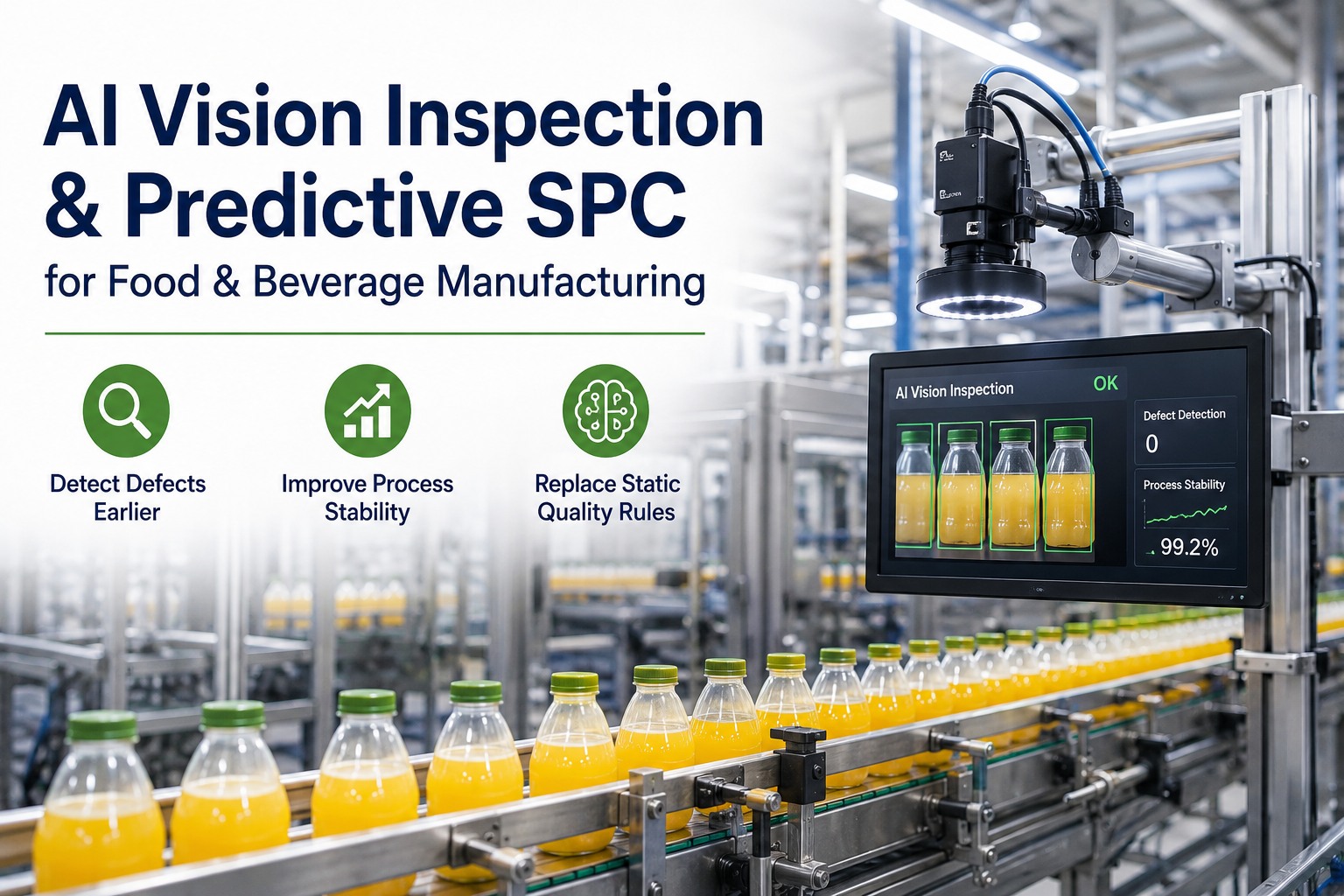
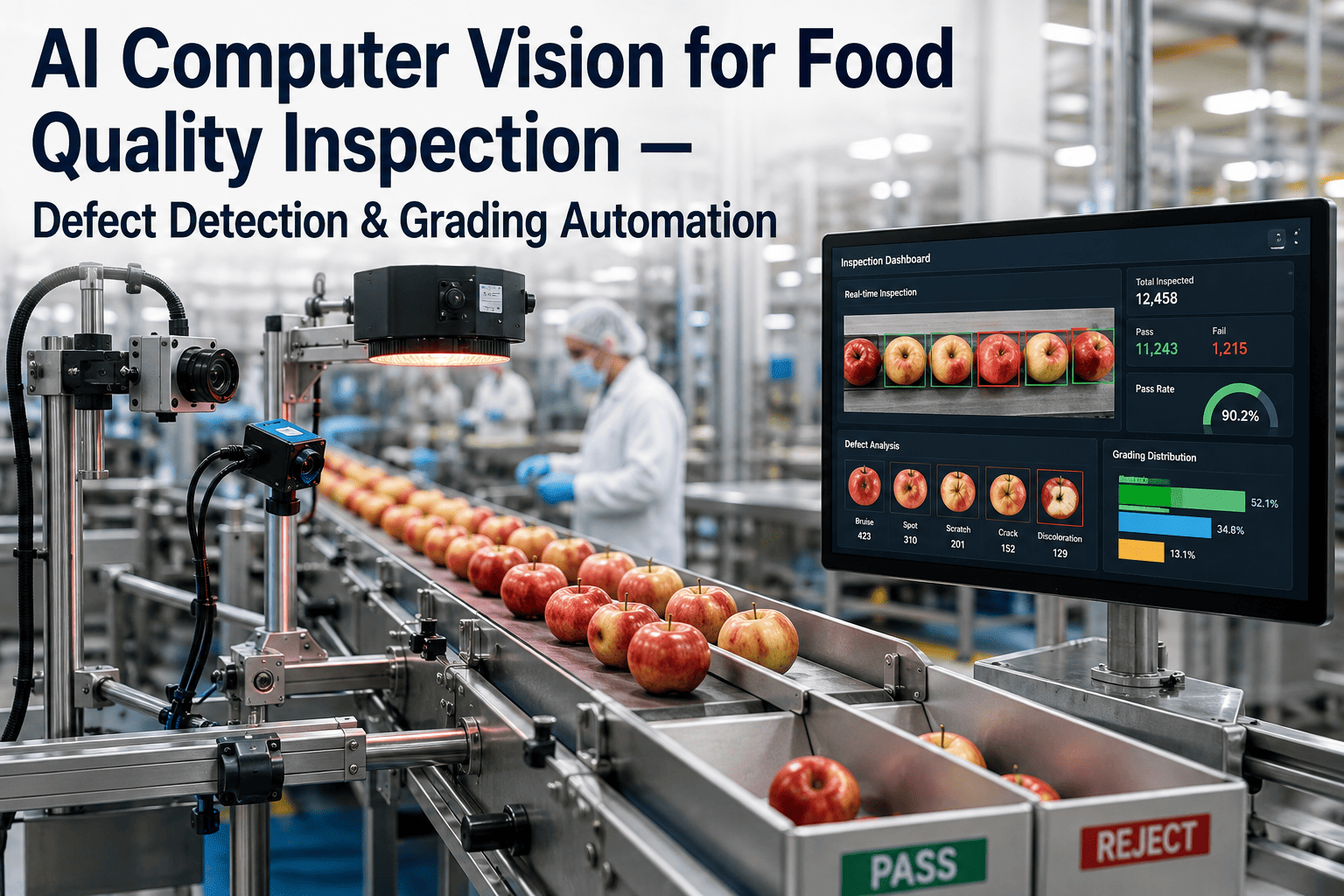
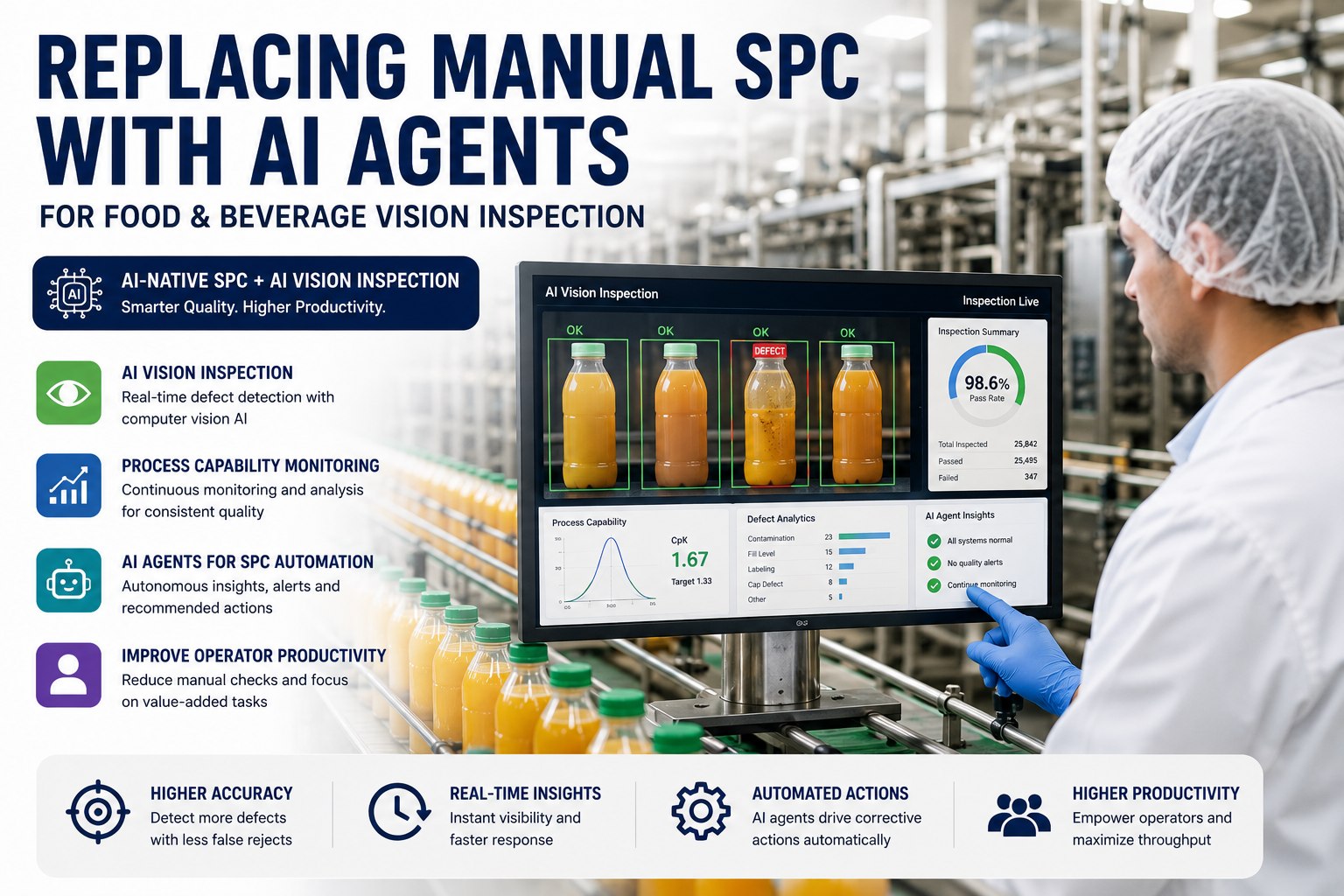
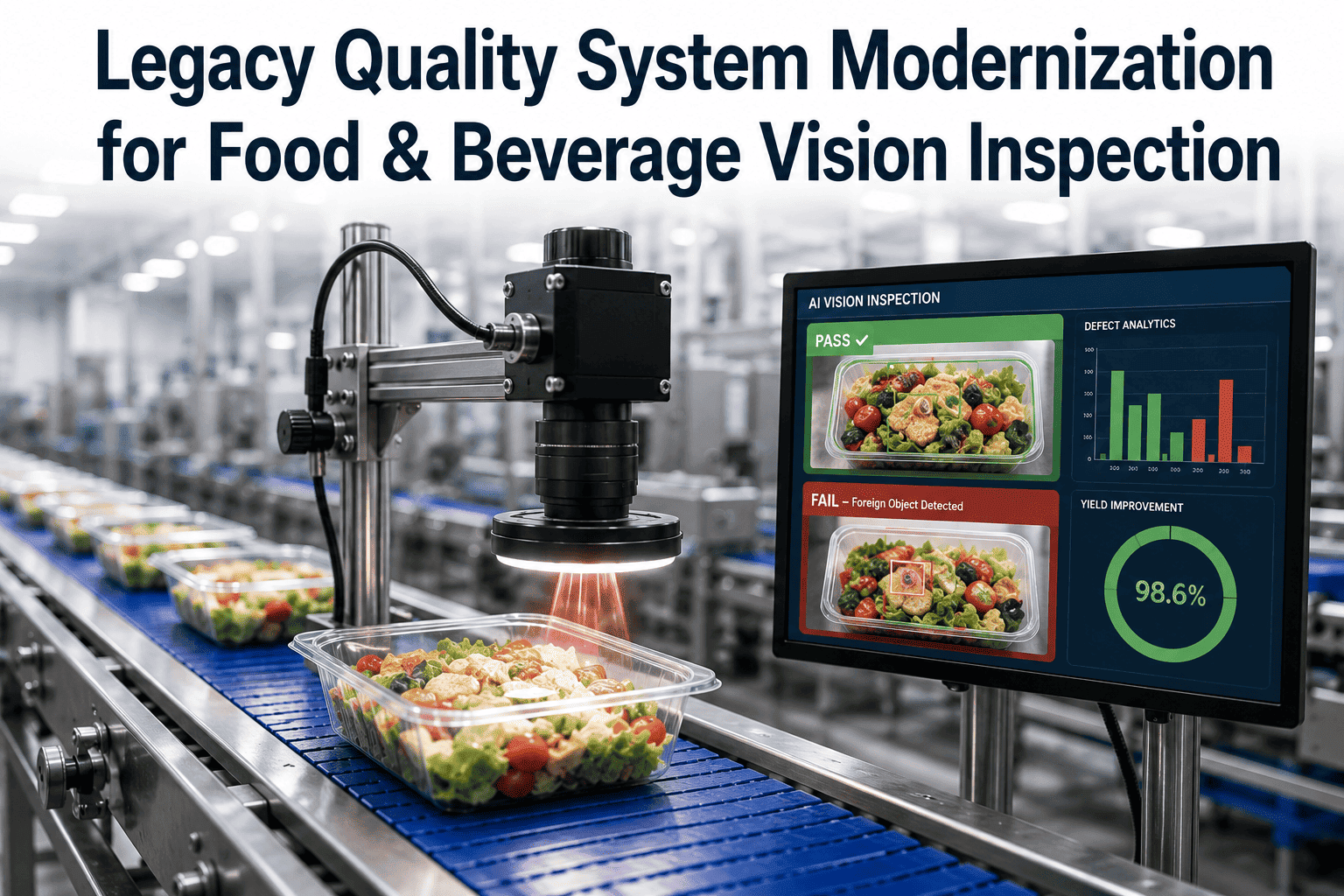
Most F&B vision systems are sold to catch defects. The breakthrough is using them as the highest-frequency stability sensor on the line. Every defect a camera flags is also a signature of process drift — a label skew traces back to web tension, a fill underweight traces back to filler valve wear. Vision-to-predictive-SPC fusion turns those signatures into 30 to 90 minute forecasts of when the next defects will occur — and prescribes the process correction before they do. Book an AI SPC migration workshop to fuse vision and predictive SPC on your lines.
AI Vision Inspection + Predictive SPC — F&B Process Stability 2026
The Vision-to-Stability Loop — Defects Become Predictions, Not Just Rejects
01
Vision Capture
IP69K cameras at line speed, sub-100ms inference per unit
→
02
Defect Signature
AI classifies defect into one of 6 taxonomy categories with confidence score
→
03
Predictive SPC Fusion
Defect signature joined with process data, drift forecast generated
→
04
Process Correction
Corrective setpoint dispatched to PLC before the next 47 defects occur
↻
Loop closes back to Vision Capture · Process re-centered · Stability sustained
99% vs 85%AI vision catch rate vs. manual inspection baseline
14×Fewer defect escapes per million units after fusion
30–90 minPredictive lead time on next defect cluster
Cpk 1.67+Process capability after vision-fed stability loop
The 6 F&B Defect Categories AI Vision Detects — and What Each Tells You
Each defect category is a fingerprint of a different process root cause. A modern AI vision system classifies defects into the six categories below — and each category routes to specific predictive SPC models that catch the upstream drift.
01
Foreign Objects
Metal fragments · Glass · Plastic · Bone · Pest matter
Root signal: Upstream contamination, equipment wear, ingredient supplier drift
02
Color & Appearance
Color shift · Burn · Browning · Texture anomaly · Surface defects
Root signal: Thermal profile drift, roast time, fermentation rate
03
Fill & Weight
Under-fill · Over-fill · Inconsistent dose · Air voids
Root signal: Filler valve wear, viscosity drift, line speed variance
04
Packaging Integrity
Seal failure · Dent · Crack · Leak · Cap misalign · Closure torque
Root signal: Sealer temperature, head pressure, packaging supplier drift
05
Label & Print
Skew · Wrinkle · Wrong label · Print quality · Date code error
Root signal: Web tension, applicator drift, label master data error
06
Dimensional
Size out-of-spec · Shape variance · Cut quality · Stack height
Root signal: Cutter wear, mold drift, line speed, ingredient hydration
Why Vision-Fed Predictive SPC Outperforms Manual Inspection & Static SAP xMII
The performance gap is not incremental — it compounds across catch rate, consistency, and the ability to predict the next defect cluster. Three approaches compared on the metrics that determine process stability.
Defect Catch Rate
AI Vision + Predictive SPC
Inter-Inspector Agreement
AI Vision + Predictive SPC
Predictive Lead Time on Next Defect Cluster
AI Vision + Predictive SPC
Want to see vision-fed predictive SPC running on your specific defect taxonomy? Book an AI SPC migration workshop — we will demo the fusion architecture on your line data.
The Vision-to-Predictive-SPC Architecture: 4 Layers, One Data Path
Vision-as-stability-sensor requires a specific architecture — not a camera bolted onto a separate SPC system. The 4-layer stack below is what disciplined deployments follow, with each layer's data feeding the next.
01
Sense Layer
Cameras + Edge AI Inference
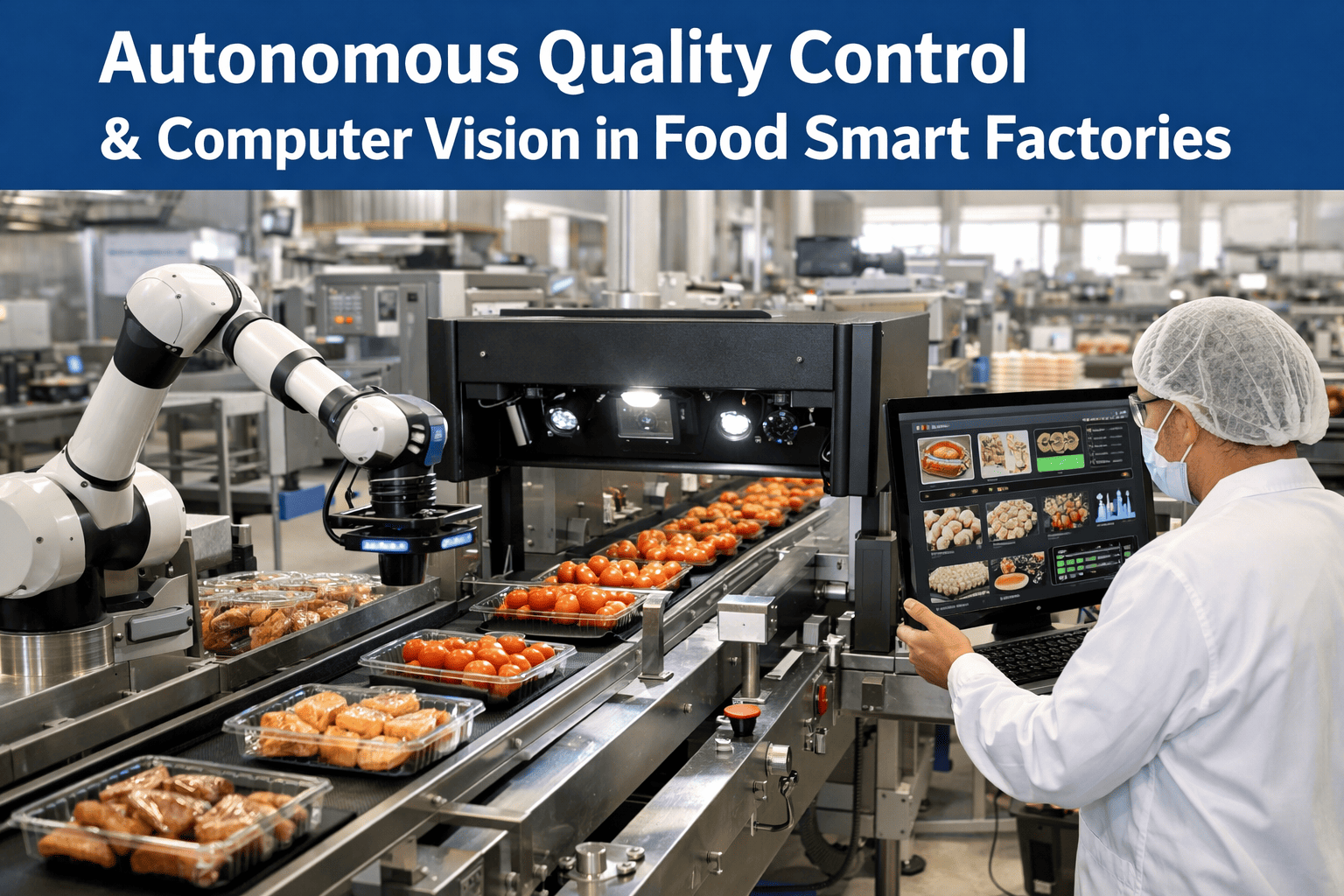
2 to 8 IP69K stainless cameras per inspection station. Edge GPUs run inference in under 100ms per unit. Only defect events and confidence scores leave the device — raw images stay local for privacy and bandwidth.
02
Classify Layer
Defect Taxonomy & Routing
Each defect tagged into one of 6 taxonomy categories with confidence score and image evidence. Routed to the predictive SPC model matched to that defect type's process roots.
03
Predict Layer
Multivariate SPC Fusion
Defect events joined with PLC process data, lab results, and recipe state. Multivariate models forecast the next 30 to 90 minutes of defect probability per category. Drift signals surfaced before defects appear.
04
Act Layer
Process Correction Dispatch
Predicted drift triggers corrective setpoint dispatch to PLCs under governance rules. Sealer temperature, filler valve trim, web tension, thermal profile — all adjusted before the next defect cluster materialises.
Stop Treating Vision as a Reject Trigger — Start Using It as a Stability Sensor
iFactory's AI SPC migration workshop maps your vision-to-SPC opportunity, demos the defect-to-prediction loop running on your specific defect taxonomy, and produces the 8 to 12 week phased migration plan that preserves SAP QM as system of record while adding vision-fed predictive intelligence.
The 8–12 Week Vision-Fed Predictive SPC Migration Roadmap
Migration is phased — never rip-and-replace. SAP xMII and QM continue running while vision-fed predictive SPC takes over the stability intelligence layer. Four phases from camera install to closed-loop live.
Wk 1–3
Camera Install & Calibration
Mount IP69K cameras and structured LED lighting per inspection station. Calibrate optics for line speed. Establish baseline defect classification accuracy at 95%+.
Wk 4–6
Defect Taxonomy Training
Train AI models on your specific defect examples per category. Validate against historical reject samples. Routing rules established per defect type.
Wk 7–9
Predictive SPC Fusion
Multivariate models join vision events with PLC data and recipe state. Validate predictive lead time accuracy. Operators see forecasts in advisory mode.
Wk 10–12
Closed-Loop Stability Live
Governance rules approved. Corrective setpoints dispatched to PLCs under defined bands. Cpk 1.67+ achieved on flagship SKU.
Expert Perspective: Why Vision Belongs in the SPC Loop — Not Bolted Beside It
The largest gain we see is not from the vision system catching more defects — it is from using the defects the vision system catches to predict the next 47. A label skew event is not just a reject. It is the highest-resolution signal we have about web tension drift, applicator wear, or label master data corruption. The plants that treat vision as a separate camera system bolted alongside SAP xMII get the catch-rate improvement but miss the stability gain. The plants that integrate vision events into the predictive SPC layer get both the catch-rate improvement and the 30 to 90 minute predictive lead time on the next defect cluster. Cpk on flagship SKUs typically moves from 0.9 to 1.67 or higher in the first 6 months. That is the difference between a quality system and a stability system.
— iFactory F&B SPC Migration Practice, Vision Inspection Architecture 2025 to 2026
0.9 → 1.67+
Cpk improvement on flagship SKU after vision-SPC fusion
37%
Typical defect reduction within 90 days of go-live
7–8 mo
Typical payback on vision-fed predictive SPC migration
Ready to fuse vision and predictive SPC for process stability gains? Talk to our F&B vision inspection team — we will design the 8 to 12 week migration plan.
Turn Every Defect Into a 30–90 Minute Stability Forecast
iFactory's AI SPC migration workshop maps your defect taxonomy, demos the vision-to-predictive-SPC loop on your specific lines, designs the 4-layer architecture, and produces the 8 to 12 week phased migration plan — preserving SAP QM and xMII while adding vision-fed stability intelligence.
Frequently Asked Questions
How is vision-fed predictive SPC different from standard AI vision inspection?
Standard vision inspection ends at defect detection — the camera flags a defective unit and triggers a reject. Vision-fed predictive SPC treats every defect event as a process drift signal, fuses it with PLC and recipe data, and forecasts the next 30 to 90 minutes of defect probability. The output is corrective setpoints dispatched to PLCs before more defects occur — not just a reject count.
Does vision-fed SPC require replacing SAP xMII or SAP QM?
No. Both SAP systems remain in production. SAP QM continues as quality system of record for compliance, certificates, and audit trail. SAP xMII continues as production data acquisition and dashboard layer. AI-native SPC inserts vision events into the predictive intelligence layer between them — adding capability without removing SAP investments.
What hardware is required for AI vision in food and beverage environments?
Typical deployments use 2 to 8 IP69K-rated stainless cameras per inspection station with structured LED lighting and edge GPU inference under 100ms per unit. IP69K rating handles washdown environments. Edge inference keeps raw images local — only defect events and confidence scores leave the device, preserving bandwidth and FSMA 204 traceability requirements.
How much process stability improvement is realistic on flagship F&B lines?
Cpk on flagship SKUs typically moves from 0.9 to 1.67 or higher within 6 months of vision-fed SPC go-live. Defect rates fall 37% in the first 90 days from improved detection alone, with the predictive layer reducing defect clusters by another 50 to 75% as the model matures. Payback typically lands at 7 to 8 months.
How does iFactory's AI SPC migration workshop work?
iFactory's workshop maps your defect taxonomy against the 6 standard F&B categories, demos vision-to-predictive-SPC fusion on your line data, designs the 4-layer architecture preserving SAP QM and xMII, identifies highest-Cpk-impact lines for first migration, and produces the 8 to 12 week phased migration plan. All delivered before any system change.
Book your migration workshop here.