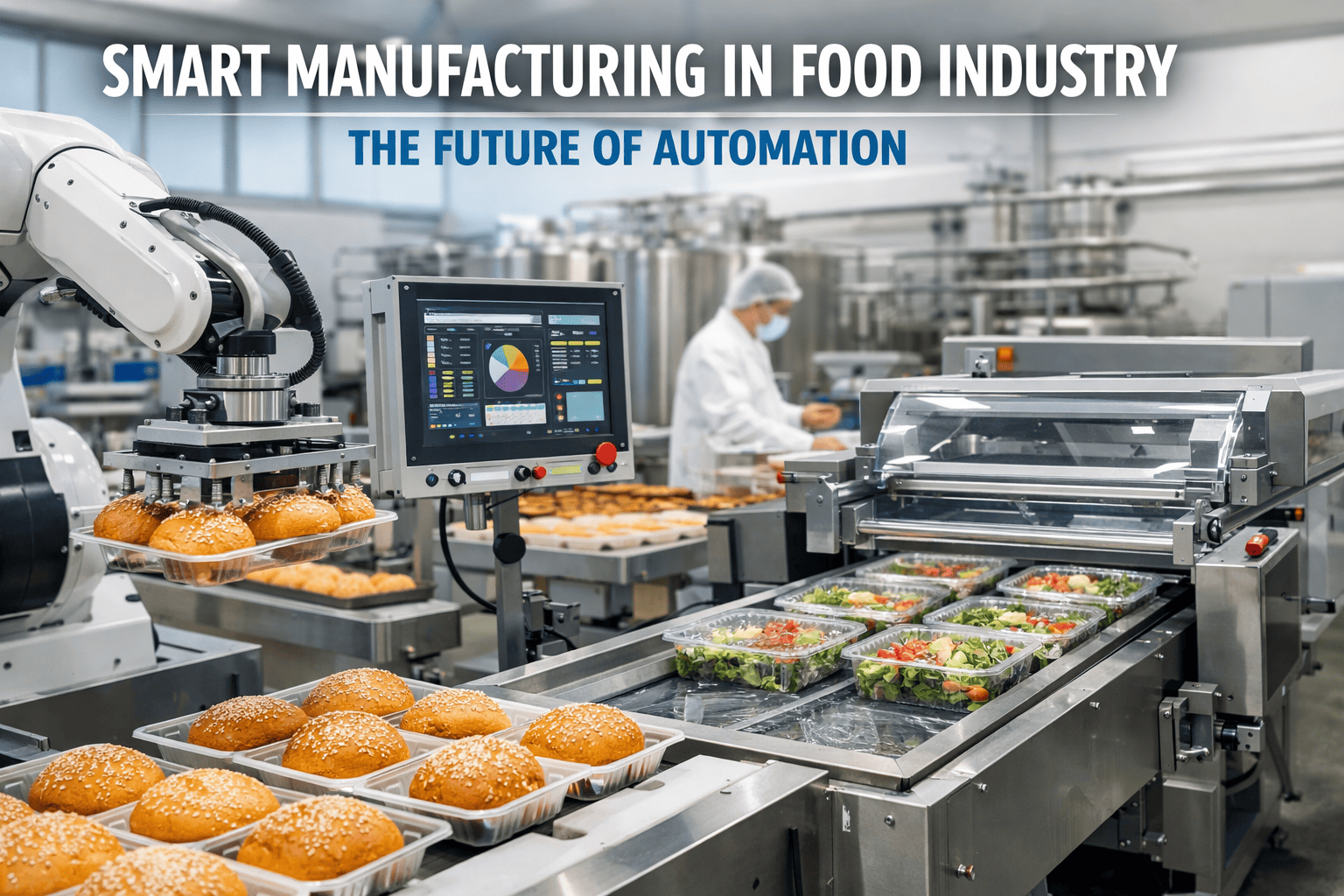
Smart Manufacturing in Food Industry: The Future of Automation

By Samuel Jones on March 7, 2026

smart-manufacturing-in-food-industry-the-future-of-automation

The global smart food manufacturing market is projected to exceed $17.2 billion by 2028, and the facilities investing now are pulling ahead by double-digit margins in yield, uptime, and compliance readiness. Smart manufacturing is no longer a pilot program for the world's largest food companies—it is a practical, deployable reality for mid-size processors, bakeries, dairy plants, and packaged goods manufacturers. This guide covers exactly what smart manufacturing means for food production in 2026, which technologies deliver the fastest ROI, and how iFactory connects the entire automation stack into a single operational intelligence platform. Sign up free to see how your facility compares to smart manufacturing benchmarks.

Smart Manufacturing in Food Industry
The Future of Food Automation Is Already Here
From AI-driven predictive maintenance and real-time OEE dashboards to automated compliance documentation and digital work orders—smart manufacturing connects every machine, every process, and every record into a single source of truth. iFactory is the platform that makes it happen.
$17.2B
Smart food manufacturing market by 2028
34%
OEE improvement with integrated smart systems
50%
Reduction in unplanned downtime at smart-enabled plants
Why Smart Manufacturing Matters Now

Food Plants Are Under Pressure from Every Direction

Margins are thinning, labor is scarce, compliance standards are rising, and retailers are demanding more flexibility with shorter lead times. Smart manufacturing addresses all four pressures simultaneously—not by adding headcount, but by making every existing resource more productive and every process more visible.

Margin Compression
Raw material costs have risen 22% since 2022 while retail pricing pressure limits pass-through. Smart manufacturing identifies waste at every stage—over-processing, energy inefficiency, yield loss, and equipment downtime—recovering 3–8% of production cost.
Workforce Shortages
The food manufacturing sector has 150,000+ unfilled positions in the U.S. alone. Automation and AI do not replace workers—they extend what smaller teams can accomplish by eliminating manual data collection, paper-based tracking, and reactive troubleshooting.
Regulatory Escalation
FSMA, SQF, BRC, and GFSI frameworks now require documented proof of process control, equipment maintenance, and environmental monitoring. Manual record-keeping cannot keep pace—smart systems generate audit-ready documentation automatically.
Retailer Demands
Major grocery chains enforce tighter delivery windows, demand full lot traceability, and penalize late or short shipments. Smart manufacturing gives food plants the real-time visibility to meet these requirements without adding buffer inventory or overtime labor.
The Smart Manufacturing Advantage
Food plants that adopt connected smart manufacturing platforms report an average 34% improvement in Overall Equipment Effectiveness (OEE), a 50% reduction in unplanned downtime, and a 25–30% decrease in total maintenance costs—all within the first 12–18 months. These gains compound: higher OEE means more output from the same equipment, fewer stops mean less spoilage and less overtime, and automated documentation means faster audits and fewer findings. The question is no longer whether smart manufacturing works in food production. The question is how much it is costing your facility to wait.
The 5 Pillars of Smart Food Manufacturing

What a Fully Connected Food Plant Actually Looks Like

Smart manufacturing is not a single technology. It is the integration of five capability layers into a unified system where data flows automatically from the shop floor to the management dashboard—and back down as optimized instructions. Sign up to see which pillars your facility has in place and where the gaps are.

01
Connected Equipment and IoT Sensors
Every critical asset—mixers, conveyors, refrigeration compressors, heat exchangers, packaging lines, boilers—is equipped with wireless IoT sensors that stream vibration, temperature, pressure, and energy data in real time. This sensor layer transforms isolated machines into a connected network where equipment health is continuously visible.
Foundation layer — all other pillars depend on this
02
AI-Powered Predictive Maintenance
Machine learning models learn each asset's unique operating signature and detect deviations weeks before failure. Instead of servicing equipment on a calendar, maintenance is triggered by actual condition—eliminating both under-maintenance (missed failures) and over-maintenance (unnecessary service). Work orders are generated automatically with fault diagnosis, parts requirements, and technician assignment.
Saves 25–30% on maintenance costs, prevents 65% of unplanned stops
03
Real-Time Production Intelligence (OEE)
Automated data capture from equipment sensors replaces manual production logging. OEE (Overall Equipment Effectiveness) is calculated in real time—breaking down availability, performance, and quality losses at the line, shift, and SKU level. Managers see exactly where production time is being lost and can intervene before the shift ends instead of reviewing reports the next morning.
Drives 15–34% OEE improvement within 12 months
04
Automated Compliance and Traceability
Every sensor reading, work order, calibration event, temperature log, and production record is automatically timestamped and stored in an audit-ready format. When SQF, BRC, or FSMA auditors request documentation, the system generates complete reports in seconds—covering CCP equipment uptime, maintenance history, environmental monitoring, and lot traceability across the entire production chain.
Eliminates manual record-keeping gaps and audit findings
05
Energy and Sustainability Optimization
Smart monitoring tracks energy consumption at the asset level—identifying motors, compressors, and heating systems operating outside efficiency parameters. Degrading equipment consumes 15–30% more energy before it fails. Catching efficiency drift early reduces both energy costs and Scope 1/2 emissions, supporting ESG reporting requirements that are becoming standard for food industry supply chain partners.
Reduces energy costs 8–15% with documented sustainability gains

Traditional vs. Smart Food Manufacturing: The Performance Gap

This comparison reflects documented outcomes from food and beverage plants that transitioned from conventional operations to integrated smart manufacturing platforms over 12–18 months.

Operational Performance Comparison
Metric Traditional Operations Smart Manufacturing Gain
Overall Equipment Effectiveness 45–55% (industry average) 70–85% +25–34 points
Unplanned Downtime 15–25 incidents/quarter 5–10 incidents/quarter 50–65% reduction
Production Yield Baseline (100%) 103–108% of baseline 3–8% improvement
Maintenance Costs Baseline (100%) 70–75% of baseline 25–30% lower
Energy per Unit Produced Baseline (100%) 85–92% of baseline 8–15% savings
Product Spoilage Rate 2–5% of production volume 0.5–1.5% of production volume 60–70% reduction
Audit Preparation Time 40–80 hours per audit cycle 2–4 hours (automated reports) 95% time savings
Changeover Time Operator-dependent, variable Data-optimized, standardized 20–30% faster
See Smart Manufacturing in Action
Watch iFactory Connect a Real Food Plant's Equipment, Maintenance, and Compliance in One Dashboard
Our 30-minute demo walks through a live food manufacturing facility—showing real-time OEE tracking, predictive maintenance alerts, automated work orders, and the compliance documentation trail that auditors require. No slides. Real data.
Key Technologies Driving Food Automation

The Technology Stack Behind Smart Food Plants

Smart manufacturing combines multiple technology layers into an integrated system. Here are the six technologies delivering the highest ROI in food manufacturing environments today.

Industrial IoT Sensors
Food-grade wireless sensors (IP67/IP69K rated) capture vibration, temperature, humidity, pressure, and energy data from every critical asset. Battery-powered or wired, they install in minutes without equipment modification and feed data to the central platform continuously.
Edge Computing
On-premise edge devices process sensor data locally, enabling sub-second alert responses without cloud latency. Critical for food plants where refrigeration alarms and safety interlocks require immediate reaction—especially during nights, weekends, and skeleton-crew shifts.
Machine Learning Models
AI builds unique behavioral baselines for each asset in your specific environment—learning seasonal patterns, product changeovers, CIP cycles, and ambient conditions. Anomaly detection accuracy improves over time, reducing false alarms while catching real degradation signals earlier.
Real-Time Dashboards
Centralized dashboards display OEE, asset health scores, active alerts, work order status, and energy consumption across all lines and sites. Managers make data-driven decisions in minutes that previously required hours of manual report compilation.
Digital Work Orders
Paper-based maintenance logs and spreadsheet tracking are replaced by digital work orders automatically generated from AI alerts. Each order includes fault diagnosis, required parts, safety procedures, and assigned technician—with full timestamped audit trail for compliance documentation.
Energy Monitoring
Asset-level energy metering identifies equipment running outside efficiency parameters. Degrading motors, fouled heat exchangers, and cycling compressors waste 15–30% more energy before they fail. Catching drift early reduces both utility costs and carbon footprint.

Smart Manufacturing ROI: What the Numbers Look Like

These figures represent documented results from food and beverage manufacturing facilities operating on integrated smart manufacturing platforms for 12 months or more.

34%
Average OEE improvement across connected lines
50%
Reduction in unplanned downtime events
30%
Maintenance cost reduction in year one
60%
Reduction in product spoilage linked to equipment failure
Sign up free and benchmark your facility against these numbers. Most plants identify their first optimization opportunity within the first 30 days of connecting equipment.

Smart Manufacturing Use Cases Across Food Sectors

Smart manufacturing applies to every food processing environment. Here is how the technology delivers value across specific sectors.

Dairy Processing
Pasteurizer efficiency monitoring, cold chain integrity tracking, CIP cycle optimization, and real-time documentation of temperature compliance across all processing stages. AI detects heat exchanger fouling and compressor degradation weeks before food safety thresholds are breached.
Result: 85% fewer spoilage events, 40% faster audit preparation
Bakery and Snack Production
Oven temperature uniformity monitoring, mixer and divider health tracking, conveyor belt alignment detection, and packaging line OEE optimization. Smart systems identify under-performing ovens, uneven product distribution, and seal integrity degradation before quality defects reach customers.
Result: 5–8% yield improvement, 30% reduction in quality holds
Meat and Poultry Processing
Refrigeration system monitoring across receiving, processing, and storage. Automated HACCP documentation for CCP equipment uptime. Conveyor and cutting equipment vibration analysis. Water and energy consumption tracking per production run for sustainability reporting.
Result: 50% fewer unplanned cold chain interruptions
Beverage Manufacturing
Filling line speed optimization, carbonation system monitoring, bottle/can inspection integration, and CIP chemical usage tracking. Real-time OEE dashboards identify micro-stops and speed losses that accumulate into hours of lost throughput per week across high-speed filling lines.
Result: 20–34% OEE improvement on filling lines
We were a classic example of a food plant that had good equipment but no visibility. We knew our OEE was somewhere around 52% but could not pinpoint why. Within three months of deploying iFactory, we could see exactly where time was being lost—changeover inefficiencies, micro-stops on our packaging line, and a mixer gearbox that was slowly degrading. We hit 74% OEE by month eight and avoided a $160,000 mixer failure that the AI caught 38 days early. The compliance documentation alone would have justified the investment—our last SQF audit took 3 hours of prep instead of three weeks.
Plant Manager Frozen Foods Processing, Pacific Northwest — 185,000 sq ft, 2-shift operation
Getting Started

Your Path to Smart Manufacturing in 4 Steps

Most food plants do not need to transform overnight. The highest-ROI approach starts small, proves value fast, and expands from documented results.

1
Connect Your 3–5 Most Critical Assets
Start with the equipment whose failure causes the most downtime and the highest cost—typically refrigeration compressors, main production line conveyors, and primary mixing equipment. Sensor installation takes hours, not weeks, and requires zero production interruption.
Outcome: Real-time equipment visibility from day one
2
Establish AI Baselines and Activate Alerts
The AI builds unique behavioral models for each connected asset within 2–4 weeks of continuous data. Once baselines are established, anomaly detection activates automatically—flagging deviations with predicted failure modes and recommended interventions.
Outcome: First predictive alerts within 30 days
3
Automate Work Orders and Compliance Docs
Connect AI alerts to your maintenance workflow. Critical anomalies automatically generate work orders with fault diagnosis, required parts, and technician assignment. Every action is timestamped for audit-ready compliance documentation—no manual data entry required.
Outcome: Zero-delay maintenance response, complete audit trail
4
Expand Across Lines, Sites, and Capabilities
Once ROI is documented on initial assets, expand sensor coverage to auxiliary equipment, add OEE tracking to additional lines, and integrate energy monitoring. Most food plants reach full smart manufacturing maturity within 12–18 months using this phased approach.
Outcome: Full facility intelligence and continuous improvement

Transform Your Food Plant This Quarter

iFactory — The Smart Manufacturing Platform Built for Food Production

iFactory gives food manufacturers a single platform that connects equipment monitoring, predictive maintenance, OEE tracking, work order automation, and compliance documentation into one unified system. No rip-and-replace. No 18-month implementation. Connect your first assets in under 10 minutes and start generating the data that drives 34% OEE improvements and 30% maintenance cost reductions.
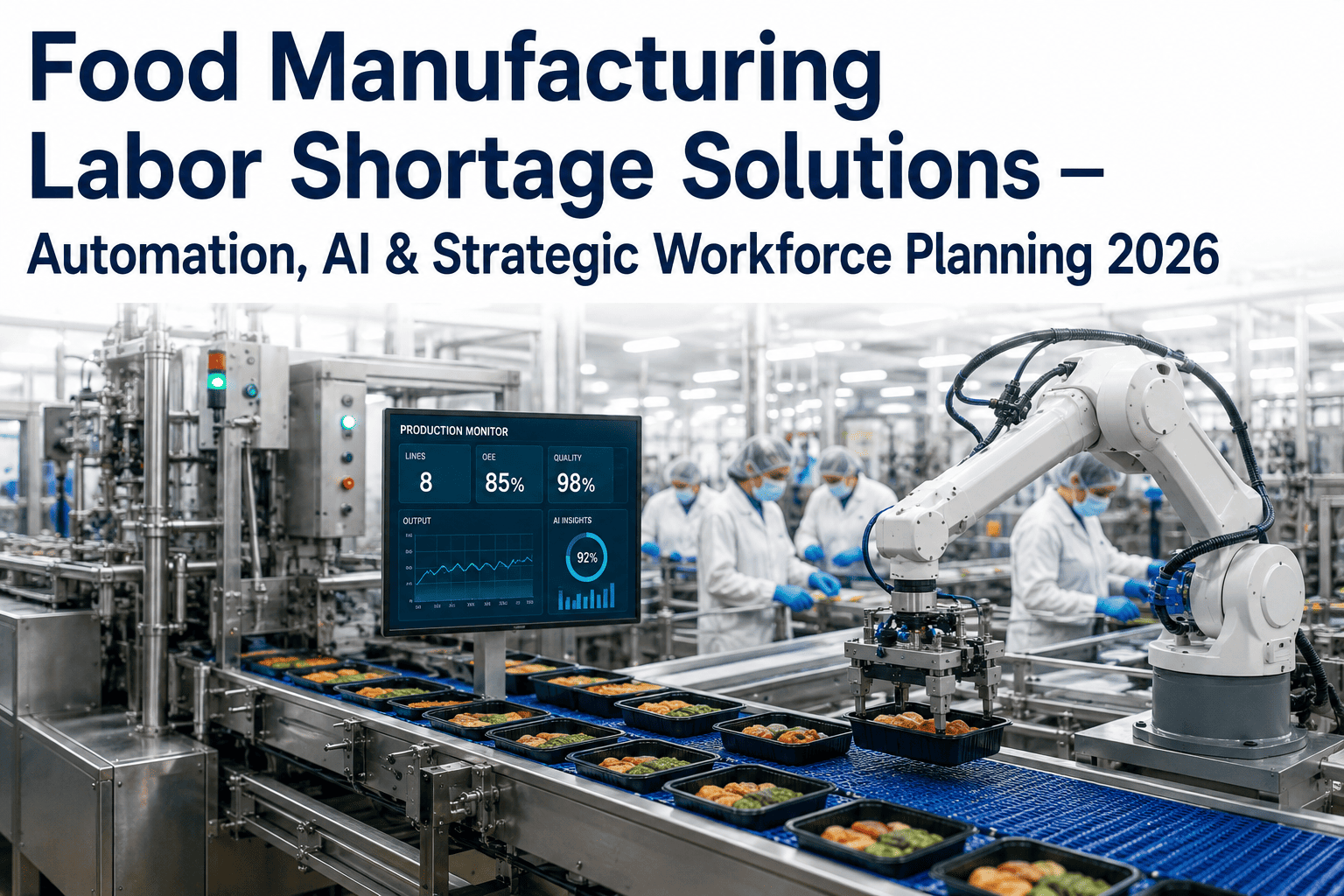
AI predictive maintenance across all connected food plant assets
Real-time OEE dashboards by line, shift, and product
Automated FSMA/SQF/BRC compliance documentation
Energy monitoring and ESG reporting for supply chain partners

Frequently Asked Questions

What does "smart manufacturing" actually mean for a food plant?
Smart manufacturing means connecting your equipment, processes, and records into a unified digital system where data flows automatically. In practical terms, it means every critical machine reports its health in real time, maintenance is triggered by actual condition instead of calendar schedules, production performance is measured continuously (not estimated), and compliance documentation generates itself. It is not about robots replacing people—it is about giving your existing team complete visibility and automated workflows.
How much does it cost to implement smart manufacturing in a food facility?
Implementation costs vary by facility size and scope, but the phased approach most food plants use starts at a fraction of what a single major equipment failure costs. Starting with 3–5 critical assets and expanding based on proven ROI keeps initial investment low while generating savings from month one. Most facilities achieve full payback within 7–9 months. Sign up free to get a customized ROI projection for your facility.
Do we need to replace our existing equipment to go smart?
No. Smart manufacturing platforms like iFactory are designed to connect to your existing equipment—not replace it. Wireless IoT sensors retrofit onto any motor, compressor, conveyor, or processing unit regardless of age, brand, or manufacturer. The platform also integrates with your existing CMMS, ERP, and SCADA systems through standard API connections. There is no rip-and-replace required.
How does smart manufacturing help with food safety compliance?
Every sensor reading, equipment alert, work order, calibration event, and technician action is automatically timestamped and stored in an audit-ready format. When FSMA, SQF, or BRC auditors request maintenance records, CCP equipment uptime proof, or environmental monitoring data, the system generates complete documentation in seconds. This eliminates the manual record-keeping gaps that are the most common source of audit findings in food plants. Sign up to see how automated compliance documentation works for your facility.
Can a mid-size food plant benefit from smart manufacturing, or is it only for large operations?
Mid-size food plants often see the highest relative ROI from smart manufacturing because they operate with tighter margins and smaller maintenance teams. A single prevented refrigeration failure or a 5% yield improvement generates outsized financial impact when the plant cannot absorb losses the way a multi-billion-dollar operation can. The phased implementation approach makes smart manufacturing accessible to facilities of any size.
How long before we see measurable results?
Most food plants identify their first measurable improvement within 30–45 days of connecting equipment. Quick wins typically come from discovering over-maintained assets, catching early-stage equipment anomalies, and quantifying production losses that were previously invisible. Full smart manufacturing maturity—with integrated predictive maintenance, OEE tracking, and automated compliance—typically develops over 12–18 months through phased expansion. Book a demo to see a realistic timeline for your facility.

Share This Story, Choose Your Platform!