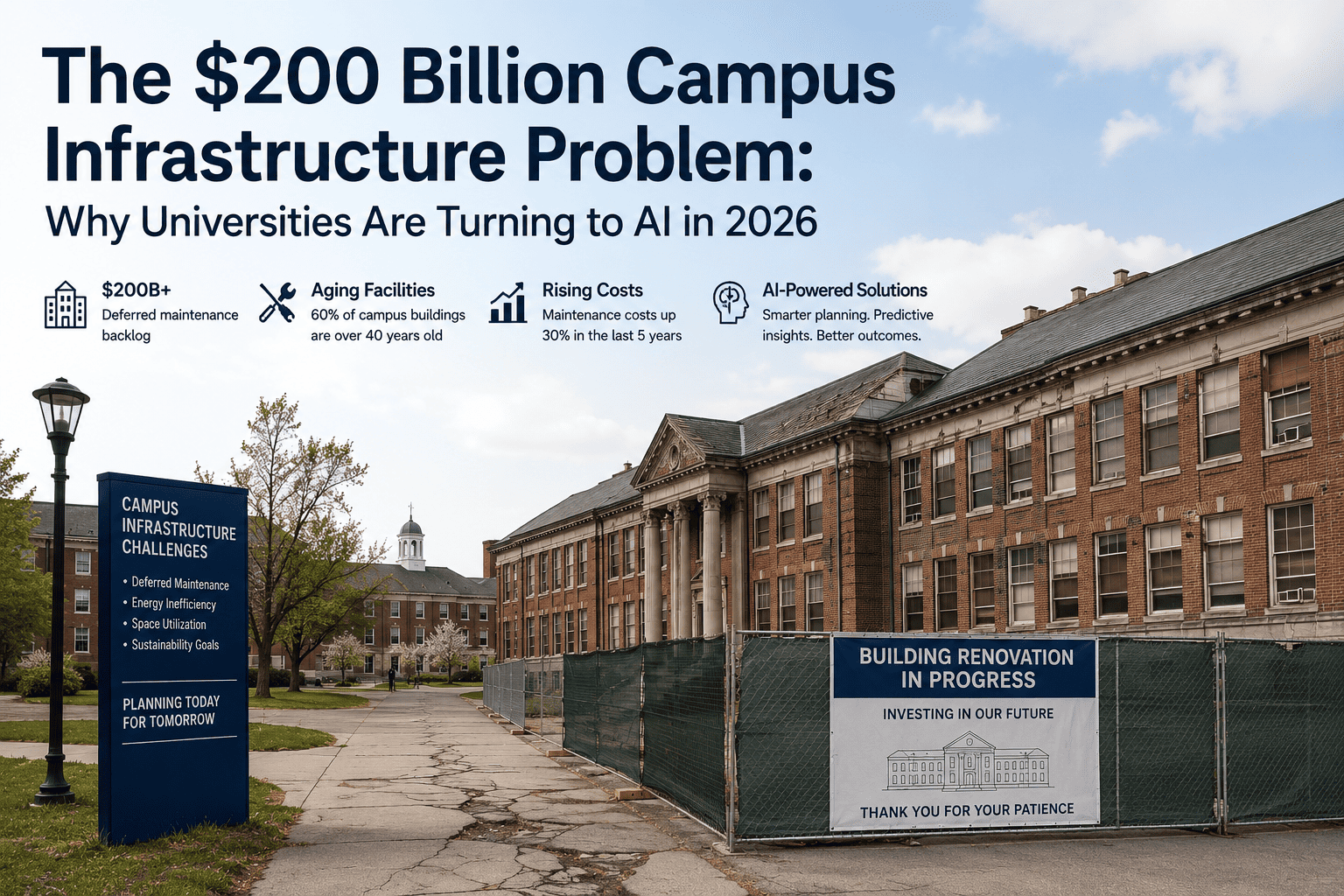
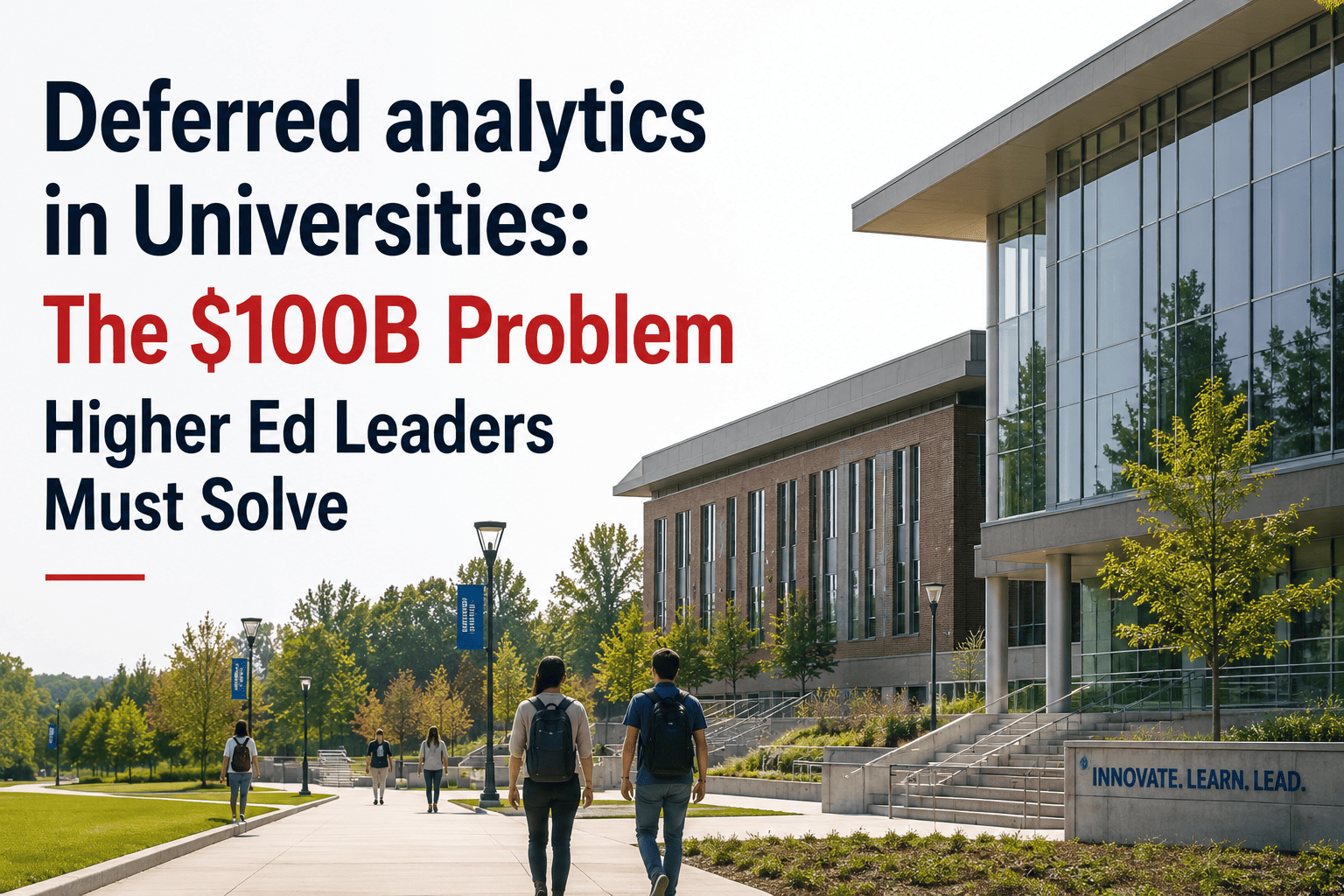
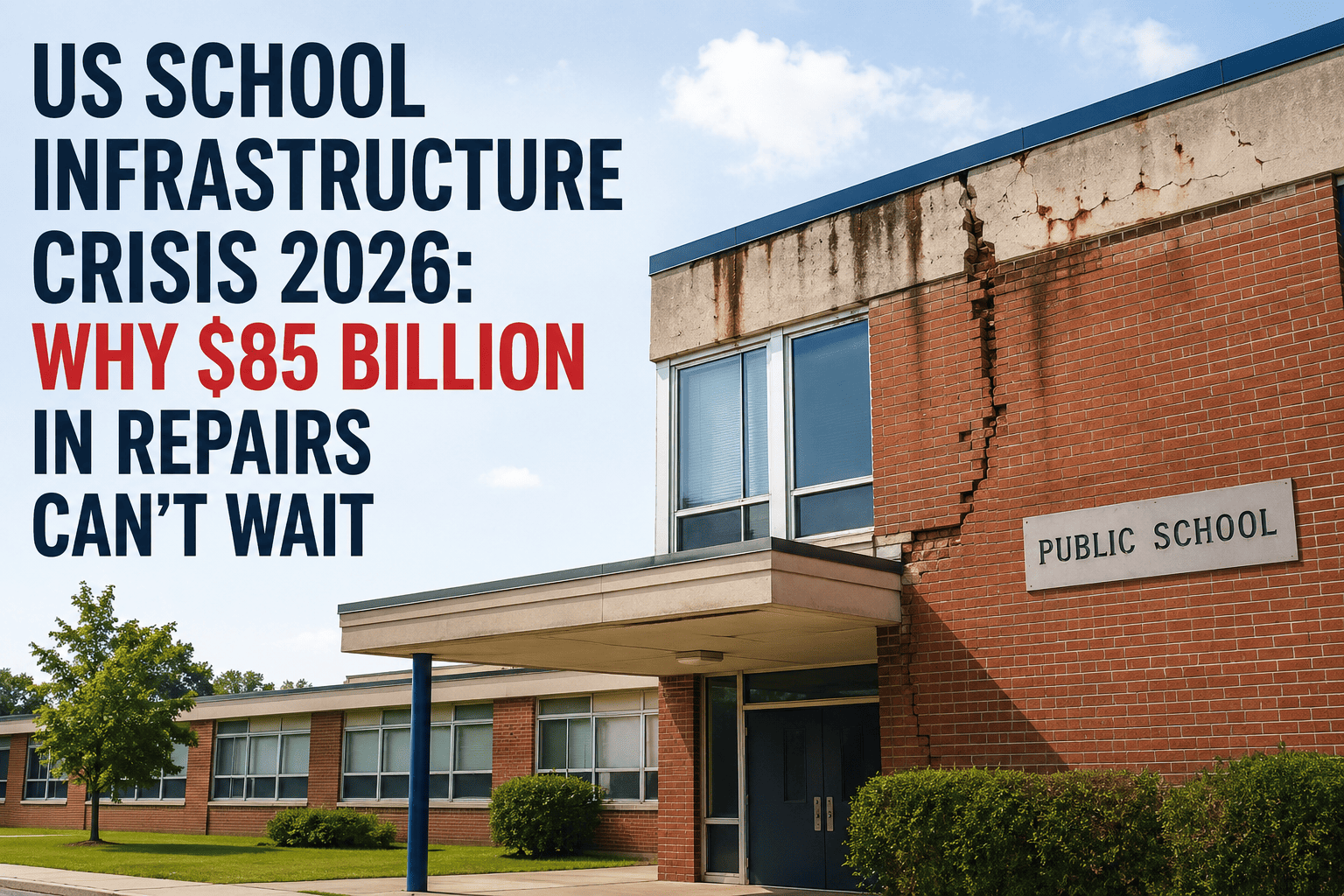
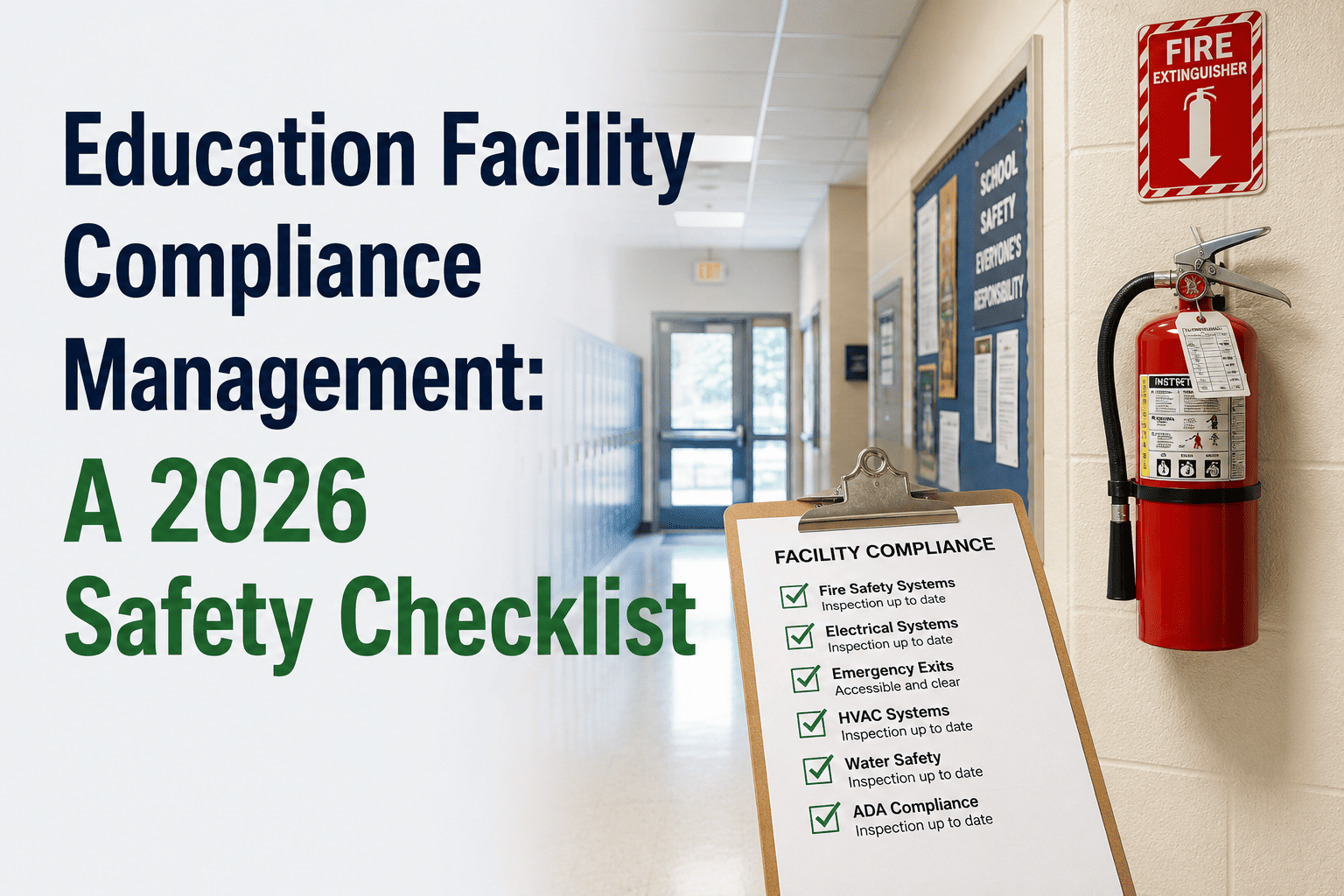
The $200 Billion Campus Infrastructure Problem: Why Universities Are Turning to AI in 2026
By Alfred on May 27, 2026
The deferred maintenance backlog across U.S. higher education has crossed $200 billion. Gordian's 2026 report: $156 per sq ft, up 8% year-over-year, while funding covers only 73.5% of need. Average campus: 53 years old, HVAC and infrastructure past design life. Moody's flags deferred maintenance negatively. 2026 enrollment cliff compresses revenue as costs accelerate. Institutions closing the gap use better data — not more money. Book a demo to see how iFactory breaks the deferral cycle.
Industry Authority Report — Higher Education 2026
The $200 Billion Campus Infrastructure Problem: Why Universities Are Turning to AI in 2026
$156/sq ft deferred burden · 8% annual backlog growth · 53-yr avg building age · 2026 enrollment cliff · Moody's credit flag · Funding covers 73.5% of need · AI predictive maintenance · FCI capital planning.
Per sq ft deferred burden — 8% YoY increase per Gordian 2026
73.5%
Funding coverage — institutions fall 26.5% short of what is needed
53 Yrs
Average campus building age — most major systems past design life
6–8%
Annual backlog growth vs 2–3% budget growth — gap widens every year
The Scale of the Problem: What $200 Billion Actually Means
$200B+
Total estimated deferred maintenance across U.S. higher education
Gordian's database of 43,000 campus buildings documents $156 per gross square foot — 8% increase over prior year. Across 15 billion gross square feet, total exceeds $200 billion.
$11.4M
Added to the average university's backlog every single year
Without a systematic capital renewal programme, the average university adds $11.4 million annually. Equipment from 1975 runs on hope rather than lifecycle data — and failures are discovered on the worst possible day.
Top 3
Ranking of facility quality in student enrollment decisions in 2026
The 2026 enrollment cliff means fewer students and greater competition. Facility quality ranks top-3 in enrollment decisions. Deteriorating campuses lose students to better-maintained competitors.
Negative
Moody's credit indicator for institutions with high deferred maintenance ratios
Moody's flags growing deferred maintenance as a negative credit signal — an unfunded liability. Institutions with FCI data and capital plans demonstrate the stewardship that supports favorable ratings.
Four Forces Compounding the Crisis
Funding Growth vs Backlog Growth: The Math Doesn't Work
Budgets grow 2–3% annually. Backlog grows 6–8%. The gap widens every year without AI-driven prioritization to address the structural imbalance.
Force 1
Buildings Older Than the Equipment Standards They Were Designed For
Average campus building: 53 years old. HVAC design life: 15–25 years. One-third of buildings are over 50 — every major system past intended lifespan.
Force 2
The Workforce Knowledge Cliff Mirrors the Enrollment Cliff
Median craft worker age: 54. Over half between 50–65. When a 28-year chief engineer retires, knowledge of every system leaves with them.
Force 3
Capital Requests Without Data Are Denied — Or Never Made
Boards approve documented evidence, not anecdotes. "Building C HVAC is old" loses to enrollment data requests. FCI scores and cost-of-deferral projections change the equation.
FCI 0.34, deferral cost $1.4M vs replacement $380K
Energy waste
30–50% over-consumption, invisible
Asset-level anomaly detection
Knowledge retention
28-year engineer retires — knowledge gone
Failure histories encoded permanently
Bond / credit rating
Undocumented backlog flags as credit risk
FCI trend data supports favorable ratings
Multi-campus view
12 spreadsheets, no portfolio benchmark
One platform, one FCI methodology
How iFactory Addresses Each Dimension
AI 01
Predictive Maintenance · Stop Discovering Failures on the Worst Day
Before: Reactive · After: Predictive
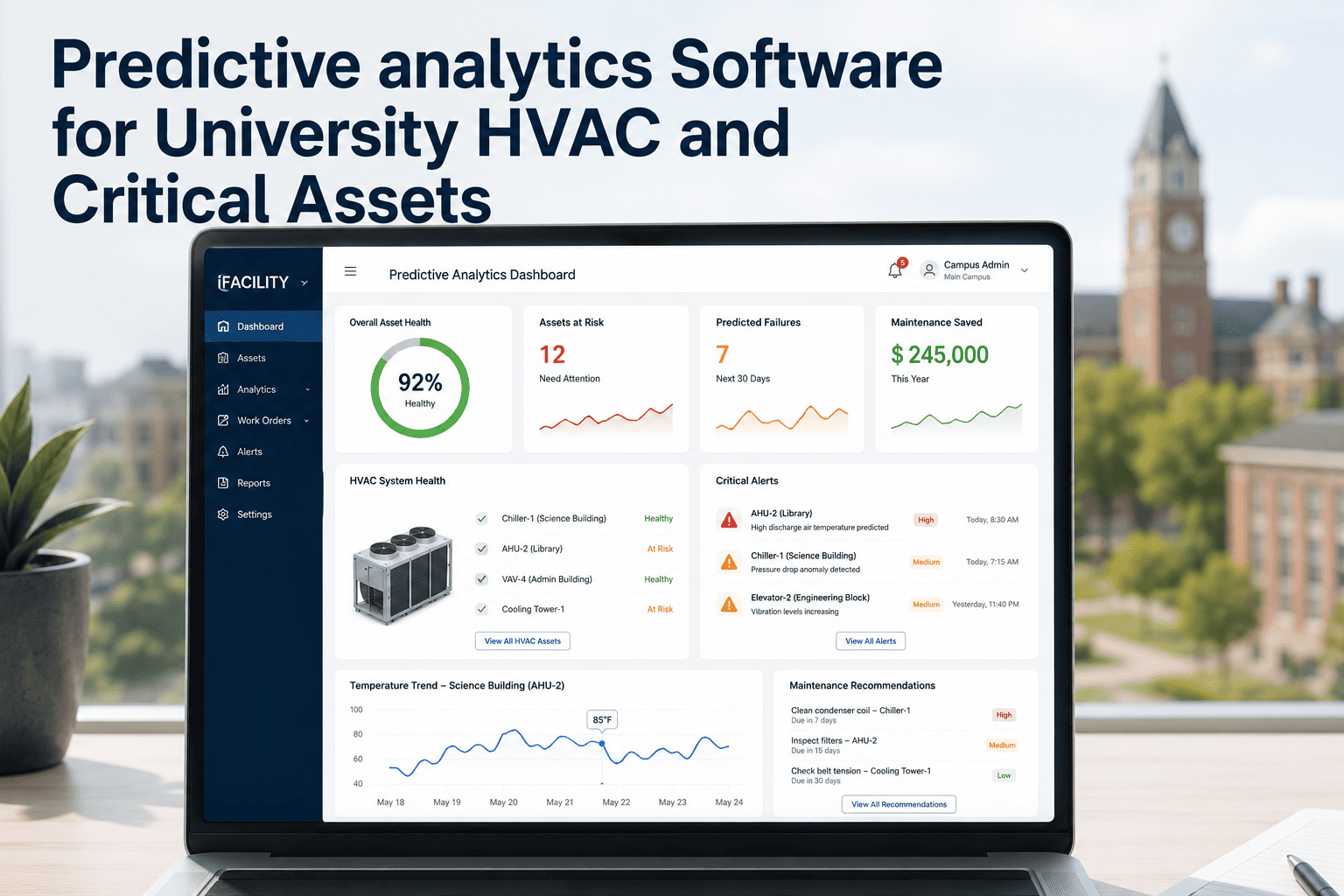
iFactory monitors equipment through IoT sensors, telemetry, and maintenance history — flagging assets weeks before breakdown. A chiller caught predictively: $38,500 planned. Same failure during finals: $134,000 emergency. Alerts reach the team and director simultaneously.
Signal typeVibration, temp, run-hours, energy draw
Facility Condition Index · Evidence That Gets Capital Approved
Before: Anecdote · After: FCI Data
iFactory calculates FCI per building from live work orders, inspections, and condition scores — APPA-aligned methodology boards and rating agencies recognize. Cost-of-deferral projections turn anecdote into evidence: "deferring Building C HVAC 24 months adds $940,000." Capital requests built on data compete differently. Contact iFactory about an FCI baseline for your portfolio.
Energy Intelligence · Address the 30–50% Waste in Aging Buildings
Before: Aggregate bill · After: Asset-level detection
Energy is the second-largest education facilities expense after personnel — $14 billion annually across U.S. higher education. Degraded systems running past design life consume 30–50% more than specified, invisible at aggregate bill level. iFactory detects building-level anomalies — simultaneous heating and cooling, stuck valves, HVAC overrun — at the asset level before they compound across the semester.
Knowledge Retention · Encode Institutional Memory Before It Retires
Before: In people's heads · After: In the platform
The median age of skilled campus craft workers is 54. When a chief engineer with 28 years of institutional knowledge retires, that knowledge disappears unless encoded. iFactory's asset records, failure histories, and PM logs encode equipment intelligence permanently — new technicians inherit the history of every asset, and cross-campus pattern matching grows the institution's intelligence over time.
Knowledge captureFailure modes, quirks, notes per asset
ContinuitySurvives retirements and turnover
The Infrastructure Problem Has Three Timelines
IMMEDIATE · This Semester
Stop paying emergency rates
Predictive maintenance catches failures weeks ahead — emergency procurement at 3–4× cost is the most avoidable budget drain.
Predictive maintenance
MEDIUM TERM · This Budget Cycle
Win the capital you need
FCI data gives boards evidence they approve. Data-backed requests win over anecdote.
FCI capital planning
LONG TERM · Institutional Survival
Compete for the enrollment cliff cohort
Facility quality is a top-3 enrollment factor. Improving FCI scores demonstrate the campus quality prospective students respond to.
Enrollment competitiveness
FAQ: AI Solutions for the Campus Crisis
Gordian's 2026 State of Facilities report documents $156 per gross square foot in deferred capital renewal across its database of 43,000 campus buildings. Applied to approximately 15 billion gross square feet of U.S. higher-education space, the total exceeds $200 billion. Gordian's figure is an 8% increase over the prior year. APPA's widely cited $112 billion covers a narrower institutional scope. Both are estimates of a target growing 6–8% annually. Book a demo to see how iFactory tracks your backlog.
Three mechanisms: converts emergency repairs (3–4× cost) into planned work at normal cost; extends asset life by catching degradation before irreversible failure; and generates FCI and condition data that makes capital requests boardroom-defensible — how institutions secure funding to address the backlog. AI changes the growth trajectory from 6–8% annually to a rate planned budgets can address.
Moody's assesses: documented FCI data showing systematic condition tracking; a capital renewal programme with reserved funding; a trend line showing whether the backlog is growing or declining; and reactive-to-planned spend ratio as an operational discipline signal. Undocumented or growing backlogs signal fiscal weakness. iFactory's FCI outputs and capital planning exports are formatted to support the documentation credit reviews require.
Both. Crisis institutions prioritize predictive maintenance, FCI baseline generation, and reactive-to-planned ratio tracking — live within weeks. Institutions ahead add capital forecasting and energy monitoring. First step: a documented asset baseline. Book a 30-minute call about where your institution sits.
Get Your Campus Infrastructure Intelligence Baseline
Predictive maintenance. FCI capital planning. Energy anomaly detection. Cross-campus AI. One platform — built for institutions that cannot afford another year of 6–8% backlog growth.