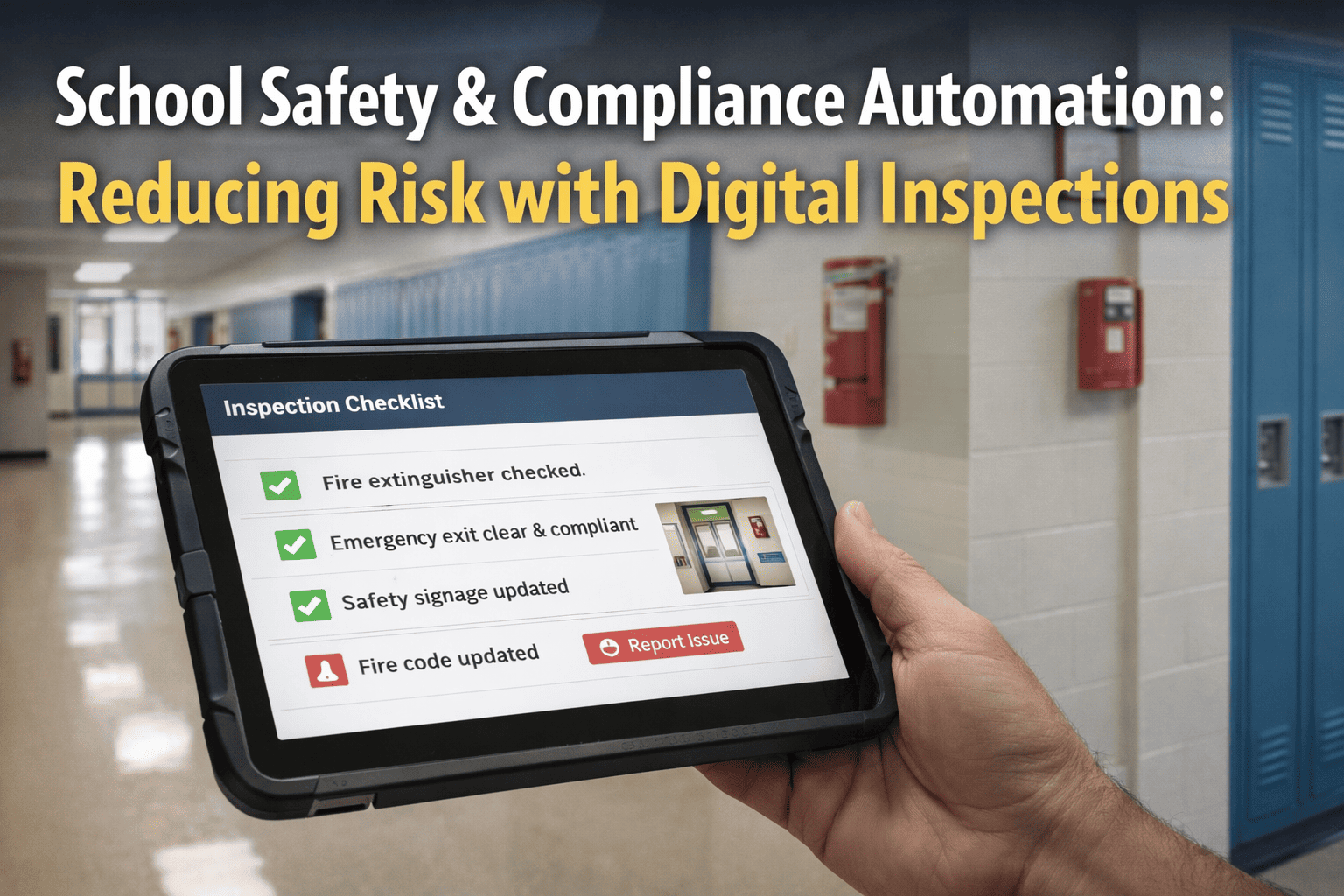
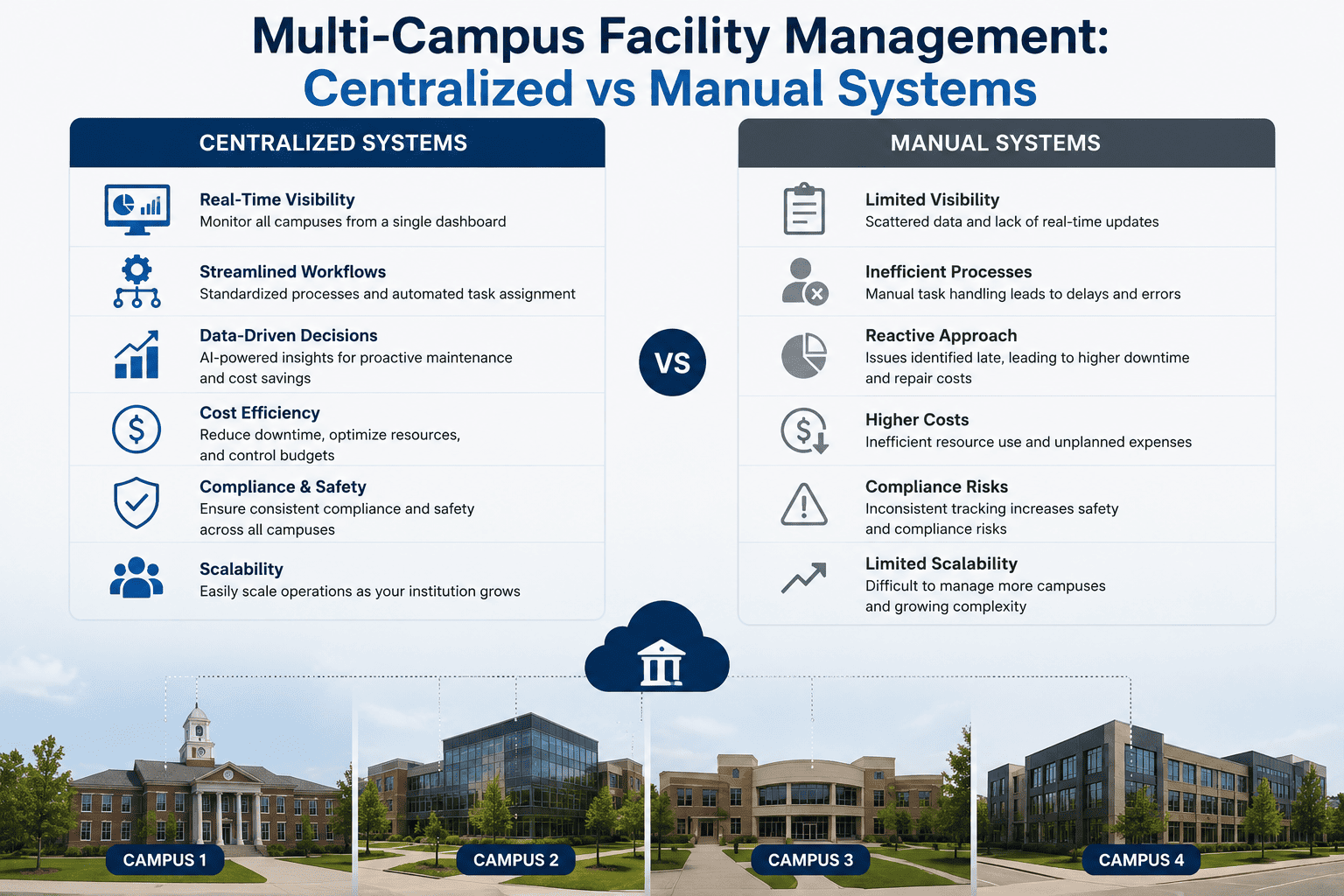
Every school district and university campus in 2026 operates under a compliance framework that has never been more demanding. Fire safety inspections, electrical audits, IAQ testing, ADA reviews, OSHA heat illness documentation, and EPA chemical reporting are continuous operational requirements with penalty structures, accreditation consequences, and credit rating implications that compound every quarter a gap goes undocumented. Institutions still managing compliance through spreadsheets and paper logs are structurally exposed. A single missed fire inspection or undocumented HVAC cycle discovered during an accreditation visit triggers corrective action timelines and legal liability far exceeding the cost of the infrastructure that would have prevented it. Book a Demo to see how AI-driven compliance eliminates this exposure across your entire campus.
EDUCATION INDUSTRY · COMPLIANCE MANAGEMENT · 2026 SAFETY GUIDE
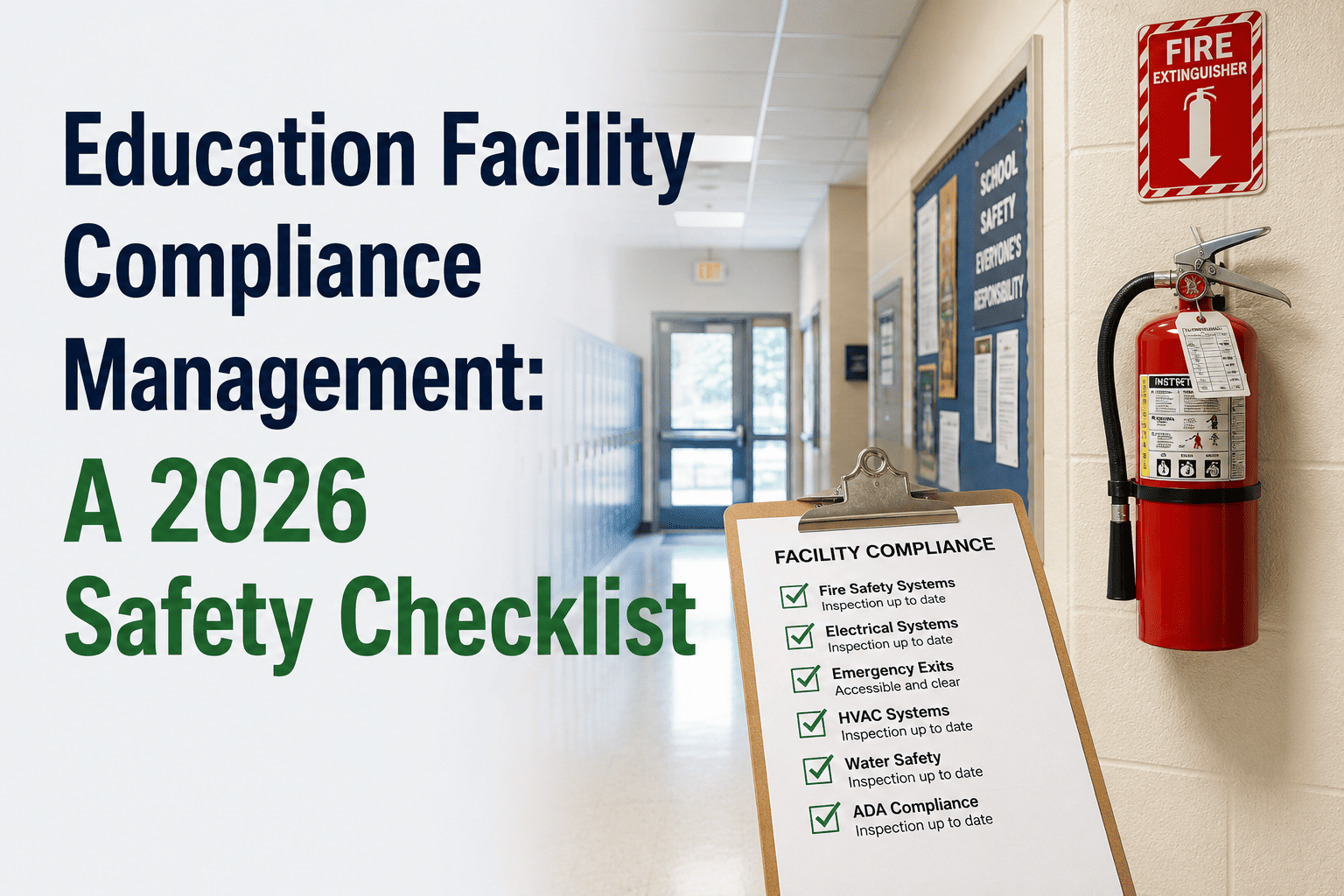
Education Facility Compliance Management: A 2026 Safety Checklist
Ensure fire safety, electrical compliance, and inspection readiness with digital compliance management for K-12 districts and universities operating under real audit, accreditation, and regulatory pressure in 2026.
12+Compliance Frameworks Per Campus
87%Reporting Hours Saved
ZeroAudit Deficiencies After Deployment
100%Documentation Always Export-Ready
The 2026 Compliance Landscape for Education Facilities
Federal agencies have introduced new documentation requirements, state oversight bodies have tightened inspection mandates, and accreditation organizations have elevated facility condition standards entering 2026. The challenge for most institutions is not awareness of requirements. It is the operational capacity to document compliance across hundreds of buildings and dozens of overlapping frameworks simultaneously. When compliance relies on manual processes, gaps are discovered by auditors at the worst possible moment, not proactively. Book a Demo to map your institution's posture against 2026 requirements.
Applicable InstitutionsK-12 public and private districts, community colleges, four-year universities, and multi-campus systems
Primary FrameworksOSHA, EPA, NFPA, IBC, ADA, state fire codes, accreditation standards, Clery Act
New 2026 RequirementsOSHA Heat Illness Prevention rule, expanded EPA lead and IAQ testing, enhanced accreditation facility benchmarks
Consequence of GapsRegulatory penalties, corrective action timelines, accreditation risk, credit rating impact, enrollment disruption
SolutionAI-driven compliance platform with automated tracking, inspection scheduling, and audit-ready reporting
Documented OutcomeZero audit deficiencies, 87% reporting hour reduction, corrective action closed 6 months ahead of deadline
The 2026 Education Facility Compliance Safety Checklist
The checklist below covers every major compliance domain applicable to K-12 and higher education facilities in 2026. Institutions using digital compliance management platforms track every item automatically. Institutions relying on manual systems face structural gaps in one or more categories at any given time.
Annual sprinkler system inspection per NFPA 25. Wet, dry, and pre-action systems require annual inspection with quarterly visual checks in all occupied spaces. Test results retained minimum three years.
Fire alarm and detection system testing per NFPA 72. Full device testing annually, semi-annual initiating device functional tests, and notification appliance verification across all campus zones.
Fire extinguisher inspection monthly visual checks, annual maintenance per NFPA 10. All inspections logged with inspector credentials and findings documented per unit location.
Emergency egress and exit lighting monthly functional tests, annual 90-minute battery test. All deficiencies and corrective actions documented within 72 hours of identification.
Fire door inspection annual inspection of all fire-rated assemblies per NFPA 80 including latching, closing, and gap measurement. Universities with dormitories face heightened enforcement frequency.
Electrical panel and switchgear inspection annual thermographic scanning of all distribution panels and motor control centers per NFPA 70B. Hot spots documented with corrective action timelines and re-inspection verification.
GFCI outlet testing monthly testing in all wet locations including labs, restrooms, kitchens, and outdoor areas per NEC Article 210. Results documented per outlet with date, tester, and pass/fail status.
Emergency generator testing monthly no-load start test, annual full-load transfer test per NFPA 110. Fuel level, battery condition, and transfer switch operation documented at every test interval.
Laboratory electrical safety OSHA 29 CFR 1910.303 and NEC compliance review annually for all science labs. Fume hood connections, emergency shutoff accessibility, and grounding documented per room.
OSHA Heat Illness Prevention 2026 documentation new federal requirement mandating documented HVAC maintenance schedules and temperature monitoring records for all occupied spaces with written heat illness prevention plan accessible on demand.
Air handling unit and filter maintenance filter replacement per manufacturer schedule with MERV rating, change date, and condition at removal documented. ASHRAE 62.1 ventilation rate verification semi-annually per occupied space category.
Cooling tower Legionella water management required under ASHRAE 188 for all campus cooling towers. Monthly water chemistry testing, quarterly biological sampling, and annual plan review documented for minimum five years.
Indoor air quality baseline documentation EPA Tools for Schools annual IAQ assessments with written action plan. Mold inspection protocols and moisture intrusion remediation records required. Classrooms and dormitories are priority spaces.
Lead in drinking water testing per EPA LCRR 2024 mandatory testing of all drinking water outlets in K-12 every five years. Results communicated to parents and staff within 30 days. Remediation documented before return to service.
Asbestos management per AHERA triennial re-inspection by accredited inspector, six-month periodic surveillance, and annual occupant notification. Management plan maintained on-site and accessible within five days of request.
Chemical storage and hazardous waste compliance OSHA Hazard Communication Standard requires chemical inventory, Safety Data Sheet accessibility, and annual training documentation. RCRA hazardous waste disposal records retained three years minimum.
Radon testing in ground-contact spaces EPA recommends testing in classrooms, offices, and storage rooms in elevated-radon states. Mitigation records documented for spaces exceeding 4 pCi/L. Re-testing required within two years of mitigation.
ADA transition plan annual review federally funded institutions must maintain and annually update ADA self-evaluation and transition plans. Barrier removal progress documented with completion dates, responsible parties, and budget allocations.
Elevator and lift inspection annual inspection by state-licensed inspector, certificate posted in each cab. Monthly safety checks per unit including door operation and emergency communication documented.
Accreditation body facility standards HLC, SACSCOC, WASC, and MSCHE each require evidence of systematic facility condition management, capital planning, and maintenance adequacy referenced with inspection histories and FCI data.
Clery Act fire safety reporting universities must annually report fire safety data for all on-campus housing with evacuation procedures and system testing records. Daily fire log maintenance with 60-day public availability required.
The 2026 compliance checklist above is a minimum documentation obligation. Institutions managing it manually are structurally exposed on multiple categories at any given point. AI-driven compliance platforms convert this checklist from a liability into an automated operational routine.
How AI-Driven Compliance Management Works
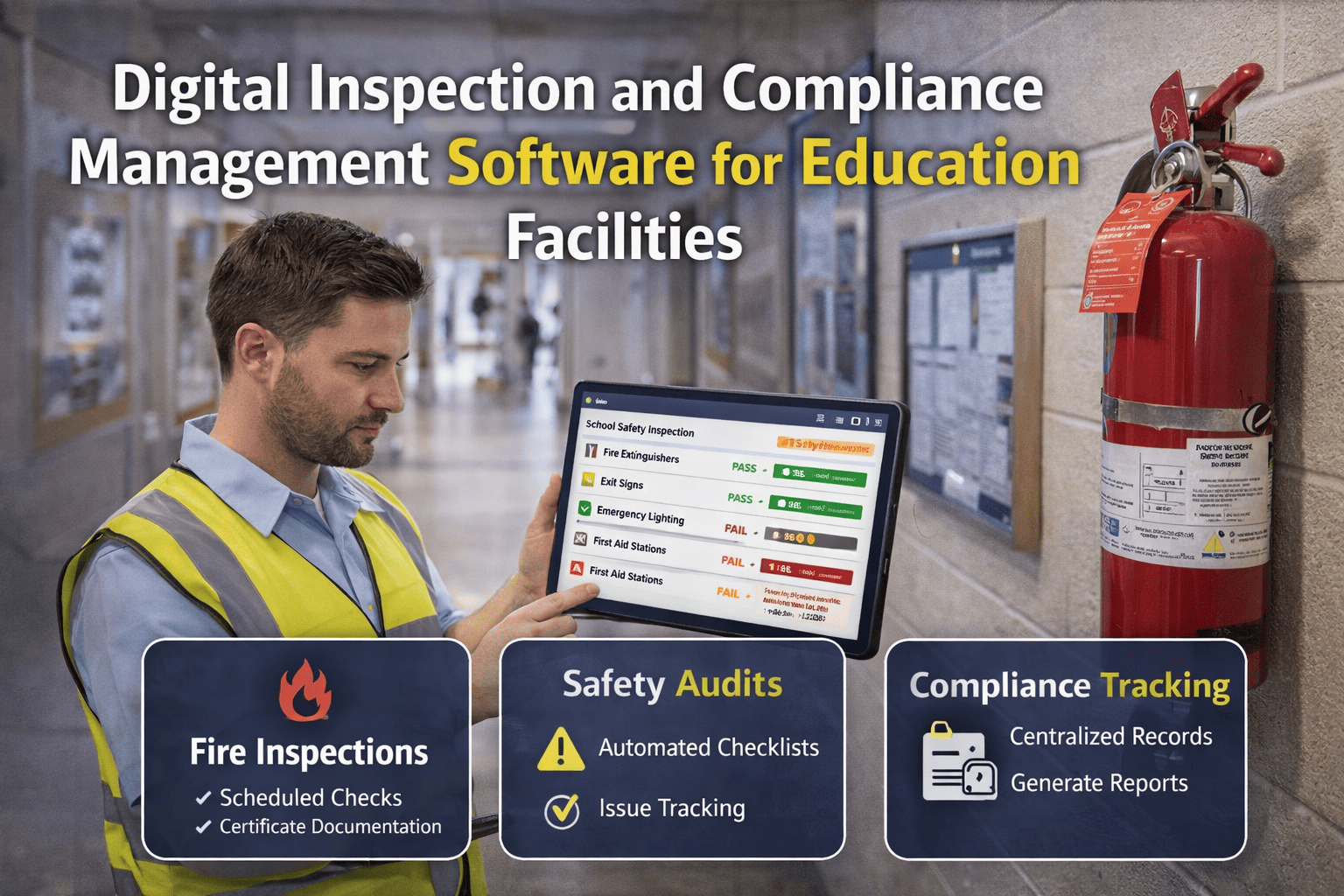
AI-driven compliance management platforms replace every manual process above with automated tracking, scheduling, documentation, and reporting through six integrated capabilities that connect to your existing systems. Book a Demo to see how each maps to your institution's compliance obligations.
Automated Inspection Scheduling
- All deadlines across every framework tracked automatically per building
- Alerts dispatched 30, 14, and 7 days before each deadline
- Overdue items escalated to department heads automatically
- Schedules survive staff changes, live in the platform not calendars
Centralized Documentation
- All inspection reports and maintenance records in one searchable platform
- Audit packages assembled automatically from live data in one click
- Accessible to regulators and accreditation reviewers on demand
- Retention schedules enforced per regulatory requirement automatically
Corrective Action Tracking
- Every finding generates a tracked corrective action with owner and deadline
- Completion requires verified documentation before item can close
- Overdue actions escalated automatically to compliance officer
- Full history retained and exportable for regulatory response
Portfolio Compliance Dashboard
- Real-time compliance status across every building simultaneously
- Upcoming deadlines and open findings on one leadership view
- Compliance score per building for inspection resource prioritization
- Board-ready summary report generated automatically
Regulatory Report Generation
- OSHA, EPA, NFPA, ADA reports generated automatically from live data
- Accreditation self-study documentation assembled with FCI references
- Bond covenant and credit agency documentation produced on demand
- State-specific formats configured during implementation
API Integration with Campus Systems
- Open API connects CMMS, ERP, GIS, and BAS without data migration
- Third-party contractor reports imported automatically
- Work order completion updates compliance records without duplicate entry
- Core integration completed within 60-90 days of deployment
Documented Compliance Outcomes
All results below are from documented university and school district deployments measured against pre-deployment baselines on existing budgets without additional compliance staff. Book a Demo to see how these outcomes apply to your institution.
Annual Independent Audit Findings
Before Deployment
Multiple findings per cycle, formal corrective action, bottom 22% peer ranking
After 18 Months
Zero deficiencies, corrective action closed 6 months early, top 40% ranking
Automated scheduling and centralized documentation eliminated every finding category from prior audits. State corrective action closed at month 12 against a 24-month deadline, removing the institution from the oversight watchlist.
Compliance Reporting Staff Hours
Before Deployment
Approx 140 staff hours per quarterly compliance cycle
After 18 Months
Approx 18 hours per cycle, 87% reduction through automation
Automated report generation pulls from live data across all connected systems, eliminating the manual assembly process that consumed the majority of quarterly capacity. Reclaimed hours redirect to field inspection and capital planning.
Inspection Completion and Corrective Action Rate
Before Deployment
Gap between required and documented, informal corrective tracking, no portfolio visibility
After 18 Months
100% inspections tracked, 100% corrective actions verified and closed with documentation
Automated scheduling eliminated the gap between required and documented inspections within 90 days. Platform-enforced verified closure means every corrective action has a documented chain of evidence from finding to resolution.
Achieve Zero Audit Deficiencies Without Adding Compliance Staff.
AI-driven compliance management is deployable now with documented results across K-12 districts and universities. Core integration is operational within 60-90 days.
Key Benefits for Education Facility Compliance Teams
Zero audit deficiencies across all compliance categories simultaneously.
Automated scheduling and centralized documentation eliminate every finding category manual systems generate, across OSHA, EPA, NFPA, ADA, and state frameworks without increasing compliance staff.
State corrective action closed 6 months ahead of required deadline.
The documented deployment achieved full corrective action closure at month 12 against a 24-month deadline, removing the institution from the oversight watchlist and improving peer ranking from bottom 22% to top 40%.
Compliance documentation always current and audit-ready without manual assembly.
Every inspection record and corrective action is stored centrally, updated in real time, and exportable on demand. Audit packages for any framework are assembled automatically without days of advance preparation.
OSHA 2026 Heat Illness Prevention fully documented without new processes.
The platform generates written prevention plans, temperature monitoring records, and HVAC maintenance schedules required under the 2026 rule automatically from existing maintenance data without new administrative workflows.
Accreditation facility standards met with documented evidence across all self-study categories.
Inspection histories, FCI data, and capital replacement schedules are produced in accreditation-ready format for all major regional bodies, converting the facility section of every self-study from a vulnerability into a documented strength.
87% reduction in compliance hours redirected to higher-value facility work.
Over 480 staff hours per year shift from manual assembly to direct facility improvement and compliance program management, redirected toward field inspections, capital planning coordination, and state oversight engagement.
Frequently Asked Questions
What compliance frameworks does the platform support?
OSHA, EPA, NFPA, IBC, ADA, Clery Act, AHERA, RCRA, and all major regional accreditation standards. State-specific formats configured during implementation.
Book a Demo to review coverage for your frameworks.
How does the platform handle OSHA 2026 Heat Illness Prevention documentation?
Written heat illness prevention plans, temperature monitoring records, and HVAC maintenance schedules are generated automatically from existing maintenance data without creating new staff workflows.
Contact Support to review OSHA 2026 coverage.
Can the platform produce accreditation self-study facility documentation?
Yes. Inspection histories, FCI data, and maintenance completion rates in accreditation-ready format for HLC, SACSCOC, WASC, and MSCHE are assembled automatically.
Book a Demo to review your accreditor's requirements.
How quickly does compliance documentation improve after deployment?
Scheduling and tracking are operational within 60-90 days. Audit-ready reporting is available immediately. Zero deficiency outcomes are documented at month 12-18 across completed deployments.
Contact Support for a timeline specific to your portfolio.
Does the platform integrate with existing CMMS, ERP, and GIS systems?
Yes. Open API integration connects all major campus systems without data migration. Third-party contractor reports imported automatically. Core integration completed in 60-90 days.
Book a Demo to confirm system compatibility.
How are corrective actions tracked and verified?
Every finding generates a tracked item with owner, deadline, and required verification. Completion requires photos or re-inspection evidence before closure. Overdue actions escalate automatically to directors.
Contact Support to review the workflow.
What institution sizes are appropriate?
K-12 districts and universities managing 200 to 10,000+ assets. Single-building schools and large multi-campus systems have both achieved zero-deficiency audit outcomes on the same platform.
Book a Demo to assess your fit.
Can the platform generate Clery Act fire safety documentation?
Yes. Annual fire safety report data, daily fire log, and system testing records for all on-campus housing generated automatically from live inspection data.
Contact Support to review full Clery Act coverage.
EDUCATION COMPLIANCE ROI · ZERO DEFICIENCY AUDIT RESULTS
Ready to Achieve Zero Audit Deficiencies Across Your Campus?
AI-driven compliance management for education facilities is proven, deployable, and built for institutions under real OSHA, EPA, NFPA, ADA, and accreditation pressure in 2026. Start with a 30-minute conversation about your compliance exposure.