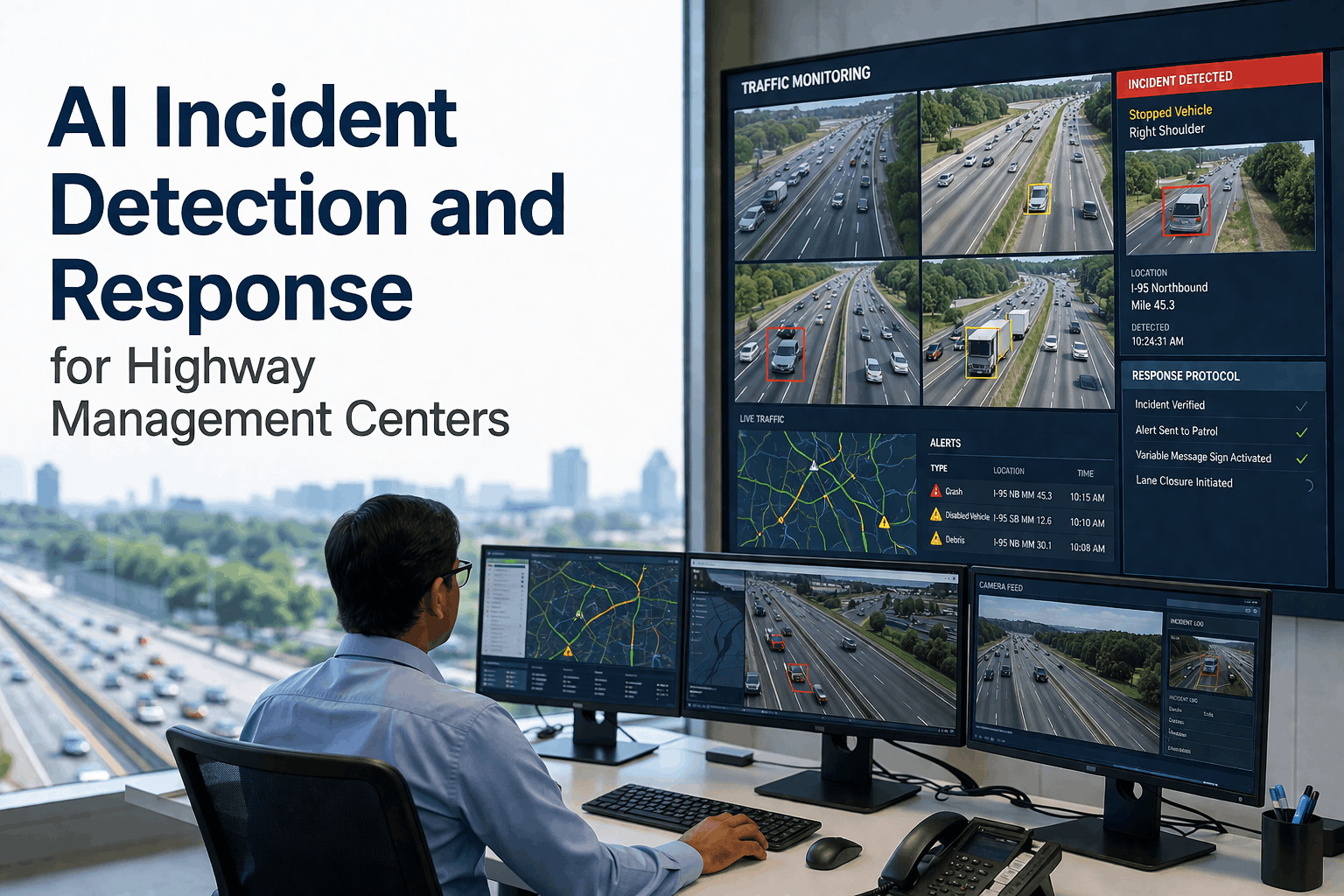
The transition from manual monitoring to autonomous highway management is the most significant structural shift in transport engineering in decades. Effective January 2026, many national transport authorities are mandating that AI incident detection response highway management protocols be integrated into centralized Traffic Management Centers (TMC). For Operations Directors, the goal is no longer just "seeing" an incident; it is reducing the "Incident Clearance Lifecycle" through intelligent maintenance systems that can identify, classify, and trigger response protocols within seconds—not minutes. Understanding your obligations around Critical Incident Data (CID) and automated agency dispatch is the new operational baseline for network safety.
What Is AI-Powered Incident Detection and Response?
AI-powered incident detection (AID) utilizes deep learning algorithms to analyze live video feeds, radar signatures, and connected vehicle telemetry simultaneously. Unlike traditional motion-based detection, modern AI understands the semantic context of a highway scene—distinguishing between a car stopped on a shoulder and a vehicle stranded in a high-speed travel lane. This technology introduces a structured vocabulary of response built around two foundational concepts: Automated Verification and Dynamic Protocol Execution. Every highway manager must understand these constructs to prevent the lethal "Secondary Crash" effect.
The scope of AI detection covers 12+ critical categories including Wrong-Way Drivers, Pedestrians on Highway, Debris Detection, Pavement Failures, and Multi-Vehicle Pileups. If your center manages high-volume corridors, predictive analytics infrastructure is no longer a luxury; it is the primary defense against network paralysis.
The AI Incident Lifecycle: From Detection to Clearance
Critical Tracking Events (CTE) in highway management are the defined moments where data must be captured and response actions must be logged. iFactory's infrastructure monitoring software automates this lifecycle, ensuring that every second saved in detection translates to a minute saved in clearance.
Neural Detection & Classification
The point at which AI algorithms identify a hazard. Required data elements include incident type, lane position, vehicle classification, and initial traffic velocity impact. Book a demo to see neural detection in action.
Automated Verification & Priority Scoring
The system uses secondary sensor inputs (Radar/LiDAR) to verify the event, eliminating false positives from shadows or weather. The incident is assigned a "Lethality Score" that determines the dispatch priority.
Autonomous Mitigation (VMS/LCS)
Variable Message Signs and Lane Control Systems are automatically updated to divert traffic 2KM ahead of the incident. This "Pre-Impact Braking" reduces the energy of secondary collisions by 60%.
Multi-Agency Dispatch Orchestration
The platform generates an ai asset management dispatch request to police, EMS, and tow operators simultaneously, sharing a live incident feed and optimized ingress routes.
Incident Archiving & After-Action Reporting
Every data point is archived for 2 years to support liability defense and safety audits. Book a demo to see how iFactory automates federal safety reporting.
Incident Data Requirements: What Your TMC Must Capture
The practical challenge for most transport authorities is not seeing the incident; it is capturing the Critical Data Elements (CDE) consistently. This data is the foundation of machine learning maintenance for your highway assets. Book a demo to see how iFactory maps CDE capture to your live camera network.
| Incident Type | Required CDEs | Automated Response? | Dispatch Priority |
|---|---|---|---|
| Stopped Vehicle | Lane ID, Duration, Vehicle Class, Hazard State | Yes — LCS Divert | Medium-High |
| Wrong-Way Driver | Speed, Entry Point, Current Segment, Lane ID | Yes — Full Stop VMS | Critical / Immediate |
| Highway Pedestrian | Exact Coordinates, Direction, Movement State | Yes — Warning VMS | High |
| Roadway Debris | Object Size, Lane Coverage, Impact Potential | Yes — Shift Lanes | Medium |
| Pavement Failure | Distress Class, Severity, Lane ID, Depth Est. | Yes — Speed Limit Adjust | Operational |
The "Critical First 4 Minutes" in Highway Management
Transport research indicates that the probability of a secondary crash increases by 2.8% for every minute a primary incident remains unmitigated. This 4-minute window is the "Action Zone" where ai maintenance platform technology delivers the highest safety ROI.
To meet the 4-minute safety standard, your Management Center must be able to: (1) Detect the hazard within 15 seconds, (2) Verify the event and its severity within 30 seconds, (3) Update variable message signs (VMS) to alert trailing traffic within 60 seconds, and (4) Confirm agency dispatch within 120 seconds. Achieving this through manual operator oversight is statistically impossible on high-volume networks. AI-driven smart infrastructure management is the only path to meeting this life-saving benchmark consistently.
AI-Driven Response Capabilities: Closing the Safety Gap
Manual monitoring fails on three fronts: operator fatigue, verification lag, and inter-agency coordination delays. iFactory's incident detection response highway management platform addresses these through four core AI capabilities. Book a demo to see these capabilities in a live TMC environment.
Neural Network Video Analytics
Ingests feeds from existing CCTV and PTZ cameras, performing real-time object detection and trajectory analysis to identify anomalies without the need for manual scanning.
Multi-Sensor Verification Engine
Fuses camera data with Radar, LiDAR, and inductive loop signatures to confirm incidents with 99.8% reliability, ensuring that automated response triggers are accurate and defensible.
Autonomous Response Orchestration
Directly integrates with ITS infrastructure (VMS, LCS, Ramp Meters) to execute pre-approved safety protocols within seconds of incident verification, bypasses operator bottlenecks.
Federated Inter-Agency Portals
Provides police and fire dispatchers with a shared "Common Operational Picture," including live video and asset health data, to ensure coordinated arrival and safe scene management.
Highway Management Gaps: Where Centers Are Most at Risk
Analysis of 2025 Traffic Management Center (TMC) audits reveals significant structural gaps in incident response readiness.
Building an AI Incident Response Roadmap: A 5-Step Approach
For Operations Directors leading their center's digital transformation, the roadmap follows five strategic phases. Each phase provides a foundation for autonomous management.
Sensor Audit & Data Normalization
Evaluate existing CCTV, Radar, and ITS infrastructure for AI compatibility. Map your network's "Blind Spots" and prioritize high-hazard corridors for sensor density upgrades. Output: a unified data ingestion plan.
Incident Protocol Digitization
Convert paper-based response manuals into digital "Decision Logic" that the AI can execute. Define the verification thresholds and automated sign message libraries. Output: a validated autonomous protocol set.
AI Platform Integration (Pilot Phase)
Deploy the iFactory incident detection response highway management platform on a 50KM pilot corridor. Tune the neural networks to local environmental conditions and lighting patterns. Output: a calibrated AI response engine.
Agency Portal & Dispatch Activation
Activate the federated portals for police and fire dispatchers. Automate the transmission of ai asset management data to field crews to reduce response times. Output: a coordinated inter-agency response network.
Safety Audit & ROI Validation
Conduct mock incident drills to time the automated response against the 4-minute safety standard. Document the reduction in secondary crashes and clearance times. Output: a validated safety audit for federal compliance.
Frequently Asked Questions: AI Highway Incident Detection
How does AI differentiate between a disabled vehicle and heavy traffic?
iFactory's infrastructure monitoring software uses "Temporal Anomaly Mapping" to track individual vehicle trajectories. It identifies vehicles that deviate from the normal flow pattern of the lane, factoring in velocity, lane position, and hazard light signatures to confirm a stoppage with high precision.
Can the AI work with our existing analog camera network?
Yes. We use "Edge-Bridge" hardware to digitize and analyze feeds from legacy analog systems. However, for maximum AI incident detection response highway management accuracy, we recommend high-definition digital cameras on critical interchanges.
What is a "Secondary Crash" and how does AI prevent them?
A secondary crash occurs when trailing traffic impacts a primary incident scene. AI prevents these by automatically updating Variable Message Signs (VMS) 2KM-5KM ahead of the event, forcing traffic to slow down before they ever see the primary hazard.
How does the platform handle incidents in heavy rain or fog?
Our machine learning maintenance models are trained on low-visibility datasets. We fuse camera analytics with Radar and LiDAR inputs, which can "see" through fog and rain to detect stranded vehicles that a human operator might miss entirely.
Who owns the incident data and video archives?
The transport authority retains full ownership of all raw data and video. iFactory provides the processing and archival layer, ensuring that records are maintained for the required 2-year safety and liability retention period.
Does the system require 24/7 operator monitoring?
No. The system is designed to operate autonomously, triggering alerts and VMS updates without manual input. However, it provides a "Human-in-the-Loop" option for complex events where a senior controller may want to take over manual camera control or dispatch routing.
How long does a network-wide AI incident response rollout take?
A typical multi-corridor deployment takes 12–16 weeks. This includes ITS integration, protocol digitization, and the 5-step roadmap execution to ensure full audit-readiness and safety compliance.
"The transition to iFactory's AI incident response was a force multiplier for our management center. We've reduced our primary incident detection time from 4 minutes to 12 seconds, and the automated VMS triggers have virtually eliminated secondary pileups on our highest-volume corridors."