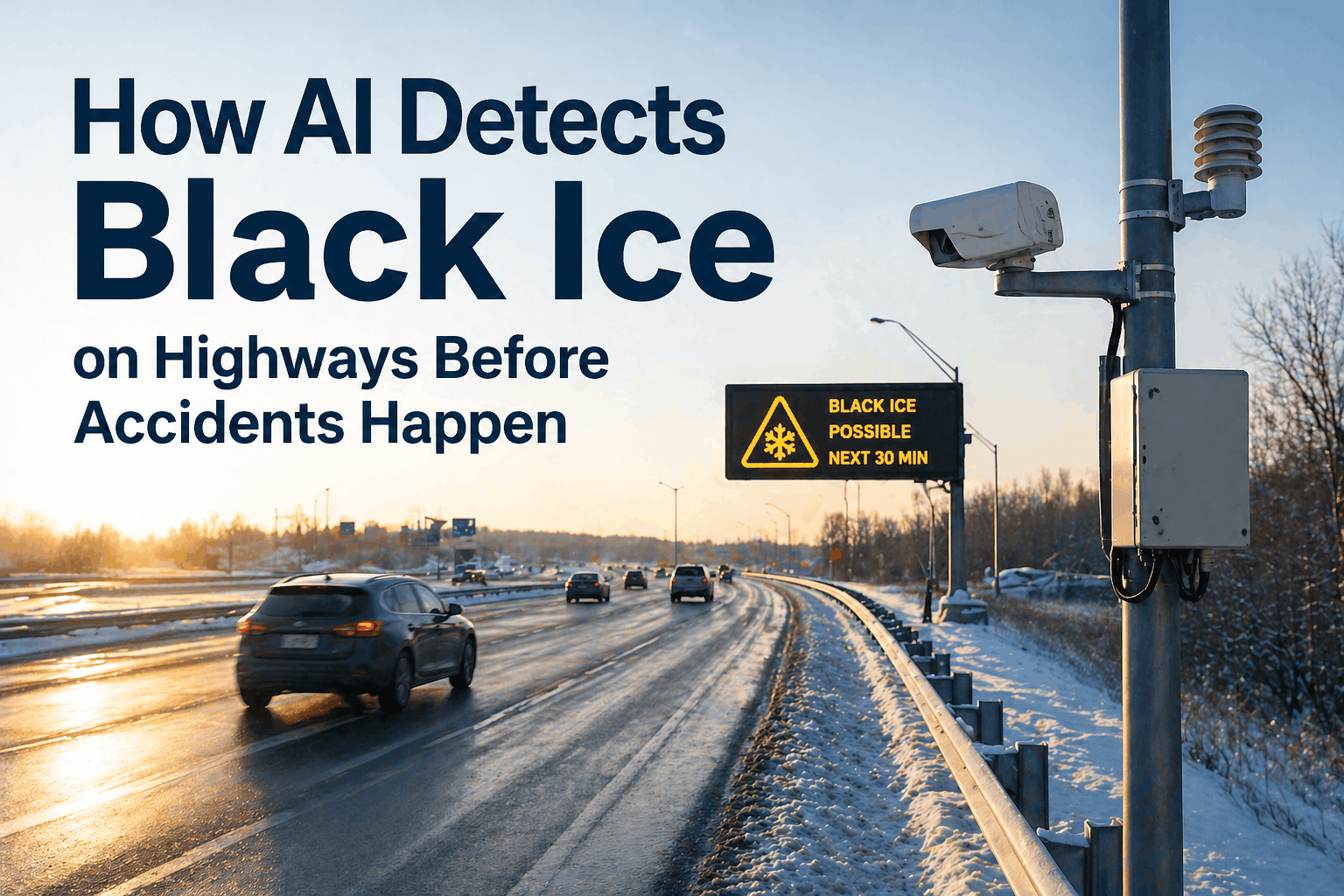
As climate volatility transitions from a future forecast to an immediate operational reality, municipal infrastructure managers are finding that yesterday's engineering standards no longer guarantee tomorrow's continuity. A highway segment designed for standard winter conditions now faces flash-freeze events and black ice formation that traditional salt-spreading schedules simply cannot catch. In 2026, AI black ice detection highway accidents prevention is no longer an optional safety initiative—it is a core fiduciary responsibility. Building resilience demands a shift from static, reactive plowing to a dynamic, predictive "Asset Hardening" model. This guide outlines the framework for infrastructure monitoring software adaptation, leveraging thermal sensor networks and machine learning maintenance to protect public safety before the next freeze event arrives. Book a free demo to digitize your winter resilience roadmap.
Predictive Black Ice Mitigation & Infrastructure Hardening
A comprehensive technical roadmap for deploying thermal sensors and intelligent maintenance systems to provide 30-minute advance warnings of ice formation on critical highway corridors.
Critical Failure Modes in Traditional Winter Maintenance
Legacy highway management relies on air temperature and visual inspection—both of which fail to detect the "Invisible Killer" of black ice until a slide-off occurs. Schedule a safety consultation.
Thermal Inversion Detection Lag
Pavement temperatures often drop below freezing even while the air remains at 35°F. iFactory's infrastructure health monitoring tracks sub-surface thermal gradients to predict ice bonding before it becomes a surface hazard.
Over-Salting & Environmental Degradation
Without precision data, agencies over-apply salt, corroding rebar in bridges and polluting local watersheds. AI optimizes application rates based on actual ice-bonding probability, reducing salt waste by 40%.
Multi-Vehicle Pileup Cascades
The first 15 minutes of an ice event are the most lethal. Our real-time response mesh triggers automated variable message signs (VMS) to slow traffic before the first driver hits the ice patch.
Bridge Deck Micro-Climate Risk
Bridges freeze faster than roads. iFactory's LiDAR-based ai asset management monitors specific bridge deck temperatures, providing isolated alerts for these high-risk "Asset Hotspots."
Friction Loss Visibility Gaps
Road friction is invisible to cameras. We integrate tire-slip data from connected municipal fleets with thermal maps to create a "Live Friction Grid" of the entire highway network.
Emergency Response Routing Errors
Emergency vehicles are just as vulnerable to black ice as commuters. iFactory provides predictive analytics infrastructure to route ambulances through pre-treated or non-frozen corridors. Book a demo.
Why Legacy "Winter Master Plans" Fail Under Climate Volatility
Static plowing routes and reactive salting are becoming obsolete as "flash-freeze" events become more frequent. A dynamic, AI-driven approach is required to guarantee municipal continuity.
Historical Bias Failure
Old plans assume ice forms at night and melts by day. Modern volatility creates ice patches during mid-day "shadow-freezes" that legacy schedules miss entirely.
Data Silo Paralysis
Weather data, plow geolocation, and salt inventory rarely talk. iFactory unifies these into one ai maintenance platform, showing exactly where salt is needed vs where it was already applied.
The "Reactive Funding" Trap
Municipalities without data-backed safety plans face higher insurance premiums. Proactive smart infrastructure management is now a requirement for non-discretionary federal safety grants.
Manual Inspection Delays
Relying on physical patrol cars to find ice patches is too slow. iFactory's digital twins provide "Instant Visibility," flagging ice formation within seconds of sensor detection across thousands of highway miles.
Secure Your Highway Operations with iFactory Safety AI
iFactory provides the predictive analytics and real-time monitoring required to transform vulnerable winter roads into climate-hardened corridors.
From 30-minute flash-freeze warnings to automated salt rate optimization, our platform integrates directly with your DOT SCADA and GIS data. Automate your safety audits while securing your municipality's credit rating through verified accident reduction data. Schedule a winter resilience audit.
Deployment Architecture: Four Models for Black Ice Resilience
Highway authorities can deploy ice-resilience technology across four architectural tiers, from purely predictive simulations to fully autonomous adaptive response.
Predictive Thermal Twin
A 4D digital twin that simulates solar shading and pavement heat loss. It identifies exactly which bridge decks and north-facing slopes will freeze first. Book a demo to see your network's thermal twin.
Real-Time Thermal Response Mesh
Deployment of sub-pavement and non-invasive infrared sensors. This "Live Nervous System" triggers automated emergency alerts to plow dispatch and driver apps before ice bonds.
Nature-Integrated Micro-Climate Tracking
Monitoring the impact of snow-banks and surrounding vegetation on road surface temperatures. We use multispectral imaging to track shade patterns and moisture runoff, ensuring drainage assets are clear.
Autonomous Adaptive Grids
Direct integration with automated salt-brine dispensers and VMS signs. This "Self-Healing" road model requires the high-fidelity ai infrastructure data iFactory provides. Talk to our engineer.
Regulatory Frameworks Driving Winter Safety Investment
2026 mandates from DOT and federal bodies now require verifiable safety risk assessments for highway funding and insurance renewals.
The Evolution of Winter Highway Safety
From reactive plowing to AI-driven autonomous mitigation: how the methodology of road protection has transformed.
Reactive Maintenance Era
Emphasis on massive plow fleets and broad salt application. No intelligent monitoring; plows followed fixed routes regardless of localized ice formation, wasting millions in salt.
Connected Plow Fleets
First major GPS-tracked initiatives. Focus on where plows were, but still lacking real-time data on exactly where the ice was forming under the asphalt surface.
The Rise of RWIS
Road Weather Information Systems (RWIS) provided periodic data points. Useful, but too sparse to catch "micro-ice" patches in shaded turns or low-lying dips.
IoT Friction Mesh
DOTs begin integrating vehicle-slip data. Safety becomes a data task; agencies begin integrating GIS and fleet telemetry to prioritize treatment zones.
Autonomous Winter Continuity
The current standard: iFactory AI manages predictive pre-treatment, VMS alerts, and autonomous brine dispensers. 100% safety transparency becomes the baseline for insurance agencies.
Static Winter Response vs. iFactory Safety AI
A visual comparison of how authorities respond to AI black ice detection highway accidents risk using traditional methods vs the iFactory model.
High Accident Risk
Continuity Guaranteed
How iFactory Delivers Winter Safety Continuity
iFactory isn't just a dashboard—it's a municipal-wide nervous system designed to withstand the stress of winter. Our platform integrates deep-learning thermal models with high-fidelity pavement monitoring data to provide an objective, real-time view of your highway's vulnerability. Book a demo to see how we protect critical interchanges.
From bridge deck monitoring to automated driver alerting, iFactory provides the "Record of Resilience" that bond-rating agencies and federal safety reviewers demand. We ensure that every dollar spent on winter hardening is measurable, verifiable, and optimized for maximum lives saved.
For large-scale state networks, iFactory supports a federated safety model, allowing multiple districts to maintain their specific plowing workflows while sharing a unified AI black ice detection highway accidents risk layer. This ensures that no "Siloed Failure" occurs when a storm crosses jurisdictional boundaries. Talk to our safety engineer about multi-district deployment strategies.
Quantifying the iFactory Safety Advantage
Municipalities that have transitioned to AI-driven winter planning show measurable improvements in public safety and operational cost-efficiency.
Ready to Build an Accident-Free Winter Highway?
Speak with an iFactory safety specialist today about deploying predictive black ice analytics across your critical asset network.
Whether you are hardening bridge decks, optimizing salt budgets, or deploying automated hazard alerts, iFactory provides the data infrastructure your citizens depend on. Secure your grants, protect your assets, and guarantee winter continuity. Book your safety demo now.
Black Ice Detection & Winter Safety: FAQs
Q: How does iFactory risk data help with municipal liability?
Insurance agencies and legal bodies increasingly require "Standard of Care" documentation. By providing an immutable record of AI black ice detection highway accidents warnings and proactive treatment logs, iFactory allows cities to prove they met and exceeded safety standards, significantly reducing liability costs. Talk to our safety engineer.
Q: Can your thermal models integrate with our existing RWIS stations?
Yes. iFactory is designed to ingest data from existing RWIS stations and legacy sensors. We then use AI to "Fill the Gaps" between stations, using topographic and solar-shading data to predict ice formation in the hundreds of miles between physical sensors. Book a free demo.
Q: What is the difference between "Air Temperature" and "Pavement Temperature"?
Air temperature measures the atmosphere, while pavement temperature measures the road surface. Black ice often forms when air is at 35°F but the road has cooled to 28°F due to radiation heat loss. iFactory focuses exclusively on pavement monitoring to catch these dangerous inversions. Schedule a consult.
Q: How do your sensors handle heavy snow and plowing activities?
We specify non-invasive infrared thermal sensors that are mounted above the roadway on poles or gantries. This keeps the sensors out of the way of plow blades and salt corrosion, ensuring they remain functional throughout the most intense winter storms.
Q: Is iFactory compliant with the federal "Safe Streets and Roads for All" (SS4A) program?
Yes. Our data export formats are specifically tuned to the safety audit requirements of the IIJA SS4A grant program. This ensures that your technical documentation is "Grant-Ready," helping your municipality secure the funding needed for predictive analytics infrastructure. Book a demo.
Q: What is the "Shadow-Freeze" effect and can iFactory detect it?
A shadow-freeze occurs when north-facing slopes or shaded bridge decks remain frozen while the rest of the highway melts. iFactory uses high-resolution GIS solar-shading maps to identify these specific micro-climates and provide targeted alerts for these "Hidden Ice" patches.
Q: How does the system communicate alerts to the public?
iFactory integrates with your existing DOT management center to trigger Variable Message Signs (VMS), Waze/Google Maps traffic feeds, and first-responder dispatch systems. This ensures that the 30-minute warning reaches drivers before they enter the high-risk zone.