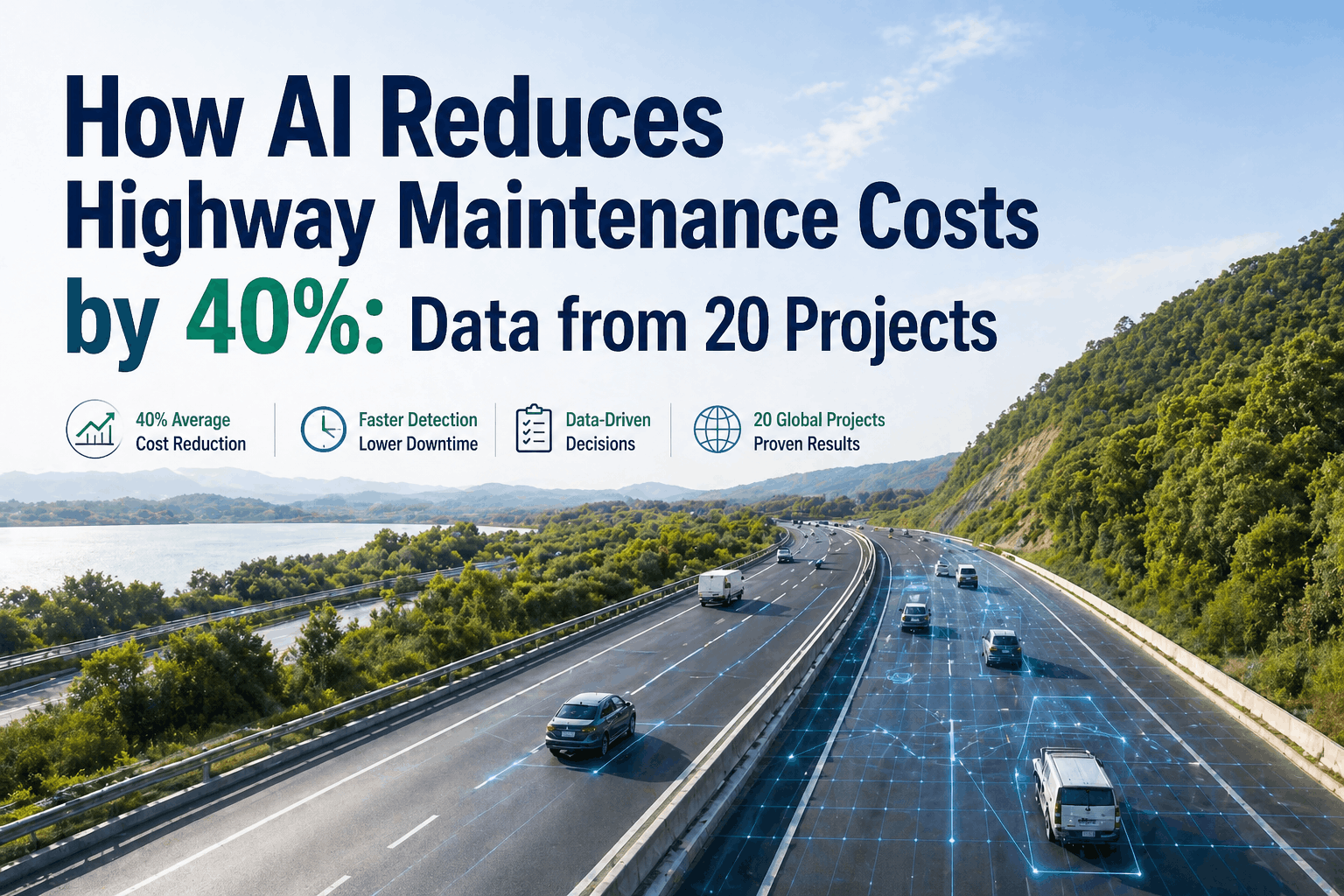
The economic burden of highway maintenance is reaching a critical inflection point. As national infrastructure continues to age, the traditional "wait-and-repair" model has become a primary driver of municipal budget deficits. However, a fundamental transformation is underway. What was once treated as a periodic inspection function—isolated visual surveys and reactive patching—is now being redefined by AI highway maintenance cost reduction data derived from real-world deployments. In 2026, leading transport authorities are no longer asking whether AI works; they are leveraging it to achieve a 40% reduction in long-term OpEx while extending asset service life by up to 35%. If your infrastructure analytics still rely on lagged reporting, Book a Demo to see how iFactory's intelligent maintenance system converts raw pavement telemetry into enterprise-grade decision support.
Turn Your Infrastructure Data Into a Strategic Asset
iFactory's infrastructure monitoring software unifies pavement health, asset lifespan, maintenance records, and financial ROI into a single operational intelligence layer—purpose-built for highway authorities.
Why Highway Maintenance Analytics Has Outgrown the Cost Center Model
For most of the last two decades, analytics in highway maintenance was defined by what it could not do. Disconnected pavement historians, GIS modules that lagged reality by weeks, and inspection systems that generated condition records without surfacing operational intelligence—these were the building blocks of the cost center model. Analytics existed to satisfy political oversight and produce post-mortem reports, not to influence decisions in the moment they could be acted upon. This reactive posture led to the "deferred maintenance trap," where the cost of repairs grew exponentially as assets deteriorated beyond the point of simple prevention.
That model is being replaced at pace. The catalysts are structural: labor cost inflation has eliminated the buffer of manual oversight; material volatility has compressed the margin for inefficiency; and public demand for 99.9% network availability has made reactive compliance economically untenable. The transport authorities absorbing these pressures while growing their networks profitably share a single structural advantage—their ai maintenance platform has been repositioned from a reporting tool to a strategic control tower that connects operational visibility to executive decision-making in real time. To see how this shift can impact your specific network, you can schedule a strategy session with our infrastructure team.
What a Strategic Control Tower Actually Means for Highway Operations
For decades, highway maintenance was defined by its limitations. Disconnected inspection teams, paper-based condition assessments, and ai asset management modules that lagged reality by months were the standard. Maintenance existed to fix what was broken, not to influence capital allocation before a failure occurred. This reactive posture is being replaced by a "Strategic Control Tower" model, where predictive analytics infrastructure identifies sub-surface fatigue long before it manifests as a pothole.
The catalysts for this shift are structural: labor cost inflation has eliminated the buffer of manual oversight; material costs for asphalt and concrete have surged; and public scrutiny of road safety has made reactive patching politically and economically untenable. The transport agencies absorbing these pressures while improving road quality share a single advantage—their ai maintenance platform has been repositioned from a reporting tool to a strategic intelligence layer that connects operational visibility to executive decision-making in real time.
The Five Pillars of AI-Driven Highway Cost Reduction
Achieving a 40% cost reduction requires architectural decisions that go beyond simple sensor deployment. The 20 global projects analyzed for this guide share five foundational capabilities that distinguish them from conventional pavement management systems.
Unified Pavement Data Infrastructure
A strategic control tower requires a single data layer that ingests from computer vision sensors, LiDAR, GIS layers, and historical work orders simultaneously—normalizing disparate data into a unified digital twin infrastructure model that makes network-wide benchmarking possible.
Real-Time Asset Performance Management (APM)
Enterprise asset management in a highway context means continuous health scoring across every segment—not periodic inspection reports. APM algorithms evaluate surface distress and roughness in real-time, converting telemetry into precise maintenance timing recommendations.
Condition-Based Predictive Maintenance
Machine learning maintenance models trained on pavement-specific failure signatures identify developing ruts and cracks weeks in advance. This shifts maintenance from "emergency response" to "scheduled prevention," which is structurally 10x cheaper to execute.
Automated Regulatory & Safety Compliance
Highway compliance is an output of operational performance. A control tower integrates safety audits, work zone records, and pavement quality documentation into an automated layer that converts audit preparation from a periodic event into a continuous state of readiness.
Executive Decision Support for CapEx Planning
When the CFO and Director of Operations share the same real-time view of network health, capital allocation is informed by smart infrastructure management rather than lagged financial reports. This compresses the cycle from insight to strategic action, ensuring budget is allocated to the highest-ROI segments.
AI-Driven Visibility vs. Traditional Pavement Management
The distinction between an AI-powered control tower and traditional pavement management is not a matter of degree—it is a matter of the operating model. The table below captures the data from 20 global projects that determine the strategic value of ai highway maintenance cost reduction data.
| Capability Dimension | Traditional Management | AI Control Tower Platform | Strategic Impact |
|---|---|---|---|
| Data Latency | Months (Visual Surveys) | Real-Time (Fleet Cameras) | Prevention happens in the "Optimal Window" |
| Failure Prediction | Reactive (Visible Defects) | Predictive (Structural Health) | 35% Extension in Pavement Service Life |
| Inspection Cost | High ($150-$400/KM) | Low ($10-$30/KM) | 90% Reduction in Manual Inspection Hours |
| Budget Accuracy | +/- 25% (Estimates) | +/- 5% (Data-Driven) | Defensible Budgeting for Taxpayer Funds |
| Repair Strategy | Patching/Reconstruction | Preventative Micro-Surfacing | 40% Lower Long-Term Rehabilitation OpEx |
Building the Business Case: What AI Highway Control Towers Deliver Financially
The financial case for repositioning analytics as a strategic asset is grounded in four value categories that compound over the deployment lifecycle. Each represents a measurable return that most highway finance teams can model against existing cost structures using data they already collect. For example, ai asset management can extend the interval between major rehabilitations by 3-5 years, which on a 1,000 KM network represents tens of millions in deferred CapEx.
Unplanned emergency repair elimination is the most immediate return category. At an average cost of $25,000 to $45,000 per major emergency road closure, preventing just 10-15 events per quarter typically covers the annual platform investment. Furthermore, predictive analytics infrastructure reduces material waste by ensuring that only the segments requiring treatment receive it, eliminating the "blanket paving" approach that wastes 15-20% of asphalt budgets annually. Manufacturers and authorities ready to build a formal business case should book a financial modeling demo to access iFactory's ROI framework.
The Competitive Divide: AI as a Structural Advantage in Infrastructure
Highway management is entering a period of structural performance divergence. The agencies investing now in intelligent maintenance systems and control tower analytics are building operational capabilities that take years to compound to full strategic value—capabilities that competitors operating on reactive models cannot replicate quickly. This gap is not just operational; it is financial, regulatory, and safety-driven. The divide between analytics leaders and laggards in infrastructure is not closing—it is accelerating.
"Transitioning to an AI-driven control tower was the single most impactful financial decision in our department's history. We aren't just fixing roads faster; we're managing them as a high-performance asset portfolio. The data from our first 12 months showed a $2.4M reduction in emergency repair spend that we reallocated to permanent network expansions."
Ready to Benchmark Your Maintenance ROI?
See how iFactory's control tower platform provides the ai highway maintenance cost reduction data to operate smarter and extend asset life across your entire network.
Frequently Asked Questions: AI Highway ROI and Cost Reduction
How does AI achieve a 40% reduction in maintenance costs?
The 40% reduction is primarily driven by shifting from reactive to preventative maintenance. By detecting "Pre-Surface Distress" through computer vision and LiDAR, agencies can apply low-cost treatments (like crack sealing) that prevent the need for expensive full-depth pavement reconstruction later. This "Avoided Cost" compounds across the entire network lifecycle.
What is the typical timeline to see a return on investment (ROI)?
Most agencies realize a 5.2x ROI within the first 24 months. Immediate savings come from a 90% reduction in manual inspection costs, while long-term gains accrue from extended asset life and reduced emergency repair incidents. Many pilots achieve "Breakeven" within 6-9 months of network activation.
How does the platform integrate with our existing Asset Management software?
iFactory uses an API-first architecture that connects seamlessly with major enterprise asset management (EAM) and GIS systems. We act as an "Intelligence Layer" that enhances your existing workflows without requiring a "rip-and-replace" of your current software stack.
Is this system applicable to all road types, or just national highways?
While the ROI is highest on national and state highways due to traffic volume, the system is equally effective for municipal urban streets. The AI models are calibrated for multiple distress types common in both rural high-speed corridors and dense urban intersections.
How does AI monitoring improve public safety and liability?
By providing a continuous, date-stamped record of all road conditions and maintenance interventions, the platform provides a "Shield of Documentation" that reduces municipal liability. Furthermore, catching ruts and potholes earlier significantly reduces pavement-driven accidents and litigation.
What data do I need to get started with a cost reduction pilot?
To start, all you need is a 100KM corridor of road. You can book a strategy session to review how we deploy sensors on your existing fleet and integrate with your historical maintenance data to benchmark your first year of savings.
Build the Maintenance Control Tower Your Budget Requires
iFactory's ai highway maintenance cost reduction data transforms pavement telemetry into a strategic asset—giving highway executives the real-time visibility and predictive intelligence to lead with precision rather than react with urgency.