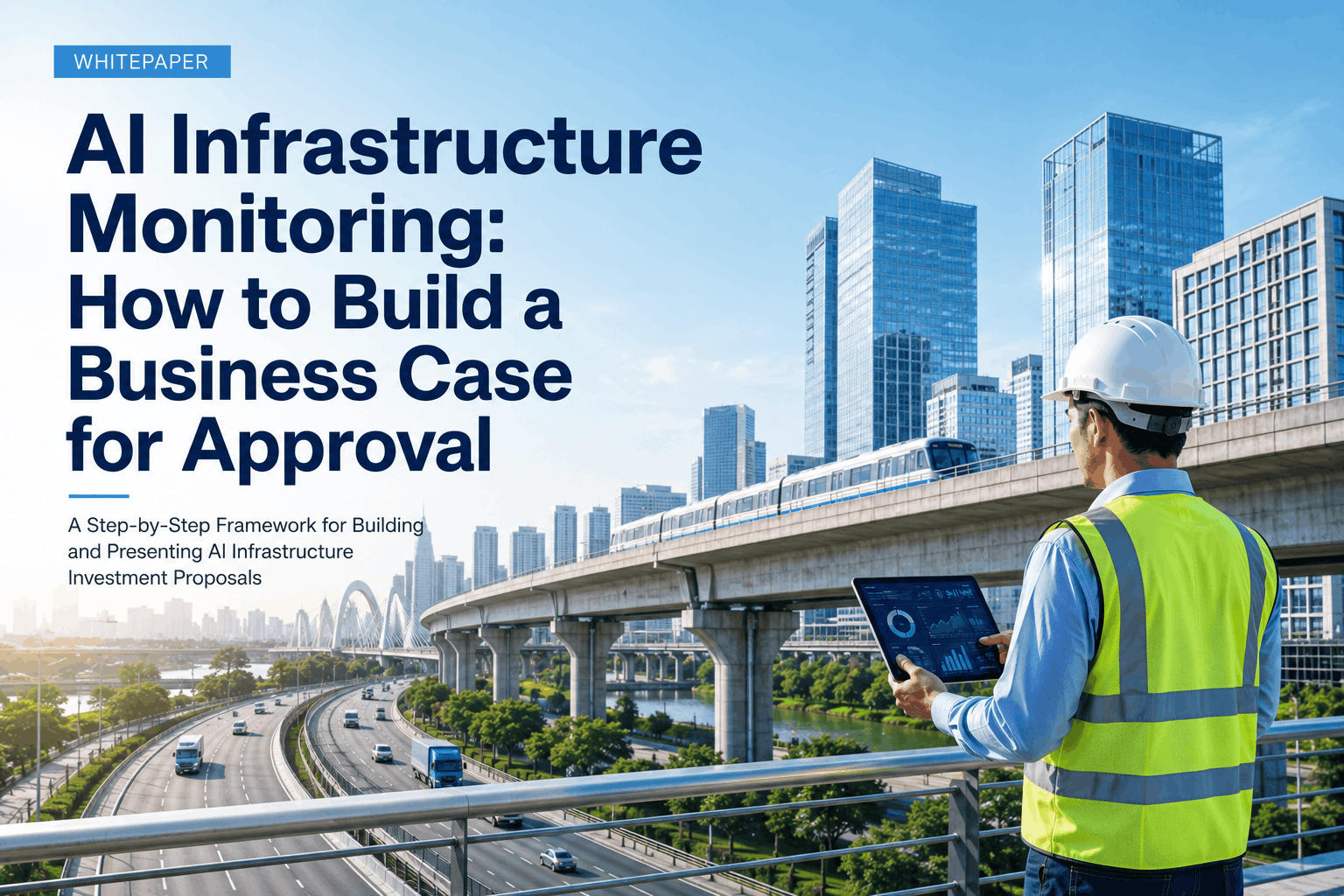
Securing executive approval for AI-driven infrastructure monitoring is no longer about proving the technology works—it is about quantifying the cost of the "Intelligence Gap" and the "Digital Inertia" that is currently eroding your municipal or national budget. Most infrastructure directors believe they have real-time visibility, yet they continue to operate with data refresh cycles running 4 to 12 hours behind physical events, resulting in "Reactive Surprises" that cost millions in emergency repairs and unplanned downtime. This AI infrastructure monitoring business case framework is designed to bridge the gap between engineering requirements and financial approval. It moves the conversation from "Experimental Tech" to "Actuarially Defensible ROI," focusing on deferred CapEx, reduced OPEX, and the total elimination of preventable catastrophic failure risk. Digital Inertia—the decision to wait for more data before acting—is not a neutral choice; it is a financial penalty that compounds with every asset lifecycle. If your current business case cannot quantify the cost of a 4-hour delay in structural anomaly detection, you aren't presenting a solution—you're presenting a cost center. By creating a "Living Financial Model" of your assets, iFactory ensures that every dollar spent is optimized for maximum health and minimal risk. To see how iFactory’s predictive intelligence platform builds its own ROI within the first 90 days, Schedule Your Free Demo with our financial modeling team today.
The Financial Blind Spot Hiding Inside Traditional Infrastructure Management
Moving from "Cost to Maintain" to "Intelligence to Save"
The primary barrier to AI approval in 2025 is the "Siloed Financial Model." Traditionally, infrastructure maintenance is treated as a fixed OPEX line item, while emergency repairs are treated as unavoidable contingencies. However, iFactory’s ai infrastructure monitoring business case reveals that 55-65% of "Unavoidable Contingencies" are actually detectable precursor events that were missed due to reporting latency. When a bridge expansion joint or a railway point machine exhibits 0.5% geometric deviation, it doesn't just log a reading—it triggers a financial liability that compounds every hour it goes uncorrected. Furthermore, the "Information Asymmetry" between the asset's actual physical state and the reported digital state creates a "Risk Premium" that authorities pay in the form of higher insurance costs and inflated emergency repair contracts. A business case built on "Real-Time Intelligence" doesn't just promise a better dashboard; it promises a fundamental restructuring of the maintenance cost curve by shifting from time-based replacement to true condition-based intervention. Schedule Your Free Demo for a custom financial gap analysis.
The Three Pillars of an Approved Infrastructure Business Case
What Your CFO Actually Needs to See Before Signing
To move an intelligent maintenance system from a pilot to a full-scale deployment, your business case must address three distinct financial dimensions: Direct Cost Recovery (OPEX), Capital Avoidance (CapEx), and Risk Actuarial Value. Finance teams in 2025 are no longer swayed by "Increased Visibility"; they require a line-by-line breakdown of how AI-driven intelligence will reduce the 'Cost per Asset Kilometer' and improve the 'Resilience Score' of the network. Schedule Your Free Demo to access iFactory's proprietary ROI modeling tools used by major metropolitan authorities.
| Financial Lever | Traditional Approach (Legacy) | AI-Driven Approach (iFactory) | Financial Impact (Annualized) |
|---|---|---|---|
| Maintenance Strategy | Calendar/Time-Based | Condition-Based (Real-Time) | 18–24% OPEX Saving |
| Asset Replacement | OEM Schedule (Static) | Health-Driven Extension | 22–30% CapEx Deferral |
| Emergency Repairs | Reactive/Contingency | Precursor Detection (Predictive) | 45–55% Cost Reduction |
| Compliance Labor | Manual Audit Prep (Weeks) | Automated Compliance Log | 70% Efficiency Gain |
| Insurance/Risk | Self-Insured/High Premiums | Verified Continuous Audit | 12–15% Premium Recovery |
Actuarial Validation: Mapping the Probabilistic ROI of Risk Mitigation
Why CFOs Value "Precursor Detection" Over "Incident Reporting"
The most sophisticated part of the ai infrastructure monitoring business case is the actuarial validation of risk. In 2025, infrastructure risk is no longer a qualitative concern—it is a quantitative metric. By deploying iFactory, authorities move from a "Probabilistic Guess" (e.g., *we think this bridge is safe*) to a "Deterministic Model" (e.g., *we know this bridge has 98.4% structural integrity and will remain stable for the next 14,000 load cycles*). This precision allows for the restructuring of 'Contingency Funds.' Instead of holding $50M in reserve for "Unforeseen Failures," a network powered by iFactory can confidently reduce that reserve by 30-40%, freeing up capital for immediate project acceleration. This "Liquidity Gain" is often the strongest argument for AI adoption, as it provides a self-funding mechanism for the technology itself. Schedule Your Free Demo to see our risk-to-liquidity modeling.
Implementation Roadmap: From Business Case to Operational Intelligence
A 3-Phase Strategy for Rapid ROI Capture
Performance Benchmarks: The Impact of AI-Driven Infrastructure Intelligence
The chart below benchmarks the average improvement achieved by infrastructure authorities within 12 months of deploying iFactory's **predictive analytics infrastructure**, based on deployments across road, rail, and utility corridors.
"Building a business case for AI was initially a challenge because finance viewed it as a 'Tech Experiment.' By using iFactory's ROI framework, we were able to demonstrate that our time-based bridge replacement schedule was wasting $1.4M annually and that our 4-hour response latency carried a public safety risk exposure of over $10M. Once the CFO saw the condition-based CapEx deferral model, approval was granted in under 30 days."
CFO, Regional Transit Authority
"The 'Cost of Waiting' was our biggest hidden expense. iFactory's whitepaper helped us quantify that every 6 months we delayed AI adoption, we were effectively losing $800K in uncaptured maintenance efficiencies and $1.2M in deferred structural health risks. The implementation paid for itself within 7 months through the prevention of a single major water main burst that the AI identified 12 days before failure."
Director of Infrastructure, Municipal Utility Board
Frequently Asked Questions
What are the primary ROI drivers in an AI infrastructure business case?
The highest-yield ROI drivers are CapEx Deferral (extending asset life based on health), OPEX Reduction (moving from time-based to condition-based maintenance), and Risk Mitigation (eliminating emergency repair premiums and regulatory fines). Most authorities find that CapEx deferral alone justifies the platform cost.
How does AI monitoring reduce municipal maintenance costs?
AI reduces costs by increasing 'Maintenance Yield.' By ensuring field crews are only dispatched to assets with verified deviations, authorities eliminate 'Inspect-to-Find' waste, which typically consumes 30-40% of maintenance labor hours.
What is the "Cost of Inaction" in infrastructure AI?
The cost of inaction is the compounding expense of reactive maintenance. Every hour a structural anomaly goes undetected, the repair cost increases exponentially. Failing to deploy AI means accepting a 4-12 hour 'Intelligence Latency' that carries measurable financial and safety penalties.
How does AI-driven monitoring impact infrastructure insurance?
Authorities with continuous, auditable health monitoring can demonstrate a superior risk profile to insurers. An unbroken digital audit trail is proof of 'Reasonable Care,' which can lead to significant premium reductions and faster claims recovery compared to manual reporting regimes.
How long does it take to get a business case approved?
Using iFactory's structured ROI framework, most authorities can move from initial audit to executive approval in 30-60 days. The key is presenting condition-based health scores as a financial asset, not just an engineering requirement.
Can AI monitoring be funded through capital budgets?
Yes. Because AI platforms like iFactory measurably extend the useful life of assets and improve project 'As-Built' fidelity, they are frequently categorized as 'Capital Improvements' rather than just operational software, allowing for funding through existing CapEx bonds.
What is the typical payback period for an AI infrastructure platform?
Most authorities achieve full payback within the first operational year. High-utilization networks with significant legacy asset debt often achieve payback in as little as 6 months through the prevention of a single major unplanned closure.
Does iFactory provide financial modeling support for business cases?
Yes. iFactory's intelligence team works directly with your engineering and finance stakeholders to build a plant-specific ROI model, mapping our technical performance benchmarks against your actual historical maintenance and repair costs.